A bit of sunshine for a Friday morning:

A bit of sunshine for a Friday morning:
HOW DO YOU “SEE” A FICTIONAL TOWN?.
I am a visual learner so I need to see it to “know” it.. How do you “see” a fictional story location? For me, I started with the “real world.”
Travel magazines and postcards of Rhode Island, Cape Cod and Narragansett Bay were a help, but not enough. So I spent one Christmas break compiling a 3 foot by 4 foot topographical map of Narragansett Bay. I found it on the web on a geological survey site and proceeded to print it out, quadrant by quadrant. Then I taped them all together until I had the complete topographical map of Narragansett Bay, including all the islands and the surrounding land areas. My husband did question if it might not have been cheaper and easier to just buy the map, but frankly, I don’t think I could have bought the entire map that I ended up with. In any event, this gave me a “visual” of sorts to know what the land around the bay was like. I could tell that while the area is not that far above sea level, there most definitely are hills and ridges, marshes and sand dunes.
The next thing I had to do was make the imaginary town a real place to me. I started by printing photos of diners, stone warehouse buildings, rocky coastlines, Fort Adams, docks and wharves, and even that building at Woods Hole with the sailing ship model jutting out from the stone wall above the doorway.
Once I had an idea of the kinds of items and places my town included, I created a map of the town. Now I could “see” where Max’s house stood in relation to Carbone’s Auto Body shop, the diner, the rich uptown area, Lighthouse Point, her school, and the downtown dock areas. I could see how much area the Naval Research base took up on Lighthouse point, where the pier and research labs were in relation to the haunted carriage house and the Yacht club, and how far of a walk it was back to the town and the diner.
Next I needed to see Max’s house and yard. I grew up in those three-family houses, so I had an idea in my mind of how they would be set up – back staircases, front and back porches, attic rooms with slanting walls, stone wall cellars that spooked you every time you had to go down there. I did a map of Max’s neighborhood, and a blueprint of both hers and Noah’s house, showing all three floors in each. I wanted to “see what she saw” when she looked out her attic window. From the map-making kit I had as a kid, I knew about doing room plans, so I could tell where the kitchen stove was, how many couches were in the living room, and if they had a computer desk. With these, I could now see Max’s house, her backyard, her neighborhood, and how it connected to everything else in town.
Rosa’s Midway Diner is such a big part of the story that it required equal attention. I have been in a number of diners over the years, so I had some mental images. I found a number of good books on diners, and consulted the American Diner Museum website. I even went to the local diner here in town (Cary, North Carolina) and with the permission of the owner, took a couple hundred interior shots of tables, counters, stools, equipment, pass-through windows from the kitchen, plates, etc.
From all of that, I created a blueprint of Rosa’s Midway Diner. I drew up the “diner of my dreams,” the one I would build if I had the money. If this book ever sells big, I swear I’ll build it. It has regular booth seating including the large back semi-circular booth that Rosa uses for her Friday night poker games. It has a large window behind it made of those glass blocks, and all tables have roses in the vases. There’s an extra long counter with stools, another counter in the front of the diner where you can sit, sip your coffee, read the paper and look out on Main Street, and a large take-out area for walk-in business. And of course, there is the new drive-through being installed as part of the take-out area.
The diner itself is a character in the book. As such, I have created a “biography” of the diner – a timeline of how it started, who created it, where it was located over the years, expansions…the whole works. Before I’m done with this, I will do an oil painting of that diner, both outside, and in. To that end, I have a very rough cardboard model of part of the diner interior, that includes the kitchen pass-through, counter and stools, and the drive-through areas
To further give the diner reality and context, I did a map of the diner area and Main Street. I felt it was important to show where the diner was in relation to all the businesses mentioned in the story, as well as to the rest of the town.
Lighthouse Point is another important part of the story and required “visuals” and biographies. I wrote up the story of the ship’s captain who built the lighthouse and surrounding stone warehouses and who died along with his family, in the fire that destroyed his mansion. I also created a map of the area around the haunted carriage house, and blueprints of the abandoned ammo bunkers and anti-aircraft gun emplacements right near the carriage house ruins.
For Uncle Jim’s lab, I chose the stone building at Woods Hole Oceanographic Institute, the former “Candle House.” I even gave Uncle Jim’s lab a similar sailing ship model jutting out from the exterior wall over the doorway. Interior shots of other buildings at Woods Hole served as inspiration for the lab and office interiors of those buildings.
Since paintings have such power for me, I did a 24 by 36 inch oil painting of where the two story worlds meet – the rocky coastline at Lighthouse Point. Every item in the painting is in the story – from the hermit crab, Carpus, who is right up front, to the lighthouse and rocky point, wooden pier, tide pool area, distant fishing trawler, fort on the hill, research labs and …yes, the ghosts.
The University of Rhode Island’s Graduate School of Oceanography is the barely veiled location of the university in the story. I gave Jerry a research lab located in a former World War II ammunition bunker, and had her out doing her environmental research on a university-sponsored ocean-going research vessel, very similar to the R/V Endeavor. I verified the research itineraries, including places visited, work performed, and the durations of cruises, from the various research vessel ship logs online. I also studied the online blueprints for these existing research ships, to see the locations of labs, bunks, galleys, as well as the rules for running such a ship and expedition.
For the museum lobby where Max sneaks up to, to file her contest entry, I did rely on a memory – a very strong one burned in my brain from early childhood. In Torrington, CT, the post office at that time was in a brick building in the center of town. (It is now further out in a refurbished old supermarket building.) The post office lobby, while a very wide open area, was a scary place to me. At one end were the faces of numerous FBI fugitives staring out from black and white printouts pinned to bulletin boards.
It was the other end of the post office lobby though, near all the service windows, that truly freaked me out for a long time. Above the windows, high up on the walls all around that part of the building, were these huge murals. They showed 1800s men and women trudging through mud, beside a Conestoga wagon. There were also other scenes of 1800s life – all scenes actually, from the life of the abolitionist, John Brown. The murals themselves were intimidating enough, but ….silly as it sounds, I thought they were alive. Standing in that post office lobby waiting for my mom, I would stare up at the wall paintings and listen to the loud voices echoing off the walls around me. I thought the figures were speaking. In reality, the echoes were the voices of the postmen behind the wall yelling back and forth to each other. But to a 4 or 5 year old staring up at scary murals, the voices came out of the paintings, out of these solemn, angry looking people struggling behind their oxen in the mud. Hence, the inspiration for the museum lobby murals that Max sees.
By the way, if you are visual too, click here to see the murals from the old Torrington, CT Post Office.
Click here to read more about the history behind Connecticut post office art work done in the 1930s Depression era as part of the New Deal.
The other items I consulted to “see” the location, involved technical things like weather charts, articles on ocean fog, articles and nature guides describing the trees, birds, types of rocks, and area geological history. And I asked questions – of myself, of my sister living up there, of Google: What is the air temperature at night in June? Are there any sea breezes? How fast do storms move in, from which direction and how bad do they get? What do your clothes feel like against your body when you’re walking near the shore – crisp and dry, or soggy and limp? Do you need a jacket to walk around at night in the summer? Do you need a wetsuit to scuba dive in July?
Aside from visuals, I needed “sound” to further “see” the place. I selected CDs based on the emotions they created in me. When you watch TV, the music tells you if something funny, poignant, or ominous is taking place. In the same fashion I needed music or sound so I could see the events as they occurred in the story and feel the emotions of that moment and location. I played those CDs over and over and over, while writing in my garage. I am amazed my husband and my neighbors are still sane.
Some of these CDs include the soundtracks from: The Band of Brothers, Cinderella Man, We Were Young Once, and the Perfect Storm. There are also ocean and bird sound CDs, Gregorian Chants, and last but not least, Rosa’s “Frankie boy,” Frank Sinatra. But be assured, there are NO Dean Martin CDs. Just for the record, I personally have nothing against Dean Martin and I LOVE his song, “That’s Amore,” but you can never account for what your characters will love or hate. Rosa hates Dean. Plain and simple.
Next up – Let’s Get Technical. Stay tuned.
Did I say that purple is my favorite color?

For the last several days, Scarlett has been sitting on top of, or in, the water filter. Even though I shut down the filter Tuesday (so no babies would get sucked up in the filter material should they hatch), she continues to stay inside the empty filter. I guess it’s like a cave – nice and sheltered. She hasn’t come out to eat, but then I imagine that filter material has a ton of bacterial and algal critters all over it.
She DOES need to be in water at some point and on that count I’m not sure how long she can stay out of the water and in the filter. I tried chasing her out of the filter Tuesday afternoon, partially to see if she was okay, and partially to see if overcoming inertia and forcing her out would keep her out, but within minutes she was back inside of the filter. Who knows if she climbs out at night when the lights are off, to go for a swim.
Wed morning she was inside the filter, still sitting at the bottom. She wasn’t moving so I jiggled the filter cartridge enough to see her move. I left her alone until Wed afternooon when I pulled the filter cartridge up a bit. Scarlett O’Hara rushed up and out of the water filter and down into the water. She sat underneath the water filter, so I guess she’s just “staying put in sheltered places.” However, she does appear to be okay.
I tried giving her a couple of shrimp pellets, assuming she must be hungry, but she basically pushed them aside. She did pick at the calcium sand, so I expect she’s looking for algae. I dropped in a couple bits of algae pellets but she ignored those too. So either she isn’t hungry due to the pregnancy, something’s wrong, or she’s full from eating whatever is on that filter packing material. Right now she is still out in the tank and has even wandered over to the air bubbler at the other end of the tank. I am heartened to see her doing her usual activities: climbing up on the bubbler, trying to climb up the side of the tank, and resting on the suction cups behind the air filter that hold it in place. So, for now, I guess, all is well.
My only “curiosity” is “will she stay out into the water to deliver the babies?” I expect she will given that female fiddler crabs look for places in their estuary homes that have active water currents so the eggs can be washed out to sea. So “instinct” alone should propel her back into the tank water at about the time of delivery, no matter how much she likes it inside the water filter. Given she did it right the first time, I can’t imagine she’s forgotten what she needs to do. I missed the delivery the first time so I don’t know exactly what she does to release them. I hope I catch it this time. Also, I do wish I could just ask her why she likes living at the bottom of a dark empty water filter. In lieu of that conversation, all I can do is watch and wait…..
Water parameters Wed afternoon were good: Nitrates 10, Nitrite 0, Hardness >300, Chlorine 0, Alkalinity 300, pH 8.0 and the Ammonia monitor is in the “safe” range at < 0.02 ppm.
The ammonia monitor is a Seachem Ammonia monitor that you can hang inside the tank. No test strips or kits. This one is called the Seachem AmmoniaAlert for Fresh and Marine tanks. It continuously monitors the free ammonia level in the water for over a year.
The monitor is color coded for concentrations:
– Safe (<0.02 ppm), Yellow
– Alert ( 0.05 ppm), Green
– Alarm ( 0.20 mg/dl), Sky Blue
– Toxic ( 0.50 mg/dl), Lavender
The insert says that the “Alert Level” of free ammonia can be tolerated for several days; “Alarm” for a few days; and “Toxic” is rapidly harmful. It would have been interesting to see what it read when I had the phytoplankton overgrowth and high nitrites, the first time I did this.
While I knew that monitoring ammonia was important and somehow related to the level of nitrites and nitrates, I wasn’t sure exactly what was going on. I found a good website, The Tropical Tank, done in the UK, that discusses water chemistry, and in particular, ammonia, nitrites, and nitrates. It’s called: More on the Nitrogen Cycle: Ammonia, Nitrite, and Nitrate
In short, there should be no ammonia or nitrite in a mature tank. Any ammonia is present in two forms: ammonia (NH3) and ammonium ion (NH4+). Ammonia is more toxic than the ion, and the higher the aquarium pH, the higher the ammonia level. Since brackish and marine tanks are basic, ie higher pH, ammonia toxicity is a constant risk.
Ammonia in a mature tank is oxidized by nitrogen-fixing bacteria, to nitrites and again, in a mature tank, nitrites are oxidized to nitrates. While you don’t want to see nitrates run high, a lower level , say < 50 ppm, are considered okay, 25 ppm is even better. If your tank isn’t cycling well, is new and not enough nitrogen-fixing bacteria, you have too many tank inhabitants, or you’ve overfed them, ammonia (and hence nitrites and nitrates) will start to spike.
The bottom line, the appearance of rising ammonia levels is the first clue that things in the tank are not well and even toxic. Given that my last endeavor with crab larvae resulted in mass death due to high nitrites (and yes, the phytoplankton caused an algae bloom that caused ammonia and nitrites to spike and I won’t use it again) I thought it might be interesting to monitor the ammonia levels in the tank on a continuous basis through this project.
This article also gives information on how to start up the nitrogen cycle in a fishless tank. I wondered how you get the cycle going when there are no fish or fish wastes to start the process.
If you are interested, this same UK website has two other interesting articles:
The Basis of Cycling: a good overview of the maturing nitrogen cycle in aquariums
Fishless Cycling Data provided to them by a US forum member, William Wallace; some concrete data on how Mr. Wallace actually did this process.
To return to the tank and Scarlett:
Wed evening, the water looked cloudy and while other parameters were still fine, I noticed a trace amount of nitrites now. I also noticed a few green spots in the yellow safe zone of the ammonia monitor. The green spots are the beginning of a change to “alert.” Given that I think we’re a few days away from birth yet, I decided to turn the water filter back on for a day or so to try and improve the tank conditions. I suspect that adding Scarlett to the tank was enough to catalyze the nitrogen cycle into high gear. It’s to be expected to see “some” ammonia and nitrites, and there also is a “good” level of nitrates, but still, I don’t want to lose the battle of water quality before the babies are even born. I will continue to monitor water quality closely today today. If necessary, I’ll do some water changes, but I would rather not do that. Since the nitrogen cycle is in its early stages, every time I take water out and put in new water, it removes some of the very nitrogen-fixing bacteria I need. The gentleman at the aquarium store said it would be best to just let the tank evolve. So as long as we don’t go beyond “alert” on the ammonia monitor, I’ll let it “evolve.” Otherwise…I’ll have to start water changes. I wish I’d known earlier about the fishless cycling Mr. Wallace did. I could have done that with this tank to get the nitrogen cycle established before moving Scarlett into it.
Tank parameters this morning are the same as yesterday afternoon and Scarlett is out walking around the tank, so, no better, no worse.
Stay tuned.
In keeping with my “photo gifts” kind of mood this week, as well as my “Under the Pier” posting today, some new shots of Admiral Byrd waving at you.
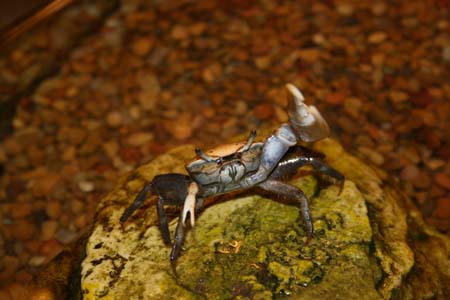
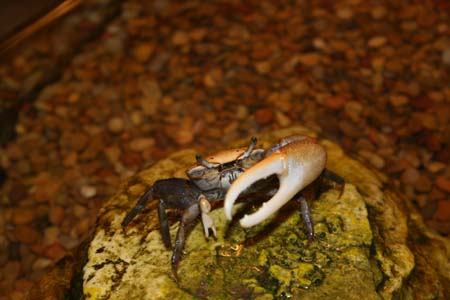
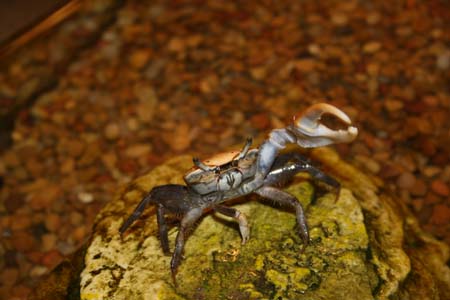
He has got to be the crab equivalent of Arnold Schwarzenegger given he holds that claw up for MANY hours a day, every day now. I should be so buff…..
I will also note that while he waves that claw so diligently in his attempts to flag down women, he is very pragmatic and can multi-task. He can keep that large claw in the air and wave it back and forth, even as he manages to pick up a shrimp pellet with the other claw and eat. The guy’s gotta keep up his strength, right? 🙂
On March 7th, I had posted about going to hear Lee Woodruff speak about her book, In An Instant – the experiences of her and her family when her husband, ABC News Anchor Bob Woodruff, was critically injured by an IED in Iraq. In response to that post, the gentleman below sent a comment about a support organization for well spouses of chronically ill individuals, which I provided as a March 9 full posting. As part of his comment, he quoted a Washington Post article about spousal caregivers. However, the link on that post doesn’t work. He has sent a corrected link to the article, listed below. So here is his post, with the new link:
From: Richard Anderson – President of the Well Spouse Association (http://wellspouse.org, 1-800-838-0879), a non-profit, 501(c)(3) grassroots organization offering peer support to husbands, wives or partners of people with chronic illness and/or disability.
Hello again:
“Thanks for posting my response to your March 7 blog, as a further blog entry in Soul Mosaic. I need to make one correction:
The URL for the Washington Post story I gave you was incorrect. This will get people there:
http://www.washingtonpost.com/wp-dyn/content/article/2008/03/04/AR2008030402498_pf.html
Richard Anderson, President, Well Spouse Association”
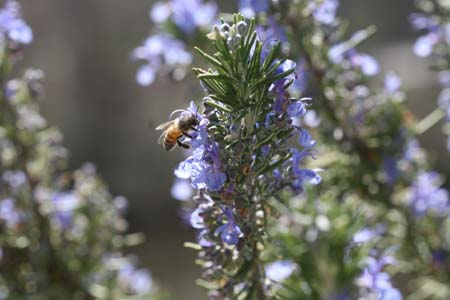
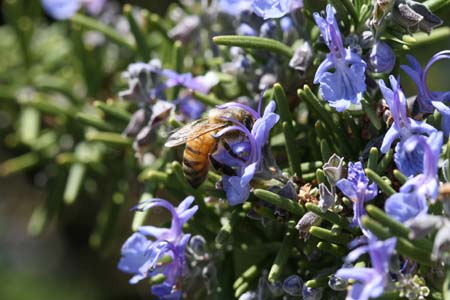
I guess I’m just in a real “spring fever” mood, though I’m probably not the only one. Case in point, this busy guy, on the rosemary bush flowers in my backyard, enjoying the Easter Sunday weather.
Yesterday was one week that we noticed Scarlett O’Hara was pregnant again.
Looking back over my notes on the first pregnancy – we noticed her eggs (2/17/08), then moved her about a week later (2/24/08) into the spare tank I’d just set up. Five days later she delivered. (2/29/08) The one thing we weren’t sure the first time was how long she was carrying the eggs before we noticed. From my log notes, I saw her on the 14th and didn’t notice anything. So, I expect it wasn’t much before 2/17 that she brought the eggs out on her abdomen. Given that, it appears it was about a two week gestation period.
If history repeats itself, 2 weeks will be about 3/31/08, next Monday.
With that in mind, I decided to move Scarlett O’Hara to the nursery. She seems calm this time, doesn’t seem disturbed by the calcium sand, sat under the water filter for a while, then moved toward the side of the tank and greedily went after the shrimp pellets I dropped in.
Since I can’t be sure when the eggs will hatch, I will shut off the water filter today.
Yesterday’s water parameters show both the main aquarium and the nursery aquarium to be about equal. No nitrates in the nursery yet, but moving Scarlett into it should kickstart the nitrogen cycle; I did drop in some shrimp pellets into the nursery the other day, just so “something” organic would be “rotting” in there and feed the nitrogen-fixing bacteria. Hopefully that will be enough to do the trick.
Yesterday’s parameters:
Main aquarium (before moving Scarlett):
Salinity 1.0115, Chlorine 0, Alkalinity 300, Hardness >300, Nitrites 0, Nitrates 20, pH 7.8-8.0
Nursery aquarium:
Salinity 1.013, Chlorine 0, Alkalinity 300, Hardness >300, Nitrites 0-0.5, Nitrates 0, pH 8.2
I have brine shrimp eggs though I won’t start hatching those until the fiddler babies are born. According to the package they take about 24-36 hours to hatch. I have something called “San Francisco Bay Brand: Brine Shrimp Hatch Mix” It has eggs, sodium chloride and magnesium sulfate and you just add a liter of water. I have a container with an air bubbler to put the mix in. No heater though. Just not going to spend another $30 or $40 for a brine shrimp heater. The kid at the pet store who has a marine tank and raises brine shrimp for his fish told me there’s no reason you can’t hatch them at room temp. He does it all the time. I’ll let you know how that works. I don’t know how many shrimp I’ll get in one of these packets. There’s three packets to the package. If needed, I’ll go back to the aquarium store and just get the larger container of shrimp eggs.
If you want to see some good instructions on hatching brine shrimp, as well as some pictures of the shrimp as they go from eggs to the tiny shrimps, click here for the San Francisco Bay Brand website.
In any event, I have the Kent Marine “ZooPlex” product to feed the babies for the first few days until the crab larvae are large enough to chase down live brine shrimp. This food is made to work well for invertebrate larvae and is considered a good brine shrimp replacement. It’s available at PetsMart. Again, we’ll see how it goes.
Over the years I’ve read about or studied different kinds of meditation. Some wanted you to focus on a word or sound repeated over and over, others on a lit candle. More recently the focus was on trying to keep a totally blank mind and completely halt all the “noise” and the 10000 things running through your brain every minute. Of course I failed at all of them…as do most people. You’re so focused on a goal, on doing it perfectly, that when you can’t measure up, you give up out of frustration or despair.
On the flip side, I suspect that if you are lucky enough to achieve what these methods want…or at least you think you achieved it, the danger is that then you might walk around feeling so proud of yourself, so much better than others because “you achieved it.” You can try “not to go there,” but it’s hard, and even if you manage not to be proud, there is also the danger of feeling “overly holy and falsely humble” about your accomplishment.
One of the things I like about Buddhism is it’s emphasis on “Middle path.” No extremes of perfection or failure. This extends to its approach to meditation practice – “acceptance” of, in fact, it’s emphasis on the fact that you’ll never be perfect and it’s not about a goal. It’s always about “letting go and coming back to the breath.” Whether the teacher is Thich Nhat Hanh, from the Zen tradition, or Jack Kornfield from the Theravadan tradition, the point is not to “eradicate” what’s going on in you, but on simply to notice it and let it go on. You don’t waste a lot of energy either trying to get rid of all the thoughts, or giving them more importance than they’re worth. You just notice what is happening, acknowledge it, let it go, and come back to the breath.
Even that though, is easier said than done and human beings have a way of making anything a goal or contest. I think the one part of those instructions that I find most useful is: “Come back to the breath.” The reality is, we will be distracted for the rest of our lives. There’s bills, fights with people, retirement planning, kids, whatever. SOMETHING is always creeping in. That’s being human. And as nice as it is to say “notice it, don’t judge it, just let it go” even that is impossible. Something sticks in our throat and it replays in our heads over and over. Our anger, hurt, pride, despair, fear, will get hooked and we have a hard time letting that go. Accept it. We all do it. We always will. Instead of beating yourself up about any of this you simply, come back to the breath.
At first glance that might seem like a useless approach. Someone more “austere” might say “Well what kind of mental discipline is that?” The point is, it’s not about “discipline.” It’s not about self-flagellation, beating yourself up, getting rid of anything, or trying to be perfect. It’s about being human, and it’s about compassion. Being gentle with yourself. It’s about accepting and loving who you are. Even with all the noise in the brain, you can chuckle at your foibles and still say I’m a good person. I’m full of love, even when I’m distracted.
So why bother learning to treat yourself with compassion in your meditation practice? Because it is the way you train yourself to be compassionate with yourself in life. Instead of expecting yourself to be perfect at jobs, parenting, being a spouse, friend, being a human being, you simply note ‘I did my best. Yup, messed that one up, it happens.’ You pick up the pieces. You make amends. You come back to whatever it was you were trying to do and start over. You “come back to it” again and again and again, with no hope of perfection, simply the willingness to “show up and try again.” So if you can accept with compassion, an imperfect meditation practice and come back to the breath, you can learn to do the same for yourself in life.
Is there a benefit to treating yourself with compassion in life?
Yes. Aside from giving yourself some inner peace and acceptance, it is the only way you can exercise that “heart muscle” and learn to give that same gift to others. If you are so hung up on perfection in yourself, will you learn to cut somebody else any slack? Will you even notice anybody is there struggling, too, if you’re so wrapped up in your own struggle to be perfect? And if you can’t accept yourself as less than perfect, will you be able to accept anybody else’s mis-steps? Come back to the breath. Come back to life. Settle yourself, with compassion.
I often noticed how babies settle down when you give them a pacifier. It’s like they need that to stop whatever is winding up in them, settle down, and come back to calm. I’ve joked that maybe adults need them, too. Something that makes you shut your mouth, take a break from the world, focus on something small, and return to calm.
Given that they don’t have adult pacifiers, perhaps coming back to the breath is the next best thing?
PS People often say animals are intuitive and sometimes animals have more compassion than people. If you think the benefits of coming back to the breath and being peaceful, are limited to humans, check out the CNN article:
Zen (dog) Master: A New Take on Prayer Position
This article has two other lessons about life:
1) Sense of humor – Even in religion, a smile is the most important thing for compassion and inner peace.
2) Beginner’s Mind – Keep an open mind to new possibilities. You might write off the dog’s practice, but how do you know that on some level, he isn’t “feeling” the warmth of the compassion in the practice?
 Soul Mosaic
