To Tame the Chaos, Will “Pick a Nipple” Work This Time?
I made my peace with the decision to write, and answered the questions, “Why now?” and “For whom?” So all I needed to do was tell the story, right? But…which parts? In what order? To mean exactly what?
I started this process overwhelmed with chaos. Lists of questions, a lifetime of details, photos, and journals, many paintings from the last several years, objects from a lifetime…simply an abundance of material that seemed worse than herding cats.
The dilemma: HOW do I make a story out of this? A story that shows what happened, how I came back, and what I have discovered, all while telling it in a way that matters to readers. Because ultimately, this is a story for all of us.
In times of greatest stress, we fall back on what we know. For me, that is lists, maps, lab techniques, details, and art. Yes, an odd mix of left and right brain tools.
Let’s start with “lab techniques.” Probably one of the most stressed-out times of my life was as a new Mom trying to figure out how to “pick a nipple.”
So the story goes like this…and no, it’s not X-rated, more exaspe-rated. Our newborn son (who survived all this and is now a healthy, happy adult) was miserable. He screamed constantly, fussed over the formula, and seemed to reject the bottle after only a few tugs.
And let’s just forget nursing right here. It wasn’t working, I was leaking from everywhere, and to show how desperate I was, I even tried a breastfeeding support group…one time. When you are desperate to help your baby, you’ll try almost anything at least once. Regarding the group, don’t ask. Suffice it to say, I was a “breastfeeding support-group drop-out.” By that point, I had post-partum depression, no sleep, and the next person who told me to “sleep when the baby sleeps,” I was ready to punch out. He never slept.
Anyway, I was terrified that something was wrong with my baby, and clueless about what to do. I had no support system, no mother I could lean on. My usual standby for everything – books – was no help either. Not even the classic – Dr. Spock.
Add to this that our pediatrician made things worse by telling me I was just a “nervous mom.” No shit. But my gut was also telling me that something was wrong, no matter what anybody else said. And to any new mom out there – you know your baby best. Don’t ever let anybody tell you otherwise.
Anyway, scared, stressed out, desperate to help my son, and realizing I was on my own, I turned to my only hope — my brain and a lab manual. When you’re under siege, you go to what you know best. This was a problem that needed to be solved. In science, to find answers, you set up an experiment, test things, record the data, and see if you get an answer. If I could do this as a kid with my toy microscope, or in a hospital lab for almost 15 years, surely there must be a way to help my son with this.
I kept a record of everything – how much he drank, how often, how he reacted, what “came out” and its characteristics. After all, for 7 years I worked in the area of the lab that did, among other things, *stool analyses*. Consider that line of work and how to respond at the end of the workday when someone asks how your day was: “same ‘ol sh-t.”
But to continue, I tracked naps, meds, shots, behavior, illnesses, and stools…everything and anything that could tell me what was causing his discomfort. From the data, I could see that he was having a problem with eating. That meant it was either external – ie, something about how I was feeding him – or internal – something about him.
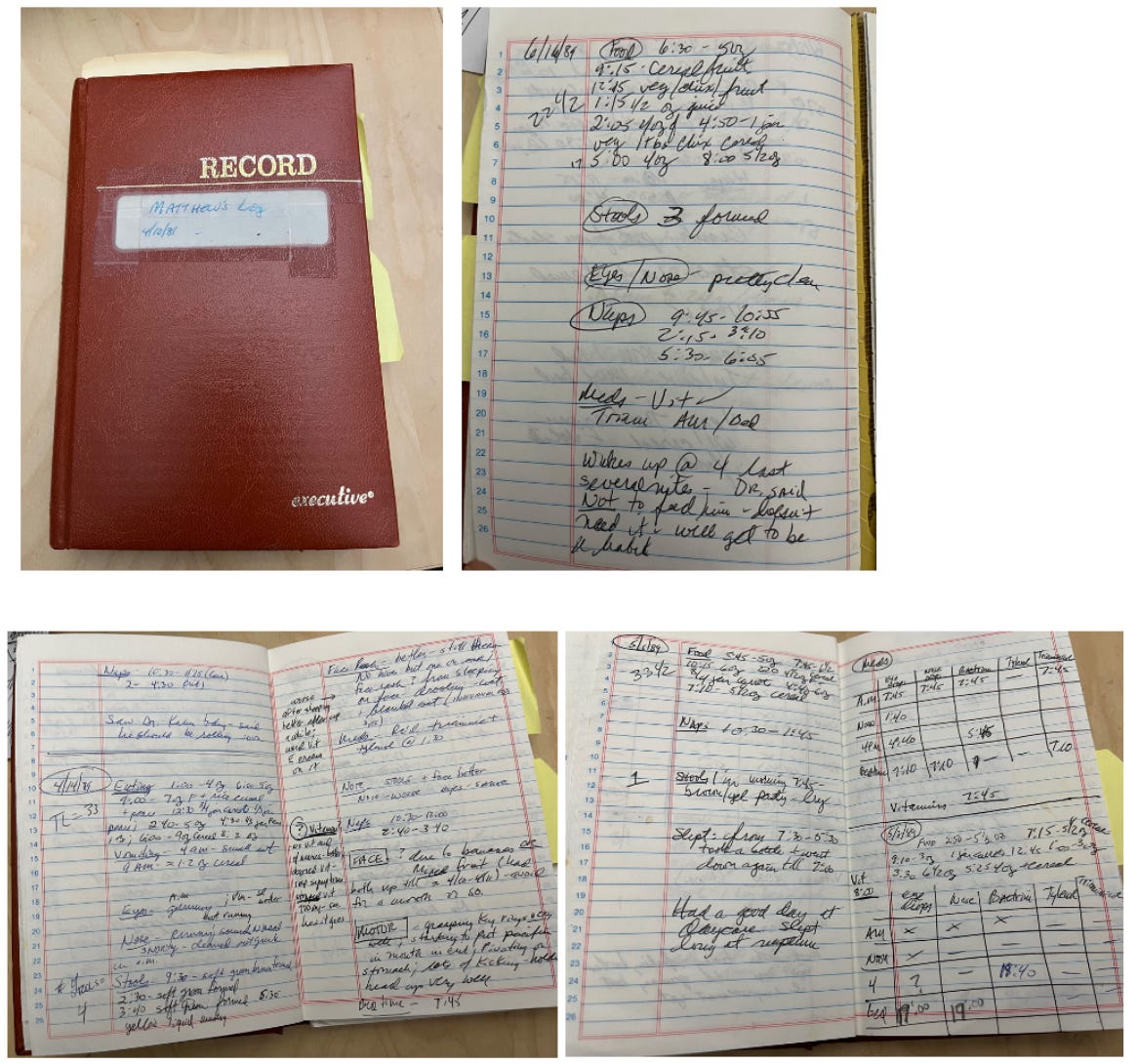
My hypothesis at that point was that the problem was something external — something about how I was feeding him. So I set out to find the exact right “tools” to solve this. I tried different bottles but quickly concluded that the actual container was probably a non-issue. What seemed to be the problem was my son spitting out the nipple shortly after I gave him a bottle. So…it must be the nipple.
I proceeded to try different nipples. I tried the plain brown latex ones with one hole. I tried them with the two holes, the three holes, and the cross-cuts. I tried them with different-sized holes. I tried silicone nipples, again, with one hole, two holes, three holes, cross-cuts, and different sizes. I tried regular-shaped nipples and orthodontic ones. If there was a nipple on the market, I bought it, tested it, and logged the results of each.
The bottom line, though, was that no matter what nipple I used, he spit them all out. Finally, one morning, I came to the end of my rope. My son was screaming and hungry. I was stress-out, sleep-deprived, and out of new nipples to try. I stood like a deer in the headlights, staring at the counter with all the various nipples arrayed neatly before me. My son’s screaming got louder. I panicked more. Any hope of my brain deciding what to do next was gone.
Enter my husband — a paragon of calm logic, as only a computer software specialist can be when faced with a problem computer system and people screaming at him to fix it. He came up behind me, put his hands on my shoulders, and said: “Dear. Our son is screaming and needs to eat. You have $40 worth of nipples on the counter. Pick one, and use it.”
Never have more magical words ever been spoken. I snapped out of my panic, picked a nipple, and fed my son. Poorly, but he did get some formula. And then, realizing I was out of ideas and that failure wasn’t an option, I called a child development specialist we knew.
She evaluated him, assured me he was healthy, and recommended a better pediatrician. That was a good thing because I told my husband if the current doctor called me a nervous mother one more time, Ed was going to have to come bail me out of jail.
I met with the new doctor. He assured me I was doing a fine job, that our son was healthy, and just a bit difficult when it came to feedings. He and I reviewed the data I’d collected and determined that his formula was the problem. The doctor suggested a different one, and voila, within no time, we had a happy baby and a calmer, more confident mom. And a funny story for our family to enjoy once the drama was over. In fact, now, our family mantra for moments of confusion and too many choices is: Pick a nipple. Start somewhere, then seek out help if you need it.
Needless to say, I learned a number of lessons from this, not the least of which was to trust me and my tools. Confronted with chaos, I found my way to a solution by collecting information and organizing it in a way that let me see the whole picture. Once organized, I could tease out patterns and work the problem.
So, to come back to how to do this book? I have the questions, and a lot of data already – my journals, my paintings, photos, therapists, input from family and close friends, and my science brain. So the data is there waiting for me to organize it.
At the same time, I am also now an artist these days. So, as opposed to my hospital lab days, I am not quite as single-mindedly left-brained anymore. I am somewhere between left and right brain approaches — an emotional person. A list-maker. A writer. A map lover. And the scientist.
Also, the problem to be solved here isn’t a simple, “What is the best formula to use?” question. This is a quest to unpeel a very large, many-layered onion, layer by layer, to get to a core filled with pain, trauma, and long-abandoned parts of me. The road to it is laced with anxiety, self-hate, confusion, and the deep desire to learn, understand, and transform. I suspect…at least I hope, that who I will be at the end of this journey will be very different. So I need the right approach to manage the many “spinning plates on poles” for this process, without dropping any.
The question now is not just “What nipple to use?” but is it even the tool I need?
And then I realized that, like any master craftsman facing a large project, you don’t just depend on one thing, you select a variety of tools…you set up a toolkit…
Tags: baby, baby bottle nipples, baby feeding problems, breastfeeding, lab manuals, lactation, motherhood, nervous Mom, pick a nipple, postpartum, problem-solving methods, sexual abuse
 Soul Mosaic
Leave a comment