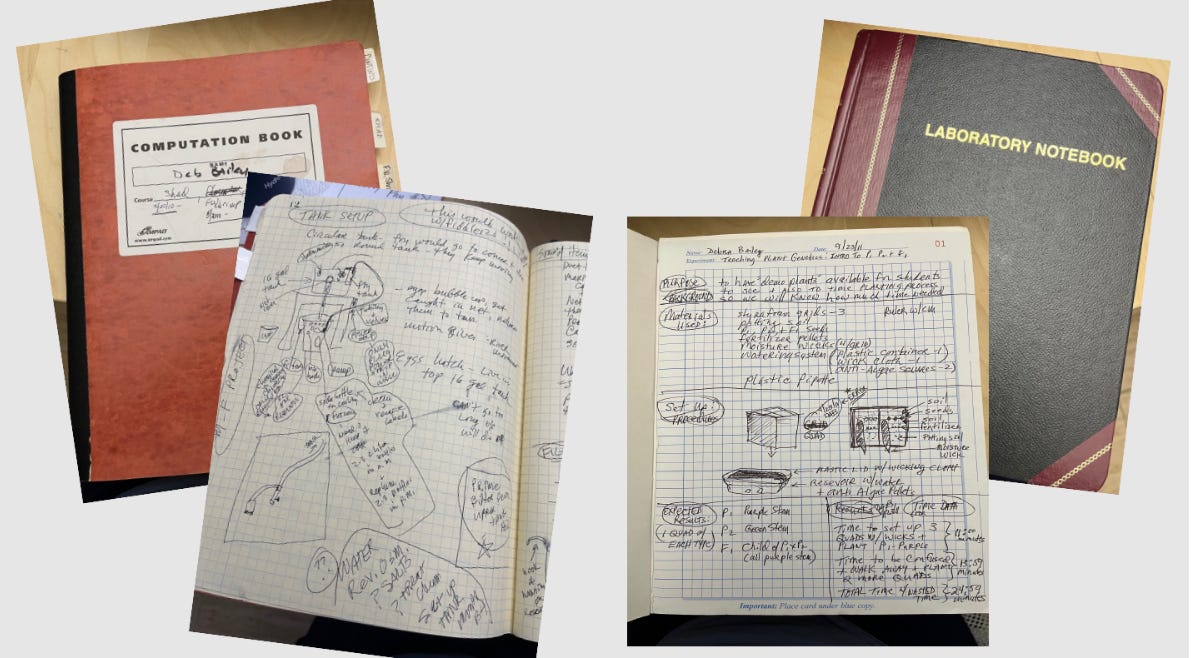
Before I could create my toolkit, I needed to have a handle on the full scope of the challenge.
Writing is the heavy lifter of excavating the wisdom….but what do you do when you can’t feel…when you can’t reach the emotions locked away…when you may not even realize the emotions are there?
And worst of all…even if and when you can get at them, what do you do when they so overwhelm you with pain and intensity that you are rendered mute in your trauma…you literally cannot find the words to fully express and release what is flooding through you?
That is where I started this journey. And so many times I just walked away because I didn’t know what to do. It felt almost impossible. I say “almost,” only because I had been here before in life and I knew there was a way to bring order to chaos – that whole “Pick a nipple” experience decades earlier.
Thumbing through that tan notebook from my son’s infancy, its pages starting to come loose, I felt hope that I could find the right way to do this, that an organic structure would suggest itself.
Certainly, this book couldn’t be like writing a nonfiction “how-to” book. Nor was it a “sit-at-the-computer-open-a-vein-and-it-would-all-neatly-come-pouring-out” process. It needed to run wild before it could show me how to proceed. But even “running wild,” needed some boundaries.
I wandered around the house and stopped in front of the ham radio receiver from the WWII tank that my Dad used for years. I stared at it on the shelf, played with the dials. Tactile memories stirred. And yes, there is the question: “Why do I have that WWII tank radio receiver in the first place?” That was no small clue.
The music on my laptop drifted in. Songs from 1965, 1966, and 1969 brought me right back into those years. One particular one came on. Several nerves twitched. Suddenly I was 12 on a violent Sunday afternoon, cowering in my bedroom.
A copy of Jacques Cousteau’s The Silent World was on the next shelf — one of my treasured 1960s Scholastic Book Services purchases that I’d kept. Again…why did I hunt these books down — these very editions? Why did I need them?
Carefully opening the book, I shoved my face right into the middle, right against the pages and inhaled deeply. I just love the smell of books from the 1960s — the ink, the paper, the age. They don’t smell like that anymore. But as I took in that sensory moment, I was back in 7th grade at Sacred Heart School on a fall afternoon, trying to sneak past the nun who told me to stay after school.
Each item on that shelf — smelling it, feeling it in my hands — generated a force that surged through me, as if these objects were Talismans infused with the power to take me back and reveal secrets I’d long forgotten or locked away. Talismans. That is exactly what they were. Objects of power to open a door.
Thoughts started racing through my brain faster than I could process them. So I resorted to my love of maps to help me. Love of maps…another clue. One thing I’ve grown to know about me is that when I am overwhelmed with ideas, I need to capture them on paper before I lose them….I need to “map them” — empty them all out of my brain onto paper — so I can “see the big picture” and spot the patterns.
So I started dumping out every thought I had as fast as it came – things I wanted to write about, things I remembered, questions I wanted answers to. I scribbled circles and boxes with cryptic words in them, then criss-crossed the paper with lines connecting them all. A “mind map.” Patterns appeared and then more memories spilled out. I was on to something here, and my mind maps were key.
I flipped through a book I have, Your Brain on Art, which spoke about the neurological connections of art to emotions and memories. Art. Paints. Ripping the plastic off a stack of canvas panels, I pulled out my paints. In no time, I had 5 or 6 paintings going at once. As memories of specific incidents came up, I threw paint down on the canvas, rapidly capturing either an abstract explosion of emotion or a detailed depiction of an instance of abuse. As I painted, moments I’d forgotten appeared on the canvas along with what I felt then. Even before I could consciously choose things to record, they came through my fingers and spilled out on the canvas before me.
Aside from serving to free emotions and prompt memory details, these processes injected moments of calm into my mental chaos. It’s like when you get sick. You feel terrible, then throw up, and for a while you feel better…until it’s time to throw up again. So I would paint, feel better, then feel worse again, then have to paint again. At this point, all I did was paint. For months, I stopped trying to write. I just painted as fast and as much as I needed.
The funny thing was, when I first started painting, I wasn’t sure I could even remember how to do it. It had been decades since I’d picked up a brush. But my hands remembered – tactile memory. I got out of the way cerebrally, picked up a brush and some paint, and just started moving them around the canvas. My hands led the way to the images.
It was such a relief. For one thing, I no longer had to hold those things in my head. Things that had been there my whole life, I could finally stop carrying. I could actually feel that young child within me relax, reassured that those moments would never be forgotten. They were there now, preserved on canvas. All those things were being brought out into the light of day, given their due, and *exposed* for the world to see. For me to see. And this time, I was seeing them as an adult…and my adult was horrified.
The paintings showed me the full magnitude of the evils done to me, the things I’d carried in my head and kept telling myself “weren’t so bad,” and to “get over it.” Now, in the light of day, in the light of 7 decades of life experience and healing, I saw the true horror of what that child, teen, and young adult endured, felt, and survived. What I had survived. I saw the full amount of courage all of my younger selves had demonstrated, especially those teen and young adult parts that I’d HATED all these years. I had despised them and yet, those parts were actually HEROES.
Suddenly, I felt remorse and grief over how I had treated all those earlier parts of me. From somewhere deep within a wall cracked wide open, and waves of hidden pain came tumbling out. It was as if all my younger selves could break down in relief at, after all these years, finally being seen correctly. How had I been so blind and unaware?
After about 50 or so paintings, I began to realize that the way to tell this story was through those paintings. They would be my framework. Those paintings were showing me the things I needed to talk about and a possible way to do it. It would be a story told through the eyes of all those younger selves, through paint, and through all the visuals I had – sketches, maps, photos, journals, objects — Talismans. They would show me what to write. And in the writing, my adult self would find the wisdom…and my meaning.
It was at this point, though, that my artist brain, while breathing a huge sigh of relief at these revelations, also felt totally overwhelmed by the immensity of it all. Even the right-brain part can recognize the need for some amount of left-brain order. As so often is the case in art, a few rules really do make the creation stronger. So that’s when my right brain invited that very helpful other half of me – my left-brain scientist – to the party.
As I mentioned in the Pick-A-Nipple entry, I am split between the emotional, creative artist and the rational scientist I’ve had to be my whole life. I am not one or the other. I’ve always existed in a state of uncomfortable “detente” between the two. It is what it is. But in this case, having both skills is just what I needed.
Essentially, the right brain pleaded: “Please can you do that lab manual thing that you did back when we had a screaming infant who wouldn’t eat and we had no clue what to do?”
My science brain happily complied. Immediately, instead of seeing chaos, it saw the wealth of valuable raw data that could be tamed and tapped for the wisdom. It reminded me that it was okay to use my strongest tool — years of lab manuals and experiments — without losing sight of the goal. Just like finding the answers for my son years ago, I could find my own answers with a “lab-manual-of-sorts” approach. No, I won’t be writing this book like a research report, but it was two categories from them that gave me my Toolkit for my writing process:
- Procedures and Methods
- Materials Needed
Procedures and Methods
Here is the process to use for writing this book. It is the disciplined set of rules for my right brain to follow so it can make the best use of all the creative ideas and objects:
- Show up: Even if I only have a short bit of time, or I can only stomach doing this in “small bites,” just show up and do *something*
- Let Go: Allow chaos to lead so *everything* can surface to be “re-examined”
- Moment to Moment: Like in the past, don’t look ahead, get overwhelmed, impatient, or despair – just focus on current moment and task and do this step by step
- Research, Acquire, Organize: Gather everything to dig out the facts – photos, journals, objects, or track down and buy things from my past that my gut knows will connect me to those memories
- Liberate: Use art, journaling, objects, whatever it takes to free the frozen emotions, trigger my memory, find the words
- Confront: Run from nothing…face all the ghosts and leave no door closed
- Look Deeply With Fresh Eyes: Look again, closer, more intently at things I thought I understood. What have I missed?
- Feel and Follow My Gut: What is coming up in my gut as I revisit and “re-see” the past. Let it tell me what to paint or write next
- Question: Interrogate everything – make no assumptions; keep no pre-conceived ideas. Question everything — the obvious, the not-so-obvious, the overlooked — and ask the hard questions
- Think: What is the truth that is before me? What does it all mean? What did I miss before? What does “adult me” finally understand only just now?
- Identify: What are the patterns, recurring elements, metaphors, themes, and symbols? What are the insights I see?
- Share the Data: Write the story chronologically, sharing what I have seen and learned
- What’s Next: What do I do with the insights? What has changed? Do I need to revisit something?
- Protect: Use therapy, calming techniques, rest, play, and boundaries to protect me as I go through this journey
Materials Needed:
In spite of the intimidating and overwhelming body of “things” for the story — photos, paintings, journals, books, songs, objects, etc. — the materials all really came down to just a few things:
- The Framework: These are the elements, many of them recurring elements, that tell the story — moments of abuse, things that happened, nightmares, and the timeline of my life. They are told through the paintings, songs, photos, and charts that depict those places in time.
- Talismans: Special objects, often from childhood, that hold particular power. They are my direct portal to a past moment, to my younger self, and to my power to remember and act.
- Moments of Respite: These are the moments or experiences I created and used, that made living through things in that house _possible_. Moment to moment, experience by experience, I strung them together to form my lifeline, my way to stay psychically “intact.” I still use them today.
- Discoveries: These are the “aha” moments that come as I revisit the Talismans and Moments of Respite. They are connections and patterns, in the form of metaphors, symbols, recurring elements and themes – and they will provide the meaning to it all and the wisdom that will help me grow and heal.
How did my right brain respond to all of this? It is a testament to the wisdom of “gut sense,” because as soon as my right brain took all this in, it exploded with joy. I felt a visceral sense of exhilaration. This was what just I needed: Right-brain chaos to lead, but specific left-brain processes to guide.How did my right brain respond to all of this? It is a testament to the wisdom of “gut sense, because as soon as my right brain took all this in, it exploded with joy. I felt a visceral sense of exhilaration. This was what just I needed: Right-brain chaos to lead with all the material, but specific left-brain processes to guide by giving order and context to it all.
Finally, a way forward…
Tags: Discoveries, Moments of Respite, Scholastic Book Services, sexual abuse, talismans, toolkit
 Soul Mosaic
Leave a comment