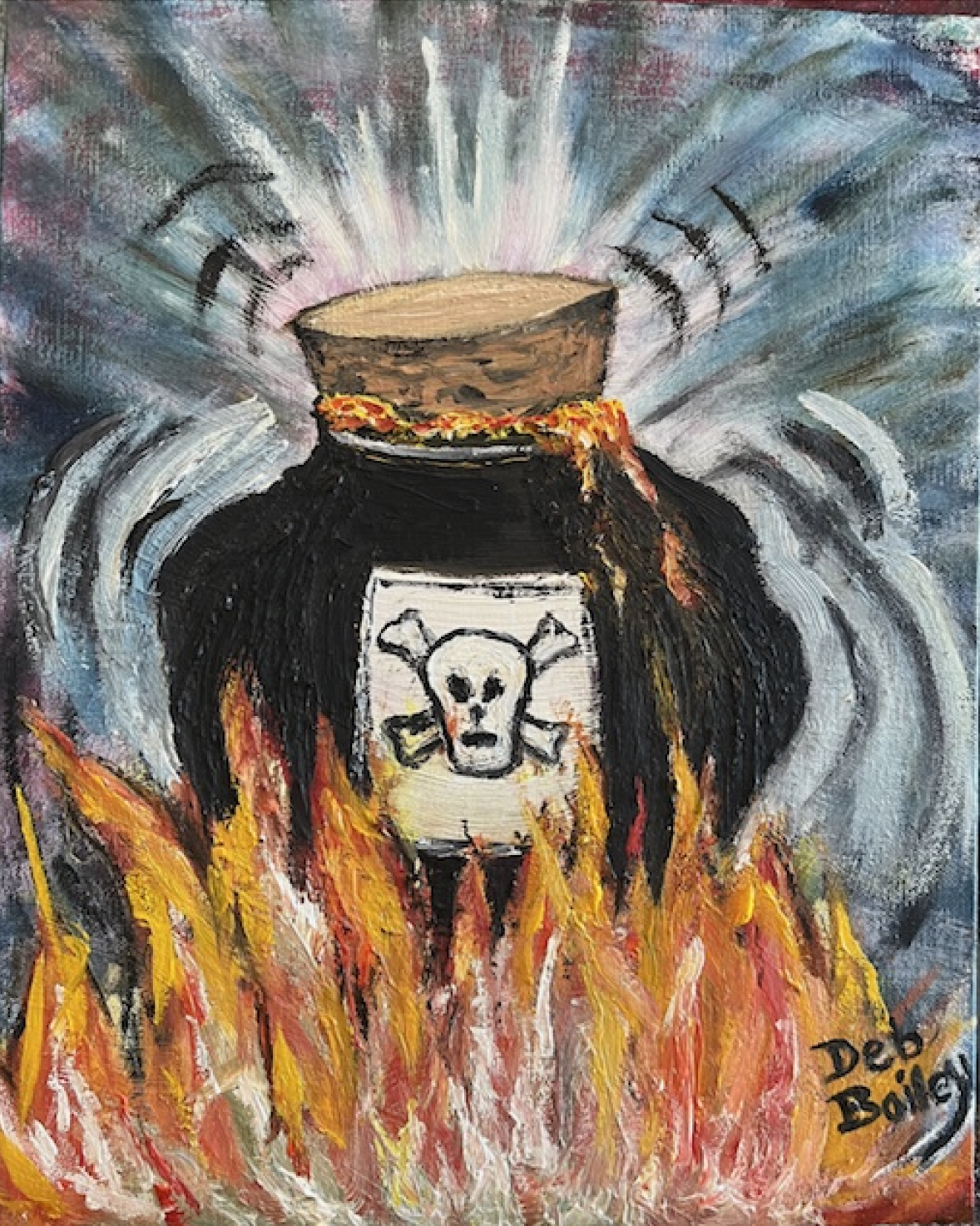
Painting by author
The place of ghosts
We all have a shadow side…a place of dark rage, born out of the pain of abandonment that wails the cry: “What about me?”
It is a place of our ghosts, filled with toxic poisons, bubbling, oozing, and swelling in a stoppered bottle. As the fires of life’s pain intensify, the heat and pressure build. The boiling liquid rises, forcing itself hard against the stopper until, finally, the block gives way.
If we’re lucky, it will just push the stopper up enough to leak out and ease the pressure. Or, if we can bring attention and wisdom to the process in time, we might be able to toggle the stopper slowly and safely release what’s under it. But if we ignore it, it builds, explodes, splatters, and destroys.
Transformative wrath
I love mythology and stories about old wise women and crones…especially since I am one now, at least, old. So, this excerpt by Jean Shinoda Bolen, MD, in her book, Goddesses in Older Women, says it eloquently:
“The archetypes of transformative wrath are most effective when balanced by wisdom. Without wisdom, they can be destructive…with wisdom, anger is channeled into a commitment to bring about change, and a determination to find the best way.
“…Outrage is good, healthy anger that finally is directed at changing an unacceptable situation. The depression and anxiety that women suffer from in the first and second phases of their lives are usually the result of feeling angry and powerless, afraid to express it….By the time a woman is in the third phase of her life, she may no longer be intimidated …or held emotionally captive by an abusive or domineering person…
“This is when she can tap into…the ‘Enough is enough!’ archetype. These are the energies of the goddesses of transformative wrath, powerful agents of change…if she has gained wisdom — and has the resources of compassion and humor — she will not be impulsive, one-sided, and carried away by fury.”
Well, I am old. And I certainly didn’t want to be impulsive and get scalded by the hot mess inside me. So “wisdom” would be welcome. That is where the guidance of my therapist, husband, and close friends always comes in handy.
What about anger?
Regarding anger, my therapist put it in perspective first by affirming my right to have it. “You come by your trauma honestly. It was done to you. And given how long you were abused, if you stayed angry for a long time, it wouldn’t be unreasonable.”
So anger, that emotion that is terrifying to so many of us, has a right to exist. And it can even be a force for good if wielded carefully.
In spite of the upwelling of so many intense emotions these last months, I was here to heal, not destroy. I could not deny the level of fury, but neither would I let it lead the journey.
I remembered something that the Buddhist monk, Thich Nhat Hanh, shared in his book about how to care for anger. He described our anger and pain as being a crying infant inside us. It doesn’t need to be ignored or punished, but instead, held with compassion and love. By embracing our rage and pain with love, we can let its fury wear itself out safely, calm it down, and then look deeper inside it to see what it is about and hear what it is trying to tell us.
So, the thing I needed to do at this moment was not run, but to stare down into that cauldron of noxious fumes and identify what ingredients my shadow side and ghosts put there to cause such pain. And try to hold it all with self-love.
Now, I am not a Buddhist monk, and more times than not, when I am pissed off by someone or something…or my dark ghostly companions have goaded me into despair and fury, I can have some really “animated” conversations with myself. Maybe I’m not exactly gently cradling the baby of my inner pain, but at least I’m paying attention to it safely.
All alone, as I clean or make dinner, I vent about all the things I’d like to tell this person or that, the things I *should* have told them, or whatever. I imagine I’m not the only person who fights the battles of the world this way. But it’s safe. No one is there to hear it all, and sometimes, out of the solitary yelling, some questions or insights will pop up.
Challenging the ghosts
In the case of all the toxic messages my inner ghosts were trying to tear me down with, I started to counter their arguments with things like:
Why do we live in a closet, swallowing down the toxic poison of secrets, and feel we would be “bad,” or “wrong,” or “disloyal” to speak our truths?
Why is it that instead, we spend most of our lives behind the facade, pretending we’re just fine, when the truth is we’re choking on that bulging bottle of family secrets?
One question that came up just the other day was, “Why do people think trauma and incest survivors should be quiet and get over it?” I was thinking about what another incest survivor said in the book, The Courage to Heal – “Incest is not a taboo. Talking about incest is the taboo.” She nailed it.
We are viewed as the “problem” — the living, breathing reminder of something everyone else doesn’t want to look at. Something ugly and uncomfortable.
So, we clamp our mouths shut, make ourselves small, and refuse to speak, like a good little victim. But…the poison keeps building and choking us. And ultimately, it will either kill us or haunt us for the rest of our lives.
I didn’t do this!
For a lifetime, I’ve felt apologetic, not wanting to cause discomfort, and feeling like speaking betrays the secret of what my father really was versus what everyone else *thinks* he was.
I kept the secret, which protected his carefully cultivated reputation and image. Because if I spoke, if I shined the light of truth on him to show his reputation was fiction, I would be the villain.
The other day, this emotion burst out of me from somewhere, and I wanted to scream – “So people don’t want to hear it, and criticize me if I speak what I need to…But I DIDN’T CAUSE THIS! I DIDN’T DO IT! IT WAS DONE TO ME! Why do I pay the price?!”
Messages to silence us
The ingredients to this stew of control are powerful: You start with a mix of secrets, personal shame, and society’s stigma, add in some misguided loyalty, wrap it in a crust of self-hate, and garnish with a side of messages to stay silent.
After a lifetime of being crushed by trauma, then add in society’s response, it’s no wonder so many never speak, and some don’t make it through.
What are the messages to silence us?
They include themes like: Minimization. Anger. Accusations. Fear. Gaslighting. Guilt trips. Shaming. Questioning your memory. And zero-sum game thinking. That is where only the person with the worst story has a right to have pain and feel it. And since your pain will never be bad enough, you don’t have a right to it.
No doubt many have heard at least one of the following, or felt its energy directed at them:
- You’re just being selfish.
- You always want the attention.
- So you had a rough time. Everyone does.
- Get over it.
- You’re being dramatic — you were always the sensitive one.
- It could be worse — there’s people dying of disease, so be happy you have it better.
- Others have had it worse than you.
- You are mistaken — it wasn’t that bad.
- You were just imagining it.
- It’s over and done with.
- It was a long time ago
- You’re still going on about that?
- Can’t you let it go?
- Focus on the present. Life is short, and you’re wasting it thinking about the past.
- Maybe if you stopped navel-gazing and focused on others, you wouldn’t have this problem.
- There are so many good things now, can’t you just move on?
- You’re going to upset everyone around you by talking about old history.
- If you just forget about it and focus on the present, everything will be fine.
- If you loved us, you would just leave it alone and move on.
- Why are you sharing private business in public?
I am sure there are more. These are more than enough, though.
Poet Lucille Clifton, writing of the abuse she suffered in her childhood, captured all of this so powerfully in her poem:
why some people be mad at me
sometimes
they ask me to remember
but they want me to remember
their memories
and i keep on remembering
mine
Why are we silenced…and what does it do to us?
In the book Your Brain on Art: How the Arts Transform Us, it states that two big inhibitors to recovery from trauma, especially shame-filled traumas like sexual assault or abuse, are the shame we feel in ourselves and the stigma put on us by society.
In shame, WE want to stay quiet because we don’t believe we have the right to speak, we haven’t been believed, or we have been beaten down by fear so that we don’t dare tell our truths.
In stigma, SOCIETY wants us to be quiet. We are viewed as a danger to the normal order of others, different, weak, or broken, and so we are set apart from them. It is probably that part of the human brain that thinks “different” or “unknown” is dangerous. We are dangerous to them, so we are driven to conform or to isolate.
No turning back
I have lived through decades of trauma, despair, suicidal questions, and finally, rebuilding, learning, and thriving. I did my work quietly because I believed that repairing was my business, I was so ashamed and loathed me, and I didn’t want to burden anyone else with it. And, I feared criticism or rejection. If I stayed quiet, I was allowed in and possibly respected for my “strength.” But if I talked?
I realized that I’ve lived for over six decades in this manner. I hid the toxicity, and pain, and the inability to feel much. But now, after everything that’s come up in me around Mom’s death…and her life; and the more I worked with my therapist and grew stronger, the more I felt this crushing pressure of “something” within me, waiting to be rescued…or maybe better: waiting to be brought back into my life.
I was starting to feel and hear that part of me that I’d sealed off and forgotten about, years ago, in order to survive. Now, for better or worse, it was time to take my own counsel. Maybe I was strong enough now to approach that sealed chamber, and open it up…and release…whatever was there. Would it be out of control and destroy me? Was there more pain than I could withstand? Or would it finally be the portal to the rest of my healing and a wonderful new life?
Time and therapy may not heal all wounds, but denial heals none. I had to know. And I was tired of running. I am the sort of person who will endure something for a very long time, and it may take me even longer to realize I am doing it and ask myself why. I am not always the quickest learner. But once I do realize and ask, there is no turning back.
 Soul Mosaic
Leave a comment