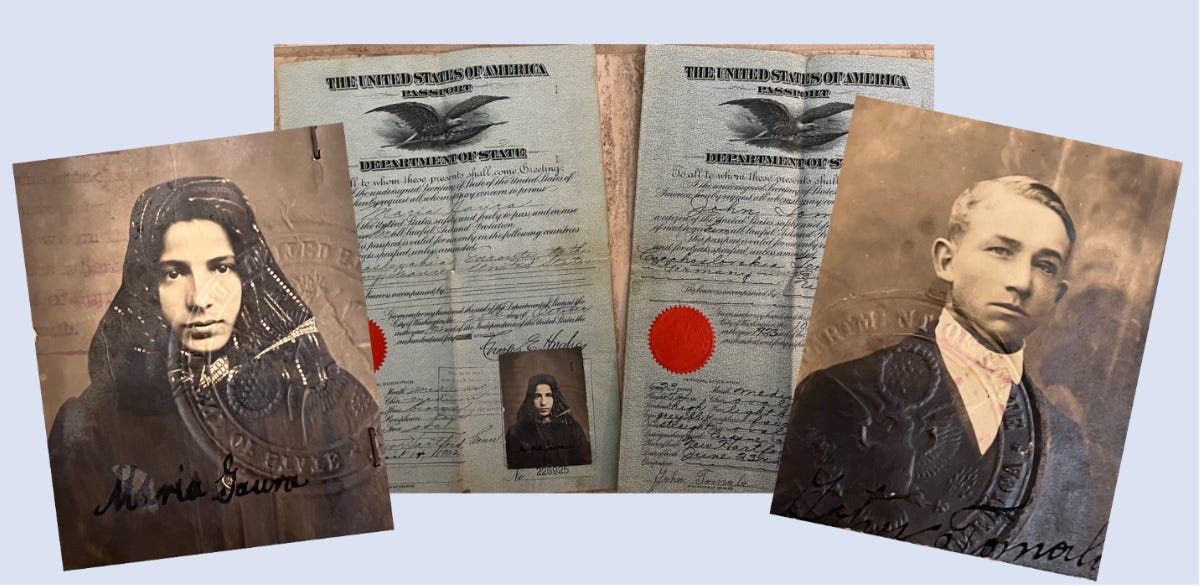
The Old Country
While my Grandmother was born here in the US in 1902, she spent most of her childhood and early adulthood in a small farming village in “the Old Country,” — or “Old Countr-r-r-y” as she called it because she rolled her Rs strongly — which was eastern Slovakia. And she still spoke mostly Slovak with my mother, which we kids only understood a bit of. When she talked with us, she always apologized for her poor grammar and explained that she spoke “Broken English.” We grew up assuming this was a special form of English. It was a smattering of English and Slovak words delivered in her Eastern European accent with her rolled Rs. To this day, I so miss her and her way of talking. It warmed my heart.
One particular afternoon, I had gone to visit her in her convalescent home and shared that I was taking a vacation trip to Germany. My Grandmother went quiet, then looked at me with an expression of total confusion and surprise. Shaking her head, she said to me in her broken-English style: “For what you go Old Countr-r-ry? There’s nothing there!”
I was kind of surprised at her reaction because I was young and just excited at the idea of going to Europe. It was my chance to travel somewhere new and have an adventure. I couldn’t understand why anyone would question the idea of such a trip. So I brushed off her comment with the arrogance only a “know-it-all” 20-something can have.
The missed story
I so wish, now, that I had asked her more about what she meant. I assumed it was her typical reference to what she and many other immigrants back then would say, that her life here was so much better than what she left behind. But it could have been something else.
Maybe all her family had been wiped out in World War II. Who had been there? What happened to them? Maybe there was nothing there anymore because it had all been destroyed. Whatever it was, I realize now that I had lost a precious opportunity to learn what she could have taught me. Instead of slowing down, looking deeper, and asking her, I rushed to judgment and missed her truth.
Wrong conclusions
All my life, I have always viewed my life in one way. I was abused. I stayed too long. I was ashamed of that stupid younger part of me who “should have” known better, and I spent the rest of my life making sure I never ended up like that again. I could excuse the young child part of me, and knew most people would view her sympathetically. But that older teen and young adult? I despised those parts of me and decided they weren’t worth talking about…they didn’t “deserve” recognition for their “failures. I was deeply ashamed of those parts and figured if anyone else ever knew, they would feel the same way, too. So for decades, except to a therapist, I never spoke of those years and never told anyone just how long I had been stuck in that house. Instead, I just moved on, pretended my past was fine, and privately fought to get back as much of my life going forward as I could.
In case anyone reads that description and picks up on what seems like heavy doses of self-hate and self-judgment, along with an appalling lack of compassion or self-love…you wouldn’t be wrong. I always saw my value as moving forward, being “strong,” and never being “weak or stupid” again.
The new lab experiment: Back to the Old Country
Finally, I came to understand that to move beyond that self-fate, I had to go back to my Old Country — my life — because there was most definitely something back there. Maybe there were answers to questions…or even more questions with no answers, but whatever was back there, I wanted…and needed…to see it. If I ever hoped to unravel that Gordian knot inside me and heal, I couldn’t do it by hating parts of me. So I had to go back there.
For this part of my journey, it was time to bring back that lab manual approach. I needed to purge any preconceived notions and just look at the evidence. I had photos, song lyrics, my “Talisman” objects, journals…all kinds of things from my past I could start with, to refresh my memory and let me look again.
I would move slowly, studiously, and with an open mind to see what I could see this time that I might have missed before. And I would look with “new eyes,” the eyes of an adult, not a traumatized child. I would be the lab investigator watching the experiment to see what came up.
The one problem. Memories. Some of the most important, traumatic ones that I most needed to look at were things not “preserved in the family photo album.” They were seared in my brain and nervous system. Somehow, I had to get those out of my head and “outside of me” so I could look at them clearly.
Fortunately, this is where that split part of me — part scientist, part artist — came in handy. I painted the things that were always in my brain, the things that haunted my nightmares, and provoked anxiety attacks. This way, I could see if my adult eyes viewed those things in a different way than how they felt inside of me. An “art” experiment.
“What next?”
So the next section of this book — The Old Country — is heavily visual with comments to give the images and objects context. That whole lab experiment process, where you do something or watch something, and record what happens.
I want to REALLY LOOK at the things that went on in that house all those years, and see, “What do they look like now, and what do they bring up in me?”
Then maybe I can make some sense of it all later, in the last two sections of the book — Journey to the Underworld and The Return. Those are like the sections in the lab report where you analyze your results and try to determine, “What next?”
A parting note for this section…
In keeping with my Slavic heritage and “the Old Country,” here’s a bit of trivia.
The old Slovak men, when they wanted to put someone down, would call them a “Stada baba,” an old lady. Like I said, not meant as a compliment.
But there is a myth of a powerful, fearsome old crone of the forest named Baba Yaga. She lived in a house that stood on chicken feet and could walk through the forest. Should you dare venture into those deep woods and approach her house, there was no telling what reception you might get. Legend says she would often eat her guests. But, it also said that she might first pose a question, and depending on how you answered, she might actually help you.
Author Kris Spisak, in her book Becoming Baba Yaga: Trickster, Feminist, and Witch of the Woods, shared one of Baba Yaga’s most likely questions, one that gave her a glimpse into the nature and courage of her guest:
Have you come to do deeds or to run from them?
I love that question, and yes, I most definitely have come to do deeds.
So, now, on to the next section — The Old Countr-r-r-y.
 Soul Mosaic
Leave a comment