“David Foster Wallace’s ‘This Is Water’ speech uses the metaphor of fish and water to highlight how the most fundamental aspects of our existence often go unnoticed. In the story, two young fish swim past an older fish who greets them with, ‘Morning, boys. How’s the water?’ After a while, one of the young fish turns to the other and asks, ‘What the heck is water?’ This illustrates how the most pervasive elements of our lives can become so familiar that they become invisible to us.
By Jonathan Winnegrad, ABO-AC, NCLE-AC in 20/20, Sept 2024
Many things go into forming a person, especially if the programming starts right from birth. As I tried to find the “entry point” to tell my story, I was overwhelmed by all the things I needed to weave into the narrative.
So, I resorted to what I always do when confronted with too much information: I throw everything I can think of onto a large sheet of paper to see it all at once. That way, I can then notice if there are key pieces that stand out — relationships, patterns, repeating elements.
In my true scientist way, I made a list of all the different influences over my young life:
Culture and place, which included things like:
- Time period — 1960s
- New England and its Yankee Puritan beliefs
- Small factory town
- Immigrant mentality
- Slavic culture
- Heavily Catholic
- Economic level
- Climate — harsh winters/hot summers create tough outlooks
- Geography — towns are in valleys isolated by tall hills, which insulates each town from outside influences
- Educational level of the people
People:
- Family members and attitudes
- Extended Family
- Outside influencers, such as friends and teachers, etc.
Then, to see any patterns, I spread them on a chart, with a little baggie holding notes for each of the above topics.
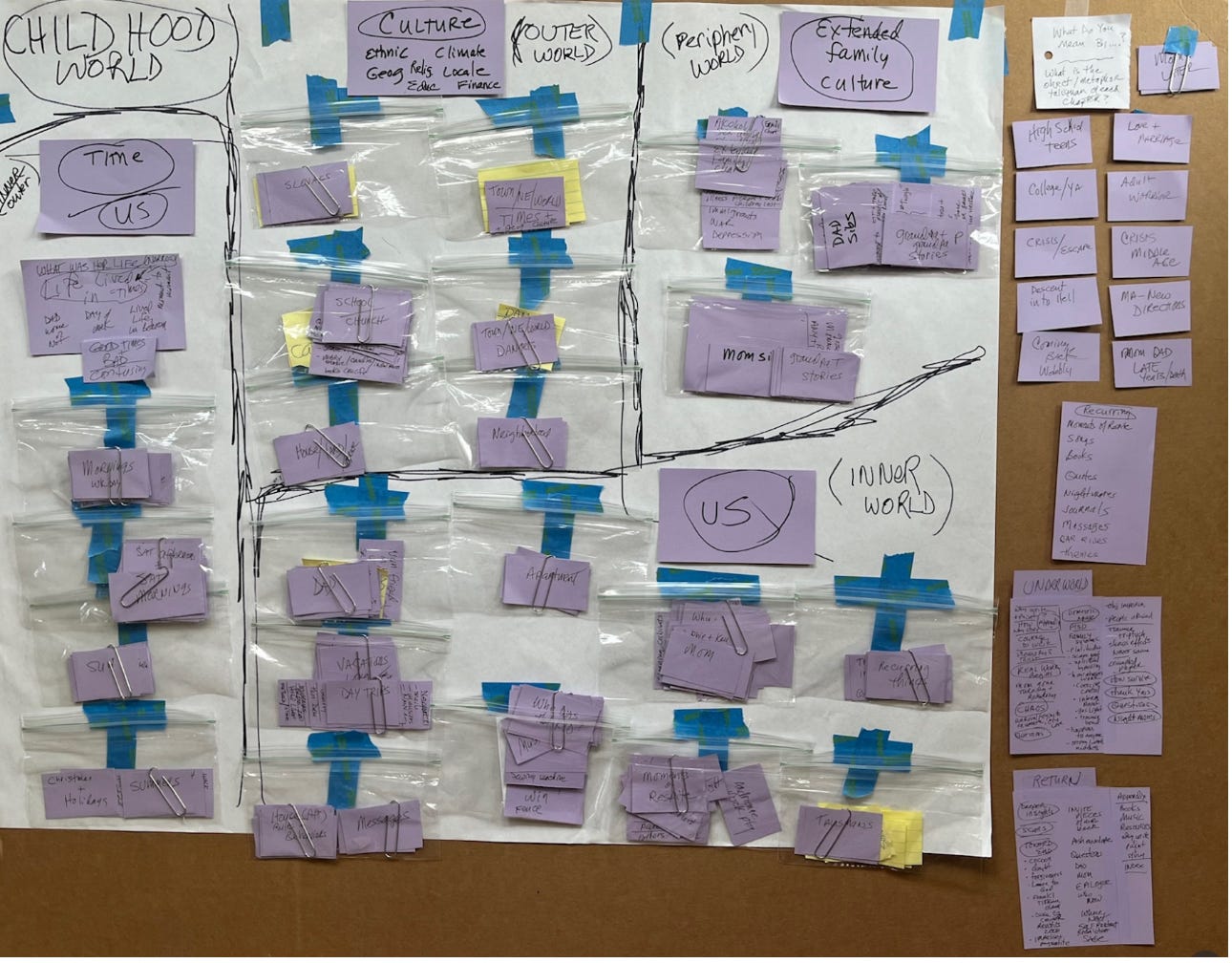
This was a decent start, and certainly all of these things played a part in my life, but they were also still peripheral. There was a powerful core to it all that I was missing.
Next, I thought of looking at my life as an “inner” versus the “outer” world approach:
- The inner world of my household – that whole “no one knows what goes on behind closed doors”
- The outer world of work, school, friends, and everything else
Again, these mattered, and I was getting “closer,” but I was still missing that overarching umbrella that held everything under it.
A friend who had heard the stories of my abuse and how I coped, noted very astutely:
“You lived a lot of your life in the ‘in-between’ times.”
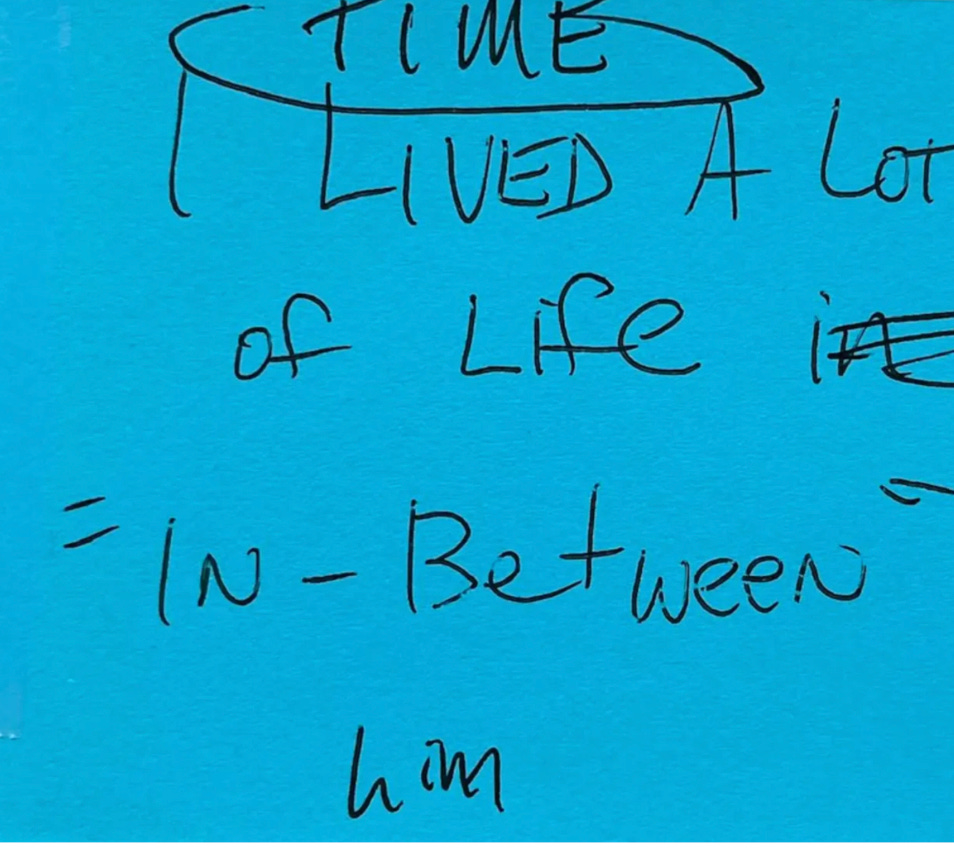
Even as I was still trying to sort it out, on a gut level I knew she had nailed the important quality…Time.
Time played a huge role in my life experiences back then. There was time in many forms, such as the time of day, day of the week, and season of the year. However, those aspects were not quite the central nucleus that everything else would spin around. But it was a TIME thing for sure.
So, I made a new chart, and this time, I made it a comparison of who I was in the times “WITH Dad” versus who I was in the times “WITHOUT Dad.”
I reflected on what my life was like when Dad wasn’t around, and thus, who I naturally was. And then I looked at who I had to be whenever he was there, and what happened to my “natural self” in those moments. Somehow, I knew I was close to the answer.
To make things stand out, I highlighted the two sides – my natural self side was green, and the times spent with him were pink.
And THAT’S when I saw it.
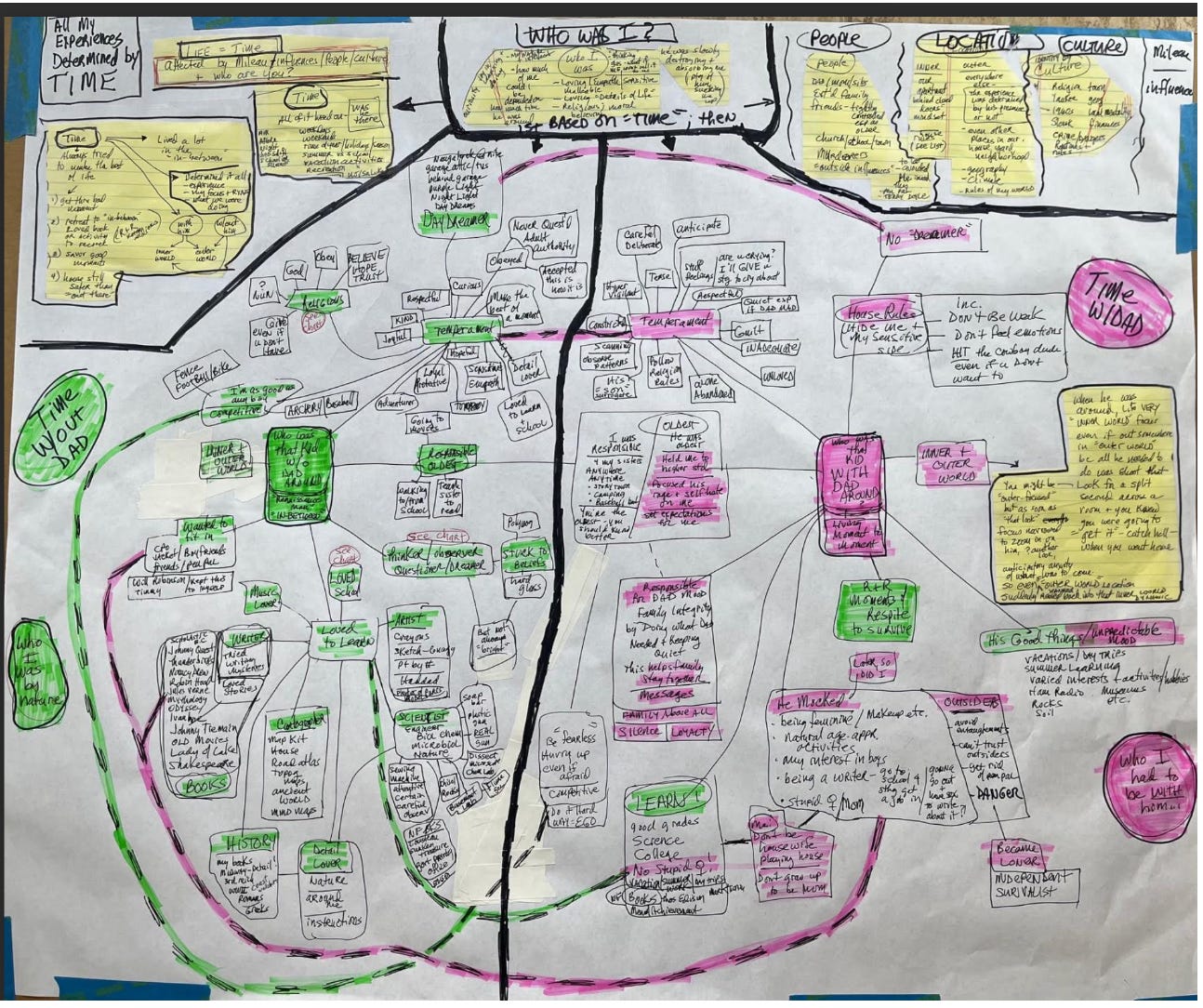
Now, the many details on the chart are not the important thing here. And I laughed in one way when I looked at it — my husband always jokes that my “mind on paper” is a scary thing!
The important thing about this chart was the difference in the two sides. The left side was who I was at my core — all my joys, interests, activities, all the things I loved to do and see and play with. It captured my fiery, competitive spirit, and all the wonderful details of who I was. The few “pink intrusions” on that side were the places where I knew those things were really not acceptable to Dad and that he would mock. But still, I kept them alive in my heart.
The biggest insight was the right side — the “Times of Dad.” So, so, so, much pink. Everything that went on whenever he was around was all-consumed by him. I could not be me. I didn’t dare be me. And I didn’t know any different, nor would I have known to question it. I just learned how to live in it because “that was life.”
There were one or two spots where things Dad valued- a love of learning, science, and a desire to “be something in life”- matched a similar attitude on my side. But except for that similarity, and those moments when Dad was in a good mood, the only other green on his side was a small box labeled, “Moments of Respite/R&R — to survive.” That box represented everything on my side — my inner nature. That’s it. I got one little green box in an ocean of pink.
So, whenever he was around, I had to bury me. All I had then were sporadic ‘in-between’ times to get me through. The pink side of the chart was the battlefield where I was constantly under siege by him in a variety of ways. And there was never any rotating out of that battlefield, ever. Only moments of R&R, those moments I now call “Moments of Respite.”
Those were the times where I could pop my head above the ocean waves of his abuse, suck down a gulp of air to restore me, and then be swamped under his mess again. Those moments were brief opportunities to tap into “my nature” to shore me up and survive all the “Times of Dad.” And whenever he was around, I lived “Moment-to-Moment.”
My survival “protocol” operated something like this:
- Be alert to his mood and avoid triggering him. Try to figure out the pattern of his moods, and maybe try to “control things” to avoid abuse. This never worked because there was no way to predict or find a pattern.
- When, not if, he explodes, go moment to moment to survive his onslaught; escape to my room, or behind Mom, but get out of sight as soon as possible.
- When he retreats to either cool off or regroup before coming back at me again, use those moments to tap into my own natural places within to calm me and prepare for the next round. During these R&R moments retreat within to my natural self. These can be anything from just noticing birds singing outside my window or a beautiful wood pattern on my floor, to daydreaming about what book to read next, or something fun to do when he isn’t home…anything, just to calm and reinforce me.
- If he’s in a good mood, do EVERYTHING possible to keep it that way. And of course, we all know that is his “true nature,” not the “bad side.” House rules said so: He was “Good and loving Dad” and the other stuff you just had to endure until it passed. And he was only like that because of either something you said or did or didn’t do, or because his job was stressful, or he had a lot on his mind. But really, he was Good Dad who just had this “bad” side.
- Remember that he keeps us safe compared to what goes on in the outside world — which I read about in the newspapers everyday — murders, war, violence. Whatever he might do to us behind closed doors, we just had to stick it out until Good Dad returned. And for sure, no one “out there” was ever going to harm us because he would never tolerate that. So he must love us…right?
- And above all — protect him back, which meant don’t EVER tell anyone what happens behind our closed doors…or ELSE.
So life and my experience of it, was about avoiding or surviving the bad times, and it was determined by which time period I was in — with Dad, or without. Any other influences or experiences were secondary.
For example, others being around offered me no protection. If I did something that set him off, “every time the others were not looking, Dad would shoot me “the look,” and I would freeze in terror. Because I knew I was going to “get it” when I got home.
We could be out at an amusement park having a nice time, and if something made him angry and he looked at me that way, I would spend the rest of the time shaking and anticipating what was going to happen to me “when we got home.” The amusement park, friends, family, none of it mattered anymore. My reality suddenly shrank to zoom in on his facial expression and my frantic efforts to try and get back on his good side. So, the umbrella over telling the whole story of who I was and why, came down to time — the “Times of Dad” versus “Times without Dad.”
After reflecting on this, I wanted a simpler image than my complicated chart to make it easy and obvious. Again, my inner scientist spoke to my artist. The biology of a cell was the answer.
I remembered doing those diagrams in sophomore high school biology, of the cell and its internal components — a nucleus, the boss that directs the cell, various organelles to perform the cell’s metabolic functions, and storage vacuoles to hold nutrients for the cell. I suddenly saw my Time with Dad in those terms, with the various organelles he used to control our household — things like violence and sexual abuse, the confusing mix of brainwashing and gaslighting, trauma bonding, and so many others.
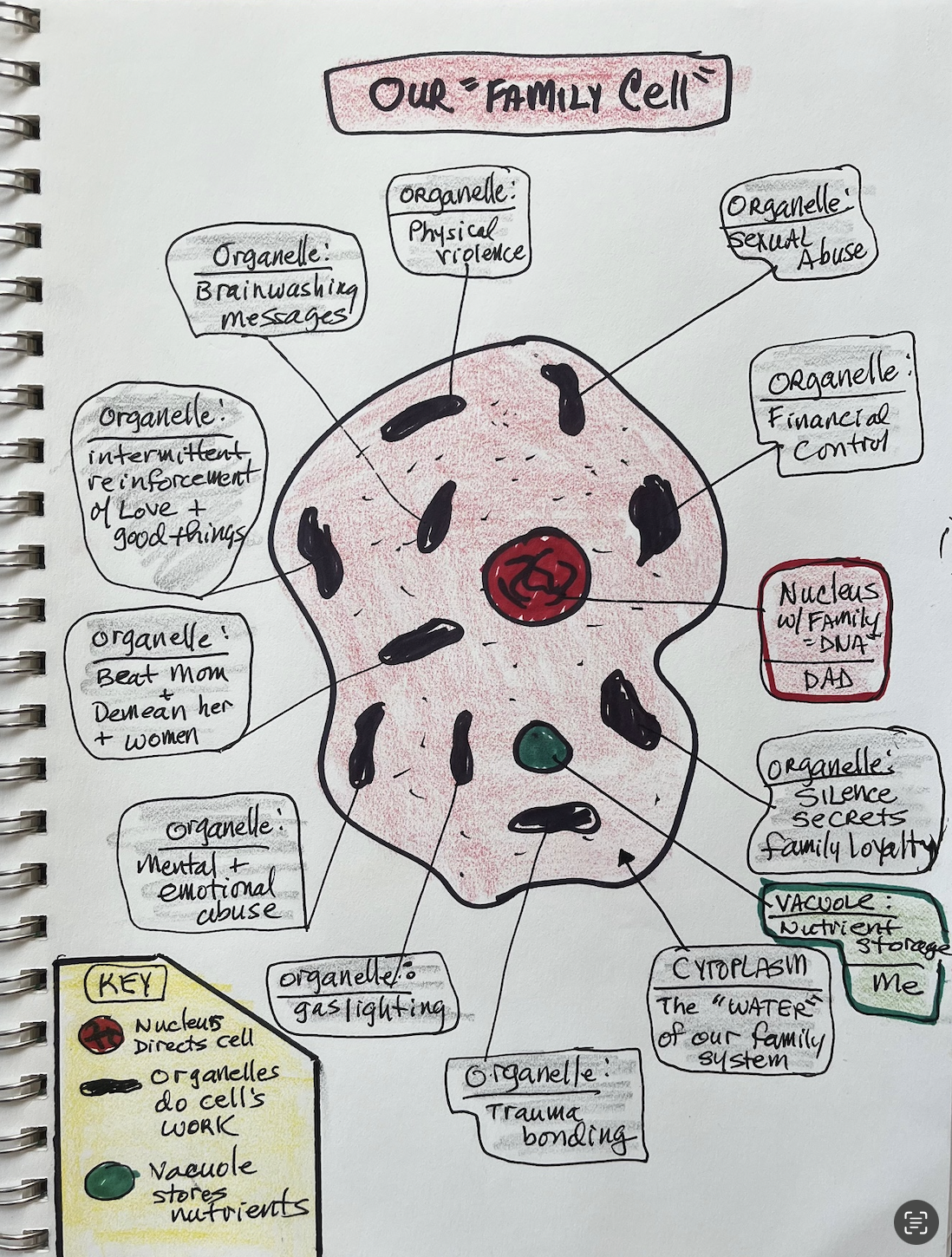
Diagram and photo by author
This image made clear to me just how much control Dad had, and how little of that time was mine to be my own person. I suddenly got a glimpse at how impossible it was for me to develop and grow into a separate, fully-formed human being. It’s impossible if all you are is a small vacuole ruled by the whims of an unpredictable cell world.
Did I think this was normal? Yes, at that time I did. Because I was raised that way — it was “the water” I lived in. I was the young fish in David Foster Wallace’s parable, who had no clue I swam in the “water of abuse.” When you are in it, when it’s always been that way and everyone in your world accepts that, it’s just your norm. You don’t know any different and you don’t question it. I just viewed it as this is how homes work — there’s good times and there’s bad. You tough out the rough parts until the good comes back, and make the best of it. And if I had any doubts on that, religion affirmed it.
Looking at this now as an adult, when I see on the chart how much of my true nature, my inner richness — the green side — was there, but how little of it I was allowed to express, I am enraged. And it starts to explain to me why I have such a fraught relationship with time, impatience, and being controlled now. I’ll write more about that particular effect in a bit.
For now, armed with an approach that will alternate between his time and mine, I can finally share the story of my life — my Old Country — with all its nuances, positive moments, and traumas, and start to find meaning.
 Soul Mosaic
Leave a comment