As usual on any afternoon, my Mother was preparing a full meal for dinner, including a homemade dessert. Dad expected full dinners, including desserts, with his meal. While store-bought” Oreos were allowed for snacks because Dad liked them and he brought home the paycheck, desserts had to be homemade.
On this particular afternoon, Mom had two cake layers cooling on top of the stove, and they gave off the sweetest vanilla aroma that I couldn’t miss as I ran into the kitchen. I stopped near the stove to examine them because they smelled so good, and that’s when I spotted the problem.
Poor Mom! She always worked so hard to make all her desserts from scratch, usually from recipes out of the red binder — her Betty Crocker cookbook. But today, looking at the cake tops, I felt bad at how they were turning out. That’s when the perfect idea popped into my head for how to help her and fix the problem.
Happily, I set to work with a knife. A few minutes later, I was almost done when Mom came into the room. She stopped dead in her tracks, her eyes wide in horror, and she yelled, “What are you doing?!”
“I’m helping you!”
I pointed to the piles of cake chunks I’d cut off the top of each tier – the uneven bumps that, to my mind, marred the smooth surface.
“The cakes were all bumpy, so I figured I’d cut them off and make it all smooth for you!”
My mother stood there, staring from me to the cakes, then back again, as she struggled to process my logic. For several moments, she said nothing. I wasn’t sure what was wrong. This was not the reaction I expected.
Then, she took in a deep breath then let her shoulders drop as she exhaled slowly, and said quietly, “It’s okay. Go play. I’ll fix this.”
Now, many years later, I realize the artful skill it must have taken her to spread frosting onto those two cake layers whose tops were almost totally crumbs….
**
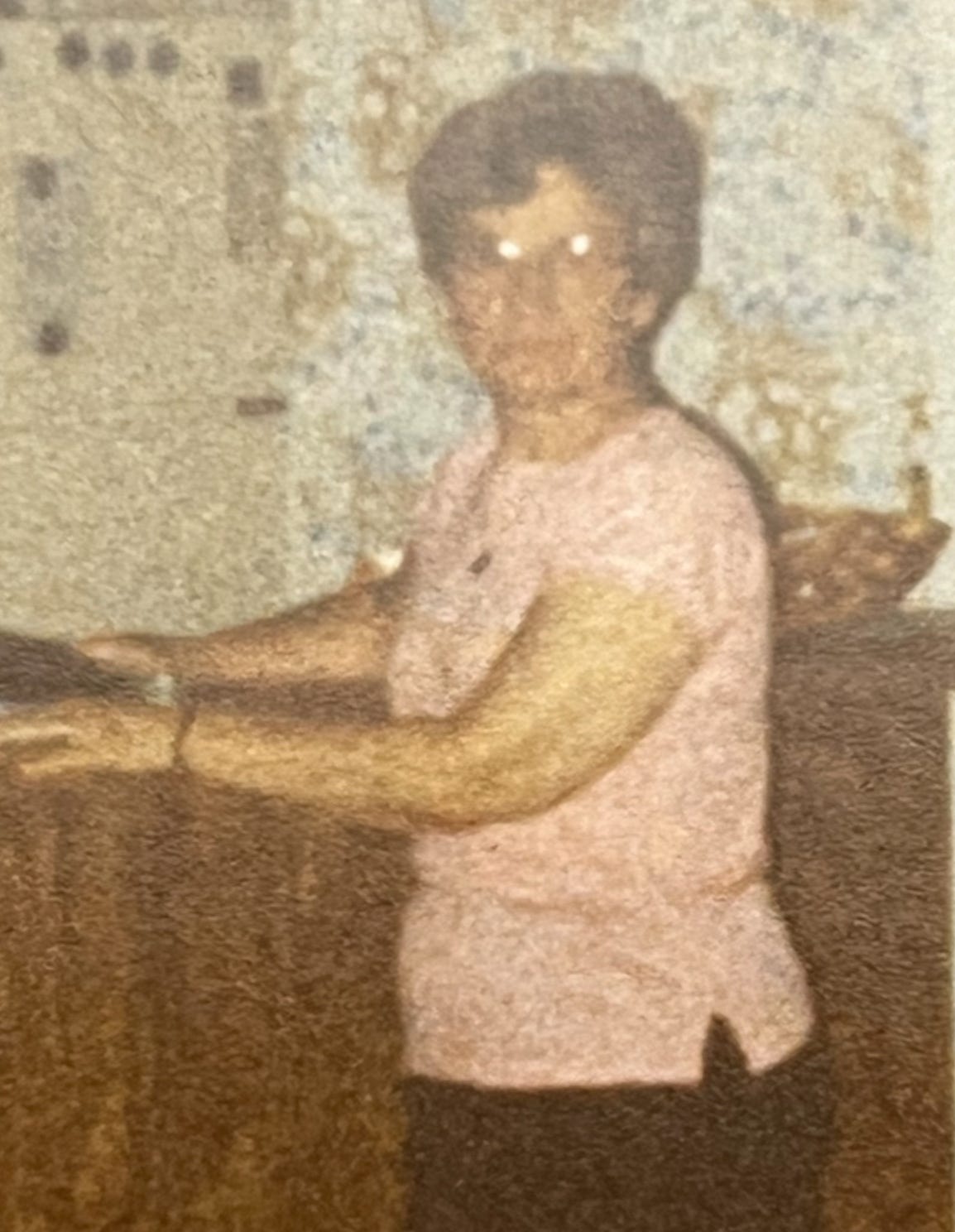
I love looking at pictures of my Mother from her early years. She was beautiful and had a radiant joy that seemed to burst out from within.
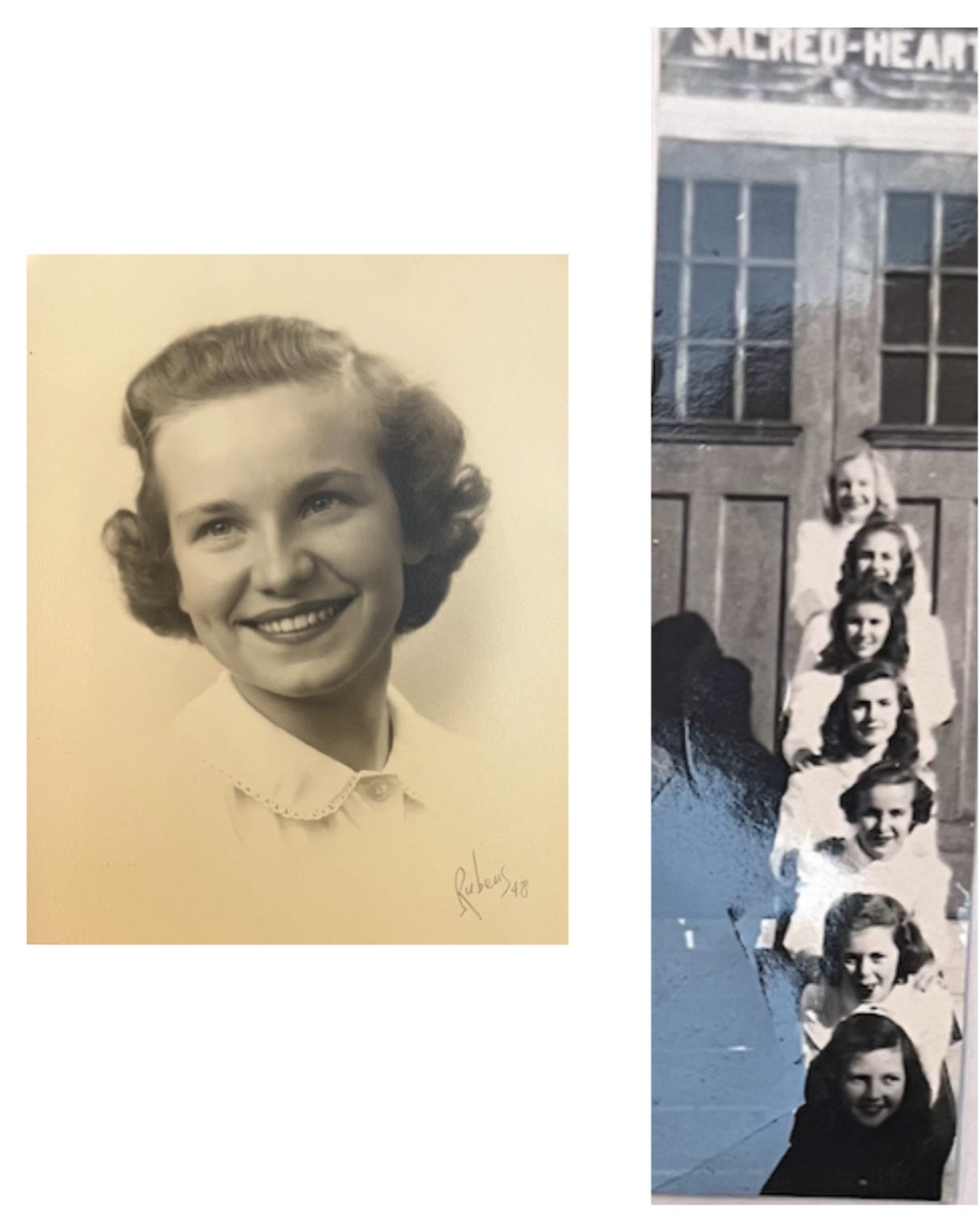
She had friends, especially the women she worked with at the Woolworth’s Department store, where Mom worked after high school. Her spot was the candy counter, and as she described her time there, I could see she just loved interacting with customers and making their day.
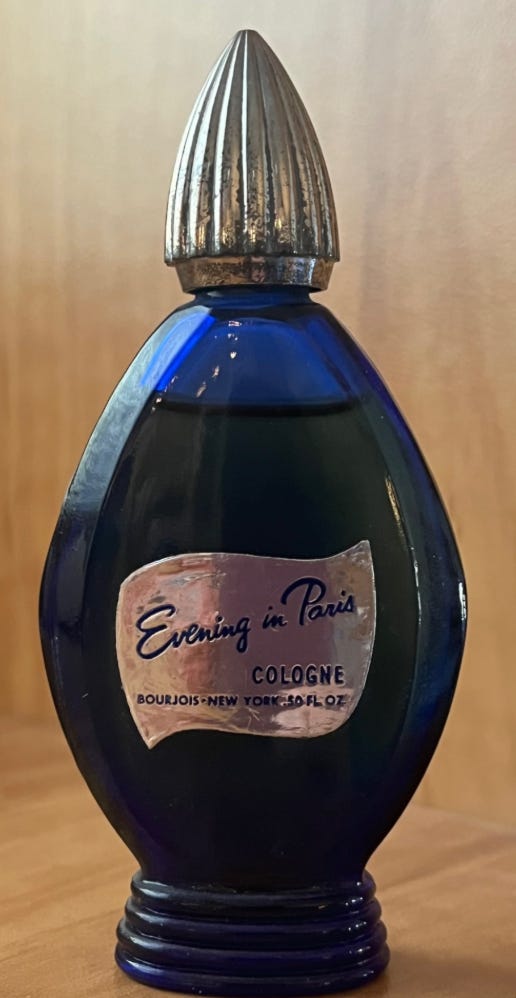
I also remember her sense of style — gloves, pillbox hats that were the vogue then, heels that matched the outfit, and her colognes – Chanel No. 5, and Evening in Paris. Even now, I have a small bottle that I don’t use; I just crack it open now and then, inhale the sweet aroma, and feel Mom next to me.
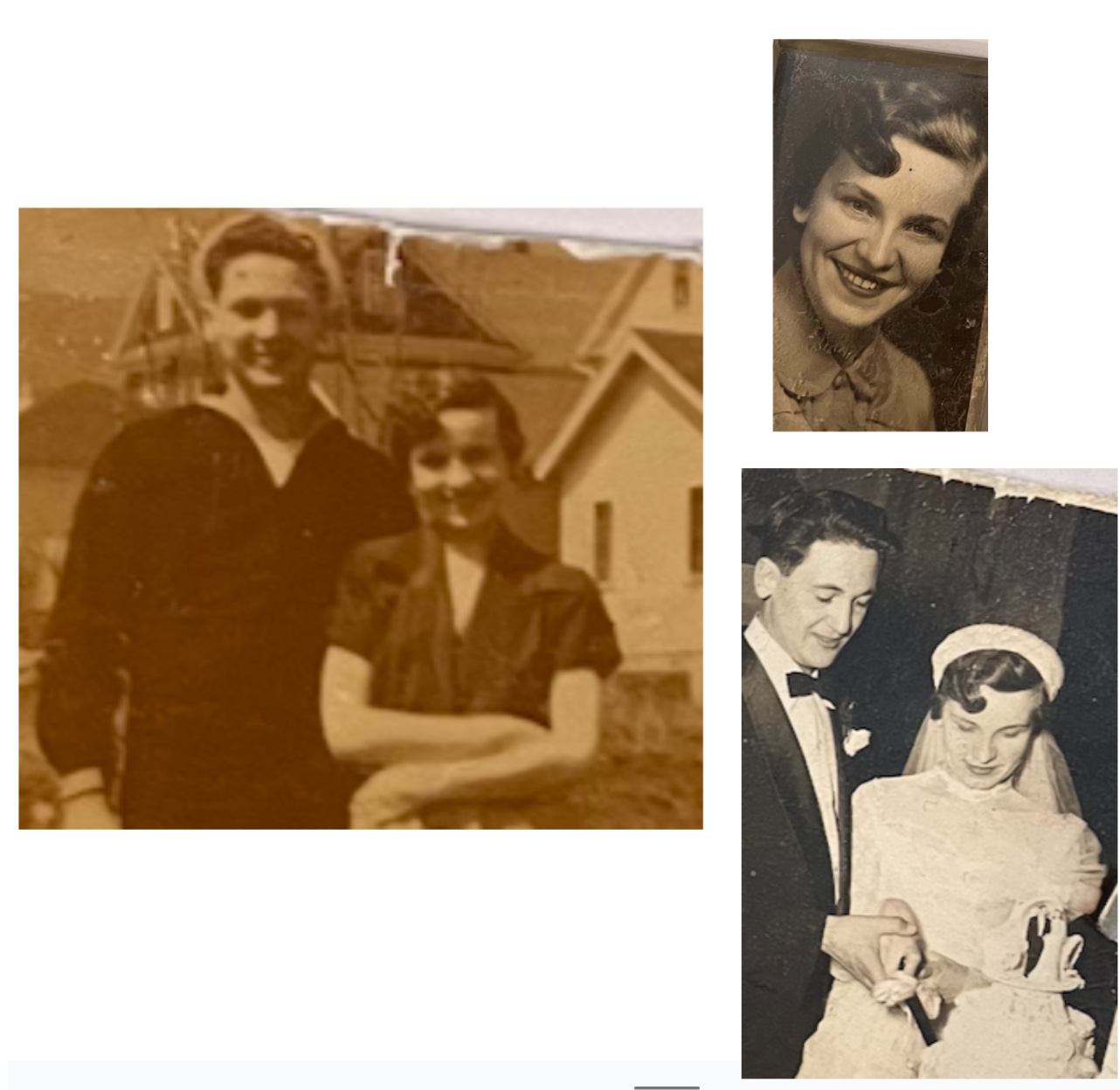
I am not exactly sure how she and my father got together. I know they both belonged to the Slovak Catholic Sokols, a national Slovak organization that was really active at the time in both their towns. And when they were kids, they both participated in regional gymnastics competitions. She was in the Torrington group, he was in the Bridgeport group, and they supposedly knew each other from that.
I also knew that even though Torrington and Bridgeport were a good hour apart, and longer in the old days when there were only backroads and no highway, the Slovak communities in Torrington and Bridgeport were pretty closely connected. It was tight-knit through mutual friendships, marriages, extended families, and all. I recall my Father saying how, as a boy, he and his grandfather would go back and forth, hitchhiking from Bridgeport to Torrington to visit family. Sometimes it would take them two days, and they would sleep on the side of the road until the next ride. Or they would walk.
So he knew Torrington, his family had connections there, and add to that the Slovak culture and Catholic religion. I only know that they dated while he was in the Navy and that he would come home on leave, borrow his Dad’s car, and head to Torrington. He would stay overnight at her home on his visits, sleeping with my Mom’s Dad and she with her Mother.
For her, he must have seemed exciting. Certainly, he could always be charming; he was ambitious and well-traveled. Both had grown up with alcoholic fathers, and neither ever drank much or wanted that in their lives because of that shared history. And I wonder if she found it a powerful force that this man was interested in HER. I have often wondered about her choice not to pursue being a nurse or a nun, and whether maybe it wasn’t her choice. Maybe she failed at nursing school, or wasn’t accepted by the convent, which could explain her never wanting to talk about it. I will never know. I only know that, whatever the reason, he must have seemed like a beacon of stability and hope in her sometimes unstable household.
For him, here was a woman who was gentle and soft-spoken, and who must have seemed very different from his mother. No doubt Mom was attentive and reveled in his stories and saw him as amazing, something he longed for and probably never got at home. Given his domineering traits later on, he must have sensed in their dating times that she would not try to dominate him as his mother had. It seems like each was made to ease the other’s insecurities.
In those pictures of their early times together, they both seem happy, so I guess it was inevitable that marriage would follow. And he mentioned one time, wistfully, how the “early days of marriage were fun.” But I know they did not stay that way. With the backgrounds each of them came from, and no insight into those dynamics, it was bound to be a problem at some point.
For example, Mom shared how even before the wedding, she got a quick introduction to the firestorm that was Dad’s mother. His mom had set up a bridal shower in Bridgeport for my mother, and promptly screwed something up. But in her fashion, she blamed my Mother and triggered a big blowup that even made Mom’s father very angry — something hard to do given that man’s quiet nature. In one heated phone call with Dad’s mom, my Mother fought back, and then Dad’s father got on the line. He apparently said to my Mother, “If you were here right now, I’d kick you right in the pants!”
My mother, demonstrating that she was no pushover and at that point in life, still had a lot of spunk in her, immediately retorted, “Oh yeah?! Well, if you were here, I’d kick you right back!” From then on, she and her future father-in-law were friends for life, and anytime her future mother-in-law gave Mom a hard time, he would defend Mom.
Their wedding was on November 7, 1953…a day after an unexpected early-season blizzard that hit so hard people coming to the wedding had to put chains on their tires in order to make it there. I’ve often wondered if that wasn’t an omen from the Universe.
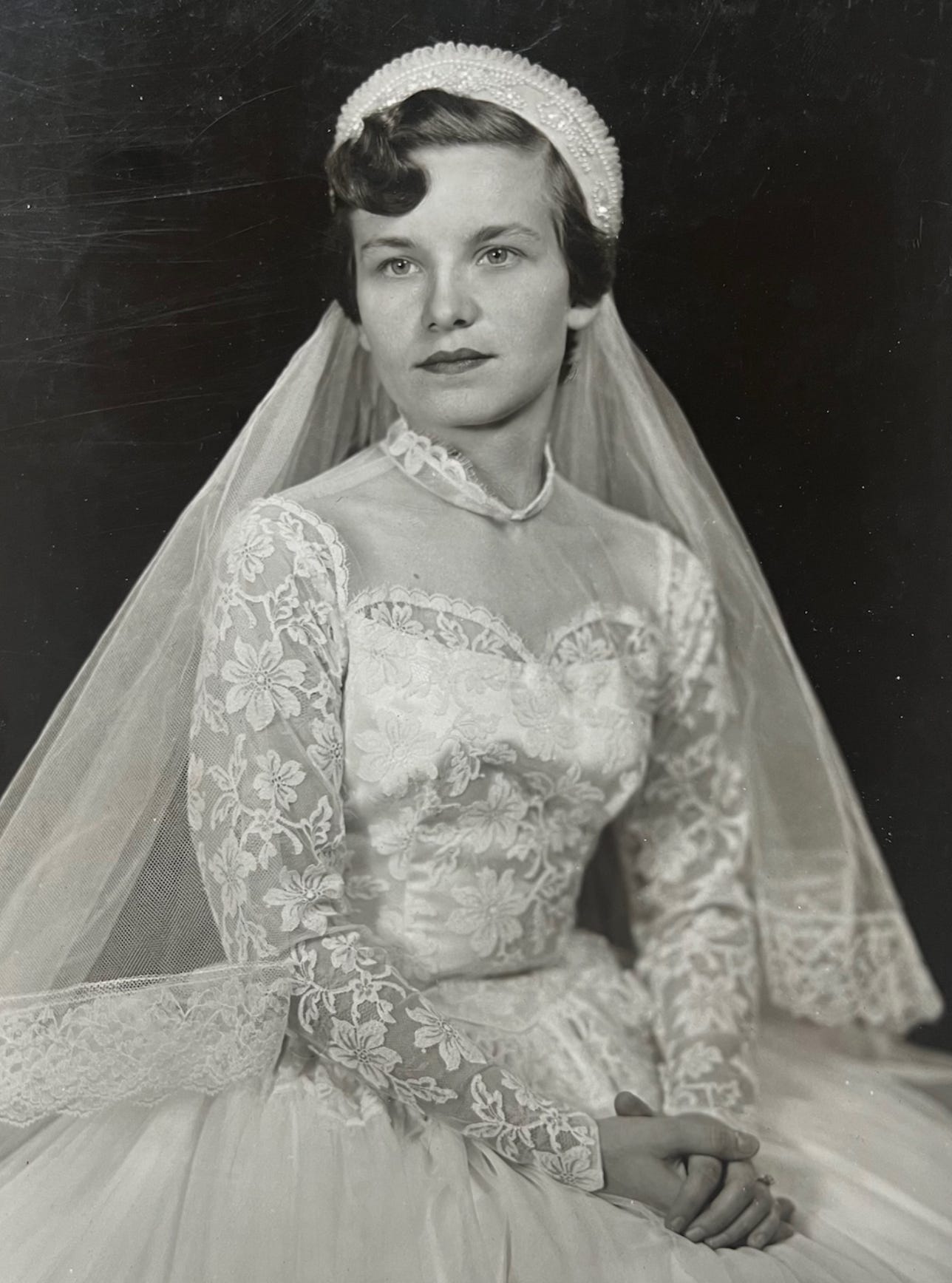
Within 6 years, Mom had 4 pregnancies, 3 of them right in a row. Her first child, a son, was stillborn. All was fine one day, then the next, they didn’t hear a heartbeat and brought her in to deliver. In those days, it was standard procedure to anesthetize women for childbirth, and they did that to Mom. By the time she came to, her son had been delivered, declared stillborn, and taken away. My father and her brother, I guess, arranged for the burial quickly, and within a couple of days, 9 months of carrying and feeling your child within, was over with, and she never even got to see him, hold him, or say good-bye.
But then she was pregnant with me within a few months, and then right after me, another child. So I don’t know that she ever got to process, or even recognize her grief from that loss. And it was the nature in our household to always just “get over things fast and move on.”
One time when I was young, I overheard her having coffee with a friend. They were discussing a mutual friend who had just lost her husband. My mother emphatically proclaimed that it was one thing to lose a child because you could always have more. But it would be horrible to lose your husband. So, to her, the husband was key. Kids were replaceable. And I think he was the same way.
I visited the cemetery one time with my uncle when I was a kid, and we went to visit my brother’s grave. He was “on the other side of the tree line,” which meant he was buried in “unconsecrated ground,” along with all the other outcast Catholic babies who died before being baptized.
According to Catholic dogma, if you weren’t baptized before you died, you carried the “stain of Original sin” on your soul, which was the sin inherited from Adam and Eve when they were cast out of the Garden of Eden. Back then, this meant you couldn’t be buried in “blessed ground” in the cemetery. It also meant that while you wouldn’t go to hell, you weren’t exactly on the list for heaven either.
I took note of this and was feeling pretty angry. It made no sense to me and seemed flat-out unfair. He didn’t choose to die. It wasn’t his fault, and it seemed like he was being punished for something that he didn’t do. Even worse, when we finally found his grave, it was just a small metal marker that said “Baby Boy Phillip.” It was starting to fall apart and was half-buried in the ground. My parents rarely went there, and to me, all through my childhood, it just seemed like my brother was an oversight, pushed to the background, and forgotten. That would eat away at me my whole childhood, and I decided someday I would make that right.
In any event, they were also really busy having us, struggling to make ends meet, and Dad was working hard, on strike, or in school. I understand that they had little time for anything but keeping things together, at least at that point.
In spite of that first loss, they went on to have more kids, and he seemed to take pride in that. He said something one time about how proud he felt when he looked at her being pregnant. “I did that,” he said proudly. That comment always weirded me out. It seemed so self-absorbed.
He also noted many times that he always wanted girls. I am not sure why. Though, in looking back, I have to wonder. And he wanted my Mother home. He didn’t want his wife working. Mom had her hands full with us, and frankly, she totally embraced being a wife and Mom, so this was fine with her.
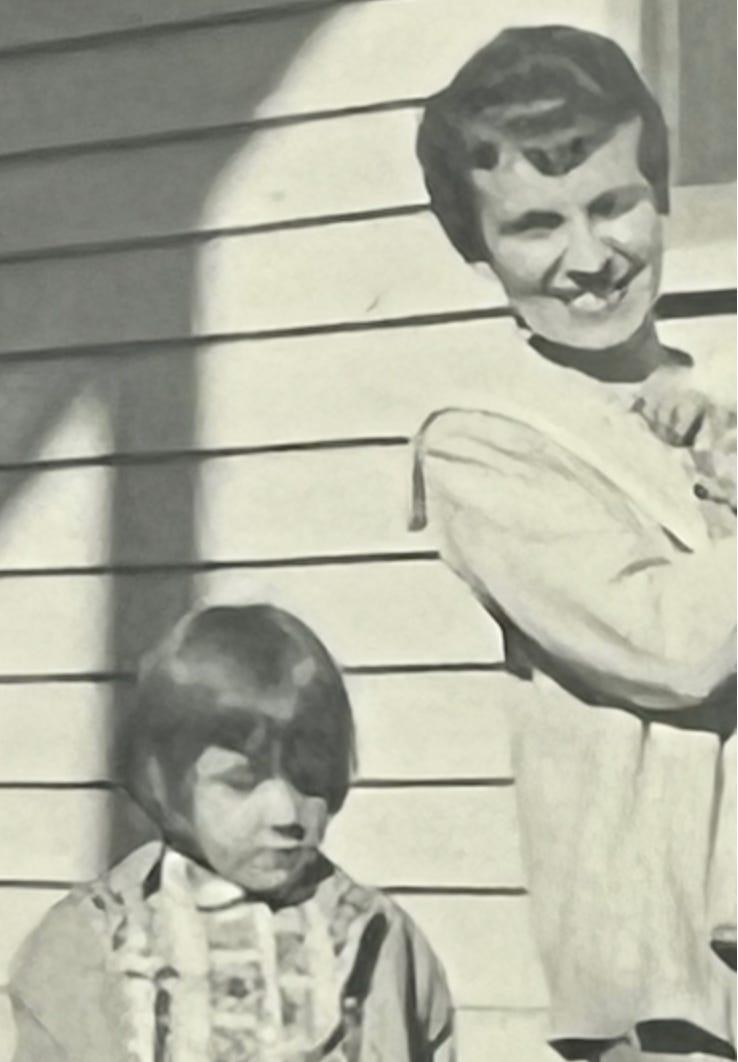
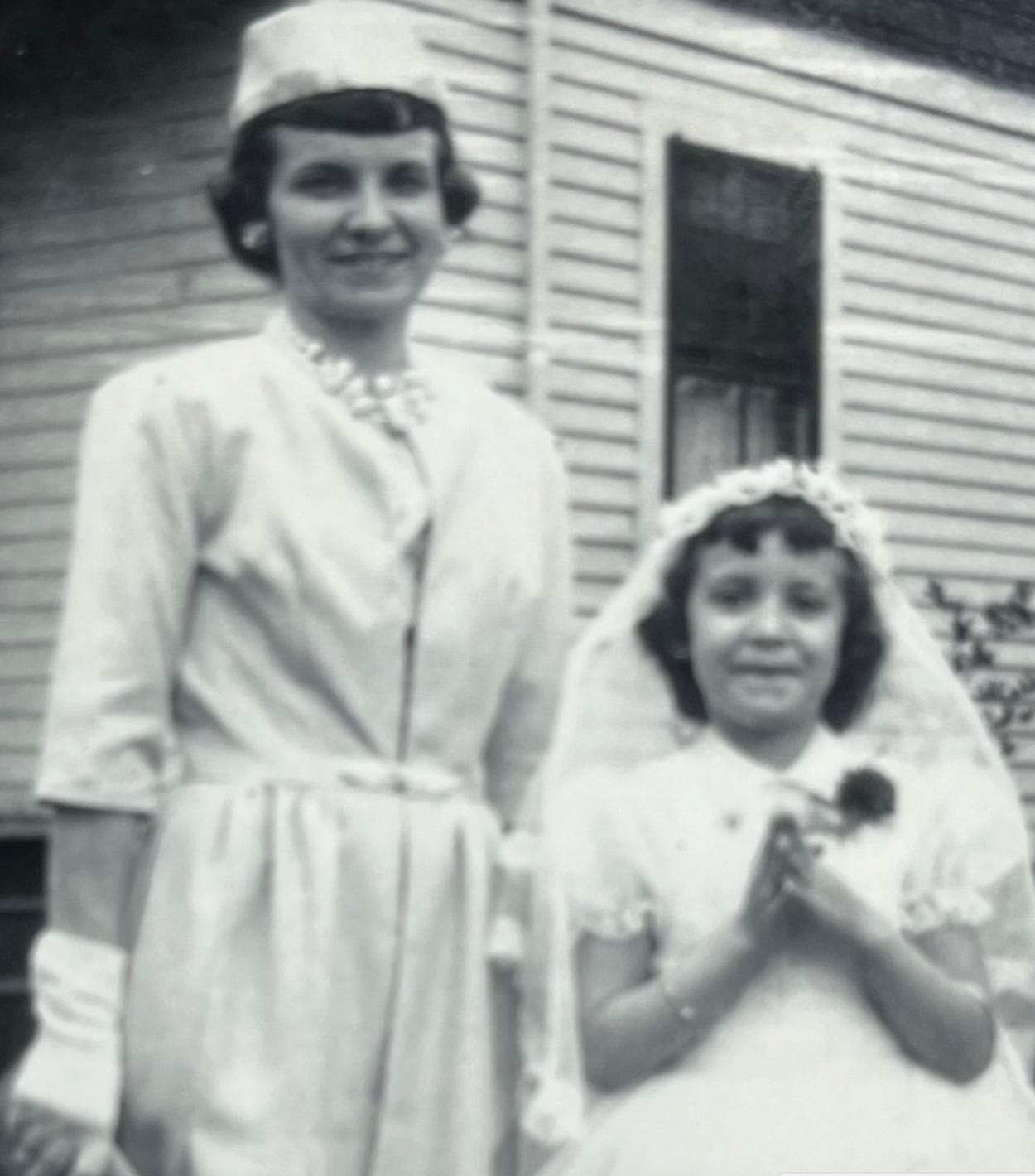
Throughout childhood, times with Mom were usually calm. Even when we misbehaved, as all kids do, it was “normal times.” She might yell or swat a bottom now and then, but we knew we were safe with her. However unpredictable and violent things could be with Dad, she was always a consistent force. Not overly emotional or demonstrative, but still, she was there, her rules stayed the same, and so we knew what was expected of us.
If we were acting up, sometimes she would use guilt to get us in line. Mom never swore in those days, and even her “swear words” really weren’t ones. But she would yell, “Look! You made me swear!” which was supposed to induce enough guilt in us to make us stop fighting or whatever we were doing to upset her. While we might feel a little bit of remorse, usually we would just get a bit quieter.
Other times she would yell, which sometimes resulted in my Grandmother — her Mom, who lived upstairs in the second-floor apartment — coming down to scold her. As Grandma descended the stairs, we’d hear her moan to my Mother in Slovak:
“Oy yoy! Dai me pokoi, Cat-ther-ine!”
Anytime anything wasn’t good, Grandma always started out with “Oy yoy!” And my Mother’s name was Catherine, but with Grandma’s accent, it seemed to come out with extra syllables.
My Mother would usually respond with, “But Ma! They have to learn!”
Hearing Grandma’s complaints, we would cheer because we thought she was telling Mom to leave us alone. We figured Grandma was on our side. Years later, I discovered that what she really meant was “Stop! You’re giving me a headache!”
One of our favorite ways to “torment” my Mother was making too much noise while she was on the phone. It didn’t start out that way intentionally; it just ended up that way. She was stuck close to the wall because the phone cord only went so far — this was the days before cell phones — so she would bang on the wall, meaning we’d better quiet down. This amused us, and we quickly realized our power over her in that situation. So we would stand just out of her reach and laugh and make more noise….until she got off the phone. Then, realizing our predicament, we would scatter. I remember one time getting cornered in the bathroom by her, and she took a light swing at my bottom, but missed.
Never one to be smart enough to just “let it go,” I taunted her with “Ha, ha! You missed me!” Then, seeing the look on her face, I bolted past her. She chased me into the living room, caught up, and smacked my arm a bit, laughing, and said, “Ha, ha! I got you!” Yes, as I would learn years later when I was a parent, kids can reduce you to that logic.
And there were the battles over “finishing what was on your plate.” My Mother’s standard rule was that she wasn’t “running a restaurant,” and that you eat what she made. If we tried to get out of eating something we didn’t like, usually vegetables, she’d remind us there were kids around the world starving. I never understood why I should gorge myself when others were hungry, so we sometimes answered with “Name 10,” or “Give me an envelope!” My mother would shake her head and laugh, but wouldn’t be upset with these comments. But she still tried to make you sit there and eat them. Until I pretended to gag at the table, at which point she got fed up and just snapped at me, “Oh, get out of here!”
Most of the time, though, we listened to her just because we liked her. And if we started fighting over a board game, she would just send us each into a separate room. That was never really punishment, though, because I would go to my room with my books, and the other two rooms either had the TV or the toy chest. It wasn’t really about punishment. She just needed quiet for a while, and I don’t blame her.
The ultimate threat, though, was, I think, the standard one issued by all 1960s moms when they’d truly had enough: “Wait ’til your Father gets home!”
THAT one, if used sparingly, worked…immediately. Recognizing we’d gone too far and that if she really did carry that threat out, it would be bad, we shaped up fast. And while she never did carry that threat out — I think even she knew that would serve no one, given my Father’s temper — we were never totally sure. So we stopped misbehaving.
When we were out in public, though, we knew Mom meant business, and we never gave her a hard time. If we forgot and started to act up, all she would have to say was either, “Do you want to go home right now?” which of course we didn’t. Or the more mortifying one, “Do you want me to hit you in front of all these people in the store and embarrass you?”
These days, that comment might get a parent arrested, but back then, we envisioned parents throughout the store closing ranks with my Mother and glaring at us, shamefully. So we settled right down. And besides, like I said, we didn’t want to get dragged home early.
Frankly, we loved going out with Mom. Back then, we only had one car, which Dad took to go to work. So on summer vacation days, she would pick a nice sunny day and declare we were going to walk downtown to do all our errands. This was a fantastic time, and we loved it.
We’d head out of our neighborhood through a few back streets and get up onto Main Street. Often, we’d hit the Post Office first, which was always a spooky place. First, the large lobby walls were covered with murals of John Brown and his followers leading covered wagons and oxen through roads of mud — paintings done, I think, in the 1930s as part of a government-funded “Works Progress Administration” project to help out-of-work artists. If the murals weren’t spooky enough, though, it was the men’s voices yelling in the background that made it seem like John Brown was really alive, yelling at the oxen. It was actually just the postal workers in the other room shouting at each other as they worked, but we didn’t understand that at the time.
Then, while Mom bought stamps, we’d go to the other end of the lobby and study the wall covered with frightening photos of the FBI’s Most Wanted criminals. They scared us to no end every time, but we always checked them out.
From there it would be to places like Mertz department store, Penny’s, and then Sears. Mom knew I knew where the bathrooms were in each store, so that was my job to lead us to any we needed. And I love Sears because it had a display for their pots and pans on the staircase that was made up of doll-sized pots and pans that I wished we could take home.
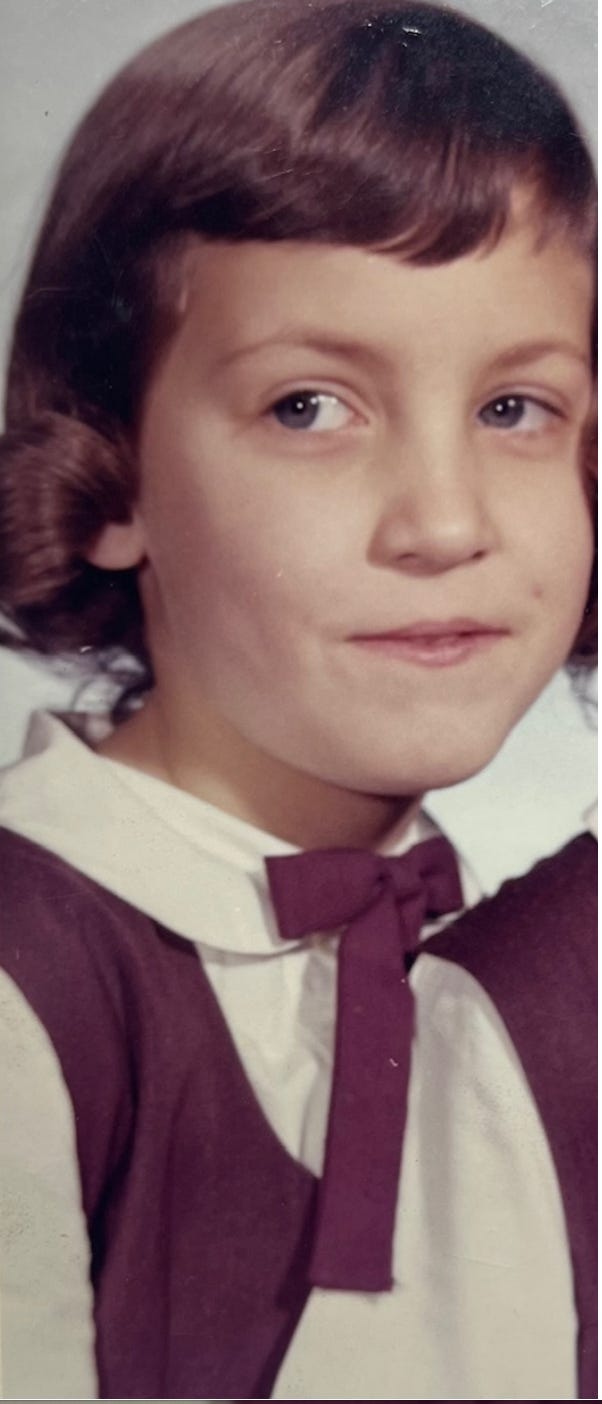
Close to the end of the summer, our trips would be to the fancy shoe store for school shoes that we knew would come off a soon as we got home from school. And to Richie’s store across Main Street, which handled all the uniforms for the four Catholic schools in town. Our school had maroon wool jumpers, matching knee socks, white Peter-Pan-collared shirts, and maroon bow ties. St Francis had green, St Mary’s was blue, and I never noticed what St. Peter’s school had.
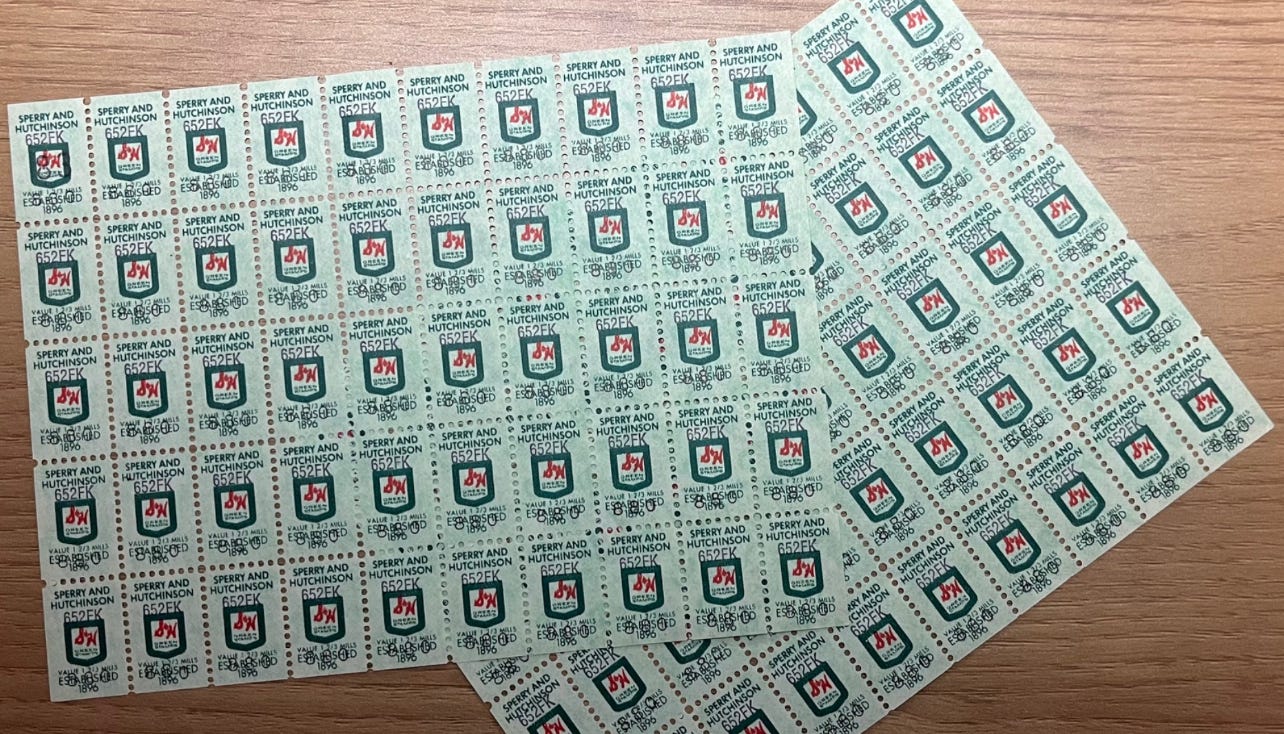
Occasionally, we’d go to the S&H Green Stamp store. That usually required advance preparation and planning, though, because you had to have your stamps all glued into the books ahead of time, and then when you knew how many books of stamps you had, you could figure out what items to cash them in for. It was always exciting to see what we might be able to choose from the catalog.
One of the favorite stores, though, would be Woolworth’s, where she used to work. Her friends who still worked there often gave us candy, and while she visited with them, we’d go check out the stationery section — I loved all the notebooks — or the toy section with the large wall of Play-Doh jars. To this day, I love the smell of Play-Doh and still keep a container of it on my desk.
But the best of all was when Woolworth’s moved further downtown into the new shopping center and had a bigger store. It had a large lunch counter where another of her friends worked as a waitress. Even though we didn’t have a lot of money, we could most times “convince” Mom to take us there for lunch.
It was always the same thing — we’d order one turkey club sandwich, cut into four sections, and each of us would have a section. And then a soda or milkshake, and sometimes ice cream. I loved watching the orange soda dispenser — a large glass squarish globe on top of the dispenser section. It was truly a soda “fountain” because the orange liquid would circulate in the container, shooting up the center and then flowing down the sides.
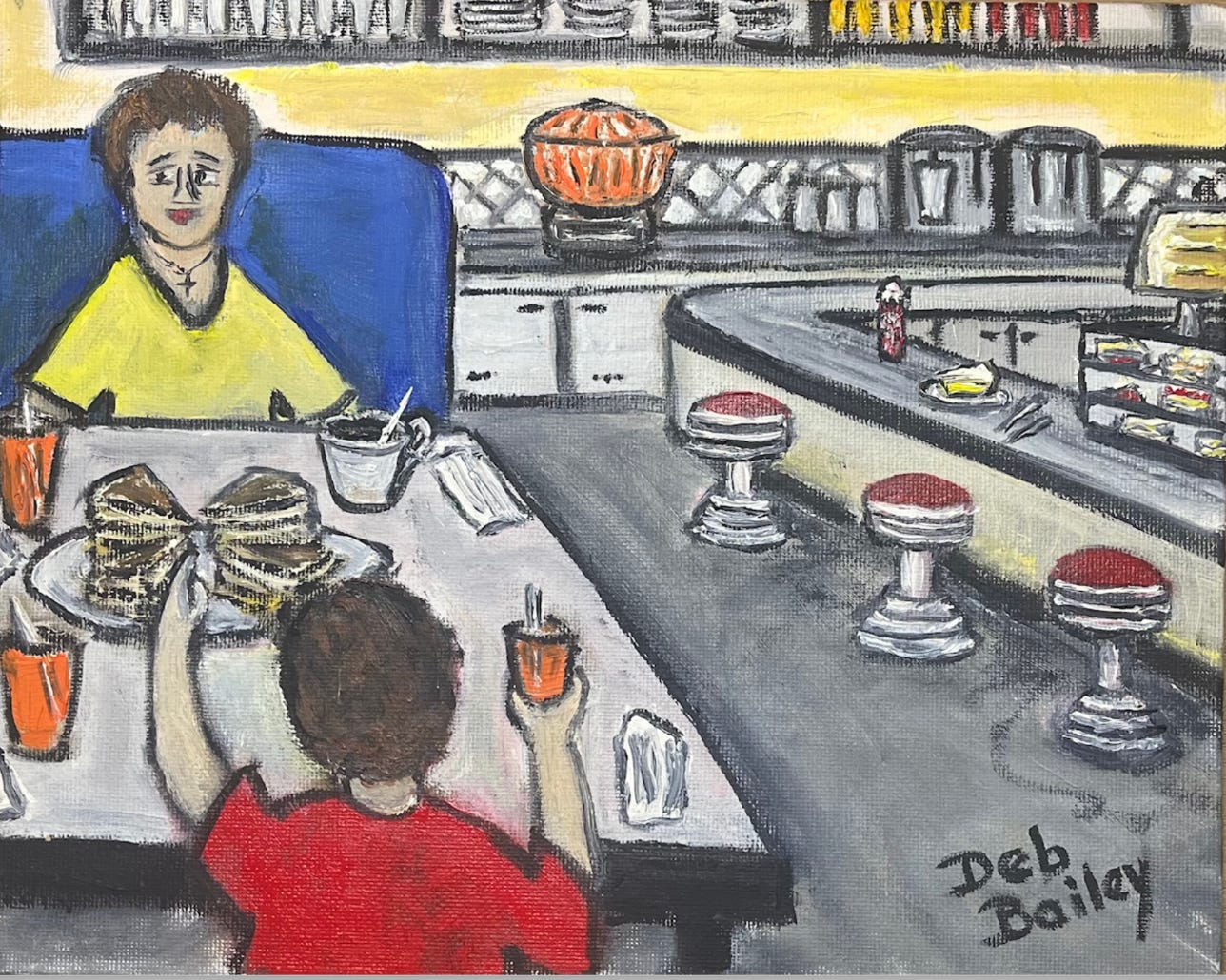
While none of these things may sound very exciting now, for us, these were treasured times. Summer days home with Mom, while Dad was at work, were peaceful. She seemed content just being a Mom and spending time with us. You could feel it. Years later, painting that scene and remembering the joy of those moments, I had to ask myself what was so wrong that she was a simple woman content with her place in life. Was it so wrong that she loved being a Mom and wife, and in doing it to the best of her ability? Why did he think that made her a “stupid woman?”
Some days, we would instead be at home playing with our Barbie and Ken dolls, and Mom would show us things like how to make tents out of paper shopping bags, so the dolls could go camping. And while there was never going to be a Barbie’s Malibu Dream House or whatever, except maybe at Christmas, she showed us how to make our own “dream houses” for the dolls out of cardboard boxes.
She was a master seamstress, and so for every upcoming holiday — Easter, Church processions, whatever— she would make us new dresses. Now, there were three things I hated about that then. One, I hated to be dressed up. Two, I hated to stop playing to have to try on the dress. And 3) the pins. She would make us stand on the aluminum kitchen table with the dress on, pinning the hem to get it even, and as she did that, we’d inevitably end up getting stuck by pins because we didn’t stand still enough. But she loved to sew and even made outfits sometimes for our Barbies and Ken dolls.
Her baking was out of this world. To the very end, her chocolate chip cookies were to die for. Some days it was cream puffs, with home-made custard and shells. Other times, it was cupcakes filled with frosting. She would cut little triangles out of the cupcake lid, fill in frosting, stuff in the triangle, then frost the top. We thought it was magic.
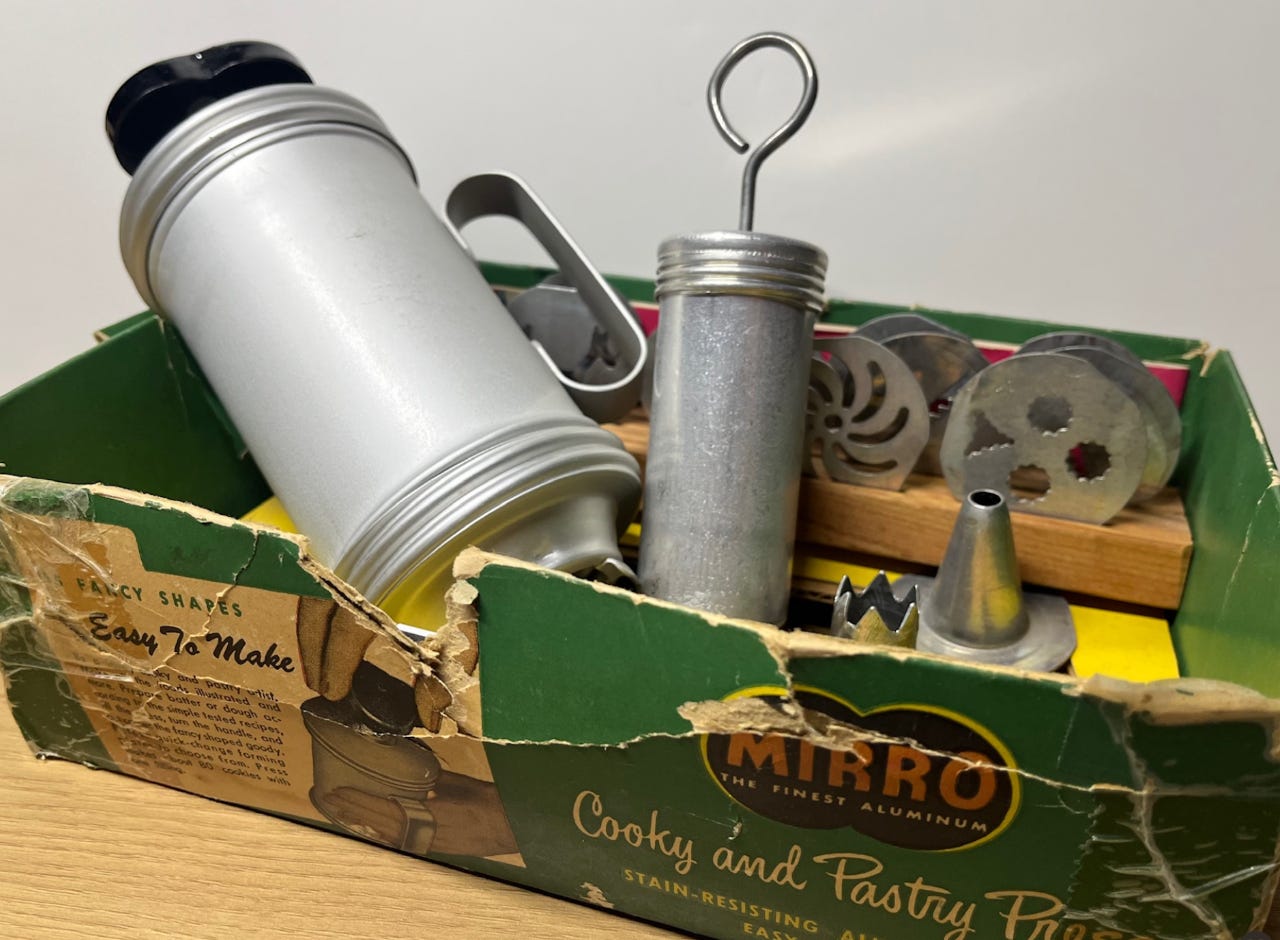
Other times we would help her, especially when she made pirohi — Slovak ravioli filled with cheddar cheese and mashed potatoes — or when she made doughnuts. Oh my God, were those good. She would roll out the yeast dough after it had risen enough, and we would follow with a soda glass to cut out circles for each doughnut, then put a hole in the middle of each one. After they raised a second time, she would fry them up to perfection — not too greasy, not too hard — perfectly springy, then put them in the pantry in a white ceramic container to cool.
Before she even finished, we would sneak in there to steal them, and she would yell at us to leave them alone yet. They were soooo good. And even better, if they were still warm, we would fill a paper bag with some confectioner’s sugar, shake the warm doughnuts in the bag, then devour the sugar-coated doughnuts.
The other thing she was meticulous about was cleaning. In the summer, we had daily chores. We didn’t have a dishwasher, though she would say that’s what her kids were for. So we would have to clean up the dishes – wash, dry, and put away. One time, I managed to negotiate getting out of it for 2 full days…until Mom got wind of that and made me do all three jobs for another day.
Sweeping was another chore, and I hated it. But then I think she hated it when it was my turn, too, because I drove her crazy with how I executed it. She was very efficient and quick and showed us that if you started in the corner at one end of our narrow apartment and just swept all the way down, you’d be done in no time. But I did it backwards. For whatever reason that makes no sense to me now, I would start in the middle and move to one end, then go back to the middle and sweep to the other end. No matter how she tried to teach me, I was adamant that I would do it my way, so she gave up arguing with me. As long as I did it.
Cleaning also meant FULL cleaning — dusting, vacuuming, and the bathroom — on Saturday mornings. We could not watch cartoons until the cleaning was done, by which time most cartoons were over. The only one we ended up getting to see was an early Hanna-Barbera one called Johnny Quest. I loved that one and frankly, so did Mom, so even if we weren’t quite done cleaning, she’d let us take a break to watch it.
These days, reflecting on those Saturdays, I no longer clean much because I maintain that I did my quota in childhood. And as an adult, I decided I wasn’t going to waste precious family time when my son was young, staying home cleaning. There was also the irony to me that my childhood house was so immaculate we could have eaten off the floor; essentially, on the surface, everything looked perfect. Just don’t look too deep.
But that’s how it was, and we towed the line because we also knew Dad wanted everything in its place. If it wasn’t, he might just lose his temper, come into the room, and dump out bureaus or closets onto the floor and make you put things away all over again. Shades of that Navy discipline permeated his parenting style.
Every Spring, we helped her clean out the cabinets, wash all the dishes and cups, reline the shelves, and then put everything back. And that was without a dishwasher. Other times, we’d help her lug everything from the refrigerator up to Grandma’s refrigerator so my Mother could shut down ours to defrost it. That was an almost daylong process because once the ice that was crusted in the freezer area thawed enough, she would hack away at the ice with the knife tipped with two prongs, and knock the ice out.
But I did have one job I loved to do — wash the kitchen floor and then wax the ceramic tiled kitchen floor with bowling alley wax. She had literal bowling alley wax and then used a buffer over it. For whatever reason, this job appealed to me more than the usual chores. Loved the buffer machine. And the bonus at the end was that once it was all polished, it was slippery as hell. Which meant you could take a running start down the hall, then come sliding into the kitchen wearing socks, and glide right across the room.
Mom’s use of items seemed to have an “ancient wisdom” kind of knowledge behind them. Certain tools were only used for certain jobs. There was the freezer defrost knife with the two-pronged ends that made it most effective for spearing those melting chunks of freezer ice. And of course, the white ceramic container that was used only for the doughnuts.
She had another oval white ceramic bin that doubled as the container for hauling things up to Grandma’s freezer, and also to put by our bed at night if we were sick and might need to throw up. And her spatula, which doubled not only for frosting cakes, but as a cold steel compress on heads that got bumped in a fall. I have no idea why she reached for the spatula and not ice, but it never failed to keep bumps from swelling.
She had her bits of wisdom too, that she would dispense — like when we complained because she would brush the tangles out of our hair and it hurt, she would remind us we needed to suffer to be beautiful. And she tried for years to understand why we so loved black olives and ketchup on eggs, but she never could figure it out, no matter how many times she sampled those.
There were the weeks Dad worked second shift and didn’t get home until after we were asleep. Mom would send us to bed at a certain time. But we all knew that Mom would fall asleep on the couch watching TV. If I waited just a few minutes, I could tiptoe down the hall and stand out of sight by the living room door and keep watching TV. I particularly loved the theme songs for some of them, such as the one for Rawhide. But the music for Perry Mason, The Outer Limits, and Rod Serling’s introduction to the Twilight Zone always scared the hell out of me. But it didn’t matter, though. My sneaky escapade was short-lived because once the next commercial came on, she always woke up. So, I would have to turn tail and bolt quietly for my room.
When it came to school, we could always count on Mom to be there. Whether it was PTA meetings, special events, or school shows, we could look out into the audience and see her watching us. She even spent a year working with one of the nuns to assemble all of the school’s books into a central library room, complete with index cards to look them up, and cataloguing them in the Dewey decimal system.
Just as I learned all the things Dad taught about his world, I took in all her ways, even as I didn’t want to be a housewife. But I carefully observed how she did everything with calm mastery, love, and care. It was like a meditation. She loved being a housewife and was in her element, and I admired that in her.
A few times she had to be in the hospital — breast biopsies that turned out okay, even as I was terrified she would die and we would be stuck with Dad — and another time for longer, when she had a hysterectomy. Dad looked after us, a tenuous time, never knowing if or when he would blow up.
But one time, before she came home from the hospital, he decided we should clean the house for Mom. That was a fine thing in itself, but he was doing a crappy job. I was so angry with him that I told him exactly that, and that Mom always cleaned and dusted much better than him. It is a testament to how angry I was that he wasn’t honoring her skills that I blurted that out. I am still here to tell the tale only because I think he just wanted to get done and get her home.
So the thing is that while Mom might not have taken us to amazing places, she took us wherever, with a sense of calm, order, and peace. Maybe I treasured that most because “peace” was a rare commodity in our house, and sometimes, in life itself.
One morning when I was 9, I remember the phone ringing. Mom jumped up to answer. My grogginess evaporated immediately when Mom started yelling “No! NO!” and started crying….
Mom grew up pretty much alone as the youngest child in her family. Her oldest sister, whom she loved dearly, left to attend high school with the nuns and later became a nun. Her oldest brother eventually left for the Army, and her next brother headed to the seminary. Mom’s Mother had a nervous breakdown when she was a child, and even though her aunt — her father’s sister — came to live with them and help out, she was somewhat of a hard, cold woman. Mom’s mother had had her own struggles in that her own Mother abandoned her when she was a young girl, to run off with another man, something my grandmother never forgave her for. She grew up without much mothering, and in a lot of respects, then so did my Mother because my grandmother, while there, was emotionally unavailable and not the most engaged.
Mom’s sister, Mary, became Sister Mary Luke, and she would only come home to visit every few years. Or on occasion, we would head to Danville, Pennsylvania, to see her when she was at the Motherhouse there on break. But Mom treasured those visits, and I think in a way she depended on Sister Luke for help and guidance when Mom was struggling with something.
Sister Luke was a deeply peaceful person and really loved being a nun. In fact, years later, I would ponder that path myself. She was a deeply empathic person who truly embraced that way of life and exuded joy to all.
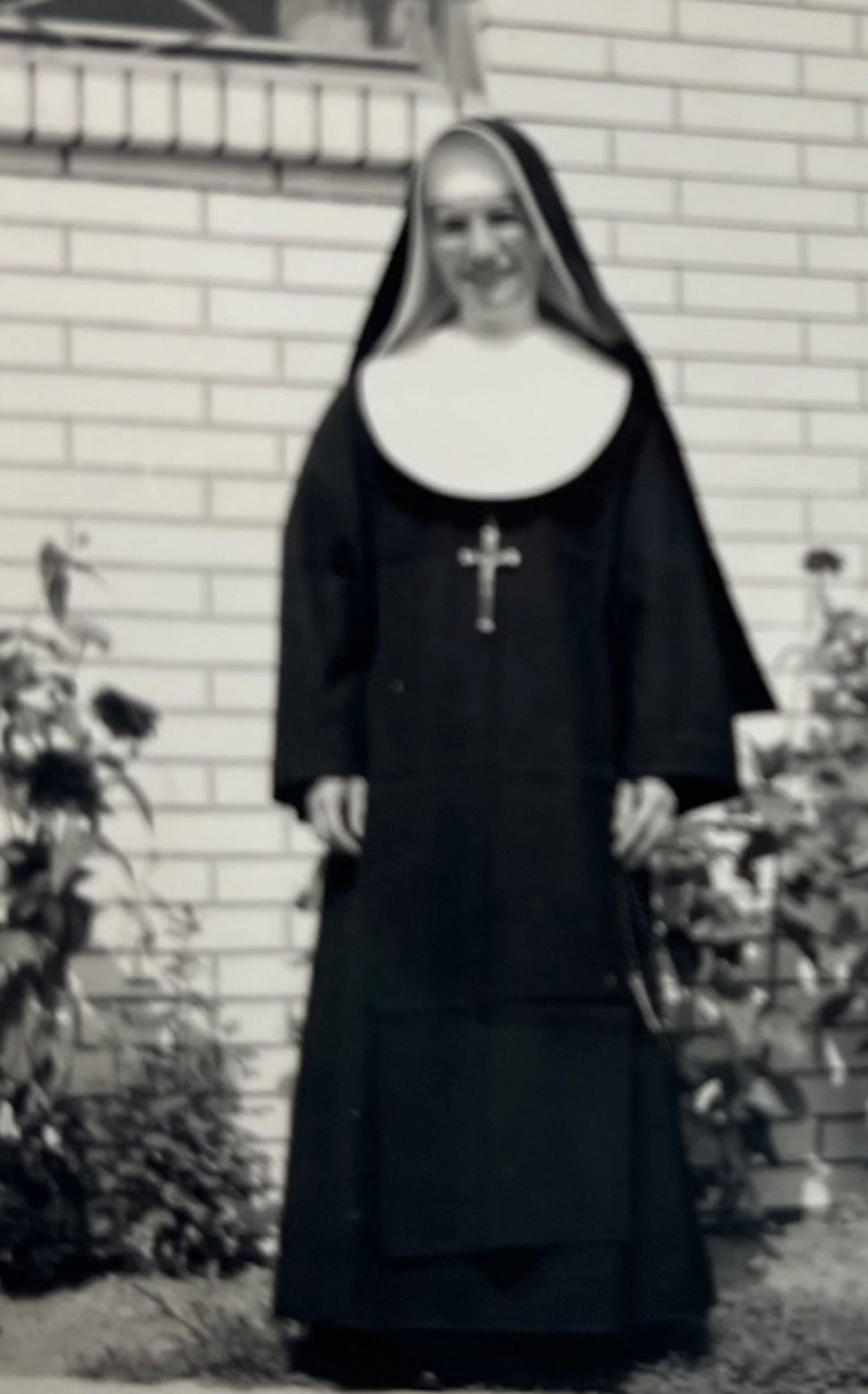
While I’ve never felt the depths of her love for her choice in life, I admired her commitment to it. I was in awe of someone who could FEEL the things she wrote on her personal inspiration card in her prayer book:
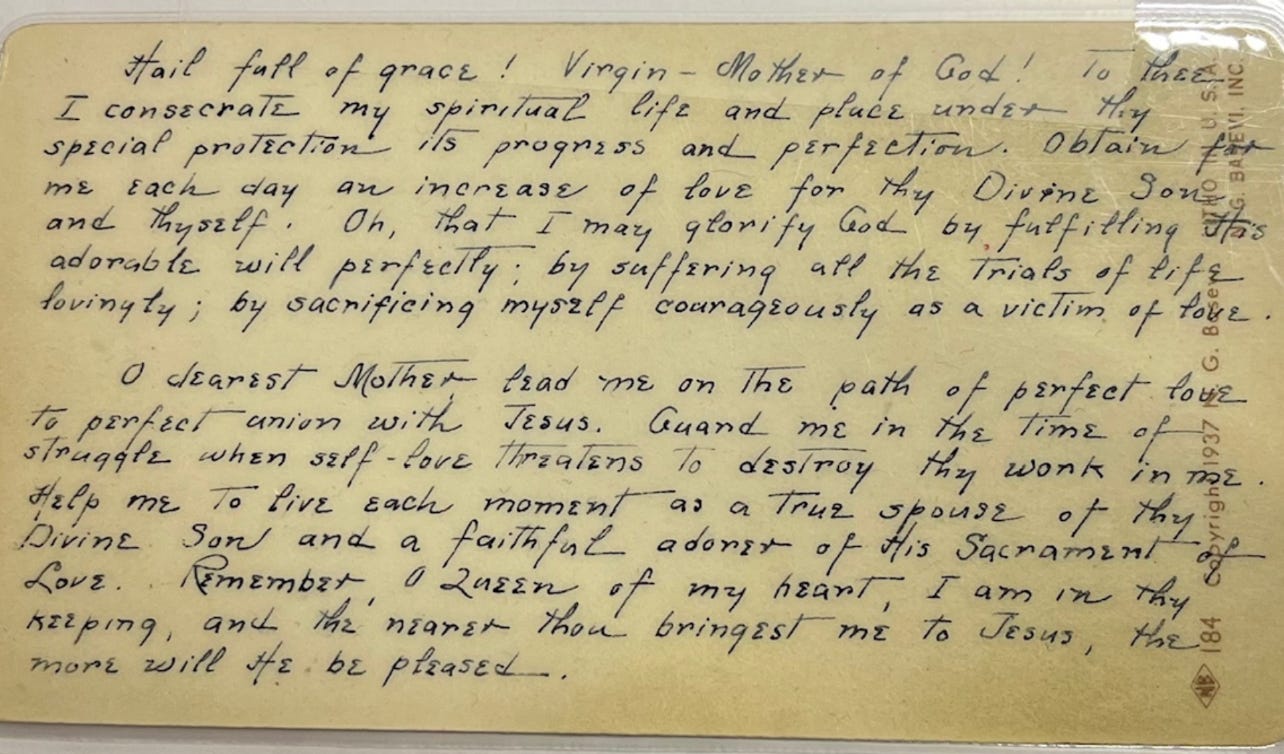
Even though we didn’t get to see her much, I do know that Sister Luke was a strong support for Mom. One time, Mom apparently appealed to Sister Luke about her son being buried in that unconsecrated ground in the cemetery, and Sister Luke seemed to understand. In fact, she was supposedly going to talk to my Uncle, Mom’s brother, who was now a missionary priest in Puerto Rico, to see if something could be done. But that never happened, either because Catholic patriarchal dogma would not be challenged, or because Sister Luke ran out of time.
In March of 1965, she and 5 other nuns drove from Lebanon, PA, to Harrisburg, about an hour away, to attend an education conference. She was teaching religion at a high school in Lebanon that year. Driving home from Harrisburg at dusk, the witching hour for winter roads that thawed during the day to refreeze, the car they were in hit a patch of ice, swerved wildly, then went off the road. The car tumbled down an embankment in the worst possible way – back over front, several times before finally landing several yards into a field. This was before seat belts. The two nuns in the front seat with my aunt were thrown from the car and died instantly. The three in the back were injured and hospitalized. My aunt remained in the car but suffered a broken neck.
My father and my Mom’s oldest brother drove down that night and stayed there until my uncle, the priest, could come up from Puerto Rico. It was my uncle who stayed with my aunt for the next two days, and who was on the phone for that early morning call. Sister Luke had died.
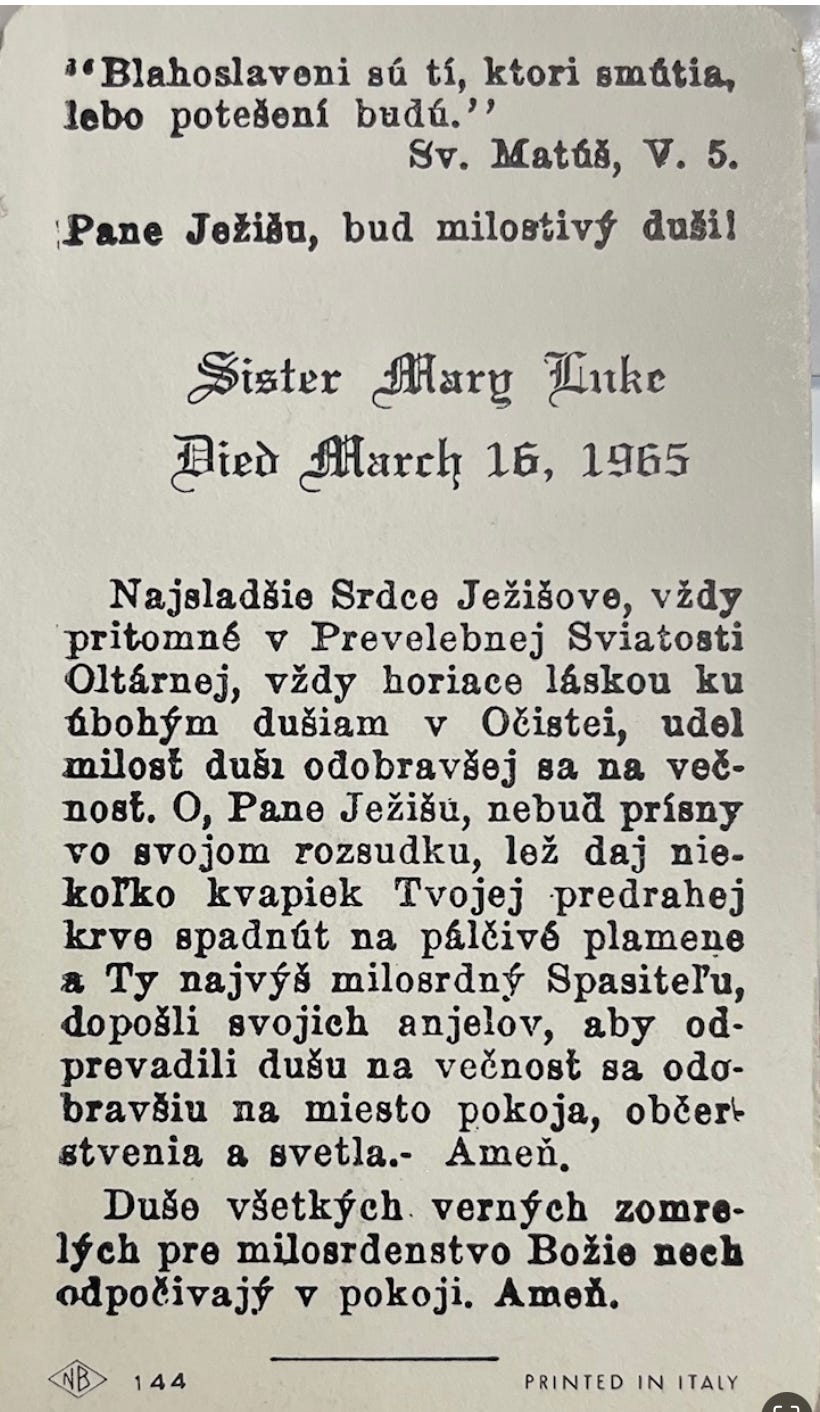
I was young at the time, too young to attend the funeral in PA. We stayed with a family friend while my parents and grandparents drove down for her funeral, but even though I was young, I was aware that this death took Mom a long time to get over. I was given one of the prayer cards from the funeral, though, and even as it was all in Slovak, I kept it in my box of treasures.
She and my grandmother would talk about Sister Luke a lot. One time, Grandma told my Mother how she dreamed of Sister Luke. She said my aunt was all dressed in white and glowing, and told my grandmother not to worry — that she was at peace. Maybe that helped them both. I don’t know. I know that many times after that, when we went upstairs to visit my grandmother, she would just be sitting at the dining room table, a thousand miles away, silently doodling numbers on a piece of paper.
Mom, too, was much quieter for a while. I sensed, even then, that her sister had been her rock, and now the only older female guide Mom had in her life, the one that I think she felt truly loved by, was gone. Her advocate was dead.
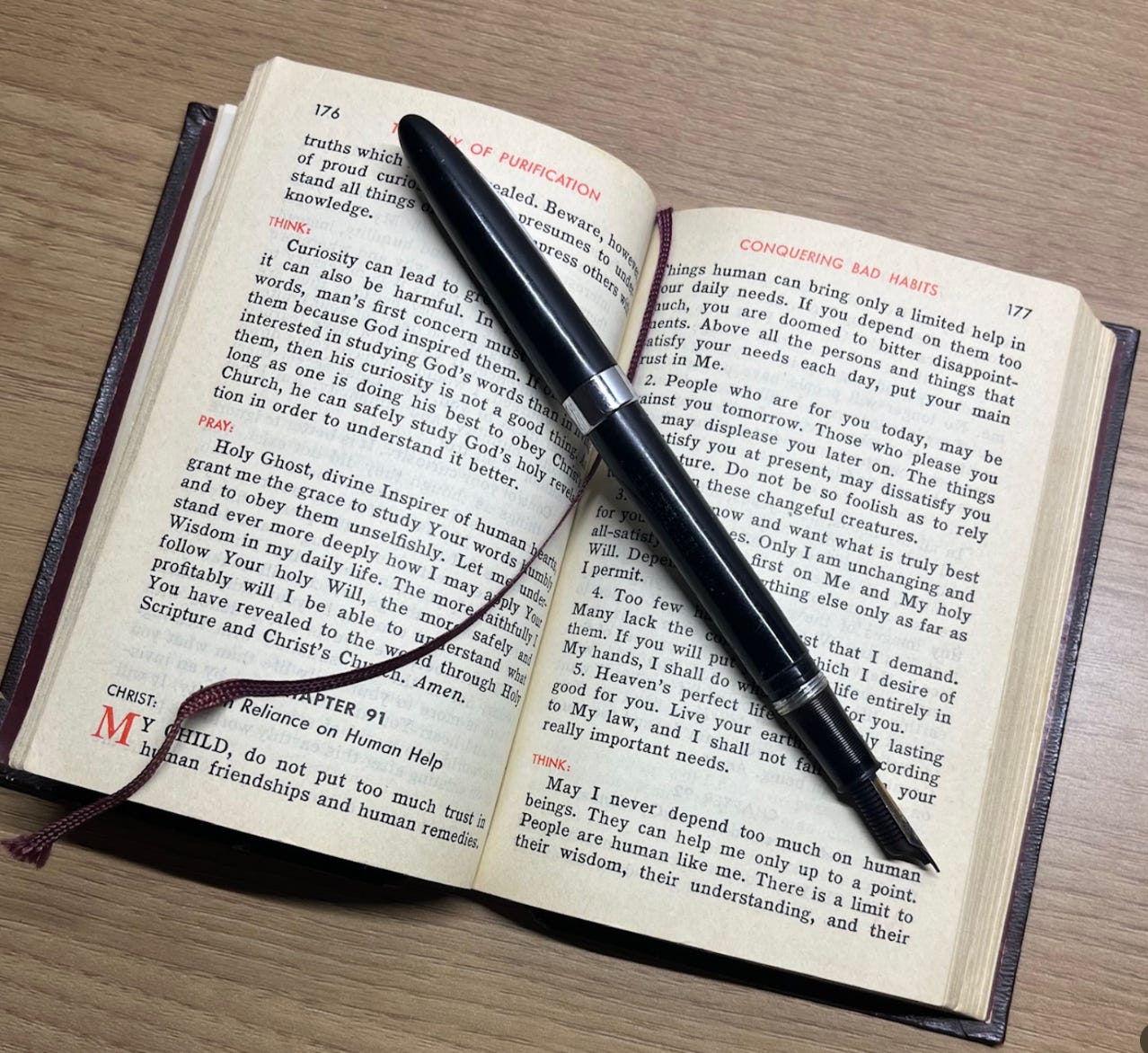
I was grateful for one thing during that time, though. Apparently, Mom sensed something in me relating to her sister. One day, she came up to me and gave me Sister Luke’s prayer book and fountain pen. Quietly, she said she just thought I would appreciate them. On that note, Mom read me correctly.
As I started to get a little older, things in our house seemed to get worse. While Dad had always picked fights, they seemed to become more and more a regular occurrence. Saturdays were a favorite day, but certainly not the only one. He would get up grumpy and then pick a fight with her, usually involving being physically abusive. Or he would hit one of us. Then Dad would tear out of the driveway in the car, only to return later, deeply apologetic, begging for forgiveness and professing just how much he needed and loved her. And there would be explanations of how life was just stressful, or if only we or she wouldn’t do “whatever,” or some other explanation, and he wouldn’t do it again. He would be frantic in those moments, almost like a child who was terrified that “Mommy would abandon him.” For our parts, we knew that at this point it would be calm and the “good Dad” would be back, so we always forgave him and so did Mom. We’d be just so relieved it was over — like that “other person” was gone — and…we also knew that to reject his apology would only start things all over again. This pattern went on for years.
These days, I think back and realize that her parents upstairs, and her aunt in the third-floor apartment, had to hear, see, and know what was happening. But that was the culture then — the man ruled his house, and you don’t interfere in a marriage. And Catholic dogma was no help either. You married for life, for better or worse, and that patriarchal culture would never have supported her leaving him. To everyone around her, it would have been viewed as — he didn’t drink, brought home a paycheck, and had good days along with the bad. You just focus on the good and that was life. So she was on her own.
Other times, he would be complaining about “stupid women,” and she would say nothing. He would push her about why she wouldn’t go to school for something. She did finally take a teacher aide class, but the truth is….she just wanted to be home, not working. She had bought into the contract early on for her to stay home and be the best housewife she could. But it seemed like that contract was changing. Another time, I remember him berating her for how she dressed and blaming her because he couldn’t get turned on.
There was always some excuse. And I could watch the pattern evolve every time from “peaceful to irritable, then build to verbal attacks,” ultimately culminating in violence. When the fight moved from out in the open to the bathroom, I would be terrified. I would listen at my bedroom wall, which was right next to the bathroom. The sound of fist hitting flesh, and her frightened cries, came clearly through the plaster, and I’d wonder, Will this be the time he kills her?”
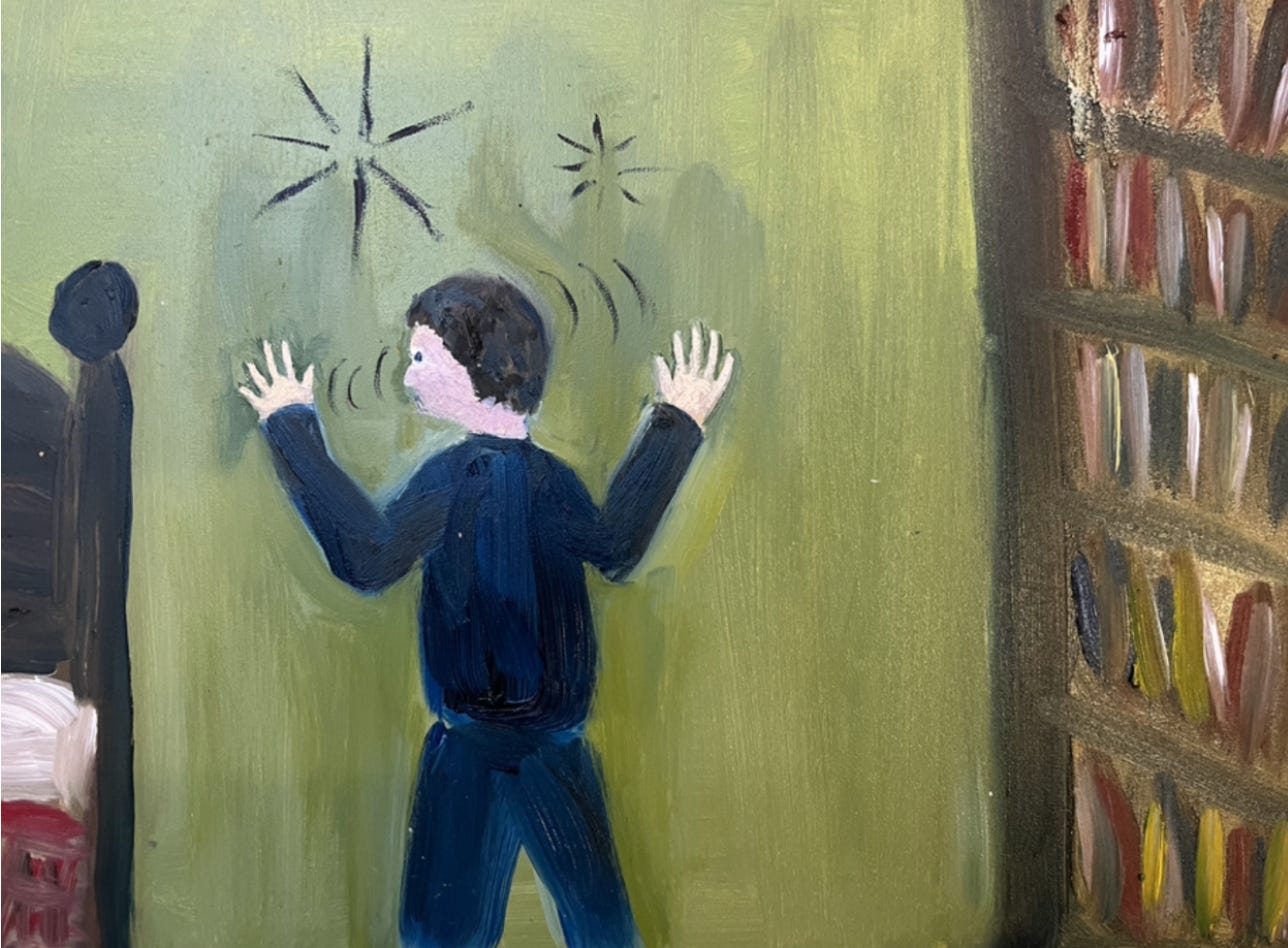
I knew that when he attacked me and would hold me against the wall by my throat, she always pulled him off. But nobody was in that bathroom to pull him off of her.
Why he bothered to move the fight into the bathroom, I’ll never know. It’s not like we couldn’t hear what was happening. We knew what was going on, we just couldn’t see it. And I think sometimes that was even scarier, imagining what he was doing to her, not being able to see it, or maybe trying to stop him? Though I don’t think that as kids, we would have tried that…I don’t know.
I read one time recently about a study on domestic violence. It said that by the time violence escalates to the man choking the family members, the next step is often murder. I didn’t know that. He was always choking us, and her.
It seemed like while he married what he wanted, he no longer wanted what he married. She had unquestioningly abided by his initial wishes to be home. In fact, his “wishes” became tight rules about her needing to have dinner on the table, homemade desserts every night. She couldn’t say she was going out with friends or participate in anything outside the house. Then he demeaned her for it. And even though he wanted her to go back to school and “be something,” he would have still expected her to also be home and not have outside connections. He wanted it all. He wanted whatever he wanted in that moment, and it changed all the time. God could have come down from heaven, and He would not have been able to please Dad.
I do think that as he rose in his job and income level, he just wanted “more” of whatever. Where she was content with a simple life, he was never satisfied, and he was always reaching for more “whatever” to fill that empty wound inside of him.
One time, a few years later, he was now making a lot more money, and so he bought her a Rolex watch. She wasn’t that thrilled with it, and he blew up. Now, maybe he was really excited and wanted to give her something special in that moment, and was upset at her lack of reaction. But then, did he ever ask her what SHE wanted? Even if we had the money, if my husband spent that much on a watch for me, I’d wring his neck because there are so many other ways that money could be used.
The truth of it is, I don’t think he knew or cared what she wanted. She had simple wants and tastes. Expensive things didn’t impress her. She didn’t long for them. And she didn’t need them. She was content. But I think he wanted the world to see his wife adorned with an expensive bauble as a way to show the world how successful he was. And the more he got like that, the worse things got at home.
All I know is that by a young age, I didn’t want to be her, and the one time he told me I most reminded him of her, meaning my gentleness, I freaked on the inside. Of course, I didn’t let him see that. But that was when I started telling myself, “Don’t grow up to be my Mother.” I didn’t want to grow up to be treated like he treated her. I was never going to be at the mercy of any man like she was. And no, maybe I never would have anyway, and maybe we really weren’t that alike, but I was determined not to take a chance.
The sad thing is, he drove a wedge between her and me that would never be truly healed, even partially. At least not until the night she died. Through things like this and more, he destroyed any hope of a Mother-daughter bond. And he destroyed her, too, demeaning her and hacking away at any self-esteem she had. It was odd because he would never let anyone outside the house ever mistreat her, but in his home, he was king, and he could do what he wanted to her. And it destroyed us.
I would spend much of my adult life trying with all my might, never to be her, and at the same time, looking for a mother in all my friendships and female relationships. So, he destroyed that, too.
 Soul Mosaic
Leave a comment