In many stories, the place and the time period are considered characters in their own right. Certainly, I would agree given the unique flavor of where I grew up, and when.
Torrington, Connecticut:
Nestled in the valley between the foothills of a section of the Appalachian Mountains known as the Berkshire Hills, Torrington is built around the Naugatuck River, which flows south through that valley, right through the center of town. When the town was originally founded, it was located on the hillsides east and west of the river valley, where the climate was healthier and less swampy and mosquito-infested in the summer.
A lot of the surrounding county area was, and remains, rural, with dairy farms, state forests, and nature trails. It is hilly countryside, and as such, the geography itself gives a sense of “constriction” between those hills, and isolation from nearby areas because of them. There are a lot of hardwood forests, including things like oak and sugar maples, and in spite of steel-gray cold skies in November, Fall, with its amazing color display, is my favorite time of year there.
The town and surrounding areas are steeped in history. Whether it is of ancient Mohawk tribes living in longhouses, or the story of Connecticut as the Charter Oak State, the state is living history.
The latter story is based on the fact that the state was given a royal charter in 1662, allowing for self-governance. During the Revolution, the charter was hidden in an oak tree to prevent it from being confiscated by the British.
Many locations around Torrington and throughout the state have markers noting various sites of importance from the 1700s and during the Revolution. The culture of the area was heavily influenced by the strict ethics of the Puritans, who had moved there from England to have religious freedom. And throughout the area, there is still a strong sense of individual ruggedness. That ruggedness is further fostered by the climate, which can suffer extremely cold winters with blizzards, and summers and falls with hurricanes, tornadoes, and Nor’easters.
Torrington was and is a small former factory town in that Northwest corner of Connecticut. It was an industrial powerhouse in the 19th and part of the 20th century, providing employment, a decent standard of living, and a strong economic base for the towns there. Industry included things like brass production, arms manufacturing, skilled tool and die companies, and small factories providing parts for the automotive and aerospace industries. Most of those places shut down and moved south during the 1960s-1980s, and later those things moved overseas. So the employment and economy of the area have taken a hit. But during my childhood, especially with the ’60s space race, things related to aircraft and aerospace industries were still thriving.
Most people during the early and middle of the 20th century lived in the main town because they worked in the local factories. This allowed them to walk to work, shops, churches, and doctors. My grandparents did not have a car, nor did most of the older Slovaks. In fact, our house was just down the street from the church and school we attended, so easily within walking distance.
The homes in town, including the one we lived in, were multi-family 2- and 3-story homes, in keeping with the blue-collar, industrial flavor of the area. There were some single-family homes scattered around in town, but more of those were on the outskirts, in more residential or agricultural areas.
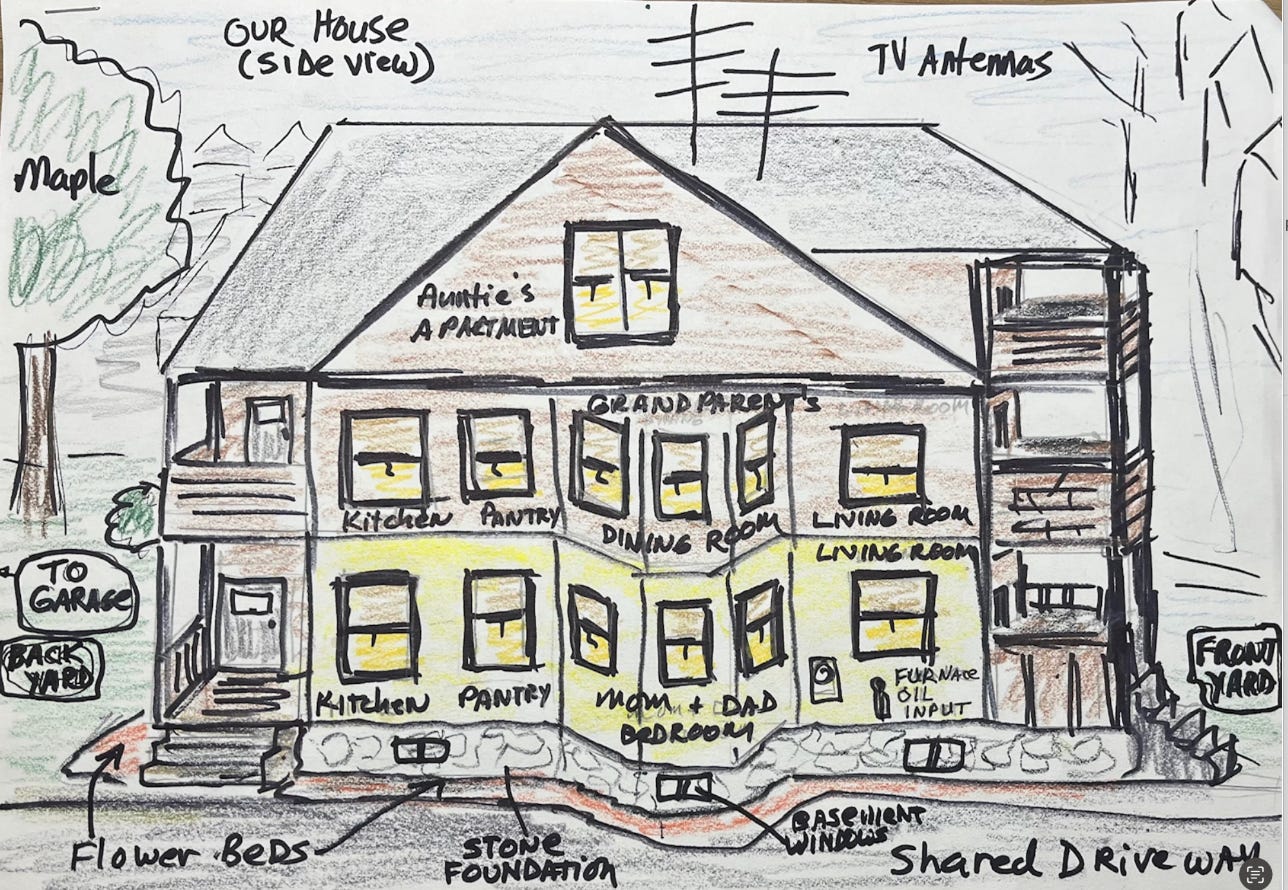
Our house and street:
Our particular house was owned by my maternal grandfather. While he and my grandmother rented for most of their life, he was able to save enough money from his brass-mill job to purchase this home.
He and my grandmother lived on the second floor. His sister, my great-aunt, lived in the 3rd-floor apartment, and my family lived on the first floor. The house was one of many similar homes lining both sides of our street, which was right off the town’s main street. And we were 3 houses up from a branch of the Naugatuck River, something that loomed large in our consciousness.
The lore of the area, which still resonated in my childhood, had to do with the August 1955 flood. It ravaged Torrington and towns up and down the entire Naugatuck River valley, from north near Massachusetts to south almost down to Long Island Sound. The Naugatuck River, due to area industry, was heavily polluted, and it was part of our childhood indoctrination to just stay away from the river and never touch it, or any stray rats that might cross our path. Our neighborhood had been heavily damaged in that flood, but was now in better shape. But still, “the Naugatuck” was viewed as not to be trifled with.
All of these homes were 50-70 years old when we lived there, and in varying stages of repair or disrepair. Most at that time were still pretty decent, as most of the owners were older immigrant types who had saved their whole life for a home, and so the homes were kept painted and adorned with flowers. Across the street was a house owned by the town to use for families in need of assistance and a place to live.
That house was more in the “disrepair” end of the spectrum. Its occupants, who changed frequently, ranged from quiet to violent, or just sad, like the old woman who lived on the third floor there when I was very young. She said little to anyone, had no lights or power, just cats, and one night set fire to her bed while looking for a cat under the bed with a candle. They took her away. Another group had three very tough-looking young teens that we avoided, and yet another family got into fistfights, especially when drunk. One night, the husband and his pregnant wife, in an alcohol-fueled fight, punched out the windows of their car with their fists. They were taken away, too.
Just down the street was a corner market where the owner and his wife lived on the second floor and sold groceries on the first floor. They knew us well, and he was always nice to us and sometimes even gave us a few pieces of candy. He was also the best source of gossip around, except for my great-aunt upstairs. When my mother would send me to “Hugo’s” store for the usual: bread, milk, veal loaf, boiled ham, and Dad’s cigarettes, Hugo would let me get them because he knew that the cigarettes would go straight home.
There was a small grocery store in the other direction, up on Main Street, called Archie’s, and another a bit south of our street called Tedesco’s. Hugo’s was my mother’s go-to, unless they were out of what she needed. Then I would trek to one of the others. But I never liked Archie’s up on Main Street, as that end of our street was a rougher, more industrial area that I found scary, so I didn’t waste time when walking there. And those treks were for mid-week needs. The rest of the groceries she would get on weekends at the larger shopping center supermarket.
Our first-floor apartment
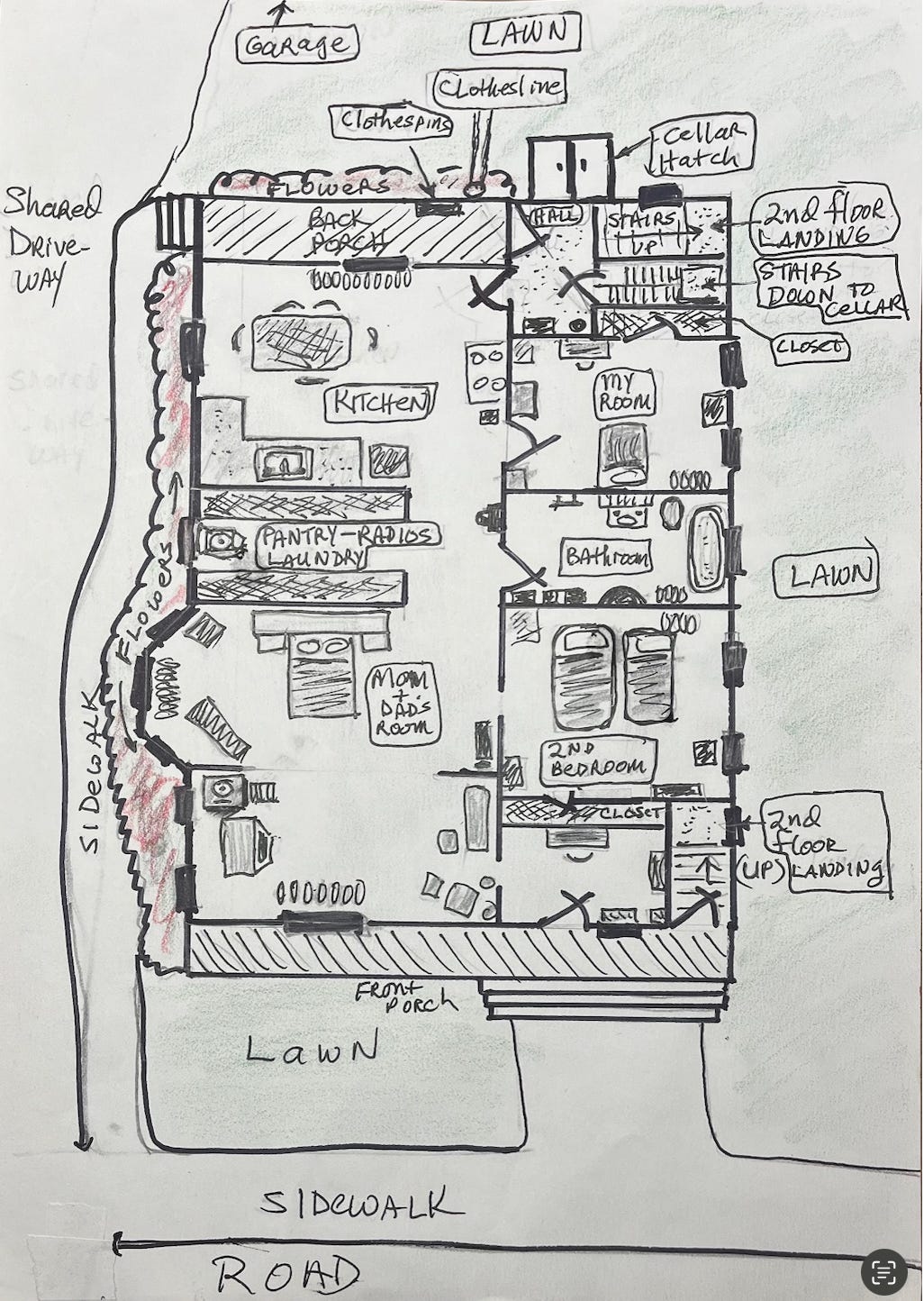
The above map shows the overall setup of the rooms in our apartment, and a little of what was immediately around the outside of the house. The map below is a bit more zoomed in on the rooms and the details of what was in them.
The apartment was not large, but we at least had heat from an oil furnace located down in the basement. The second- and third-floor apartments only had a gas stove in the middle of each apartment to heat them, which meant the bedrooms and bathrooms up there ran really cold in the middle of winter. But that was what my grandparents were comfortable with. Again, that ruggedness. And my grandmother lived in fear that our furnace would blow up. If we made too much noise or ran around too much, she would call downstairs and say, “Oy yoy! The furnace gonna blow up!”
We had one bathroom for five of us, but never thought much about that, except that, being a day-dreamer, I would always take too long during my turn. So, quite often, someone would be banging on the door to make me hurry up.
There wasn’t much storage space, only two small closets for clothes, a linen closet in the pantry, and kitchen cupboards, so there wasn’t room for lots of extras. And add to it that Dad demanded that everything be in its place; there was no such thing as leaving things lying around.
We had a washing machine but no clothes dryer or dishwasher yet. To dry clothes, my mother either hung them out on the clothesline in good weather, put them on the radiators throughout the house in bad weather, or, on occasion, usually the coldest part of winter, took them to the laundromat to use their dryers. That was always fun and weird, depending on the nature of people hanging out in the back of the laundromat. One time, someone’s dog bit me there. Another time, there was a middle-aged couple making out back there, not caring who saw them.
One of the nice things about this house arrangement is that my grandparents had an open-door policy, and my great-aunt to a lesser degree. So we had the opportunity to go visit them almost anytime. And if Grandma or Auntie were making “Krupe” – the Slovak name for their beef barley soup that my Mother would never make, we could go have some with them. Mom grew up eating soup — they didn’t have much money. Their dinner almost always involved whatever they grew in their “Victory garden,” a soup bone, and a basket of “soup vegetables” like kohlrabi, carrots, and turnips. So as an adult, Mom never ate soup unless she was really cold in the winter. And often, not even then.
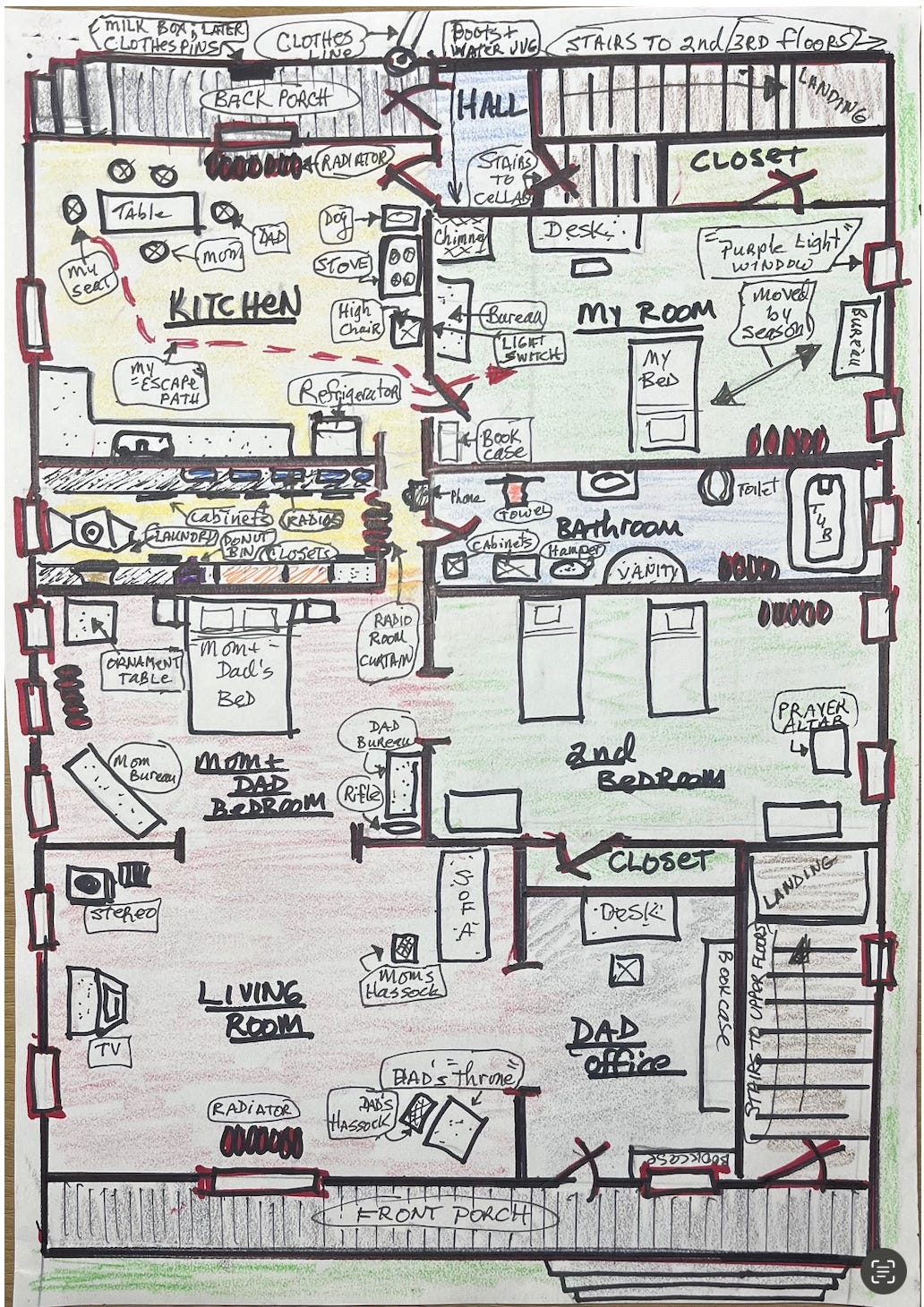
The map below zooms in on our apartment, showing the various rooms, where my bedroom was in relation to the others in the house, and adding more details of each room. For example, while my room is separate from the other bedrooms and has a door, my parents’ bedroom is in the center of the apartment, totally wide open, with no door or privacy.
Some notations — such as “my Escape Path,” the “Purple Light” window, and why my bed moved by seasons — will be explained in better detail later. I’ll also share more later about all the places I lived out my daydream adventures — the garage, yard, neighborhood, and, of course, the scary, fascinating, and questionably haunted cellar beneath our house. But regarding the map below, it is clear our apartment was very specifically arranged, and it had better stay that way. It is symbolic of the “culture of our life behind closed doors.”
Time Period: 1960s
On this, I could write a book. So I will simply say that my life in the 1960s would see the upheavals of so much change. While the early 1960s still kept the flavor of the 1940s and ‘50s, the latter part of the decade was like taking a Sno-Globe and shaking the hell out of it. And while I don’t recommend the 1940s or ’50s, I don’t view them as the “Good ‘ol Days at all, still, the late ’60s were a hell of a ride.
Aside from the space race, there were the assassinations of John and Robert Kennedy, Medgar Evers, Malcolm X, and Martin Luther King, Jr. There were race riots, war demonstrations, groups like the Black Panthers, Students for Democratic Society, Abbey Hoffman and the Chicago Seven, and names in the news like Bobby Seal and Angela Davis. And though I never learned the story, it seemed like, for a while there, I kept hearing about an aide of President Johnson’s named Bobby Baker.
Also, it was a standard feature of the nightly news to get body counts for the Vietnam War. Add in the sexual revolution, birth control, Vatican II, and the many changes in the Church rules, behaviors, and dogma, and yes, the 1960s were chaotic to say the least.
Yet, the insular quality of our small town’s culture and rules persisted for a while longer. The immigrant values of our town’s Slovak, Polish, Irish, Italian, and Middle-Eastern communities, the heavily Catholic rules, and our nun-run school, provided a protective bastion against the encroaching changes. They stood guard as long as possible against all these new influences on the horizon. And all of that kept us steeped in the rules of that earlier society, including the taboos of what should or should not be done, what you don’t speak of, and that “family secrets” and “not-so-good” times were just how things worked.
Having set the backdrop of where and when, it is time to consider that little kid, and who she was in her own right…when she was free to do so.
 Soul Mosaic
Leave a comment