“Are you crying?!”
Any kid who grew up in the 1960s knows this question, and remembers exactly how they needed to answer it…or else.
“No!” (Said while trying to breathe in between swallowing sobs as your chest heaved)
“You better not be crying!
“I’m not!”
“Okay. Because if you’re crying, I’ll give you something to cry about!”
While you still might be stifling a few more sobs over the next couple of minutes, as long as you showed you were shutting down any emotional display, you would likely escape further threats.
We all knew the rules of the game — this was part of the standard 1960s Parenting 101 technique. It meant: “You’re being too sensitive! You have nothing to be crying about, so stop it! Now! Or else!”
I can’t speak for how often this came up in other households, or how angry the parents really got over the crying, but for sure, it was the iron rule in our house, and a rage trigger for my father. And I was the frequent target of this, because 1) during childhood, I was still emotionally open and cried about everything, and 2) my father had NO tolerance for weakness, emotions, or crying. So, I learned early and fast to look away if I was ready to cry so he wouldn’t see me, or how to inhale and swallow sobs…fast.
Being “sensitive” was not something to aspire to in my house. And it sure wasn’t considered a “personal strength.” After one visit to Bridgeport to see my grandparents, my father told me that one of my uncles, after observing me, said, “She’s nice, but she is very high-strung.”
Sometimes I would get, “Why are you being so sensitive?!” Or, “She’s the sensitive one.” It was always delivered with a tone of derision and failure — mine for having that trait, his for not having broken me of it yet. And maybe a dash of confusion at why anyone would be that way. But mostly rage. Emotional displays were equated to weakness, and weakness enraged him.
My mother said that as a baby, I was very easily startled, cried a lot, and was overly sensitive to stimuli. But after years of my father’s battering, by the time I reached adulthood, I rarely ever shed a tear. Not that I had eliminated that sensitive streak, but because it went into hiding, deep underground in my psyche, covered over and protected by a shield of “strength.” And that strength would be defined as brittle outer toughness. The motto was never show weakness. And for a lot of years, it stayed that way. But…it wasn’t dead. Just dormant.
What was the nature of that kid’s sensitivity? Take a dash of that dreamer, mix in a dollop of awareness of, and love for the small overlooked details in the world, add in equal portions of idealism, moral compass, and determination to protect the underdog, and finish with a large dose of gentleness and empathy when I felt others’ pain…which was often, and there you have my sensitive streak.
I felt, and still do feel, so much of the world around me. Often it’s a bit too fast, too loud, too much. Where many like crowds or noise and action, I head for the door. Give me the “quiet periphery.” At one business party, I had to leave the room of women going on about trivia before my head exploded. Instead, I went into the quiet, darkened living room, sat next to the fish tank, and talked with the dog.
I love going out to eat before others arrive. I try to visit places at times when everyone else is not there because in those times, I can “feel” the place. The environment. The details. All the small sensory touches around me. Quiet moments of solitude are heaven to me.
Even when I worked in the hospital lab for years, I loved second shift. There were fewer people around, none of the daytime BS, and the work was emergencies and things that really mattered.
Most of my solitary moments were when Dad was at work. But even when he was around, there were times I could still “split me” into two parts. One had a watchful eye on Dad or let him have his way, and the other got lost in the soft sensory details of something around me. One of those times was on rides home from Bridgeport at night, watching the Naugatuck River.
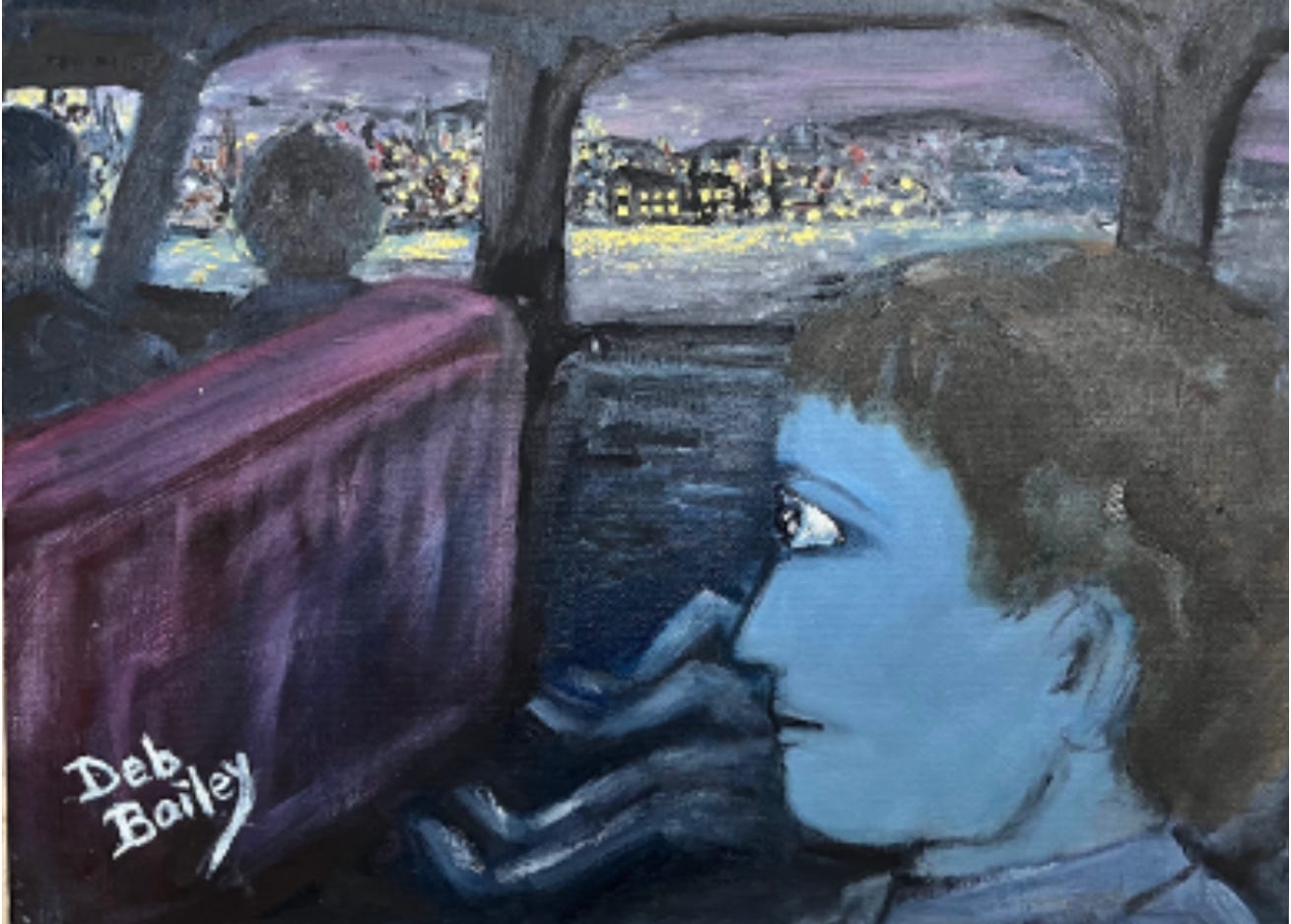
Whenever it was time to head home after a visit to those grandparents, it was usually dark, especially in the winter. My siblings would fall asleep almost immediately at the start of the hour-long ride. But I fought to keep my eyes open, even when I was very young. There were always so many things to see along the way, and I wanted to see them all. I was afraid that if I fell asleep, I would miss something. Especially the Naugatuck River at night.
In spite of its terrible reputation during the day — especially the reeking smell of chemicals flowing right into the river from the rubber plant — at night, driving home on the highway that threaded north alongside the river, it was absolutely magical. Sometimes it was on a dark stretch between towns, and I could see shards of moonlight bouncing on top of water ripples. But many times, and most of all, I loved all the twinkling lights on the hillside across the river and how they glittered on the surface of the dark water.
I would look across the river to the homes lit up and try so hard to see into their windows. Just a brief peek. I wondered who lived in each place, and what their lives were like. Were they eating supper? Laughing? Were they happy? Was it a better home situation than mine? I just soaked it all up.
And this is the split part. Because at the same time I looked longingly at the houses, and wished to be in one of them, my father was glaring at me in the rearview mirror and trying to catch my eye. I knew that meant I was supposed to stick my foot up along the side of the car so that he could take my foot and stroke it. I knew if I didn’t sit behind him and do that, I would be in deep trouble by the time I got home. Those looks he shot me, I’ll speak about later. For now, suffice it to say that they conveyed an emotional dictate I didn’t dare cross. It was almost as if I couldn’t be allowed any moments of “independent thought or dreams.” He needed to control not just my body, but my mind.
So I would shove my foot up enough so he was happy, and then I would just spend the rest of the ride staring deeply into those homes, watching the glow of the flowing water. It always amazed me how something usually so ugly could still be a place of beauty and peace.
 Soul Mosaic
Leave a comment