A few years ago, a male friend of mine, seeing my excitement over some new science factoid, told me that if I were a man living in the 15th century, I’d certainly be a Renaissance Man. I laughed and appreciated the compliment but didn’t think much more of it — until recently– when another friend of mine told me that to her, I *am* a Renaissance *woman*. This time, I stopped and really took that in, then asked her why.
Her response was two-fold. First, she gave me her definition of a Renaissance person — someone who can do anything, if they “will” it; someone who embraces all areas of knowledge and develops their capacities to their very best; and someone who does all of this with kindness, compassion, and love, as they inspire and lead others. The second part was her listing of all the times she saw me do those things.
Needless to say, I was overwhelmed and deeply touched by her comments. I’d never thought of myself in these ways — it’s funny how hard we are on ourselves and miss our specialness, yet others see our beauty. But anyway, her comments, on the heels of those from my other friend, really made my day. I’d always seen myself as simply someone who gets excited by all the world has to offer, and curious – sometimes dangerously so, as I’ll show in the scientist section. And maybe someone who’s just unable to stay focused on one thing. It seems I was always viewing me from a slightly negative or critical place. Hearing both of my friends’ comments showed me a whole new view of myself, and that kid.
Maybe that’s why I have had to take several entries to describe who I was as that kid. Just too many pieces to capture in one essay. So here I’ll talk about another one — that “visual creative” — before going on to the last and strongest part of me, the scientist.
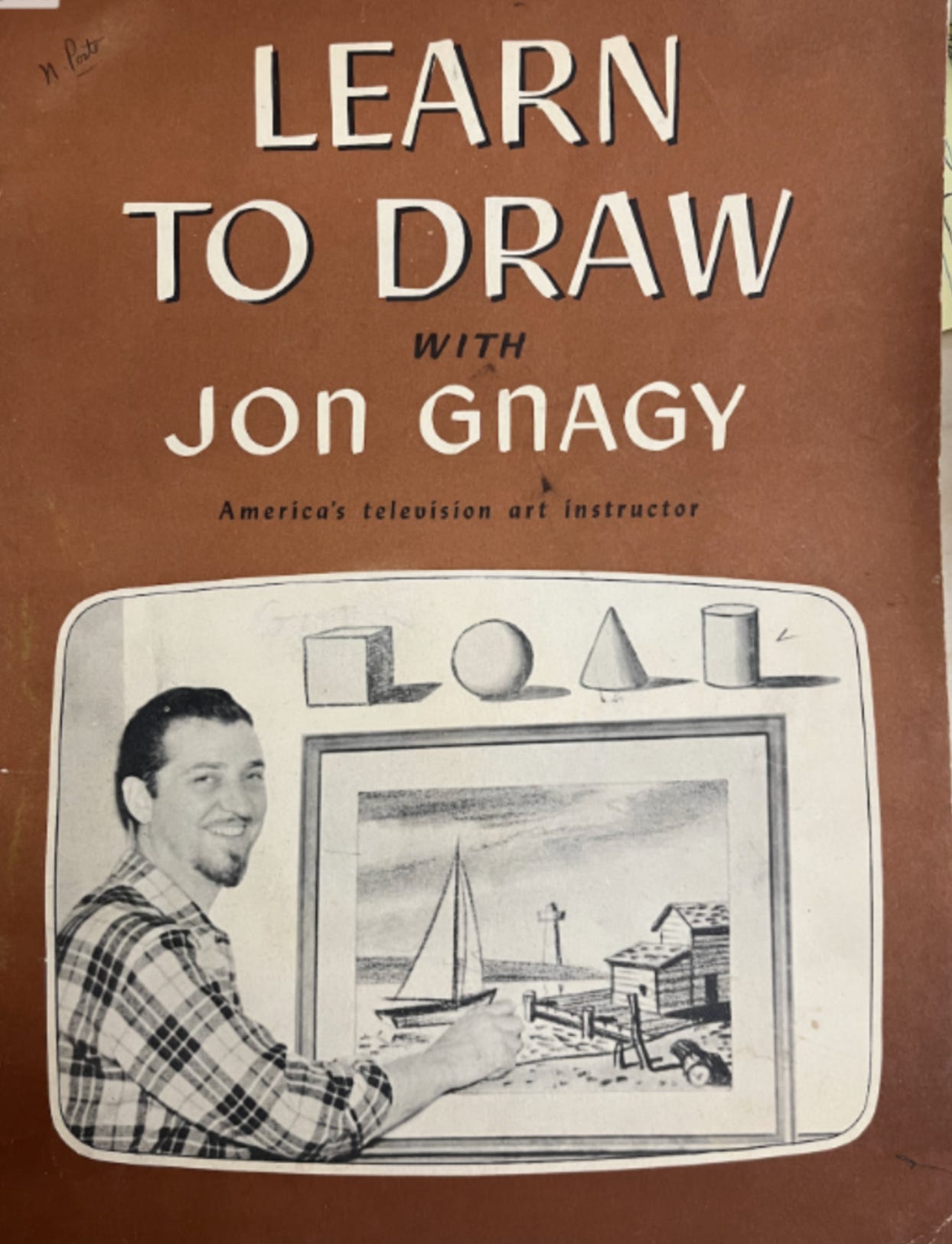
As with so many things in my life, it was a Christmas present that introduced me to the skills of capturing my world on paper. The early 1960s TV show by Jon Gnagy was a favorite, and I still remember the kit I received one Christmas. Aside from the book that had step-by-step lessons and examples, there was paper, pencils, a hand sharpener…everything needed to plant yet another “personality seed” in me. Or maybe, “awaken and sprout” one that already existed in me.
In fact, as an aside, that is the thing about children in general. They are such amazing beings, sponges soaking up everything around them, and so filled with potential to do so many things in life if given half a chance. That is why it is an especially deep tragedy to abuse a child in any way. They are a walking cornucopia of abundance that the world so needs. They are filled with such a huge variety of seeds that, with the right help, can grow into so many possibilities. They deserve that chance.
All it takes is an adult or two to water those seeds with encouragement, make some “nutrients” available in the form of tools, books, opportunities, or time, and then stand back and see what those amazing kids do with it all. That is the part I absolutely loved when teaching for 15 years at a local science museum. It was the opportunity to help those kids unearth what was already within them, and encourage them to try things out without worrying about doing it “right,” but instead, just “play,” and discover the hope of what was possible.
For whatever reason, my father gave us these toys and books, or took us places, or pushed us to learn. And those efforts landed on very fertile ground in me. So for whatever his reasons, I am grateful. They gave me tools to survive him and his abuse, and to feed my spirit as I later escaped and rebuilt myself.
One particular artistic “talisman” of my early life was crayons…even in spite of the time I drew all over my father’s radio sets. While my early boxes of crayons held just simple colors like brown, blue, white, red, or orange, they still held deep creative power.
Crayons were like having a liquid rainbow flowing out of my fingertips. The feel of them in my hands, the mix of wax and pigment smells when I opened the box, and the sight of them arrayed before me, just waiting for me to tap their potential — what a rush!. Armed with these tools, I just KNEW that I could wield them to capture my world and express whatever I felt inside.
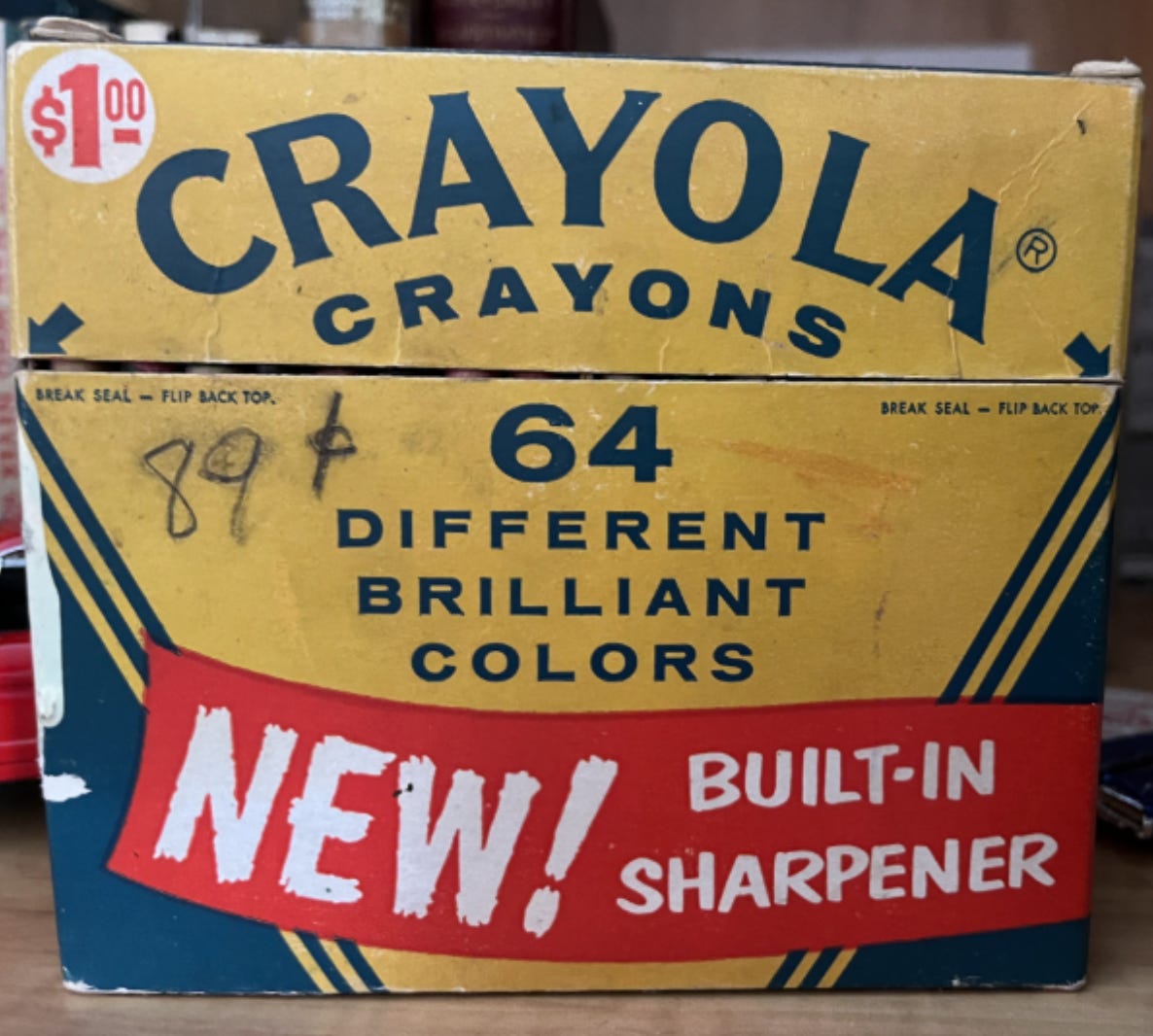
If that wasn’t enough, there was the ultimate, “lusted-after,” crayon set of my childhood, the one every kid wanted — the “Crayola Crayons 64 Different Brilliant Colors” set, complete with the built-in sharpener on the side of the box. Imagine now, not just purple, but periwinkle, not just brown, but sepia. And who would expect not just green or blue, but choices like spring green, olive green, and forest green, or cadet blue, sky blue, or green blue! I couldn’t wait to start creating!
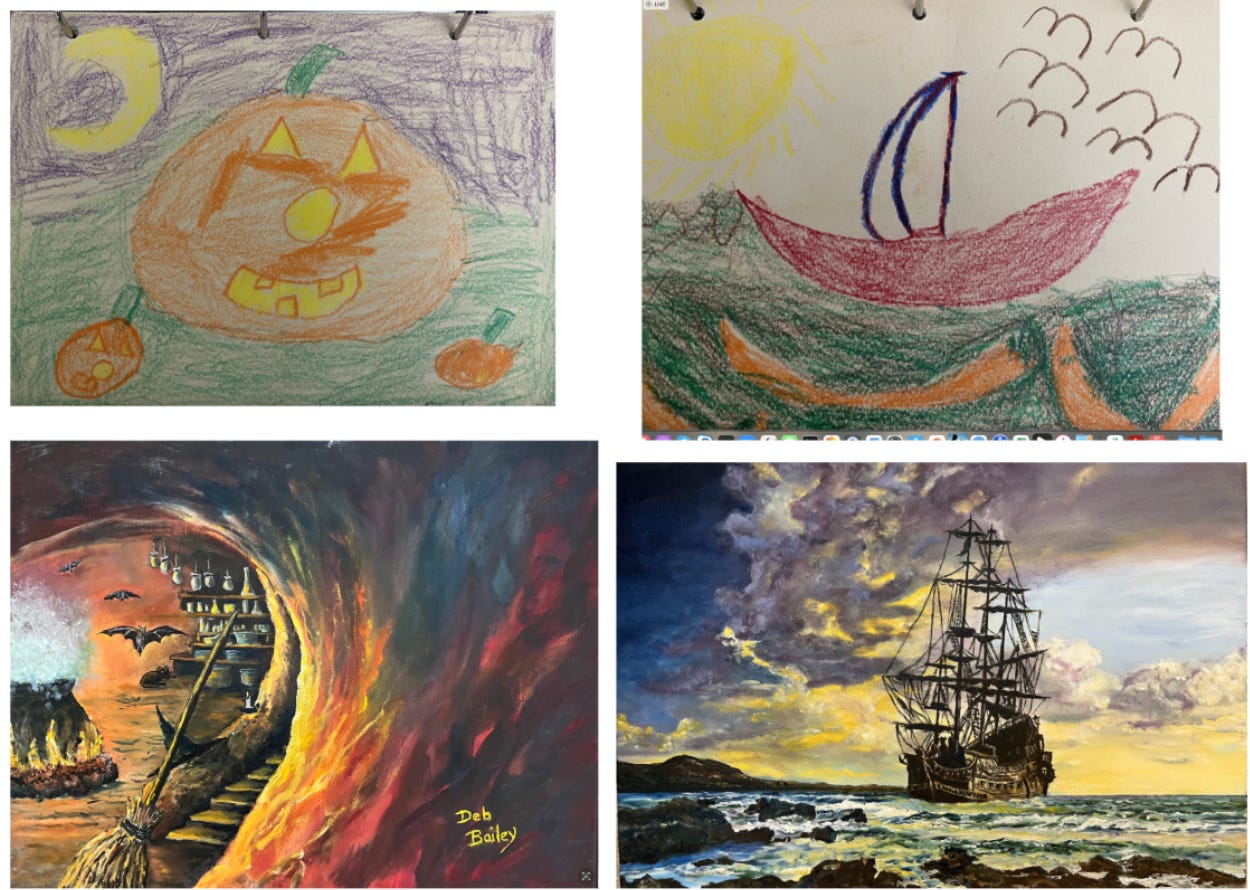
While my early efforts may be more “surreal,” they fueled a lifelong love of making the places in my mind, real. Even now, I love rendering unique and imaginary worlds onto canvas with oil paints. Again, I have my father to thank for sending us to a local woman artist who would teach kids how to paint after school in her basement. Mrs. H is long gone, but she was magnificent in her skills and patience with so many children. I studied with her for many years, and when I paint now, I remember her with much love.
But even beyond crayons and paints, there was music! While I wasn’t “in charge” of the radio — that was Dad’s choice yet, whether at home or when he was driving. And in the car, it was usually this soft music station called WRCH, which had a little jingle that went: W-R-C-H, 910, Rich Music.”
On weekends though, he played two or three record albums, and they actually grew on me. One harkened back to his Navy days, and was the sound track to a WWII documentary series called “Victory at Sea.” After a while, I knew every note. I could feel the ominous strains building as the big battle approached, the crescendo of the fight, the somber notes of the aftermath, and the reprieve of the “port call.”
The other albums were of Herb Alpert and the Tijuana Brass. The poignant wailing of the trumpet during The Lonely Bull; the rhythmic beat of the solo drum in A Taste of Honey before the the key changed and the trumpet weighed in again; and the major key notes alternating with “minor key sorrow” in El Presidente! To this day when one of those comes on the radio, I still stop in my tracks to re-experience the emotions evoked. And because that music calmed him, that meant life was calm for everyone, at least for that moment.
I also discovered you could make worlds of your own in 3-D as well. I had an assignment for religion class with the nuns to make a model of some scene from the Bible. I decided on something full of excitement, danger, and divine magic – the parting of the Red Sea as the Israelites were being hunted down by Pharaoh’s soldiers.
I took a wooden board, a bunch of miniature medieval soldiers, the only things the hobby shop had that were close to ancient Egyptians, some paint, and 10 pounds of Plaster of Paris, and set to work. I had no idea what I was doing, but I learned to fashion waves and land from the plaster. Then I painted the land and waves with tempera paints and glued in my soldiers. It was a magnificent scene of small people running through parted waves towering above them, pursued by the “Egyptians.” The only problem was that it weighed a ton, and my father had to deliver it to school for me. No one explained that you put the plaster on top of paper, cardboard, rags, or wire. Instead, my waves were solid Plaster of Paris. But…I got the point across!
Moments of creation — drawing, coloring, painting, modeling — they were again “Moments of Respite” that I could lose myself in. They were the moments of good times and relief that allowed inner joy to seep out into my life.
So with that, I move on to the culmination of this and all previous qualities — my scientist side.
 Soul Mosaic
Leave a comment