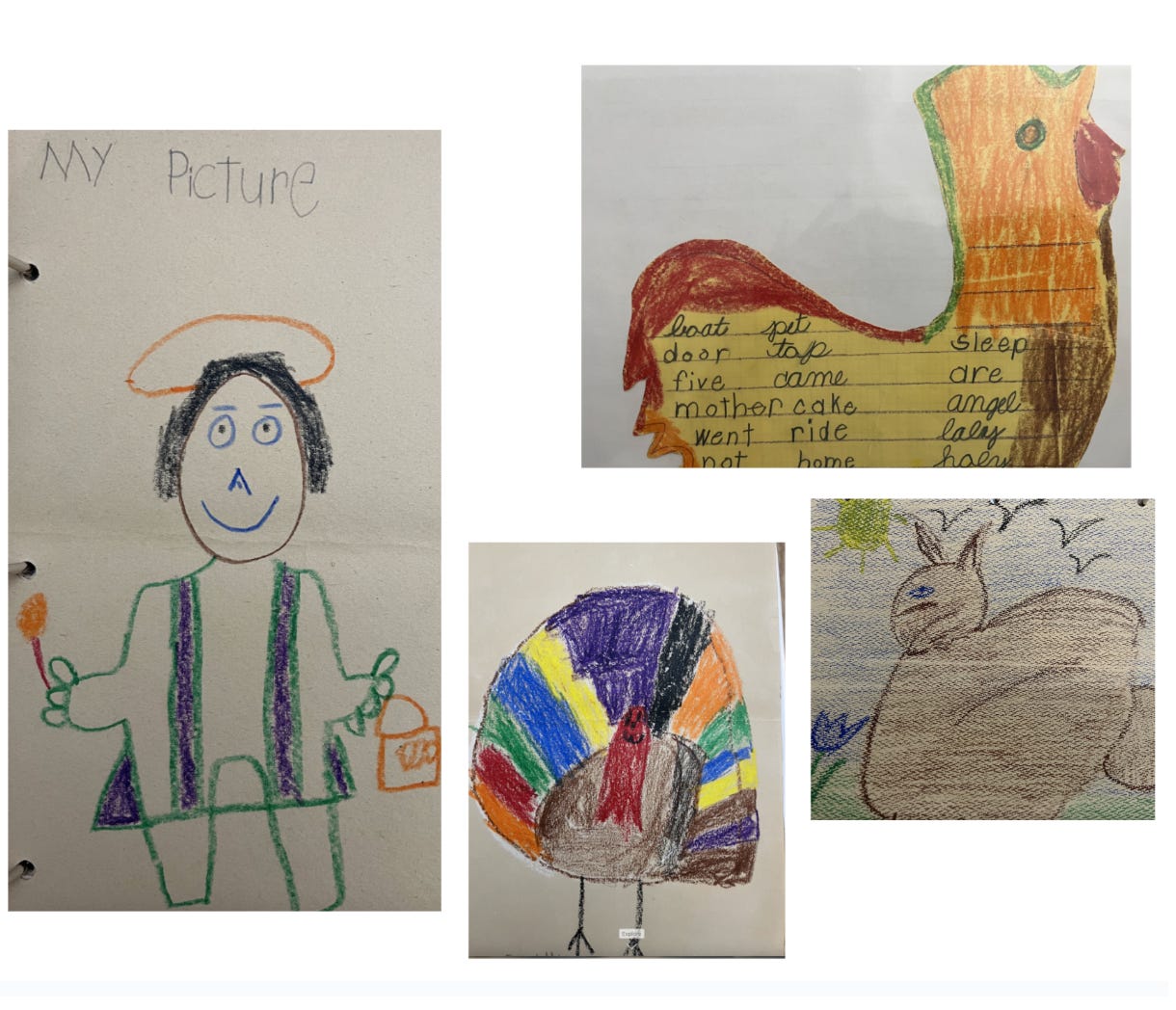
Photo by author
I think if anything captures the soul of that first grader, these drawings do. Innocence revealed in the art…though I don’t think I’d ever want to meet that rabbit!
But this was the year my world expanded to include the domains of Sacred Heart Catholic School and the Sacred Heart Church. It was the beginning of a whole new adventure — school. And even though I would struggle, school was a relief and a reprieve from home.
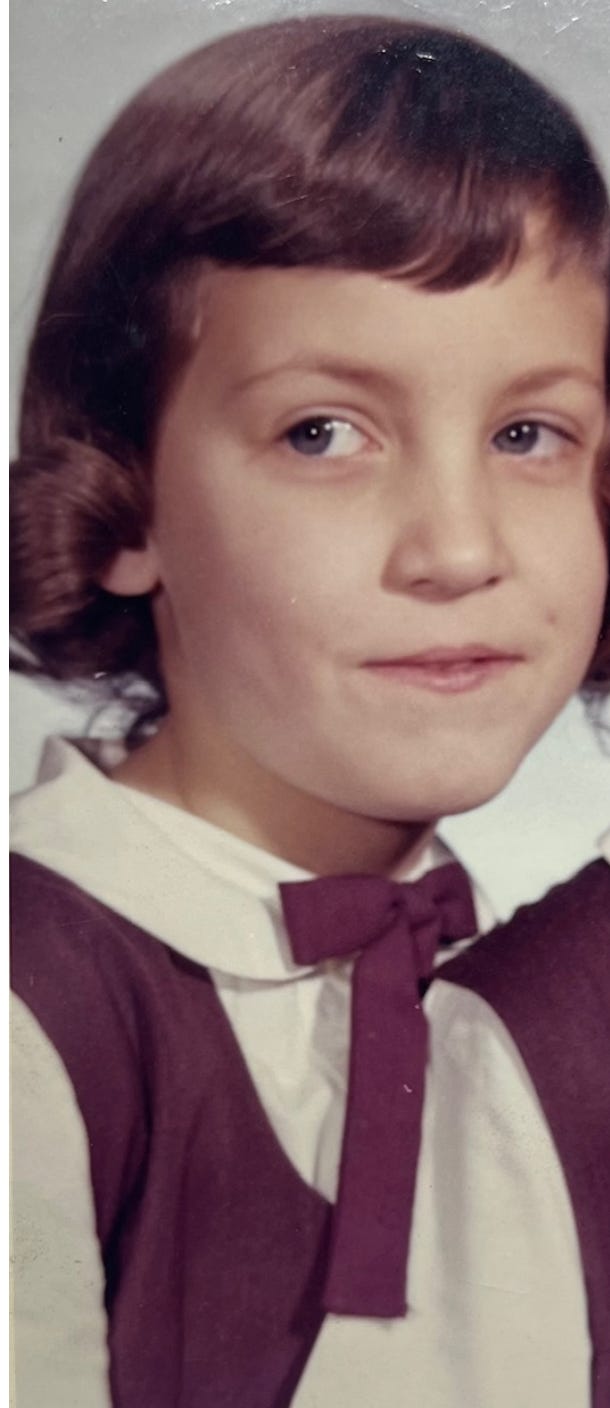
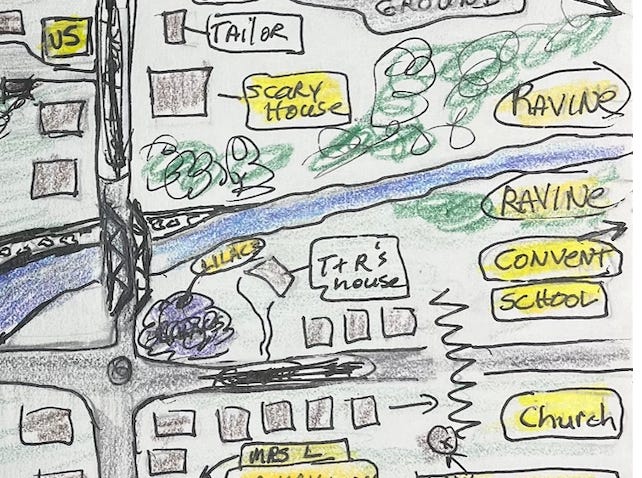
The walk to school
It felt glorious! As I set out that first morning, I later learned that my grandfather was watching me from his second-floor front porch, crying. But I was unaware of that because I was off on a new adventure — all “six-year-old grown-up” me, leaving my little world and walking to school all by myself.
That bridge…
The first test of my spirit was the metal replacement bridge over the nearby Naugatuck River. It had been installed 5 years earlier, after the “1955 Flood” washed the other one away. Hurricane Diane had come through that August and set the Naugatuck River on a destructive rampage through towns up and down its entire valley across the state. With lives lost, and buildings, bridges, and roads ripped apart, that story was a powerful piece of local lore that everyone still spoke about.
The bridge was scary in several ways. For one, the rats lived somewhere along the riverbank under it. Also, the Naugatuck was a mess. People often threw trash in it, and we’d been told never to go near the river. Anytime I was on that bridge, I could see shopping carts, boxes, and pieces of broken things. And sometimes it was different colors because the woolen mill upstream would dump out its leftover dyes into the water. So, some days the Naugatuck was green, and on other days, it was purple, yellow, red, or orange.
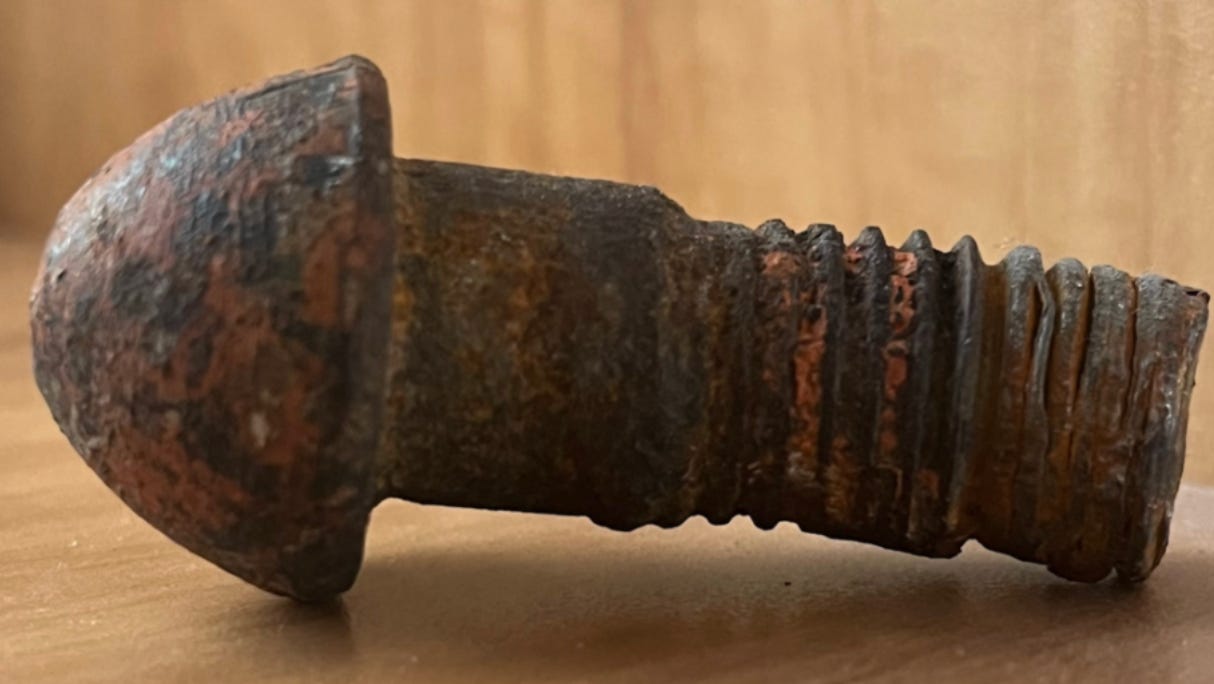
As to the bridge itself, I was fascinated by it in a terrified way. The walkway was made of wooden slats with spaces between them. Since the bridge was meant to be a temporary structure until a better one could be built, it was not fancy.
As I walked across, I would stop and lean forward to peer between those slats. Far, far below me — at least it felt that way — the water rushed by. I was always afraid I would fall in. Yet, frozen between fascination and terror, I would remain there, hunched over for several minutes, until I couldn’t stand it any longer. Then I would bolt the rest of the way across the bridge to the corner crosswalk.
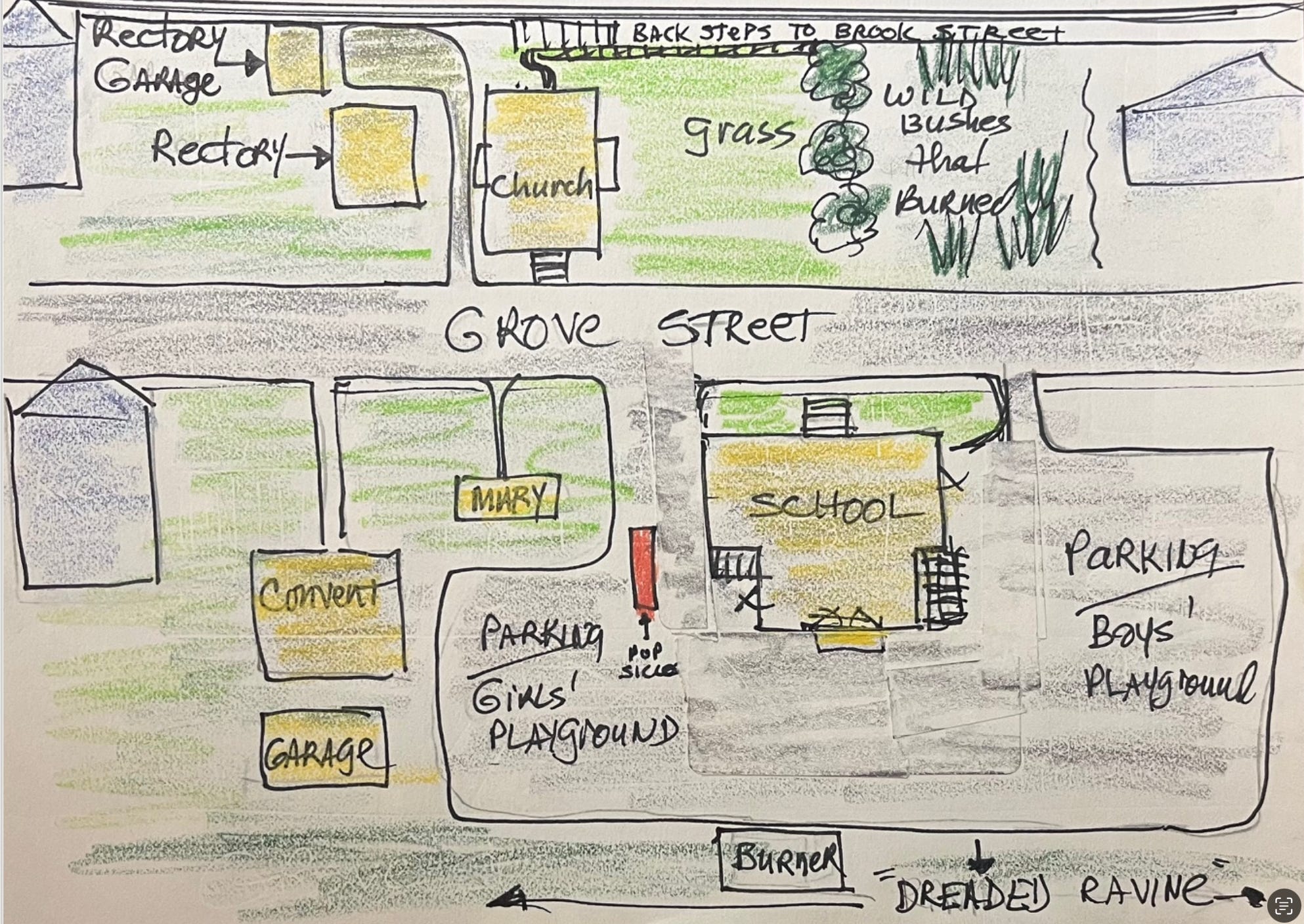
Up the street & “No Man’s Land”
Crossing the street was a careful endeavor with lots of rules. Again, new adventures — the rules of how to use the walk lights that the parents had lobbied for and which had recently been installed. First, I would cross the street I lived on, then, once on the other side, cross over Grove Street to walk up the hill to the school and church.
Shuffling through piles of leaves and crunching them under my shoes, I strode up the hill. The landmarks of my walk became familiar friends — all the different 3-family houses that closely lined both sides of the street. I knew each one by its color, shape, and driveways. Three-family houses were a common thing in town. Everybody lived in one in that area, the only difference being what floor you lived on.
As I got closer to the church, the houses thinned out until there was just the one house off on its own, a one-level ranch house for the older woman and her brother, who was in a wheelchair. After that, there was this open field that sloped steeply downhill to the next street over. In New England, hills were everywhere. So you could be at one level on your street, and the next street over could be far down an embankment. On that street, I could see men walking into the old brick factory building and the auto shop next door, heading to work.
The field itself was my resting stop for another adventure. Wild with weeds and bushes, it was a no-man’s land. But for me, I saw animal trails and tunnels winding through the branches of seed pods and flowers. I don’t know who owned that patch, and they never seemed to mow it, which was fine by me because it made the space so much more interesting. I would stand there, lost in dreams. But one year it caught on fire, leaving it blackened and desolate, and after that, somebody mowed it regularly.
The bell for church would rouse me from my imaginings. Since I had spent so much time by the bushes, I’d have to run so I wouldn’t be late for Mass.
That first school day of every year
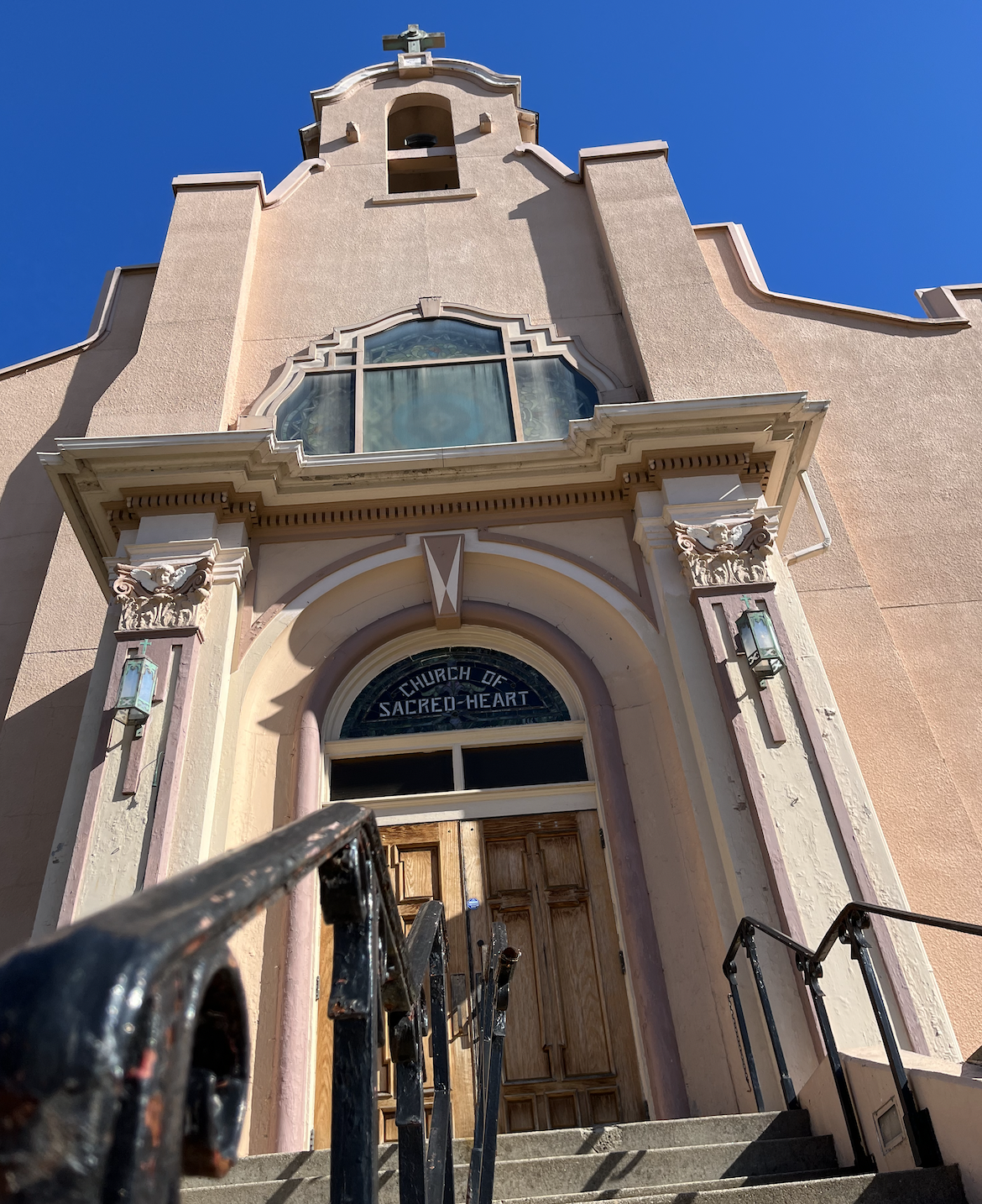
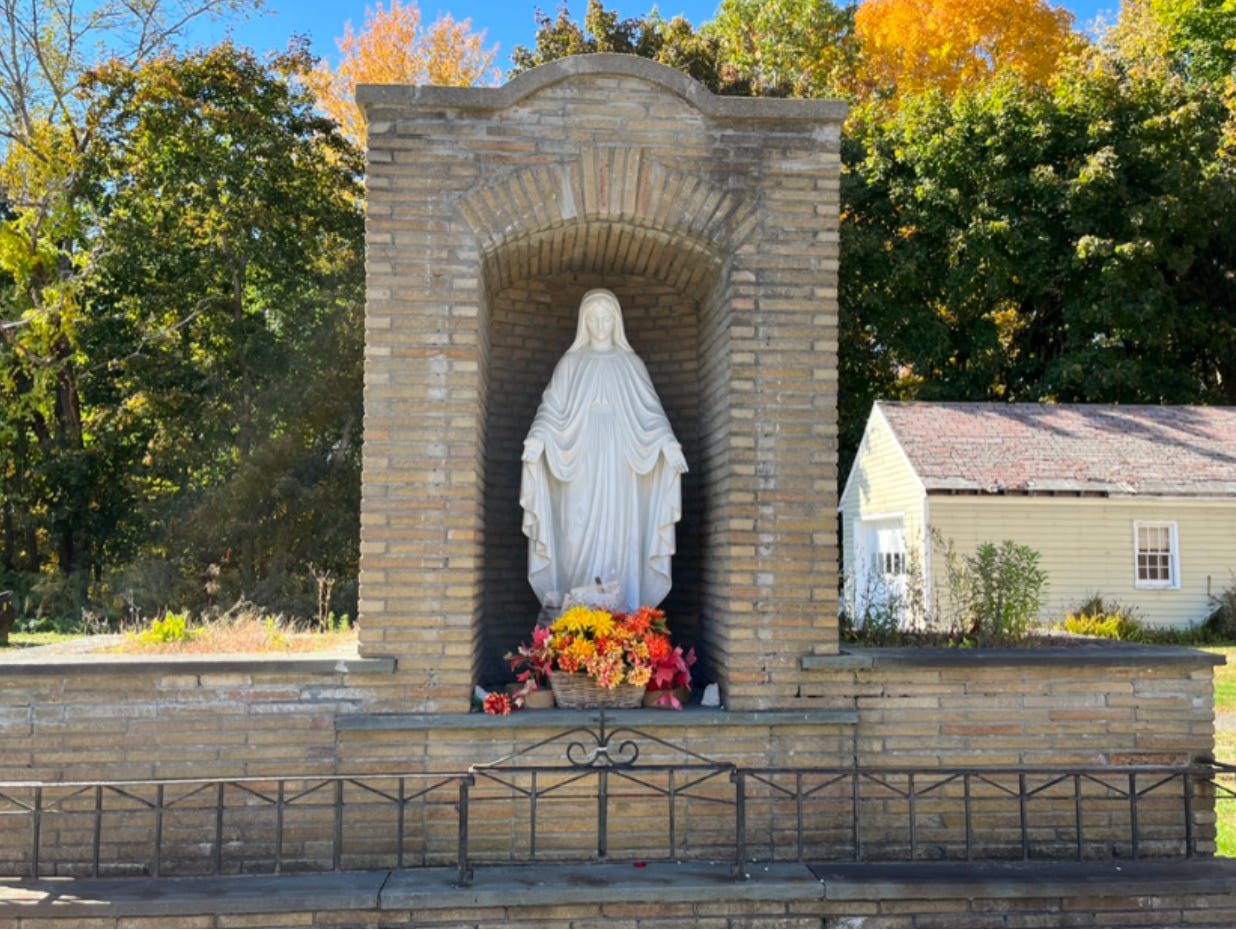
The church looked like an adobe Spanish mission, which was odd to me, given that it was here in New England, built by Slovak immigrants in the early 1900s. Across the street was the convent, the school….and Mary, the Blessed Virgin Mary, that is. She, or rather, her statue resided in a sheltered, tan-bricked enclosure. Mary was my friend back then, and is again, though for years we had our differences. But I’ll talk more about that soon.
Rushing up the church steps, I’d get there just in time for Mass. One of our school rules from the nuns was that as everyone arrived for school, they were to go directly to church first. I will speak of Mass, God, and Mary shortly, as they were huge influences on me then. But first, school.
Once Mass ended, all of us students would then exit our pews two-by-two and march out of church, across the street, and into the school. Two 8th-grade boys — who seemed so big and powerful to me – stood in the street as we crossed. They were the crossing guards, adorned with their shiny badges on belts across their chests and stop signs in their hands. They would hold up traffic for us so we could all get safely across the street.
Walking into my classroom that first year…and at the beginning of every school year for the next 8 years, I noticed several things. First, there was the smell of newly varnished desks that a group of the school dads refinished every summer. Next, the steps of the steel staircases and hallway floors were freshly painted with battleship gray paint. And then there would be the distribution of new school books and the new box of Crayola crayons that first day.
Depending on our grade, there would be a phonics book, a speller, Warriner’s grammar, or a reader. Also, books for math, history, geography, science, and of course, religion. But it was the new box of crayons I loved best.
That first year, it was the 8-pack Jumbo Crayolas with the words “the BIG crayon for little fingers” on the back of the green-and-yellow-orange box. Every year, we would be given a new box of crayons for art class — something I treasured. In later years, it would be the 12-pack skinnier ones. But that first year, I still remember the feel of those fat crayons in my small hands. And every year, I lived for Friday afternoon art class, as long as the nun didn’t take it away to punish us for misbehaving.
The “Lunch Ladies”
But in spite of being young and just starting out, the nuns taught us quickly that there were rules you’d better learn, and fast. One of them had to do with the “lunch count.”
I loved my first-grade nun well enough…except for the fact that she made the girls, me included, play the triangle in class band. I wanted the wood block with the wooden striker – loved its crisp, staccato sound when the two collided. But that was a “boy” instrument. Instead, girls were relegated to play the triangles, which you daintily held by pinching the little ring holder between your thumb and forefinger and then ever-so-delicately tapping the angled metal with the wand to yield a soft note. God, how I hated the triangle.
And I think she was also a coward, because she, too, was afraid of the “lunch ladies.” Either that, or she thought it was “character-building” to send a lone 6-year-old, unescorted, down to the depths of the school basement, into the bowels of the darkened cafeteria, to breach the inner sanctum of the kitchen where “the lunch ladies” reigned supreme. There, you had to face those two women alone and admit that yes, you forgot to include yourself in the “lunch count” when Sister took it earlier.
I usually took my own lunch in a brown paper bag labeled with “Debbie Phillip, 1st Grade,” efficiently written by my mother in black marker across its side. We didn’t have a lot of money for school lunch. (Or for the bags of Stateline potato chips the nuns sold at recess to raise money for something).
But every now and then, Mom would let me have school lunch, and that was always a big treat. Not that the food was exceptional, except when Mrs. T still worked there. She loved the kids and would even bake fresh doughnuts. But the other ladies got rid of her after she fell one time in the kitchen. They said it was for her safety, but I always felt they resented how the kids loved her cooking and didn’t like that she was willing to work harder than they would. But anyway, I digress.
On this particular day, Mom let me have hot lunch. Not being in sync with the usual routine for that, I didn’t notice when Sister did the “lunch count.” That involved asking anyone taking hot lunch that day to raise their hands so she could send that number down to the lunch ladies. And all the nuns knew – get it done first thing or risk the wrath of those two women, something even the toughest nuns avoided.
Somehow, I realized my mistake, so I told Sister, figuring rationally that there must be some way to fix an honest mistake. Not so, though. Sister shook her head and said that I would have to march down to the lunch ladies and tell them myself that I missed the count. I had the first inkling this wasn’t a good thing by the way she said, “Tell them, myself,” with special emphasis on that last word, myself.
To the “bowels of the basement”
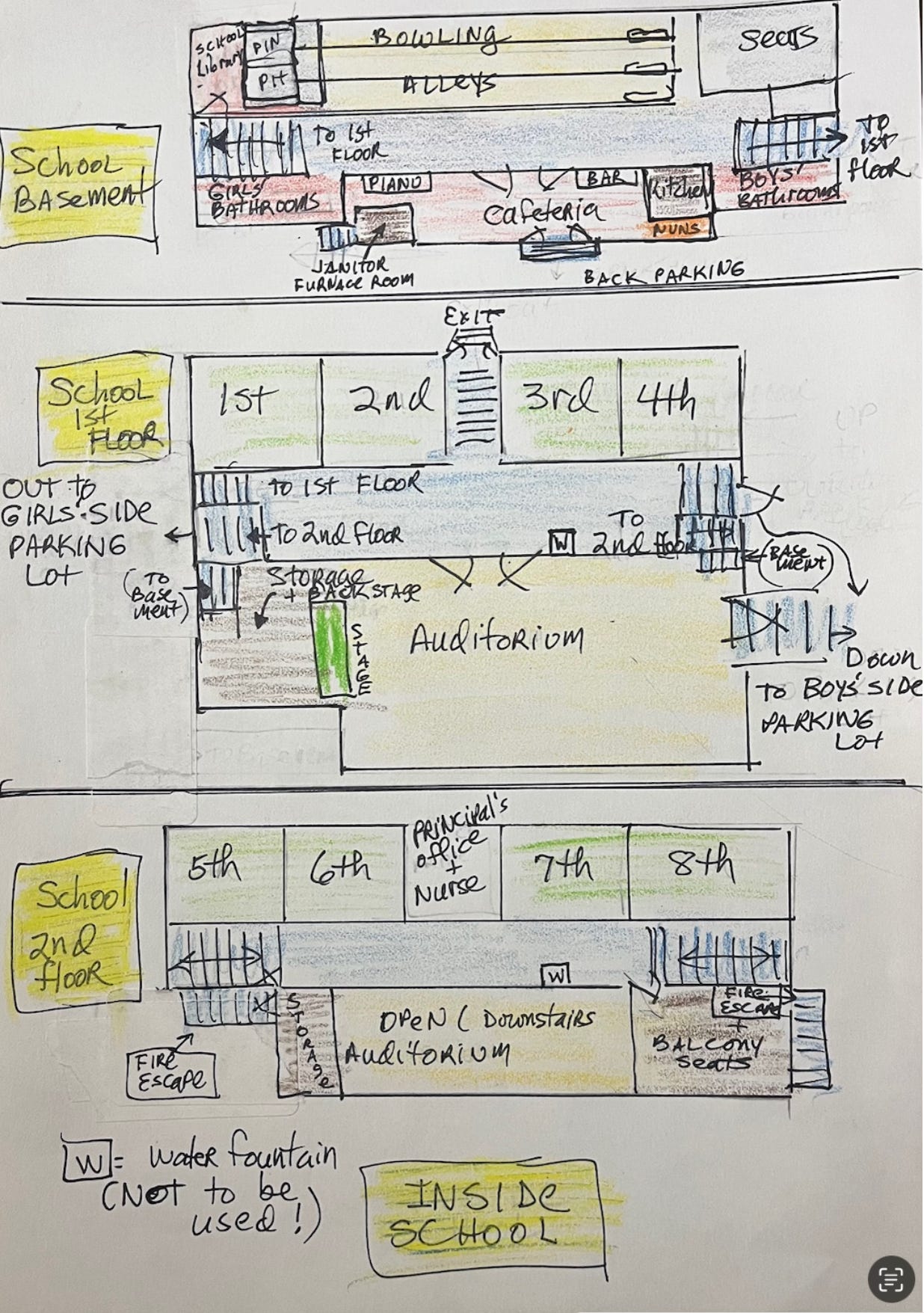
Undaunted, and glad for the chance to have a break from class, I headed down the two flights of steep Navy-gray metal staircases to the basement. It was dark, a little eerie, and I always walked faster past the girls’ bathrooms. I always expected some boogeyman to be there lurking in the dim entrance.
I pushed open the swinging door and entered the hall with the bowling alleys — dark there, too, but for some reason not as scary. I never actually saw anyone use the bowling alleys. To me, they were just part of the building, put in decades ago when the school was built in the early 1900s by those Slovak immigrants.
Fascinated, I took in all the details – shiny alley floors; criss-crossed shadows splayed across them from the barred basement windows; bleachers in the back, gray walls, gray floors, gray doors, and silence. Blessed, peaceful silence that enveloped me like a blanket. I could have stayed there all day.
And then, I heard it – screechy, cackling, howls of laughter echoing out of the kitchen. Either that or the lunch ladies were killing whatever it was they were about to cook.
I glanced at the closed doors to the cafeteria, which were dark gray too, and which seemed to get bigger and more threatening by the moment. My stomach tightened. I stopped before those doors as more raucous laughter drifted out. I wanted to run, but there was no choice. I was going to have to get this over with.
Gently edging the door open, I peeked into the empty cafeteria. Tables were set up in neat rows and aisles, and it was dark in there, too. The lunch ladies hadn’t yet turned on the familiar overhead lights that would make the room warm and welcoming.
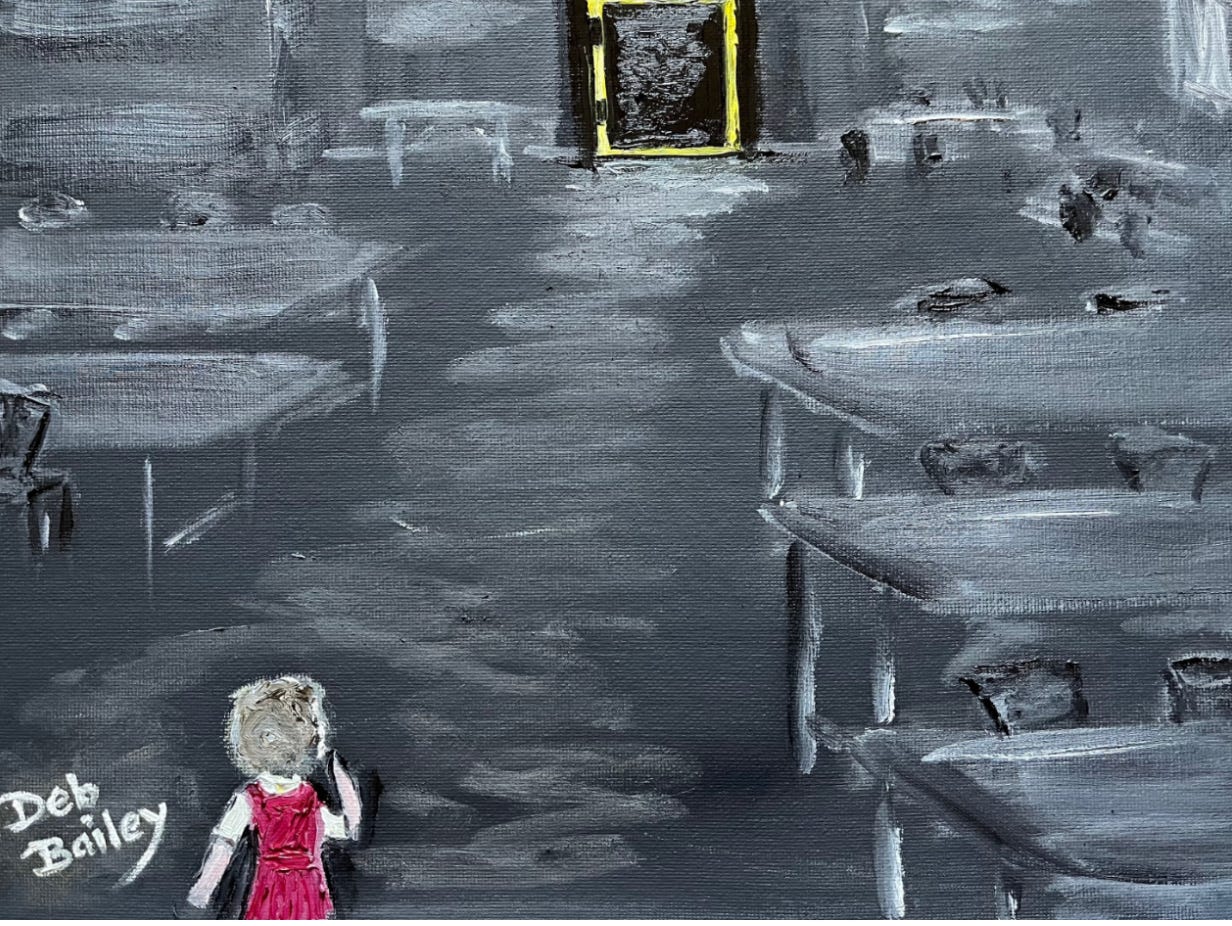
The “portal to hell”
Another blast of yelling and laughter shook me again. I glanced across the long hall, vast as an ocean at that moment, and spotted my destination — the kitchen door. It, too, was gray and closed, but like a portal to hell, it was framed in a blazing rim of almost blinding light.
I crept up to that door, hesitated, then timidly knocked. Laughter and screeching stopped.
“Whose there?!”
I took this to mean I should go in, so I gave the door a push and stepped into the brightly lit kitchen.
Mrs R, whose house I walked by each morning on the way up the hill, was the older and meaner of the two ladies. She stood on the left by the stove, hands on her hips, glaring at me. Her helper, M, stood off to my right near the sink. She was the less caustic of the two, and had it just been her, it would have been much less intimidating. While she might not have been happy that I missed the lunch count, she would have just shaken her head and written down a new total on the lunch count paper.
But Mrs R — she was a living, breathing version of the gravel-voiced aunts in the Bart Simpson cartoon, long before there was a Bart Simpson. Except she was worse because I truly thought she might breathe out fire at any moment. I often saw her in church on Sundays, wrapped in the mink stole her husband gave her. He was a nice, soft-spoken man. A few years later, I heard he died, rather young, from a heart attack. I pondered how he and she got together. But I banished that thought quickly. Not a nice thought. And probably a sin.
Her raspy voice sliced into me.
“Well, what do you want?”
Barely able to speak, I stuttered that I had missed the lunch count, and Sister (blame the nun) sent me down to tell her.
There was a moment of silence. I should have known it was ominous, but to my inexperienced mind, I held out hope for a peaceful resolution.
She took a long drag on her cigarette, then she seemed to exhale fire amid her cigarette smoke, and spewed a hailstorm of words at me.
“You missed the lunch count?!!
The pitch of her voice rose.
What do you mean you missed the lunch count?! How could you miss the lunch count?!
The volume of her yelling now was almost fever-pitched.
Weren’t you listening to Sister?! Don’t you know we need to know early?! We can’t be……”
The rest of the words just flooded over me like a wall of noise, and I tried to shut it out. M just nodded in agreement and uttered words of support while Mrs R took a breath before launching another salvo.
My awareness was split. First and foremost, I was shaking. Shocked by the intensity and volume of the blast coming at me, I went into the same survival mode I had learned at home. I guess home prepared me for life. But I knew the drill: “Batten down the external hatches” and hold on till it was over. Tighten your muscles, stomach, fists, eyes, clench your teeth and “go inside yourself.” If you were lucky, you could minimize the input and partly ward off the barrage of verbal blows.
The other part of me distracted myself by observing them. I watched Mrs. R and quickly realized she had no mercy and even seemed to be enjoying this. M at the sink wore her face like a passive mask, and I knew immediately I had no hope for an ally there. Her expression made it clear she was not going to risk her own hide to save some poor, quaking, first-grader from the wrath of Mrs. R.
The words and volume kept increasing, and I tightened my eyes trying to block it all out. Suddenly, I was aware I was not alone. Behind and almost looming over me, I felt a large presence. In that moment, I wondered if God was about to rescue me. Maybe it was just like the nuns said, He still did miracles, even today.
Superman
Well, maybe so, because for sure God sent me Superman, in the form of Mr. K, the gruff, slightly hefty, older man who served as the school janitor. I’d forgotten that he often worked in his shop in the “furnace room.” It was a small room behind the gray door at the opposite end of the cafeteria that we never dared venture into. The “furnace room” was off limits, not because of Mr K, but because if the nuns caught you, God help you. He must have been in his furnace room when they started yelling and came to see what the hell was going on.
He took his cigarette out of his mouth, drew in a deep breath, and while he wasn’t loud, his deep voice had a commanding presence that brooked no argument.
“What’s the matter with you?! He was talking to the women, not me.
Even I picked up on the high level of disgust literally dripping off his words.
“What are you picking on her for?! Leave her alone already!”
The ladies went silent, and I knew why. No matter how much of a bully she might be, she knew his word was final. You didn’t argue with the man.
It was my deliverance, and that was all I needed. Before anyone could say another word, I was out of there. I barely remember racing around his legs and bolting across the dark cafeteria, past the bowling alley, the girls’ bathroom, and up two flights of stairs. I don’t even remember getting back to my classroom.
I don’t know if the nun even noticed my return. If she did, she might have just registered surprise that I returned physically unscathed and had not been eaten alive. But that would have been it. As far as she or any adult then would have viewed it: “I made the mistake; I got what I deserved; next time maybe I’ll know better.”
The bottom line
What I learned was that after any “assault,” whether at school or at home, you just accepted that you were wrong. There was no escape from the onslaught if the grown-up was so inclined to deliver one…and there wasn’t supposed to be. Instead, you just got good at “battening down the hatches,” going inside yourself, and waiting out the storm until it was safe to come out and things went back to “normal” again.
In spite of this, there was still a sense of safety there. School was still my relief from home. The nuns provided order and rules, which were a protection in their own way. Even the religion books did. Everywhere, there were specific rules. And you learned fast what you had to do to stay in Sister’s or God’s good graces, unlike home.
That said, even as its sense of order felt safe, school also taught us right from the start, you weren’t going to be coddled…
 Soul Mosaic
Leave a comment