As strange as it sounds, I LOVED the weekday Masses we had to attend before school. It was just me, and God, and a safe space…
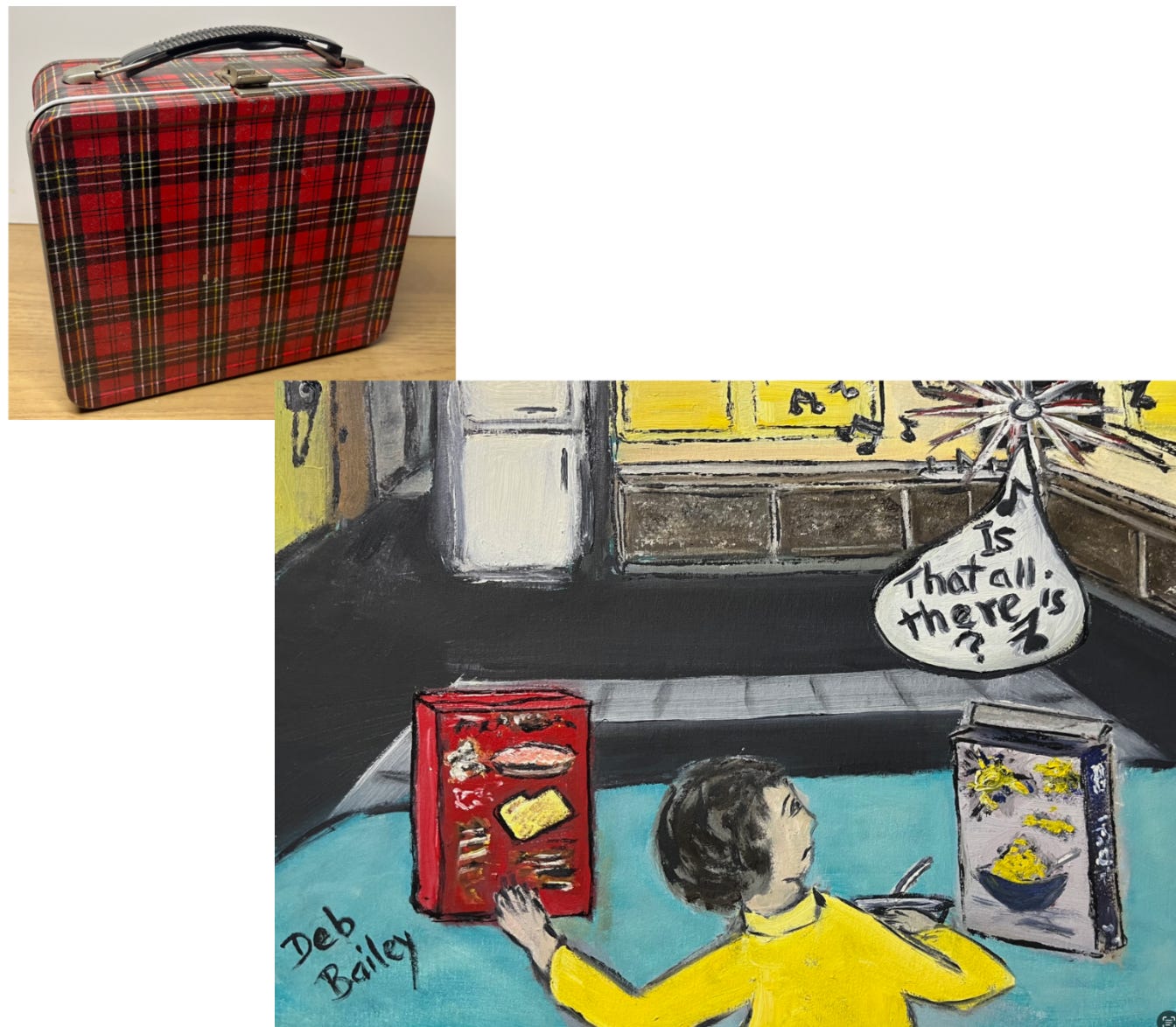
School days started early. When I was first able to receive Communion with Mass at the end of second grade, the rule required that we fast for 3 hours prior to Communion. So I would just dress, grab my red-checkered metal lunch box, and go to church. My mother had packed not just lunch, but some buttered toast with cinnamon and sugar – my favorite. After Mass, the Sisters would give us time to eat breakfast. That rule changed soon after to a 1-hour fast, so I would eat breakfast before leaving in the morning.
Dad would’ve already gone to work, or he would be asleep, so that part of the process was peaceful enough. I’d munch on cereal while the local AM radio station played in the background.
At that time, one of the popular songs was Peggy Lee’s, “Is That All There Is?” I’d listen to her lament over and over, “Is that all there is?” about everything from a circus, to love, to her house burning down. No matter what happened in the song, all she would say was, “Is that all there is?” And then suggest breaking out the booze and keep dancing. I wasn’t sure what the point of the song was or why anyone bothered to write it. Mornings were hard enough without that energy.
Instead, I’d focus on the back of the Ritz cracker box, reading the recipe for “Mock Apple pie” as I ate. Apparently, using their crackers and some spices instead of apples, you could make a pie that tasted like the real thing. While I thought it was neat that you could do that, I wondered why anyone would want to make or eat a fake apple pie. Years later, I learned that during the Depression, apples were expensive and scarce. So this was a way to substitute crackers and still have a dessert. Anyway, done with cereal and Mock Apple pie, and not thinking about if that was all there was, I got dressed and headed to school, and morning Mass.
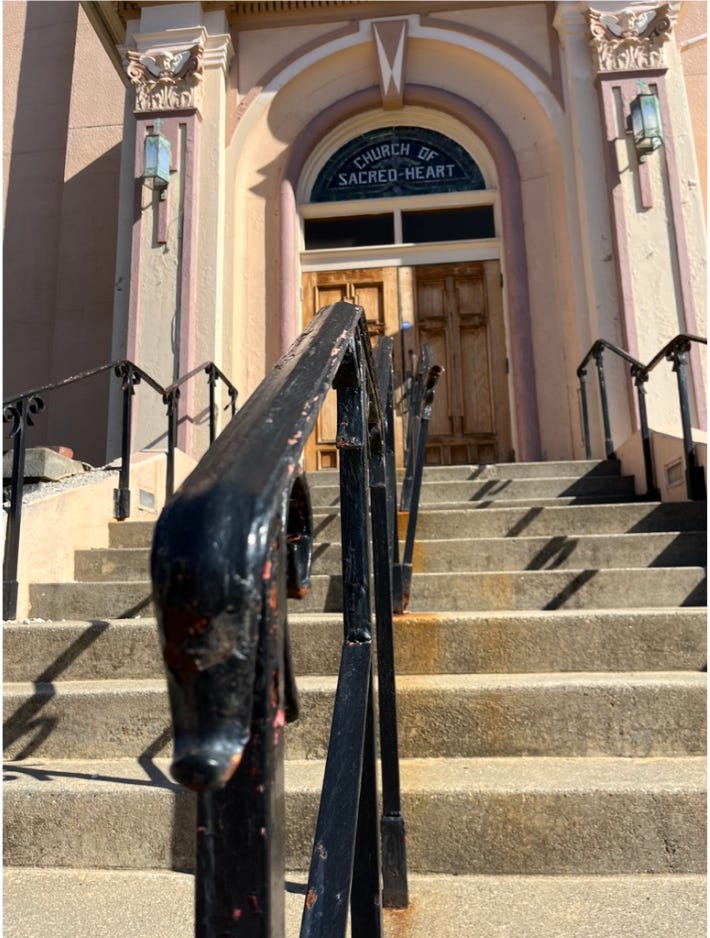
At church, I’d run to the top of the concrete stairs, yank open the heavy wooden door, and slip quietly inside the vestibule area. The moment the door shut, it felt like I’d entered another world — still, dark, and quiet. It seemed like the air itself didn’t move. Sometimes I would stand there for a couple of minutes before entering the church, just to “soak up” the holy feeling. It was so peaceful, and I loved it.
In one corner of the vestibule, there was a stainless steel cylinder filled with holy water. It had a small spigot at the bottom so people could come and fill their own bottles for home. All good Catholic families knew to have some on hand at home for emergencies. Sickness, maybe? Death? Bad things? I just knew you should always have some on hand. Rules that you embraced. It’s like when the priests came around every January to bless homes. They would come in with their garments, holy water, and a red crayon. They’d say prayers of blessing, sprinkle holy water on the door, then mark the top of the doorframe in crayon with the date and the initials of the three kings. You just embraced it as part of normal life.
Next to the cylinder of holy water was a stand with prayer books, holy cards with Saints’ pictures on the front and prayers on the back, rosaries, and packages of veils – just in case you forgot yours. You would make a donation for whatever you took, dropping your coins into the metal box at the bottom. I always jumped a little when the coins fell in because their clattering seemed to echo throughout the entire church. Above the rack was a life-sized Jesus on a cross, looking down at you. I can’t imagine anyone dared take a veil or prayer book from that stand without paying, given that Jesus was right there.
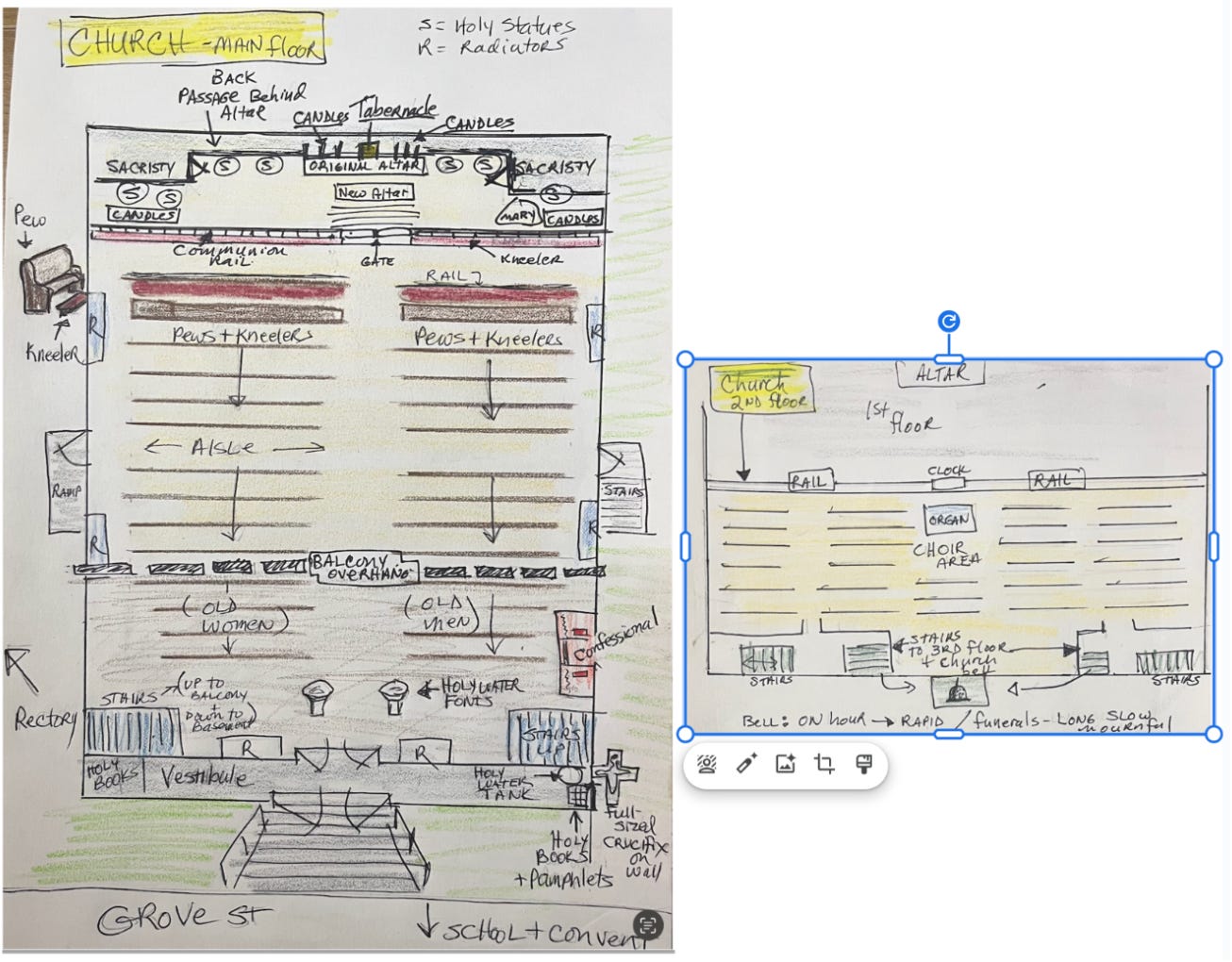
Past the vestibule was the main area of the church. It was dark in the back because it was underneath the overhang for the balcony upstairs. On Sundays, the organist and choir would be up in the balcony, along with more parishioners.
On each side of the main aisle were rows of dark wooden pews. They extended all the way to the front, near the altar. And there were also side aisles along the pews leading to the front.
The main altar was against the front wall of the church. At that point, the priest faced that altar with his back to the people as he said the Mass in Latin. Later on, it changed. They placed a table altar in front of that main one. That allowed the priest to stand behind it and face the congregation, as he said the Mass in English.
The whole front area of the church was adorned with statues — Jesus, St. Joseph, the saints and angels, candles, and in the middle of the altar, was the “tabernacle.” That was the golden, locked compartment where the hosts for Communion were stored. That was viewed as the holiest of holy places in the church because once the Communion hosts were blessed during Mass, they were considered to be Christ’s body, and those would also be in the tabernacle. So God lived in the center of the altar. That was why you kneeled before entering your pew if you walked up the center aisle, or you made a cross on your forehead if you walked past the front of the church. You were honoring Jesus, who was in that golden box in the center of the altar.
As I stepped into the back of the church, I’d dip my fingers in the holy water basin and bless myself with the sign of the cross — something I learned to do at a young age. I liked that ritual. I also liked playing in the water.
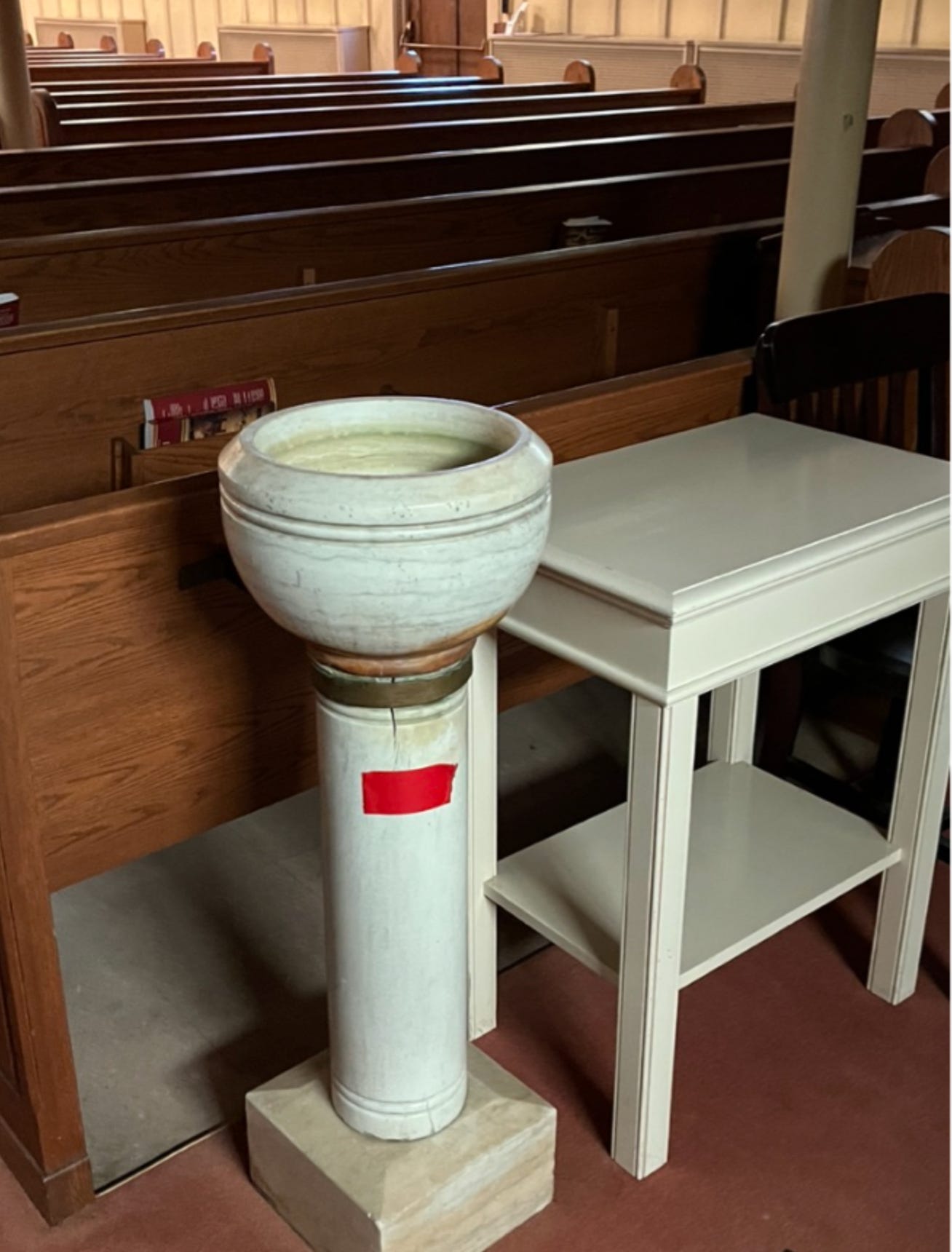
Some of the old people sitting back there would smile. The same people were there every day. These were the older church members who had built this church and school. They were the ones who came over “on the boat,” found jobs, had little, but gave generously to their church. They wanted to create a future for their kids and for all the future generations of Slovak kids here in this new world. It was their legacy to us, and their smiles radiated the satisfaction with what they created. They reminded me of the Guardian Angels the Nuns always talk about — protectors, elders, guards. Their presence here every day felt like that — the ever-present guardians who made my little world secure.
They always sat in the back under the balcony, knowing that the front pews were for all the school children coming in. Some of them had their eyes closed, rosaries dangling over the back of the pew in front of them. The only movements would be those beads slipping through their fingers, and their lips moving as they prayed silently. Even though it could get boring saying 50 “Hail Mary’s” and a bunch of “Our Father’s and Glory Be’s,” there was still something soothing about sitting quietly and going inside yourself as you said each prayer.
I always noticed that the old Slovaks sat with men on one side, women, with heads covered in “babushkas” or headscarves, on the other. If a woman forgot her babushka, you knew because she either had a tissue or a tiny veil pinned to her head. At that time, women NEVER went into church without a head covering. Most good Catholic girls’ purses came equipped with a set of rosary beads, bobby pins, and a veil in that standard, square, flat plastic snap-case. And if you forgot the veil, you bought one from the back of the church.
Why the old men and women never sat together, I can’t say. They often walked to church together, but as soon as they got there, they’d split up and sit on their respective sides. Or the men would stand in the back. The younger families didn’t do that, but the old people did. I guess it was just their way.
After blessing myself, I’d walk quietly up the side aisle, underneath the large stone “Stations of the Cross” sculptures hanging on the walls between the windows. Each of those 14 stations, 7 on each side of the church walls, showed a part of the story of Jesus’ crucifixion.
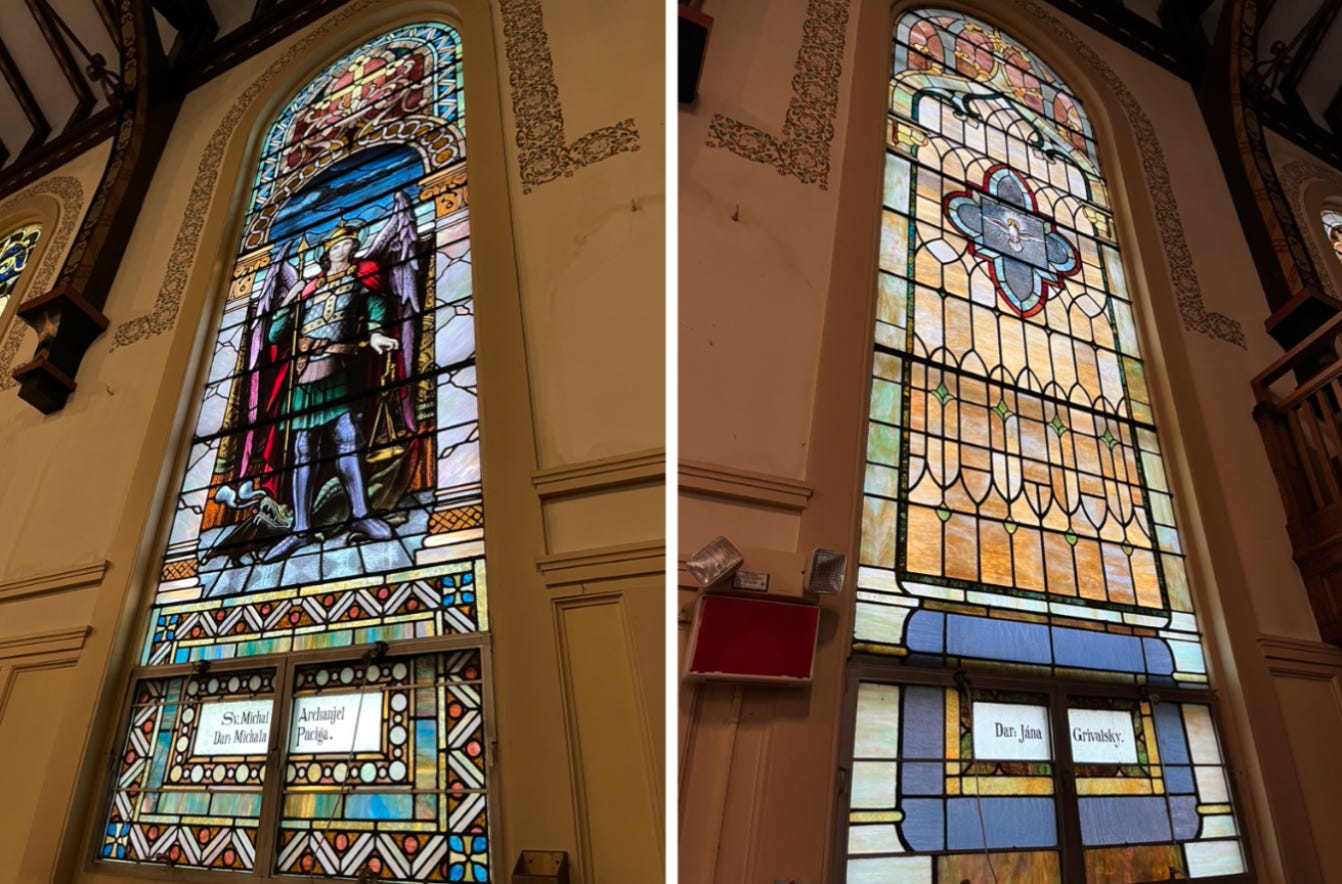
As to the windows, on both sides of the church, 3-story-high stained glass windows lined the walls. They were beautiful and each one was different. I still remember the holy-warrior-like, St.Michael the Archangel on one, and another with the bluish base that reminded me of a jelly jar. It never occurred to me to question why St. Michael was an “archangel” — a higher-ranked angel than all the others. He just was. And he was a warrior…unlike the Archangel Gabriel, who delivered messages to Mary and others. The bottom panels of all the windows had names in Slovak of the people who had donated the money for them.
When I got to my assigned pew — each grade had its own pew to sit in — I still remember sliding my hand along the back of the pew in front of me as I sidestepped all the way over toward the middle. I still marvel at how smooth that heavily varnished dark wood was under my fingers. There was never a jagged bit of wood to catch your finger on, anywhere. The old people had made sure of that.
Reaching my spot, I’d pull down the kneeler, drop my book bag and lunch box on the floor in front of me, and kneel to say my prayers. I was usually there early, when there were barely any Nuns or kids yet. And I liked it that way. Closing my eyes, I’d sigh, “I’m here, God.” It’s interesting, but I would end up saying the same thing in Hebrew, years later in a synagogue, as I stepped into a ritual bath — “Hineini…Here I am, God,”
Anyway, I was now on my time. My moments for peace and quiet. The best part of my day. While I wouldn’t admit it to any of the kids – they all complained about having to go to church before school — secretly, deep down, I absolutely loved it. I wouldn’t have traded it for anything. I loved the stillness, the safety, the smell of holy candle wicks burning, and that tiny, high-pitched sound coming from the steam-fed radiators along the walls. I was in my world. No matter what happened the rest of the day in school or at home, those moments were mine.
After my prayers, I’d sit back in the pew and look around at my familiar things, taking stock to be sure nothing had changed, which it never did. There was the red light of comfort – the always-lit candle in the red glass jar above the altar that hung from a chain and signified this was a Catholic church. And 3 stories above me, there were the wrought-iron framed, medieval-looking, tubular glass lights on chains.
On either side of the altar were racks of votive candles, their flames flickering in red or blue glass holders. On the right side of the church, behind those candles, was my favorite statue — the one of Mary holding her dead son across her lap, just taken down from the cross. Carved into her face was so much pain. But it was especially her eyes that got me. Those were painted in such a way that she actually looked like she was crying. I will speak more of Mary and that statue in the entry about Confession.
Assured that all was well in that my world, I’d feel a flutter in my stomach – a snuggly feeling…like I could stay there all day. I WANTED to stay there all day.
I’d start to pray again. Usually, I started off with “God help me with my spelling test,” or “please don’t let Sister pass my notebook around the classroom again as an example of what a notebook and handwriting should not look like.” It always ended the same. “Please God, make him stop.” I believed in God. I BELIEVED that prayer that said “Ask and you shall receive.” I KNEW God would help me… eventually. If I asked enough. If I asked the right way.
When it was almost time for Mass, an altar boy would come out with that long gold metal rod with a wick at the end that had a small flame. I’d watch him lift the lit end up close to the tall candles on the altar, struggling to catch each candle with that tiny flame. I so wanted to be an altar boy, but girls weren’t allowed then.
On weekdays, Mass was always a “Low Mass,” which meant no singing, and I preferred it that way. Just prayers in Latin, and a quiet start to the day. The Sunday Masses were usually the “High Masses,” which meant that every time you turned around, somebody started singing. That made Mass take forever and drove me crazy. And also, all that singing interrupted my thoughts when I was trying to talk to God. The other thing I liked about weekday Masses was that they were short — the priest didn’t give a sermon. Those were reserved for Sunday Masses, and I could do without them. Which is also funny now, because in the synagogue, I love listening to what the Rabbi has to share. I guess it comes down to what you have to say…and the attitude that you say it with.
During Mass, the priest was busy at the altar doing his prayers. Since he had his back to us and was uttering things quietly in Latin, I would go back and forth between listening to him and continuing with my own thoughts. I loved the richness of the Latin words — Dominus vobiscum. Et cum spiri tu tuo. And especially, Kyrie eleison…though technically, that one is Greek. But what a beautiful line. And it sounded so much richer than the English translation: God have mercy. Years later, I fell in love with the song of the same name, done by Mister Mister. But Kyrie eleison filled my heart with the sense of a power from beyond me.
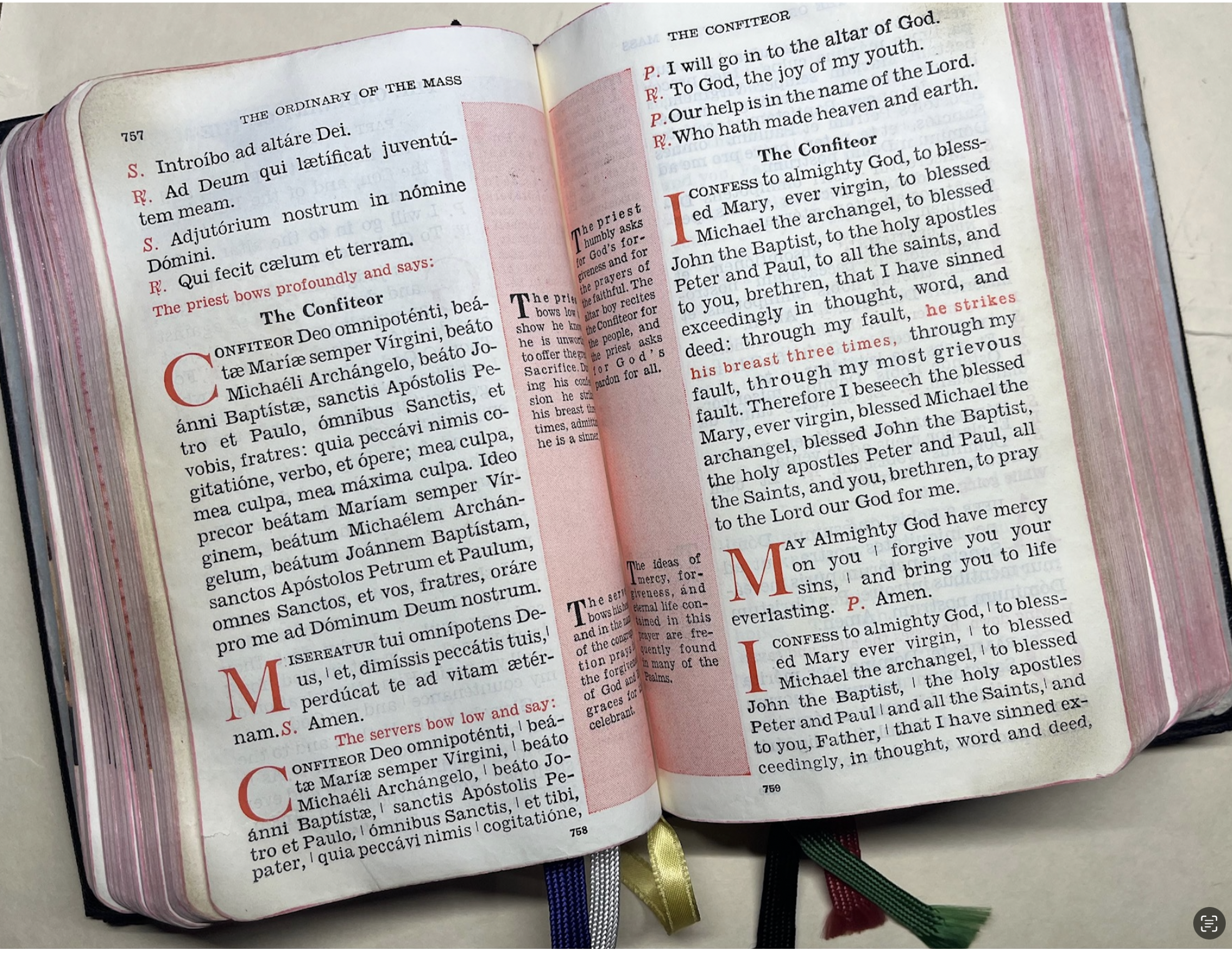
Photo by author
As Mass continued, I’d sit there with my Missal — a Catholic prayer book on steroids — trying to match up the Latin-word page on one side, with the English-word side on the other. In those moments, I felt God and reveled in it. It was me, and God, and no stress.
My favorite parts of Mass were the readings – the Epistles and Gospel stories. Those stories stuck in my head, and they gave me so many lessons for how to live life, especially during hard times. I’ll talk about those stories in the next entry.
During Mass, more and more kids would come in, as they were dropped off by parents or the town school bus. Given that our town was heavily Catholic, and so was the bus company owner, all the schools, public or parochial — which was what Catholic schools were called — got school bus service.
After the Gospels, the priest and altar boys were busy with the rituals that fascinated me — pouring water and wine from glass cruets into the gold chalice, then pouring water over the priest’s fingers into a little bowl. Must have been shades of the early lab person in me. But that sequence of moves, the precision and repetition, always performed the same way, just hooked me.
Then there would be more Latin prayers before the most holy moment of the Mass, the Consecration. Everything stopped — no one moved, and any kids coming into church waited in the back during this part. The altar boy would ring the bells while the priest would hold up the host for all to see. This was the moment when the host was transformed into Jesus’ body. I’d stare at it, trying to imagine God resting in that host. One time, the priest dropped it, and everyone was horrified. After that particular Mass, there was the special cleaning ritual with extra prayers.
Once the Consecration was done, the priest continued with a long stretch of prayers and seemed to list about a thousand different saints by name. Linus, Clement, Cornelius..Lucy, Felicity, Agatha…the list went on. But at least now the kids waiting in the back could come into the pew.
Communion followed shortly after that. I would go up and receive a host in my mouth, thinking about how God had come to me. Was with me. And I was sure that He would help me.
At the end of Mass, I felt almost sad. The quiet time of me and God was over. Now it was on to the rest of whatever was waiting in my day. I’d stand up with my classmates, ready to march in two-by-two formation past the waiting, smiling, old people, out past tall, strong 8th-grade boys with their safety patrol belts across their chests, stopping traffic with their signs, and on to school. But before I left, I’d look up at the altar one last time and think, Thank you, God. See you tomorrow.
Tags: Catholic, christianity, faith, God, Jesus
 Soul Mosaic
Leave a comment