Disclaimer
Aside from school and my quiet morning Masses, my religion had other ways that it was a very strong influence over who I was and how I dealt with what was happening. I can’t speak for how things operate in the Catholic Church today. I have long since left. So what I share here about Catholicism is from what I grew up with and how it affected me, personally, for better or worse. Thus, I speak only about my own experiences, and no disrespect to anyone else’s.
What is Normal?
To a child, whatever they are living in is “normal.” A child has no other experience or way to assess that what they are living in is beyond the pale, or “abusive.” They only know what is reflected back at them from those around them.
For me, that was from the rules of my culture, my religion, my household, the ethics and examples of the adults around me….all the things I have been sharing. And that would have been IN ADDITION TO the constant repetition of brainwashing messages I got at home from Dad. So if all of those influences reflect back to me that this is just normal life, that is what I accepted.
The only other reference point a child has is their own sense, intuitively, of what feels right or wrong, good or bad to them. Their own compass that just comes from within. My own nature was gentle, even as it was competitive. I loved deeply. I was loyal and had a strong code of honor. And I was very sensitive to not hurting anyone’s feelings, especially the people close to me.
I also seemed to have an ingrained sense of morality, and an intense awareness of church teachings and of what was sinful…which meant what was hurting God.
So it was a source of conflict to me to hear Dad’s messages that what we were doing was okay, versus feeling in my gut that it wasn’t right. Then add in what I learned in religion class and in church. And to me, it seemed like what we were doing was a sin, and so I must be hurting God. These were no small conflicts for a child to feel, much less resolve. And it would only get worse with time.
What were those church teachings and influences? I split them into two categories, the first of which I’ll talk about in this essay – the stories that taught a way to live. The second, the rules and rituals the Church laid out, I’ll speak of in the next essay.
My religion back then
When I look back, I see my religious training provided a rock-solid foundation that gave me something to hang on to and to grow around. It was an unshakeable core for 28 years, until I finally got out…at which point, it all exploded — my connection to religion of any kind…and my relationship with God.
I will simply give it credit as a foundation, the one available to me, and which I suppose was better than no foundation at all. Even a tomato plant grows better with a broken fence to climb than to have nothing at all.
There were good aspects of my religion that I internalized deeply — lessons on love, loyalty, compassion, generosity, honor — and the clear rules gave me stability in the midst of chaos at home. In fact, I think some of my ability to sustain for so long in that house came from the support and nurturance I got from my connection to God through my religion.
Other things, though, were not emotionally healthy at all. Passivity and obedience and “kindness” were bred into me so I followed and didn’t question. So, those things contributed to my staying too long, too passively, in that house, and being so “moldable” by my father.
But as a child, I had no idea of any of those things. I simply absorbed the rules, embraced the lessons with my whole soul, felt the hope right to my core, and believed with all my heart in everything I heard and learned.
And as to getting help from God to make Dad stop abusing me, I trusted it was just a matter of time, and to have faith, and wait. God was my friend. And I was taught, and accepted, that life was according to “His will.” And of course, being a mere mortal, it was beyond me to understand God’s will. I just had to have faith and wait.
So, my religion’s teachings were my compass. And I believed.
One REALLY powerful force that I LOVED — Stories
My favorite moments during the Mass were the gospels. That is because those were the stories all about Jesus, His life, the things He said and taught. I loved and related to stories and books in other areas of my life, so this was no different.
The gospels told stories of struggle, persistence, devotion at all costs to friends and family, kindness and generosity – and they so deeply touched my soul and fed me. They molded me, especially given the child I was, longing for peace, and searching for clues to navigate life in general, and at home in particular. Even today, whether it is a novel, a memoir, or the rabbi sharing her thoughts on a Torah portion, I soak up every word, yearning for the message woven within. However, where I now can bring an adult’s mind and sense of balance, as a child, I took the lessons in without question.
The ones that I most fervently responded to, and which formed my sense of ethics, are these.
Keep trying and believing even when it seems hopeless
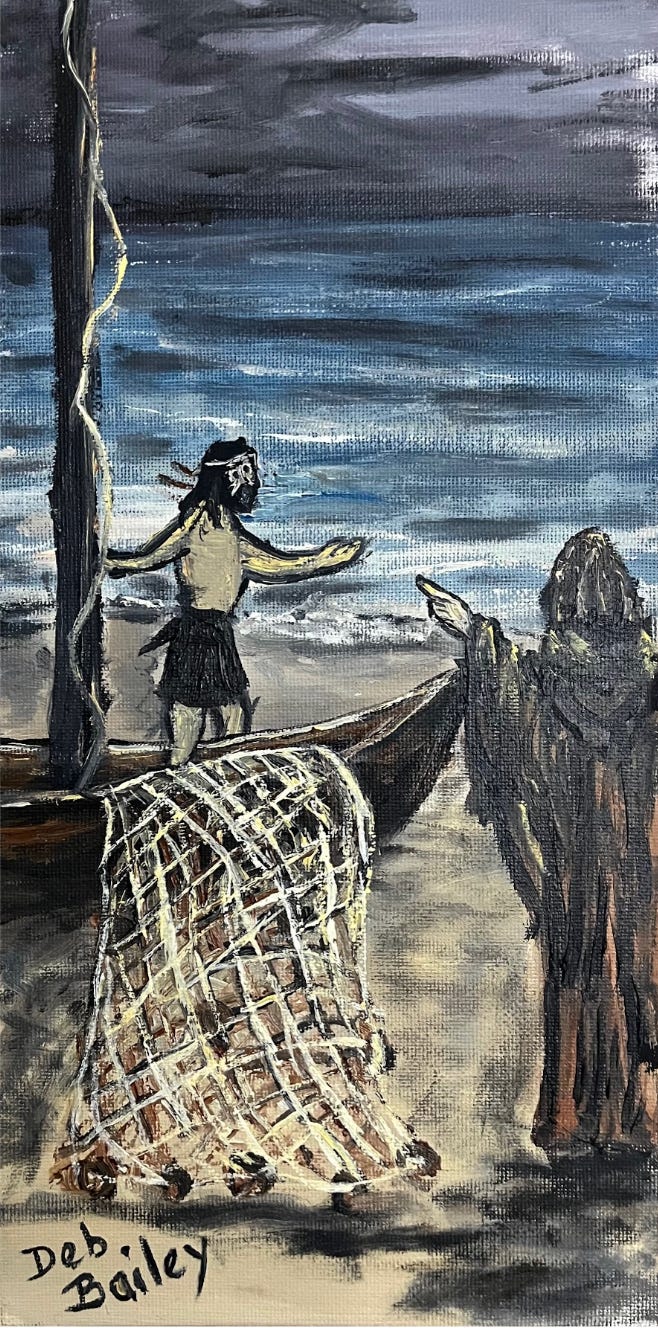
Luke 5:1-11 – The Fishermen
One of the most powerful stories that affected me then…and still…was the one of Peter and his friends out fishing all night and catching nothing. Bone-tired and empty-handed, they returned in the morning, only to be greeted by Jesus, who told them to go back out and try again. He instructed them to put the nets out on the boat’s right side this time.
All the fishermen were incredulous and knew from experience that to obey that command was a waste of time, especially at that time of day. Even Peter expressed his doubts. But he added that because Jesus said so, they would do it. And when they did, they caught so many fish their nets almost broke, and they had to call for more help.
My younger self took in that message of God working in mysterious ways. To my young self, it seemed that God liked to have you sustain, or do things that seemed counterintuitive or illogical, just to prove that faith in Him would yield the best outcome.
So the two lessons I internalized were:
1) When God says to do it, you trust and just do it, even if it seems impossible or illogical.
2) God doesn’t always give you what you want, need, or ask for, right away. Sometimes you just have to wait, and hang on, and try again….and wait again….and hang on again….
So when I prayed for a savior in my house, and it just wasn’t happening “today,” I should just keep throwing the net back in again and again, until things changed.
I also learned that God can be, at the very least, inscrutable as to His motives. I sometimes wondered why God needed all the mystery and drama and proof that you trusted HIm. Why couldn’t He just be up front and do what you needed? But ultimately, I just knew – keep hanging on. It’s God’s will.
God will not abandon you
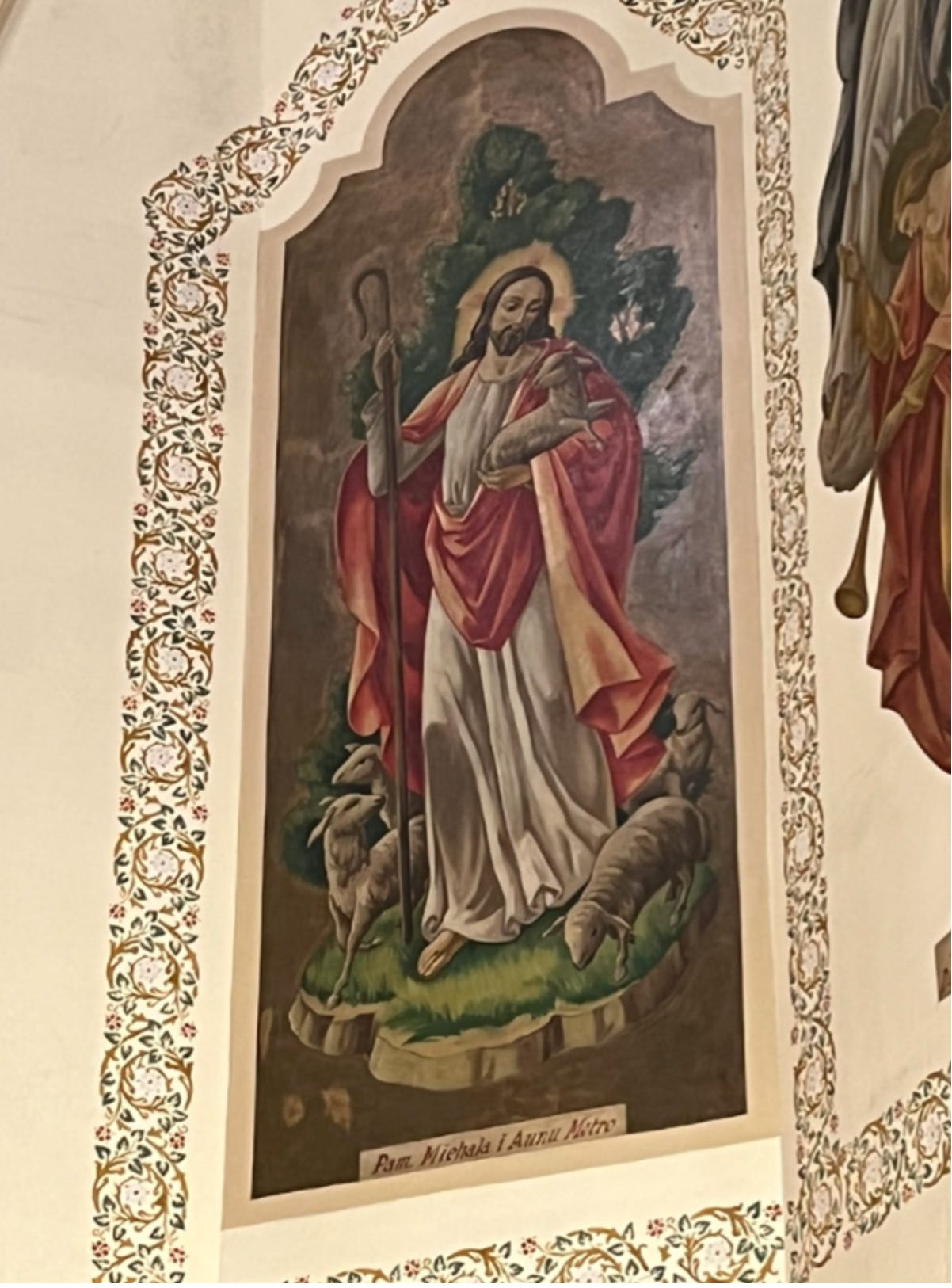
John 10:11-18 – The Good Shepherd
Another was the story of the Good Shepherd, which was Jesus. No matter where you wandered, how far off-track, or into danger you went, Jesus would leave the rest of the flock behind if He had to, and come looking for you. And if needed, He would lay down His life to protect you. I reveled in the idea of someone who would go to such lengths for my safety. I so needed that.
Ask and it shall be given….
As if it reinforced the unwavering protection by the Good Shepherd story, this line cemented my belief that if I prayed the right way, and often enough, surely God would rescue me from the impossible situation I was in with Dad:
(Matthew 7:7-8) Ask and it shall be given to you
And so I asked, and asked…and asked….
Pure love, self-sacrifice and courage
Speaking of being willing to die for the sake of another, two other quotes I took in and adhered to fervently, at least in spirit, were these:
Greater love hath no man than that he lay down his life for a friend (John 15:13)
The two greatest commandments – Love your God with all your heart and soul, and love your neighbor as yourself. (Matthew 22:36-40)
Regarding “friends and neighbors,” I absolutely believed in loving others like me. And that if you love your friend, you stood by them, unconditionally. You didn’t abandon them, but were willing to sacrifice your own comfort, even yourself, for them. It was the ultimate demonstration of pure, unconditional love. Which, to me, was the only kind. Love that came with strings attached wasn’t love. And this rule I embraced totally. Given that I was a child living in absolutes, versus an adult who could think with “nuance,” that approach played to my detriment.
I also believed, with the total certainty and idealism of that child, that you displayed your love by having the courage to lay down your life for them. When I read the story of the teen martyr, St. Tarcissius, I was in awe of his courage. During the days of Christian persecutions in Rome, he volunteered for the dangerous job of carrying a hidden bag of Communion hosts to a group of Christians in hiding. On the way, he encountered his pagan friends, who kept asking what he had, then realized he was a Christian and started beating him and pelting him with rocks. Rather than give up the hosts, he endured the stoning and died. A Roman guard, who was secretly a Christian, brought his body to the priest, and they buried him in the Catacombs.
To me, that story was the ultimate “Greater love” moment. The ultimate sense of courage and honor to aspire to. I wondered, “Would I be worthy if I had to do that?”
And as to loving God with all my heart…I did. And I believed He was there for me. Which made accepting Dad’s version of things harder and harder and harder as time went on. In a lot of ways, I think that sense of God’s word trumping Dad’s is what ultimately powered me to pull myself together enough later to get out. But that would be a long time in coming.
Generosity, money management, and trust in God to provide
The money and charity thing was a bit confusing.
There was a story about a rich man who left for a trip, leaving his servants to manage various funds of money. (Matthew 25:14-30) They were to responsibly tend to those funds while he was away. Two of the three servants invested the funds and made more money for the master. Upon his return, they received praise and a reward for that. The third one, however, just buried the money in the ground out of fear. He preserved it, but did nothing to put that money to work. The master considered him lazy and wicked and punished him. So, it seemed like God wanted you to make as much money as you could. I eventually came to realize this was more about using to the best of your ability, your own personal talents and skills, and not wasting them. But that understanding came later.
At the same time, I heard the other stories that seemed to say money wasn’t a good thing and to give it all away. There was the line about it being easier for a camel to go through the eye of a needle than for a rich man to enter the Kingdom of Heaven (Luke 18:25). Or the story of the poor widow who willingly gave up her last coin in the donation plate, while those much richer only gave out of their abundance. (Luke 21:1-4)
And the most powerful one for me: Matthew 6:26-34. That was the story of how the birds of the air don’t worry about where their next meal is coming from. And the lilies of the field neither toil nor sow, just grow and become beautiful. They let God handle it.
So what I heard then was that it was best to give, and give, and give, even at your own expense. And let God handle things.
Innocence, forgiveness, and God’s caring
Then, there were recommendations to approach life with the innocence and faith of the little children ( Matthew 18:3); to turn the other cheek, no matter what someone did to you (Matthew 5:38-40); and in spite of things, forgive and be generous, such as in the story of the Prodigal son who squandered his inheritance, returned contrite, and was welcomed back with love. (Luke 15:11-32)
And who could listen to words like The Lord is My Shepherd, in Psalm 23, or that God knew and watched over me even in my mother’s womb in Psalm 139, and doubt God was watching over me?
And the Beatitudes….
(From the Sermon on the Mount – Matthew 5:1-11)
They speak for themselves in terms of what was best to be in life…
- Blessed are the poor in spirit, for theirs is the kingdom of heaven
- Blessed are those who mourn, for they will be comforted
- Blessed are the meek, for they will inherit the land
- Blessed are they who hunger and thirst for righteousness, for they will be satisfied
- Blessed are the merciful, for they will be shown mercy
- Blessed are the pure in heart, for they will see God
- Blessed are the peacemakers, for they will be called children of God
- Blessed are they who are persecuted for the sake of righteousness, for theirs is the kingdom of heaven
So all of these various tales and parables were key in forming who I was and how I thought I should live my life.
But there were other things too.
You are a sinner….
The biggest thing that was constantly drilled into me was that I, and everyone, was a sinner. From the very moment of birth, when I came into the world, my soul was already stained by the “Original Sin” of Adam and Eve in the Garden of Eden. That was the Church’s take on things – Eve listened to the serpent and ate the apple. Then she gave it to Adam, and he ate it. Since God had told them not to do that, and they had disobeyed God, they were then thrown out of the Garden of Eden. From then on, they were sinners and were meant to spend their lives in suffering, along with all of their descendants.
In the Church, when you are baptized, that stain of Original Sin is removed, though if you die before being baptized, like my infant brother who was stillborn, then you can never go to heaven because that sin is still there. The best you can hope for is “Limbo,” which I was told was a nice place, but not like heaven. I never quite liked that logic. It wasn’t my brother’s fault that he died before he could be baptized. Why was he stuck forever in Limbo?
But moving on from that, even if you were lucky enough to be baptized, you were still facing an entire life of struggle to avoid sin, repent your sins, and pray that God would save you from your sins. Bottom line – you were, are, and always will be a sinner…all because of Adam and Eve. They cursed us with THEIR sin.
That is a heavy load to place on anyone, much less a child. So, needless to say, I was frantic about trying to avoid as much sin as possible. I mean, being a sinner to start with, I was trying to follow the rules so I could stay in God’s good graces and not do more things wrong.
Then, if you add onto that, Dad was doing something that he said was okay, yet I wasn’t so sure. And that doubt would only grow stronger as time went on. And, add to that what the Church called a sin seemed exactly like what we were doing. So, I was confused, worried, and frantic. What if Dad was wrong, even though he kept saying he was right? That meant there was more sin being piled on my immortal soul.
Story and rules have tremendous power, positive or negative. For sure, all the sinful talk had a very negative effect on me. For contrast, here is an interesting twist on the power of story to change one’s whole outlook in a positive way.
Take this same Garden of Eden story. Only this time, tell it as the rabbi did the other night.
Adam and Eve, coddled in their perfect life in Eden, were more like plastic people. No problems. No ability to understand problems. They had no guile. No hubris, rebellion, or evil tendencies. And no awareness of the world.
Instead, they had been invited by God to reach for more. They could become alive, and partner with God to explore the continued creation of the world, because creation is ongoing and never done. They could be part of the building, fixing, and healing. But to do that, they needed the knowledge from the Tree of Life. So it was Adam and Eve’s choice to stay or eat the fruit and enter the world with a deeper awareness of struggle. God let them decide, and they accepted the invitation. So, eating the fruit was not a sin of any kind, but a choice for how to live their lives with God, and do more.
And instead of waking up each day facing that heaviness of sinful nature, we could instead wake up each day seeing that new day as a chance to start fresh. From the beginning…B’reisheet. That is the word in Hebrew that means being back at the beginning. So each day could be a new B’reisheet, to do the work of the creator and live the Psalm line: This is the day the Lord has made. Let us rejoice and be glad in it.
Told in that manner, WHAT a much more powerful story of compassion, and willingness to take on challenges to help others. A powerfully positive take on the same event.
So yes, story was a powerful motivator for me, and still is. And it determined so much about the code of ethics I would form and live by for so many years.
But there were two more influences that cemented the requirements for dealing with all that sin, and only intensified my conflicts….
 Soul Mosaic
Leave a comment