Whispering the disaster to come
The first time I walked into a therapist’s office, I was actually shaking. Terrified, consumed with shame, and coming apart at the seams, I could barely speak. In fact, when I told the therapist why I was there, I could only WHISPER the words because I was so afraid. For 28 years, I’d been brainwashed, guilted, and bullied into loyal silence by my father. And I understood that just by walking into that office, I was breaking EVERY ONE of those rules drilled into me for a lifetime. I expected unimaginable horrors to descend on me, though I couldn’t tell you what they would be. I was just convinced that this was going to result in something terrible. AND I would be inflicting hurt on my family, because of my “transgression in speaking.”
But I was hanging on by a thread, and was actually scared about how unglued I felt. I was caught between two “no-win” situations. I was damned and betraying my family if I spoke. And I was going down the tubes if I remained silent. I’d never felt this low or hopeless before. And God was of no use to me anymore.
For all those years, I’d believed in and prayed to God for help. Yet in the end, it seemed that I’d asked but not received. I’d had to get myself out of that house, alone. And that was the story of my life, past, present, and future – I was alone. So it was on me to save myself. God was out of the picture. And if my only choice left was to mentally “jump out of the plane,” so be it. Life would either provide a parachute or it would finish me.
I will talk more about that day later. But for now, I will share a comment that the therapist made to me a few years later. I had made very good progress and had stopped seeing him. We happened to run into each other in the lunch line of the local hospital where I worked, and he saw that I was married and pregnant. Stepping to the side so we could speak privately, I could see excitement almost bursting out of him. Congratulating me, he said with much emotion, “You know, between the abuse, the brainwashing, and the Catholicism, I didn’t think there was any hope for a recovery.”
While I knew that under normal circumstances, he probably wouldn’t have said that to a patient, I understood his absolute joy. This was the man who started with me when I was a pile of broken pieces that seemed beyond repair. So I both understood …and shared…his amazement at how things had changed in my life for the better.
In looking back, I realize it was a moment of bliss for both of us for all the work we did. I say, “moment,” though, because I had no idea then how much else was waiting for me down the road. However, for that moment, it was lovely. I’ll come back to “down the road” later.
The religious “molding”
But to finish the story of my “religious molding,” throughout that childhood, I believed in my religion totally. Just like believing that the rest of my life, though not perfect, was “normal.” You embrace what you are surrounded by and have no awareness that it could be any different. Or should be.
Daria Burke wrote a wonderful, insightful memoir called *Of My Own Making*. She wrote about growing up in Detroit, with an absent father and a mother plagued by drug addiction. And she summed it up perfectly, “ We are hardwired to seek out and trust the familiar, even when the familiar isn’t safe or good for us.” I lived that.
So where my family, religion, and God were concerned, I just accepted. I learned the prayers. Recited them regularly, by heart. Strove to do everything right. And there was a lot to keep track of, in order to do things right in my religion. Rituals, talismans, prayers, and rules. LOTS of rules.
Rituals
I am a lover of ritual in all areas of my life. For example, every morning, after I shower, meditate, do my stretches, and have breakfast, I make my coffee. It is a “pour-over” coffee. I’ve tried French press, drip, iced, and even the coffee pod machines. All of those are fine, but…I need ritual to start my day with peace. So, for daily imbibing, it’s pour-over.
I get out the same thermal canister, balance the red, plastic, coffee-ground funnel atop the wide mouth, and carefully smooth the bamboo-paper filter inside. Bamboo ones because they are easier on the environment.
Then I spoon in 3 heaping tablespoons of ground coffee – always heaping to the same height and shape using the same stainless-steel coffee measuring spoon. The coffee choice for the day rotates through four light roast blends that I love, blends I buy as whole beans from the various roasting houses.
One is from a local company, whose employees and whose main coffee roaster have various neurodivergence issues. The second is from the Savannah coffee shop we discovered on our first visit there. The third is an Ethiopian blend from another Savannah coffee shop. And the last is from an online company that responsibly sources the beans. I had sampled over 20 different types of coffee from them. I tried different roast levels, beans from different countries and continents, different grind levels, then smelled the fresh beans, the grounds, and the coffee they made, before finally selecting my favorite one.
While I used to hand-grind the beans for the visceral feel of the process, arthritis in my thumbs makes that too difficult now. So I researched various grinders and selected the electric one with high-carbon steel burrs. Those would grind the beans carefully and consistently, without overheating them. And I always grind them to the same granule size, for the best extraction of flavor.
Using filtered water, I heat it to almost boiling, then adjust it to 190 degrees Fahrenheit with ice cubes…using a digital thermometer, of course! And I add a few ice cubes to the canister so that when I add heavy cream to the brewed coffee, it doesn’t curdle the cream. I also sprinkle in a few grams of sea salt into the canister to counter some of the coffee’s natural acidity.
To further blunt acidity, I will first add just a bit of the hot water to the grounds, then let any carbon dioxide still in the ground beans bubble off. The fresher the beans and grind, the more bubbles of carbon dioxide there are. Since that is an acid, releasing as much as possible also gives the coffee a smoother taste.
After doing this twice, I finally add the rest of the water to the grounds, circling slowly over them, around and around, and into the center of the funnel and back out again. Then I add a generous dose of heavy cream – the one thing I judge by sight – put the lid on the canister, and sit down to enjoy my first sip of the day.
Can you say, obsessed with ritual? I didn’t watch the priest on the altar all those years to not fall in love with ritual. Maybe that’s why I always enjoyed working in the lab, too. Very specific processes, done the same way, for the best results.
But there is also something so incredibly soothing, quiet, and blissful in watching or doing a same routine over and over. Ritual is meditation. A mindful, total absorption in a practice that tunes out all other noise and distraction, and allows you to hopefully hear the quiet voice of God within you. It is that way for me now. And for a kid living in unpredictable violence, chaos, and abuse, the rituals of my religion were heaven on earth.
Aside from all those Masses, there were other special moments of ritual that my religion delivered.
Every Spring, on the Thursday night before Easter Sunday – Holy Thursday as it was called – we would have a special service. It included a procession by many of us in our white dresses, the Mass of the Last Supper, and a litany. Several priests from neighboring towns would also be there. They’d converge on the rectory, don special garments, then gather on the altar to “concelebrate,” as it was called when many priests shared performing the service.
The litany – the “Litaniae Sanctorum” or the Litany of the Saints – was a very long one. It was pages of repeated Latin prayers to God and to various saints. It’s done now in English. But again, back then, it was in the Latin that I loved. It was beautiful.
The service would end with another procession while the servers stripped the altar of all things on it. This was to prepare for the solemn Good Friday crucifixion service. Everything being removed from the altar and emptying the tabernacle symbolized Christ’s death and absence from us.
Later in the spring, in early May, there would be another service including a different litany — Litaniae Lauretanae or the Litany of Loreto — in honor of Mary. May is Mary’s month, and after this service, we would hold a crowning of Mary’s statue outside, placing a wreath of fresh flowers upon her head.
And then there were Gregorian chants. As an adult, I took a music appreciation class at the local community college and was introduced to these. Gregorian chants are hauntingly beautiful, single-vocal melodies sung in Latin. As part of the class, we visited a local abbey of cloistered nuns one Sunday. I listened in pure bliss to their soft voices singing words of Latin in the spare melodies of 9th-century music. Even today, I will sometimes play Gregorian chants while I write.
So those were the moments then, that I savored and found peace in. Today, I still find peace by making moments of ritual in my present-day life. And not just for coffee. It is especially helpful when I am having PTSD anxiety attacks and flashbacks. Rituals of any kind ground me and bring me back to a place of centered calm.
Talismans or Sacramentals
In keeping with rituals, there were talismans that were endowed by the Church with a spiritual power. The Church called them “Sacramentals.”
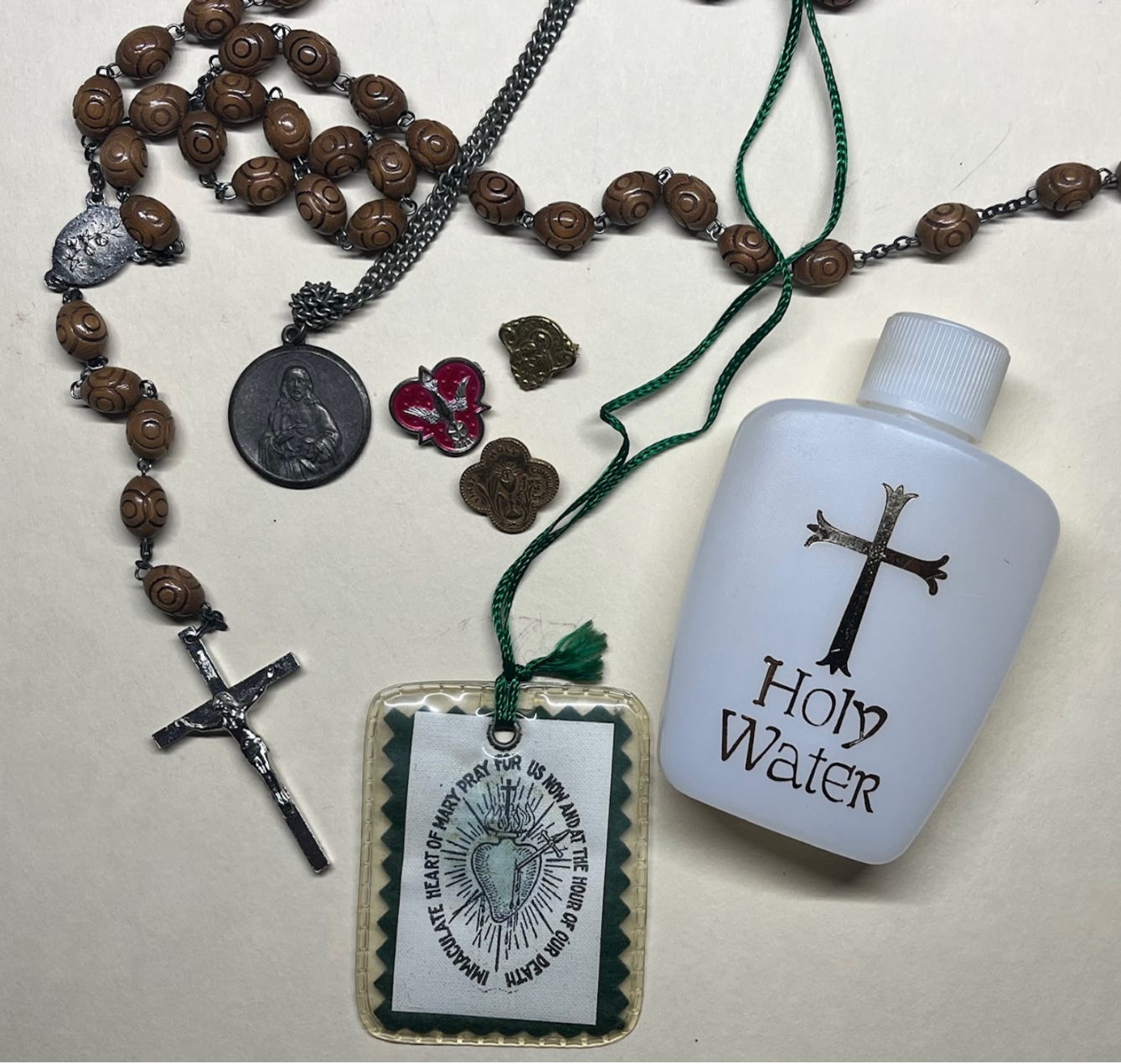
These are holy actions or things that the Church uses to get special spiritual favors from God, on our behalf. And they are treated with deep reverence. For example, any item that has been blessed requires special prayers and processes if it is to be disposed of. Often this means saying a prayer and then burning or burying the item. Even now, I still view them with a sense of the sacred, despite the fact that I am no longer Catholic. It just seems the proper way to respect other people’s beliefs, and there is also still that young child within me who cherished all of these.
The holy objects and actions include things like:
- Holy water
- Blessed candles
- Rosaries – always blessed
- Holy Scapulars and Medals
- Crucifixes
- Statues, or Holy cards with pictures, of God, Mary, or the Saints
- Blessings from priests
- Kits for priests to give a dying family member the Sacrament of the Sick at home
- Relics
To give an example of the power these were viewed as having, it was instilled in me from a young age to ALWAYS carry a set of rosaries with me. Ones that had been blessed. Not just brand new ones. I am not sure if it was because they would keep me safe, or as my mother also said, they would let everyone know I was a Catholic.
I still carry a set in my purse. I have wondered why. But they are a set that my mother made by hand for my uncle, who was the missionary priest in Puerto Rico. He would give them out to people who couldn’t afford them. So my mother made this set, sent it to my uncle to bless it, then gave it to me. On some level, I guess I am just not ready to let it go. And maybe I never have to. For one thing, I consider it a connection to my mother and uncle. Just like the voicemail on my phone from my mother that I have not deleted, even as she has been dead for a few years now. I just don’t want to or am not ready yet. And certainly, there is that child’s belief that it can’t hurt to have Mary along with you for the ride.
In fact, I now have a small altar at home that has items from my life’s spiritual struggles and journey. There is a crucifix to honor those early years. A Buddha statue for the years I studied that discipline and found my way back to God. And a mezzuzah for my final spiritual home, Judaism. I’ll talk more about those efforts later, but whenever I travel, I always take those three items with me and have them as a small altar in my hotel room. They are there, more to be mindful of my soul’s peace, wherever I am. My husband refers to them as the “Traveling Deities,” and I like that.
As to the last item in that list – relics – I was thrilled as a child to have a rosary that had a thick crucifix at the top. You could unscrew the back and remove it to reveal, inside, a thin piece of something that was supposed to be part of the bone of a saint. I have no idea how I got that rosary, what saint gave the relic, or what bone it was supposed to be from. Or even if it was a bone at all. But I treasured that…until somewhere along the line I lost the little relic piece, and then later, that particular crucifix, which broke off the rosary set. That happens in childhood. But I remember it fondly.
Prayers
Another comfort through its predictability was some of the standard prayers we learned. First, we learned the basic ones, the Our Father, the Hail Mary, and the Glory Be. I liken those to learning the alphabet or basic words. Once you have a few words, you can make a sentence. Well, if you knew those three prayers, then add on the Apostles’ Creed and one called the Hail Holy Queen, you could now make the “sentence of the rosary,” because those were the prayers you needed to say a rosary.
Praying a rosary usually took anywhere from 15 minutes to a half an hour, depending on whether you uttered the prayers slowly and mindfully, or you rattled them off quickly. But you started at the crucifix with the Apostles’ Creed, then to the beads on that same chain for one Our Father, three Hail Marys, and a Glory Be. Moving down to the circular part with all the beads, you would say five rounds or “decades” of prayer sets. Each set included one Our Father, ten Hail Marys, and a Glory Be. At the end, you said the Hail Holy Queen prayer, and then you were done.
For additional storytelling, some would name each decade of ten Hail Marys with the name of a “Mystery,” or story. So you could have a rosary with the five “Joyful” mysteries. There, each decade told part of the story of Jesus’ birth and early life. Or you could say a rosary with the five “Sorrowful” mysteries, which were about His crucifixion and death. Or the five “Glorious” mysteries, for His Resurrection and Ascension into heaven. There are more now, but these were the three when I was young.
I always just did the basic rosary, though, with no stories mixed in. I found it a distraction. If I did a rosary, I was trying to talk to Mary, not read a story. Again, it was all ritual, so it was mostly comforting.
But in looking back at the prayers I was taught, there was also some heavy negativity woven into the words. For example, even the Hail Mary prayer, which to me was one of the more positive ones, ended with a second verse that included the lines: “Holy Mary, Mother of God, pray for us sinners…” And the Our Father included the sentence, “Forgive us our trespasses as we forgive those who trespass against us.” So it was always about reminding us of our sinful nature. And in the latter one, it also made our forgiveness conditional on our forgiving others.
The ultimate one, though, was the prayer at the beginning of Mass — The Confiteor — which was about confessing our sins. But it didn’t just say we sinned, but that we “…GREATLY sinned” and added that I sinned “in my thoughts and in my words, in what I have done, and in what I have failed to do.” So that line covered just about everything in life I did. But for final extra emphasis, the closing line reminded me that it’s not just my fault, but: “my fault, my fault, my most GRIEVOUS fault,” before asking almost everyone in heaven to pray for me. Sin. Sin. SIN.
Other prayers were about making sure you never forgot what you agreed to believe in. The Apostles’ Creed wasn’t too bad. It listed the major tenets of the religion but was pretty brief. But then a bunch of Church Fathers gathered at a conference in Nicea around 300 CE to do what they did best — double the word count to say the basically same thing, with some added clauses of extra beliefs for good measure.
The Act of Hope?
And then there were the three prayers of “theological virtues” that we learned by heart: The Acts of Faith, Hope, and Charity (Love). The Act of Faith was basically the above creeds, but condensed to a paragraph. That was fine. And the last one – The Act of Charity or Love – I actually liked. It was just a recap of the two most important commandments about loving God most of all and loving your neighbor as yourself. Always good rules to live by.
But the Act of Hope – that middle one – is the one I look back at and realize how just how little hope it offered me. If anything, it was more stress.
It started out well enough by telling God that I was relying on all of His power, mercy, and promises. But then, instead of offering words that could sustain me in my house, or show me how to handle things, it went into that main second line. The one that made it clear that the only hope I should be interested in was the “hope to obtain pardon of my sins,” with the help of God and Jesus.
Nowhere was there a word about sustaining through crushing emotional duress. Nothing there about feeling life was worth living. Or that I was a good person and should keep going because things could get better. Nothing. Life was simply about saving your sinful self. Things like happiness, joy, self-esteem, playfulness…things of life now had no value.
I was a kid desperately trying to hang on to “hope”…for him to stay as the “nice” Dad. To stop abusing me. To stop hitting Mom. Hope that even if NOW wasn’t okay, somehow, sometime in the future, it would all be better. That SOMEDAY this would all be over and we could just go on normally. And that sooner or later, God would save me. But saying the Act of Hope? None of that was there.
The Baltimore Catechism
From 1885-2004, this was THE rule book for the Catholic faith. Set in a question-and-answer format to the tune of about 500 questions, it covered all the details a Catholic needed to know about beliefs, commandments, prayers, and the sacraments. I understand it is no longer used.
But as part of making our First Confession, First Communion, and later, our Confirmation, we had to memorize the answers to many of them. In fact, for Confirmation, the bishop would shoot questions at you, and you’d better know the answer, verbatim. If you didn’t, you would answer not only to the bishop, but also later, to the nuns. And that was worse because you only saw the bishop once. The nuns you would see every day. It was also considered a good thing if the bishop smacked you on the cheek, even when answering correctly, because that proved you would be a good “Soldier of Christ.”
I will admit that if you are trying to instill complicated lists, definitions, and rules in kids, this tool was probably the only way. Especially when you are trying to get across things like:
- The explanation for 3 persons in one God
- 10 Commandments
- 7 Sacraments
- 7 Deadly/Capital/Grave sins (names used interchangeably)
- Mortal vs Venial sins, their rules, and the rules about Original Sin
- Who goes to Limbo, and how does Purgatory work?
- 7 Spiritual and 7 Corporal works of mercy
- Different types of grace – Sanctifying and Actual
- How to get grace – God, prayer, Sacramentals
- 7 Gifts of the Holy Spirit
- 12 fruits of the Holy Spirit
- Moral and Cardinal virtues (in addition to the theological ones above)
- Sacramentals
- God’s judgment – specific and general
It was a lot. And reading it now, I just shake my head. Again, this is my opinion, only.
But as a kid, and being the frantic sinner and detail person, I tried to get it all straight. I believed in all of these things in my religion – I had no reason not to. This was just part of my life.
So these were the rules that trained me to be nice, not hurt anyone’s feelings, including God’s, and most of all, to comply with the rules. I was especially worried about being a sinner. And that brings up one of the most powerful rituals that haunted me then, and now – Confession.
To this day, I can still feel the heaviness of a mid-Saturday afternoon, and that existential fear as I weighed the question: “Do I go to Confession…but then, what do I tell the priest?” or, “Do I stay home and risk going to hell if I should die, because I am living in sin?”
And I was deeply affected by both the prayer for Confession – the Act of Contrition – and my awareness that if the MANY rules and criteria weren’t done right, that confession wouldn’t even count…
So, next…Confession.
 Soul Mosaic
Leave a comment