Mary…The Blessed Virgin….The BVM…The Lady in Blue…The Mother of God…The Black Madonna…Compassion Goddess…Great Earth Mother….Tara….Kwan Yin…
Regardless of the name, the embodiment of mothering, compassion, and love in some feminine form has shown up in all cultures and time periods. I will talk more later about my own journey to make my peace with a “spiritual mother” in my life. It was something I rejected for a good part of my adulthood, but I have since welcomed back, this time with a much broader understanding of things.
During my childhood, it was Mary, Mother of God, or the Blessed Virgin Mary. And as much as I loved God and prayed to Him, it was his mother that I really felt close to. He was scary. She was welcoming. Approachable. Kind. And never more so than on those Saturday afternoons after confession….
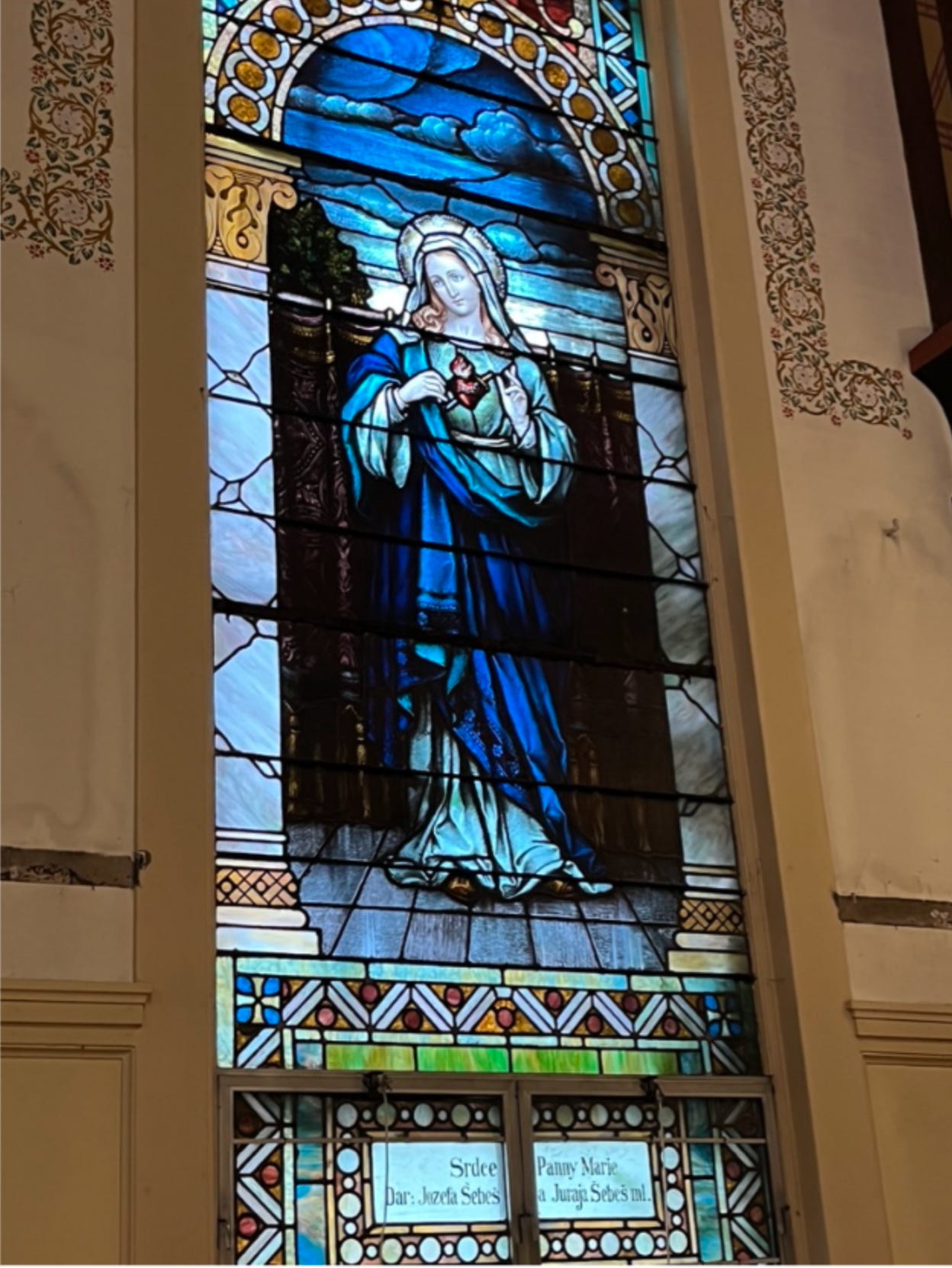
Once the ordeal of confession was over and I’d said the prayers for my penance, I’d wander around the church. Emotionally spent, but grateful to be in a total state of grace again, I wanted to remain in the peace of that church for as long as possible. I would have stayed there forever if I could have.
The first place I wandered, ALWAYS, was to the front of the church. My two favorite things were there — the votive candles and Mary’s statue. It was my favorite statue of the many in our church. She was tucked off to the right side of the front altar, kind of her own “grotto,” right next to the flickering votive candles.
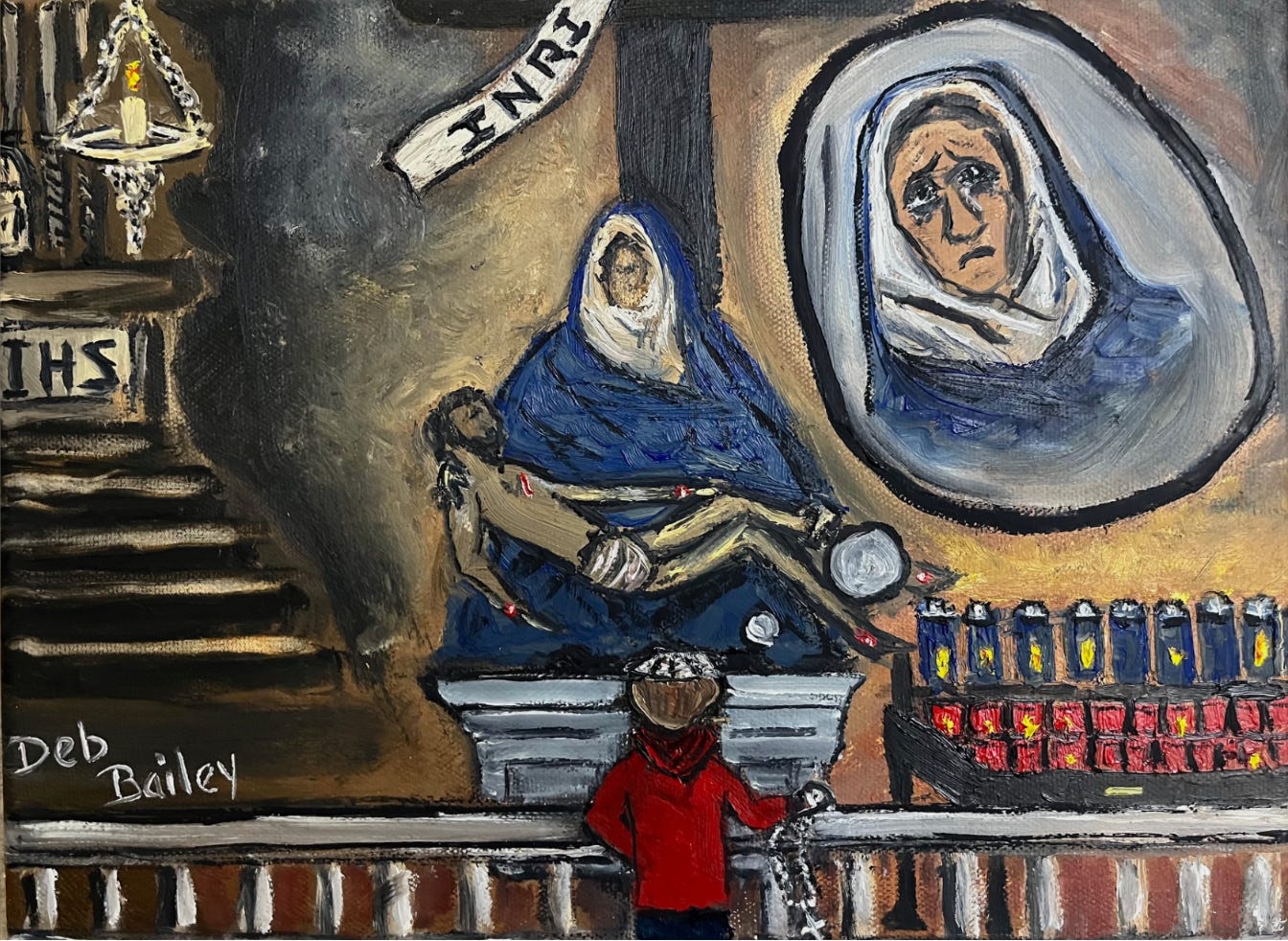
About the candles, that was my child-self loving to light them. There were two kinds in our church – small red open-topped votive candles. Those, once lit, would last for a few days. Behind them were tall blue-glass containers with silver metal lids. Those lasted a week or so. The whole point of the candles was to remember someone you cared about. Alive or dead didn’t matter. Or maybe it did. But to me, it was all about the candles and anyone I cared about.
I never messed with the tall blue ones. Those were expensive and had to be arranged through the rectory office. You would tell them who the candle was in remembrance of, pay the donation for it, and they would light the candle for you.
The small red ones you could light yourself. You would decide who you were lighting a candle for, put a few coins into the metal box for a donation, and then say a prayer for that person.
So when I knew I was going to confession, I would dig out some coins from my allowance. Then, depending on how much money I had, I would think of someone, or a few people, who were either having a hard time in life, or who had died, and they would be the ones I would pray for.
There were wooden sticks in a box on the side of the candle stand that you could use to catch fire from an already lit candle. Then you would light however many red candles you wanted. Once done, you would drop your coins into the donation box, kneel there at the altar, and say the prayers for those people. While it was fun to just light candles, and I enjoyed the ritual of it, I also cared about the people I prayed for.
However, the most intense draw for me at that front altar was Mary. Her statue. I FELT that statue in my heart. I would stand there for a long time, just studying the whole thing. She was there, in agony, holding her dead son, Jesus. He had just been taken down from the cross after being crucified. And I spent a lot of time thinking about that day, standing there at the bottom of the cross.
What was it like to lose your son? I know my mother was sad about losing hers, but like she said to her friend one time, “You can always have more children.” But Mary seemed to display so much more than “sad.”
I looked at Jesus, lying there, lifeless. The body was painted in the white-grayish color of death. There was no longer any blood coming from the wounds they inflicted on him — the nail holes, the lance wound in his side.
And, in spite of just having come out of confession and promising to avoid the near occasions of sin, I couldn’t help but notice that he was almost totally naked. Only a loincloth on. And of course, my eyes scanned “that area.” I would quickly catch myself and feel a twinge of guilt, because I wasn’t supposed to be thinking those things. And worse, this was supposed to be God, and I was looking at His naked body.
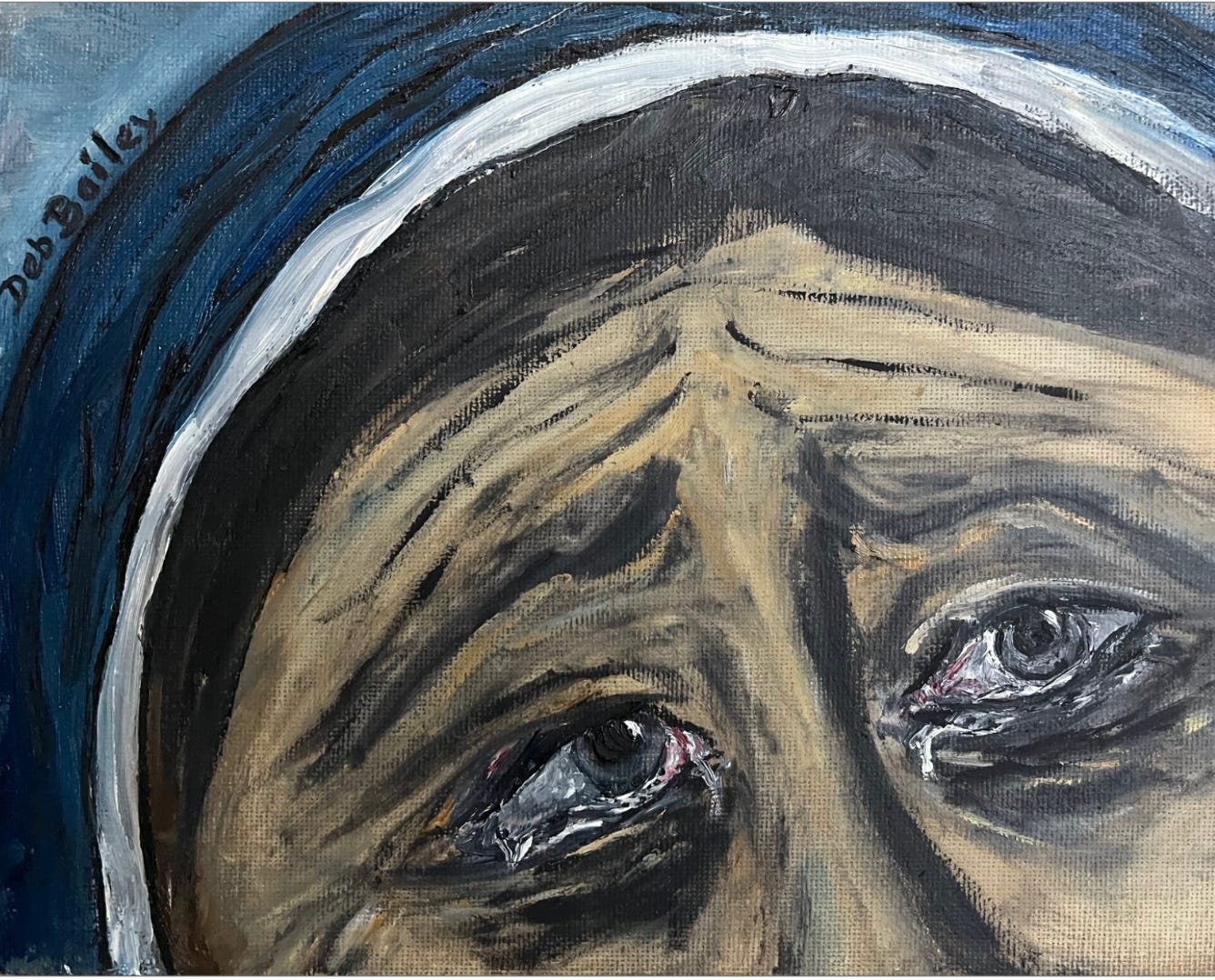
So I would turn my attention quickly back to Mary, to her face…and especially, to her eyes. They actually appeared watery, like she was crying. The priest said that the artist painted it that way on purpose. I was riveted. How did he do that? It seemed like magic to me. Beyond those eyes, there was her face — crushing sorrow etched in every line.
I thought about the stories the nuns told us of Mary — How she was loving. Long-suffering. Carried her pain in silence. And that she never had any stain of sin on her soul, not even Original Sin. That was God’s gift to her for being Jesus’ mother.
For me, I marveled at the idea of someone never doing anything wrong. HOW did she do that? I thought back to the statue of her sitting there holding her dead son. Wasn’t she angry? Even a bit?
The Church always portrayed Mary as a “saintly,” composed, cardboard figure, who “understood” this was all part of Jesus’ path and that, of course, He had to die. And the Church said she took it all with total faith and emotional equanimity. Did she? Was that part of her “perfectness” that she wasn’t upset? Or was that the way the Church Fathers wanted her portrayed? Their instrument to convince the rest of us to stay in line and just accept without question, life’s suffering as God’s will.
By the time that I escaped my house as a young adult in total despair, I despised her. Even as I tried to hang onto some connection to her spiritually, I saw her as a willing victim, a passive, powerless, milquetoast woman. A doormat. And I would hold that view for a couple of decades, even as I tried to understand her. It wasn’t until I studied Buddhism that I was able to reconsider God, and then Judaism led me to reconsider Mary. I will speak about those experiences later in the book.
But on those Saturday afternoons, I only knew I was drawn to her even as I never understood why. It is only recently, after painting these images, that I realized what it was. **HERE WAS A MOTHER WHO CARED ABOUT HER CHILD AND HIS SUFFERING**.
My mother never asked why I was going to confession so much. She never turned around when Dad was doing things to me in bed right next to her. She never checked on me after he spent an entire Sunday afternoon emotionally bludgeoning me. Maybe she cared about me, but maybe she hated me. I was never quite sure. But Mary. HERE was a mother who cared. So I would stand there for a while, just staring into the face of a mother who loved her child beyond everything.
After I lit candles and visited with Mary, I would sometimes take out my Missal. The back half of that thick prayer book was filled with gospel stories, readings for different times of the year, and special prayers…prayers that gave you indulgences.
Indulgences, the way I understood them at the time, and I read recently that this understanding was incorrect, were a way to earn “days off from your time in Purgatory.” The Church may not have intended the prayers to be thought of that way, but everyone, myself included, did.
We all knew that no one, except for Mary, some saints, and the martyrs, went straight to heaven. That was drilled in. The rest of us normal sinners were going to spend time in Purgatory. The nuns told us it was a place of suffering to make up for our sins throughout life. It wasn’t as bad as hell, and it wasn’t forever, like hell was. And it even had different levels of suffering and time spent there. That was determined by how sinful you had been in life. The more sins you racked up over your life, even if they were forgiven and absolved in confession, the more time in Purgatory, and probably the more intense your suffering there.
But the Missals had prayers with these things called Indulgences assigned to them. The idea was that if you read that prayer, you’d get some days off from Purgatory with the indulgences. Accumulate a bunch of those, and maybe you could reduce that time quite a bit.
In the Middle Ages, Indulgences were often purchased by the wealthy who could afford to donate large sums to the Church. That became quite the scandal and even led to Martin Luther’s protests and the Protestant Reformation. Eventually, indulgences were just something you could “earn” by saying special prayers and Novenas. Novenas were a long group of prayers said repeatedly for a month at a time, and those gave you many days off from Purgatory. Other, shorter prayers that you only had to say once gave you fewer days off from Purgatory, but still, it was something.
I was pragmatic. I knew I wasn’t going to say month-long novenas, but still, a few short prayers and some indulgences couldn’t hurt. So for good measure, I’d pull out my Missal and spend some time with those prayers.
Finally, I knew I had to head home. Before I left, I would spend a little time in the vestibule by the rack of holy books to see if there was anything new I wanted. Then, out of time, I headed home.
I would try to avoid him, and the near occasions of sin for as long as possible so I could preserve that state of pure grace that I was in….
 Soul Mosaic
Leave a comment