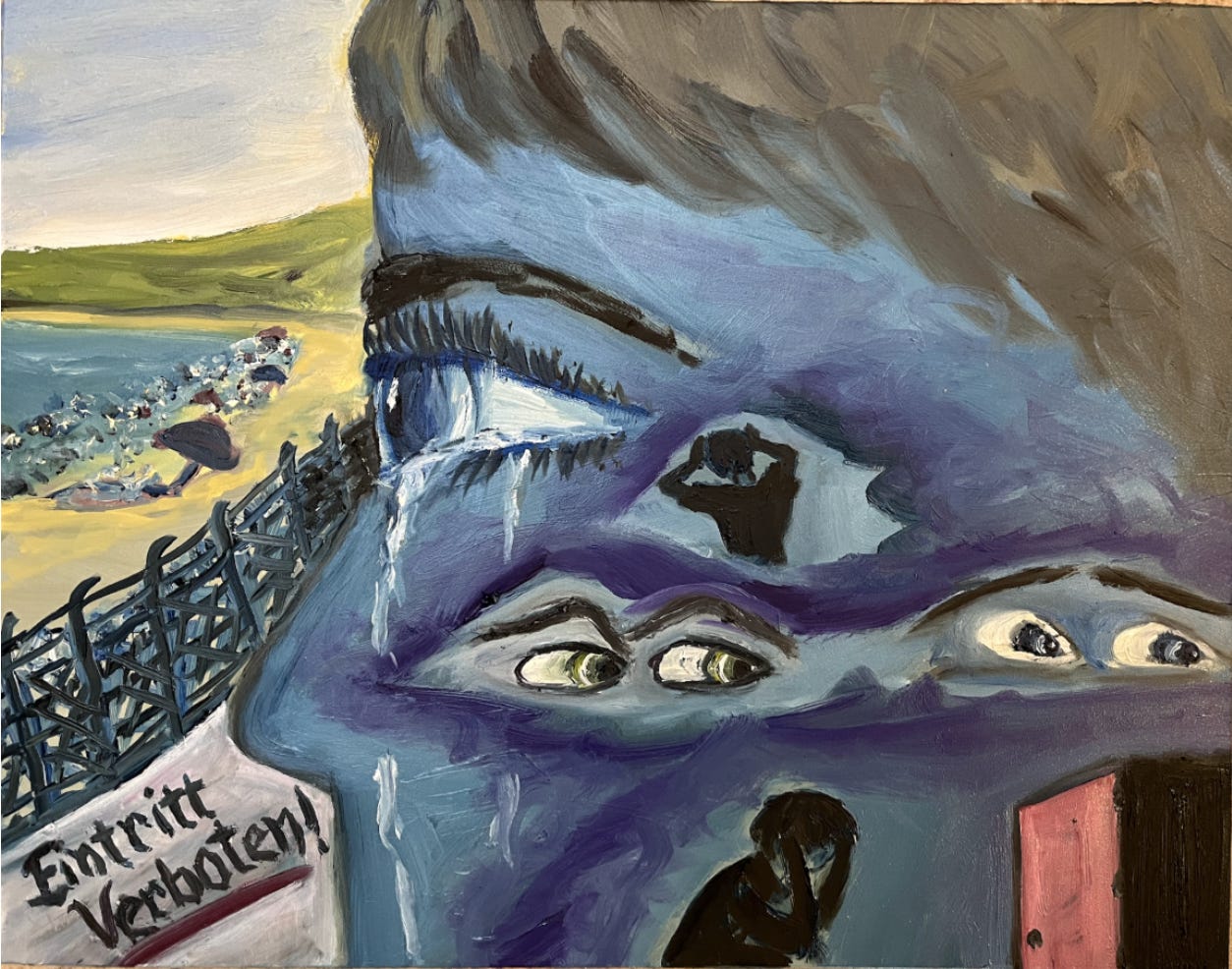
The painting: Entry Forbidden
By my mid-20s, I watched everyone around me move on into their adult life, relationships, and marriages. They moved in a world that I was denied entry to. I was an outsider who had nothing, no one, no hope of anything. I felt like a freak and an aberration of nature. Hiding my secret part of life left me feeling so dirty and shameful. I was just at my wits’ end.
And he was always leering at me, and after me. Even if I tried to reach for someone in my life, I just felt like no one could or would love me if they knew what I had to do to survive. So I gave up. I avoided him as much as I could until his rage was unbearable, then just let him have his way. I was the walking dead…
Facing “the failures”
Even though, as I do this and find it is necessary and worth it, there’s nothing like writing about the “failure periods” of your life to flood you with shame. The more you dig to heal, the more of those times that come up. Their sting still throbs, and maybe more intensely now, because revisiting them feels like you are freshly slicing open scarred-over wounds. They stand there before you in all their stark reality, with no way to sugar-coat what they were or escape what you felt. The only choice is to run but then never heal, or to face them fully head-on and just hurt as you look closer for what really happened, and wait for the understanding and acceptance that will transform them.
Now the truth is, I was doing the best I could at any point; it’s just that it wasn’t enough to measure up to what life demands of an adult. And maybe “failure period” was an unfair judgment rendered by my critical self. Maybe it wasn’t so much “failure” as the obvious outcome because of what he’d taken from me all those years. But either way, the reality is that I had a golden opportunity with the job at the UCONN Health Center lab, a chance to build a solid career path, and I blew it. There’s no other way to say it – I wasn’t measuring up…I couldn’t…
What was the point?
“You’ve had a hole in your slacks for weeks, and you just keep wearing them without fixing them! Don’t you don’t care?”
My co-worker stared at me, fists clenched, head leaning in toward me, with her eyes boring right into mine. Her earnest frustration was palpable. She was trying her best, from the depths of her heart, to reach me, generate a response, an action, anything.
I knew she was right and felt the shame. But my only response was resignation to my fate. I knew that hole had been there. I just didn’t care. It was one more thing pulling at me to respond, take care of, do something about, and I just didn’t have the energy anymore. What was the point?
UCONN – the lost opportunity
In the fall of 1977, right after my graduation, I began working full-time at the UCONN Health Center lab. That lab was a high-level, fast-paced environment on the cutting edge of anything new in the field of microbiology. It was the kind of place that would let you move up if you wanted, and really make a name for yourself. In fact, it was encouraged.
As a teaching hospital, there was an endless array of educational opportunities, conferences, experts, and graduate programs — so much low-hanging fruit ready to be picked by anyone who tried even a little. It was like osmosis. Just by being in that place, you could absorb the opportunities that were all around you. But I had nothing left.
It’s amazing – you can have the degree and all the training, but still, on the first day of any job, you know nothing. Each new place has its own methods and processes, and so you have to start all over again. It was another draining, stressful flash of reality after years of stressful realities, and I struggled to make the transition from school to work.
Trying to build a life
At first, I really tried. Concentrated on what I was shown. Took notes. Worked hard. Even as my center was an empty hole, I slapped on a smile, exuded determination, and pretended that my life was as happy as anyone else’s there. Like that kid playing in the neighborhood and determined to prove I was as good as anyone else, I faked energy and enthusiasm, trying to match my peers there.
And I tried to build some kind of life for me. I had a wish list of things I’d been wanting for years. Brand new skis and boots, a stereo of my own in my room, books. And slowly, I obtained them.
I went to the cemetery one day to visit my brother’s grave, something I did now and then. Disgusted with the broken, rusted metal plate that marked his grave, I marched to the office and arranged for a gravestone for him. My whole life, I had watched that nameplate of his slowly disintegrate and sink into the ground, as if he and his memory were slowly being reabsorbed by the earth. It was like he never existed, and I was angry.
I told my father one time that I thought God realized His mistake in sending a son because my dad would have destroyed him with expectations that poor kid could never have met. So God took the son back.
But at the same time, my brother HAD existed; he had been born, and I wasn’t letting him be forgotten. So they removed that piece of garbage nameplate and set a new gravestone with his name on it, just a bit above ground level. No more “sinking into obscurity.”
Also, in spite of how little money I had, I set up one recurring monthly donation to Save the Children. For $16 a month, I could sponsor a child, or contribute to a village project, and help them have a better life. It might not be much, but I felt that if I could save a child, that was something.
I also bought record albums — not just the current hits, but also classical music like Mozart and Bach, recordings of old Sherlock Holmes movies with Basil Rathbone and Nigel Bruce, the ones I’d watched in Bridgeport as a kid. And one of Shakespeare’s plays, including Hamlet and Macbeth. I would get my “dose of literature” somehow.
Still longing to be a writer, I even signed up for an evening adult-ed writing class at Farmington High School. My dad made a face and said, “So are you going to be like one of those writers who goes out and has sex and does all kinds of things so they can write about it?” I just ignored him and went to the class.
I became friends with that one woman at work. She was just a couple of years older than me, and we enjoyed each other’s company. One time, given that I lived fairly far from her, she invited me to come have dinner and stay over at the apartment she and her husband had near work. The meal was great, and we talked about our various backgrounds, hobbies, and enjoyed some wine. It was a rare moment of normalcy.
Of course, I shared nothing about the abuse. But I was good at talking “around” the holes in my life. I pretended that my background was as normal as the next person’s and faked knowing about the usual things of people my age, boyfriends, sex, and life. When I went home the next day, my father asked, “So why do you stay overnight with married friends? What are you doing there?” His implication was obvious, and I was disgusted. Did he have to taint everything with sex?
On occasion, I even dated. There was a young doctor at the lab who was doing a fellowship. He was a real gentleman and one of the few men I actually liked and trusted. Nothing went on. I was in no way ready for that. I was frankly terrified of men and sex. But it was a nice date.
I joined the local ski club for a little while and even dated the young son of one of my mother’s friends. But fear of men aside, we had little in common, interest-wise or in temperament.
The young man from high school that I’d dated and who was in the Navy would visit from time to time. And for a while, we continued to date on and off. But there too, it was not meant to be. He was staying in the Navy, seeing the world, growing beyond me. And I wasn’t willing to leave my town.
The truth is, dating was difficult. For the most part, while I wanted a normal life, I was tired and just wanted to do what I wanted. Having to get ready for dates, be acceptable to some guy, then deal with, “Do I kiss him goodnight or not?” — it was all too much. I was just so burned out from Dad’s pursuits that any normal interest from a guy just seemed like one more burden on me, yet another man taking something from me.
Then, even if I did find someone nice, my family wasn’t always open to it. There was a friend of mine who worked with his father in construction. He came by one afternoon with his brand new Corvette — so proud and wanting to show it off. He offered me a ride, which I accepted, even though my mother was unhappy. It was the middle of Saturday, and that meant cleaning the house. So nothing was supposed to interfere with that. I went anyway, but again, it wasn’t a deep relationship. I just wasn’t ready.
The dilemma…Dad
And then, there was Dad. His grip seemed to tighten, having me home again. He pushed more for “opportunities,” and raged more if denied. And even when I managed to avoid most of his approaches, he managed those LONG goodbyes in the morning.
When he was leaving for work, he would go into each room to say goodbye. And he would take the longest in mine, taking advantage of an opportunity to force kisses, grope me, and probe with fingers. I so wished Mom, just a few feet across the hall, would get up and come see why he was in my room so long, but she never did.
It was the same if I came home from being out with a friend, or worse, from a date. For some reason, those nights he went to bed before Mom. So I’d have to go upstairs to say I was home and goodnight. Which meant he took another opportunity for LONG goodnight gropings. And if I had come in from a date, he would “probe” to see if I had come home “aroused.” Again, if I avoided him too much, I would pay for it. So some nights he got what he wanted, and others, I risked his anger. But I felt so disgusting.
The dilemma intensified when the stresses of being his “property” and my growing wish to be free of him collided with work responsibilities. I carpooled with my father to go to work. For one, he was driving the same route. Also, the cost of gas ate up more of my paycheck than I could afford. And, he would have been angry if I didn’t ride with him. He had such a tight grip on me emotionally. But this became a problem.
The work failure
While I had a “set schedule,” lab work requires that if something comes in late or a test is not finished yet, you don’t leave. Totally understandable, and in later years, working in the lab, I sometimes stayed a double shift if there was an emergency. But at that moment in time, I was still emotionally immature about work and was heavily under his thumb. One particular day, I was already running late, the test was running late, and he wanted to get going. He’d been sitting outside, and I knew what I was facing. Caught between the demands of work and my father, I panicked and froze. And left before the test was done.
It was absolutely wrong. And the supervisor let me have it the next day. And rightly so. If I were the supervisor, I would have done the same, and in future years, I did with others who were new and just learning that responsibility. It’s just the right way to do that job.
But even then, part of me knew I should have stayed, even as the childish part of me sought a way to make it seem my boss was being unreasonable. But still, deep down, I knew I was wrong, and I was terrified and ashamed. As she berated me, I felt mortified and guilty. My whole life, I had always sought to “achieve” and do my best, whether in school or work. This wasn’t like me. But something in me snapped that day. I’d just had nothing more to give. It was like that time in the hospital internship where I was just so worn out, I slacked off. And then the director of the program reminded me that she had taken a risk on me, and I wasn’t working hard enough. So many times it was “work hard, succeed, then run out of steam and crash.” Which would catch others by surprise and disappoint them. That bothered me most of all.
With my supervisor, all I could do was apologize and promise it wouldn’t ever happen again. And it never did. But I think she was wondering if something was wrong, and almost waiting for me to explain. Yet I couldn’t tell her what was really going on. All I knew was that she was surprised at what I’d done, and I had betrayed her trust in me.
At that moment, I just felt horrible and reacted as a deer in the headlights, unable to say anything else or figure out any way to make my life better.
Until one weekend that winter, when I thought “it” might finally be over.
The “ultimate crisis” and moment of real hope
I don’t remember why Dad suddenly freaked out and was literally scared that maybe he’d been wrong in what he was doing to me. I only know I was absolutely shocked, and for the first time in my life, full of hope. REAL hope. My God, could it actually be that this weekend my life would finally change?
He was going away that weekend to the monastery in Farmington with our church’s men’s group, and he couldn’t wait to get there. I had never seen that fear in him before, and I was convinced God had finally heard my prayers and had gotten through to Dad.
So it was one of the most peaceful weekends of my life. For once, I actually looked forward to his return, anxious to hear what the priests there would have him do and what new path we would finally be taking.
He pulled into the driveway and dropped his bag in the house, greeting everyone with a big smile. He was peaceful, relaxed, almost joyful. I was happy to see what looked like a new man, and anxious to hear him say that we would never do “that” again.
I don’t know what he actually told the priests, or how he skewed it. But when he came back all happy and relieved, with a new lease on life, it was because after speaking with the priests there, they convinced him he was not a bad person after all. That God loved him, and to know he was okay.
Even now, I find it hard to describe the depth of devastation I felt inside. It was like someone had sliced my gut open with a knife. I couldn’t even respond.
He was beyond happy. And started to pursue me even more. I was plummeting into a level of dark despair I had not experienced before.
The walking dead…
Desperate, I decided to go to that monastery and tell the priest what was going on. I hoped to figure out what they told Dad, how they viewed what he was doing to me, and to seek their help to get this stopped.
Their answer – “Don’t tempt your father.”
I gave up. In that moment, I was emotionally destroyed.
There was no hope. No help. No one person who was hearing me or willing to help me. I was done. God hadn’t heard me at all, and apparently, I was the villain. My fault.
Between their words, Dad’s constant assaults, and the berating at work over my failure there, I felt besieged on all sides. I felt like a lone scarecrow in a field, nailed to a post, ringed by foes armed with swords and bayonets. And with every bodily insult, probing, or failure, it felt like being stabbed and gored emotionally, over and over. There was nowhere to turn.
From that moment, I saw no reason to care about anything. Whatever energy I’d had to fight back was sucked right out of me that day.
What was the point of anything?
Why try when there was no hope?
That weekend, the one I’d had so much hope for to bring about a change, the one I’d prayed for during more than 20 years of abuse, failed me. It laid waste to me and obliterated any willingness to try.
So for the next few months, I just “existed.” I’d get up, go to work, do my best, be professional, then come home. At home, I’d let him do whatever, do my chores, live in my world, listen to my records, then go to bed and start all over again the next day.
And if there was a hole in my pants, well, whatever. I had a gaping one in my soul that I just couldn’t deal with anymore. I was the walking dead…
 Soul Mosaic
Leave a comment