That damn water bottle
We sat across from the psychologist and waited for him to be ready to start our session.
5, 4, 3…I started counting down in my head. 2, 1, …and…there he went. Right on cue, the therapist reached across his desk, picked up his water bottle, and started fumbling with the top.
I closed my eyes for a moment as I felt my teeth grit and my jaw tighten. EVERY, DAMN, VISIT, it was the same thing. We’d sit there for several minutes, wasting precious time while he played with that damned water bottle. A glance at Ed told me he was equally fed up.
Well. If this was a marital therapy tactic to get us united about something, it was working. That was about the only thing that was working, though, in his therapy approach.
“If he played with that damned water bottle one more time, I was going to wrap it around his neck!”
I’m not sure which of us said it as we walked out the door. Frankly, we may have both said it at the same time. All we knew was that we were united in our conclusion that he was not our answer.
For that matter, neither was his women’s abuse survivors’ group, which he had referred me to. While it was helpful to see and hear the stories of other women who had suffered through sexual abuse or marital issues, something about the dynamic of the group was off.
The leader was “okay,” but not dynamic. And with no offense to anyone, it was a “Christian-based therapy” program. Having been raised Catholic, I didn’t initially consider that an issue, other than that I wasn’t feeling particularly close to God at that moment. So I would have preferred that we stick to psychology-based approaches.
Instead, I lost track of how many times the other members would comment on the value of someone or something based only on whether it was “Christian.” Exasperated, I finally just called them on it one night.
“What is it with all the ‘Christian judgment?’” I asked the group after yet another comment. “I was raised Catholic. That’s Christian. But you seem to have a different meaning for it.”
What I learned that night was that Catholic did not equal “Christian,” in their definition, and that anything or anyone who wasn’t “Christian” was an outsider. And by extension, my comment, which was not well-received, put me in that “outsider category.”
So between the therapist, his water bottle, and his women’s group, I despaired over how any of this was going to help our marriage or my own abuse healing.
The “mystical” choice
Back at work, which was a stressful place in itself as it was a fast-paced, high-pressure pharmaceutical company, I stewed over that meeting.
Turning from my desk, I remember grabbing the phone book – yes, this was the era, still, of printed telephone books. I flipped right to the yellow-page professional listings at the back of the book, to the “psychologist” listings. I had no idea who I was looking for or how in God’s name I would find the right person. I only knew the current ones were wrong for us.
I scanned the listings several times. Some were just a name and a number. Others had a quarter-page ad. How the hell would I find the right person?
I went up and down the list again and again. Suddenly, my eyes landed on a small block ad in the middle of the page. To this day, I have no idea why I stopped there. I just remember literally running my fingers over the ad, as if trying to “extract a gut sense” about that practice, from the page print itself.
It wasn’t a large ad with all kinds of services. Just a small one with a brief description. I looked one more time at the rest of the listings, yet I was still drawn back to that ad.
Shaking my head, I decided that this was one of those “pick-a-nipple” times, like the “bottle and nipple experiments” during my son’s infancy. As our family saying went, when you are confronted with too many choices, just pick one and use it.
That ad seemed inviting. So, that was it. I called them.
And from that “mystical moment” came a 10+ – year association that would be, as my husband describes it, “pivotal” to our marriage.
What I loved about our marriage
As this diagram of our early marriage shows, we had a really solid core of good things that bonded us. To borrow a metaphor from the Apollo 13 movie, we had a LOT on the “spacecraft” that was good.
The differences between us weren’t huge. We worked in different job fields. No biggie there. We had different personalities, approaches to things, natural talents, and acquired skills. Again, while those “could” be a problem for some, for us, those were more often than not “synergies.” Those differences made us stronger because where one of us was weak, the other was strong. We actually had a big selection of skills and abilities if you combined the “menu” from each of us.
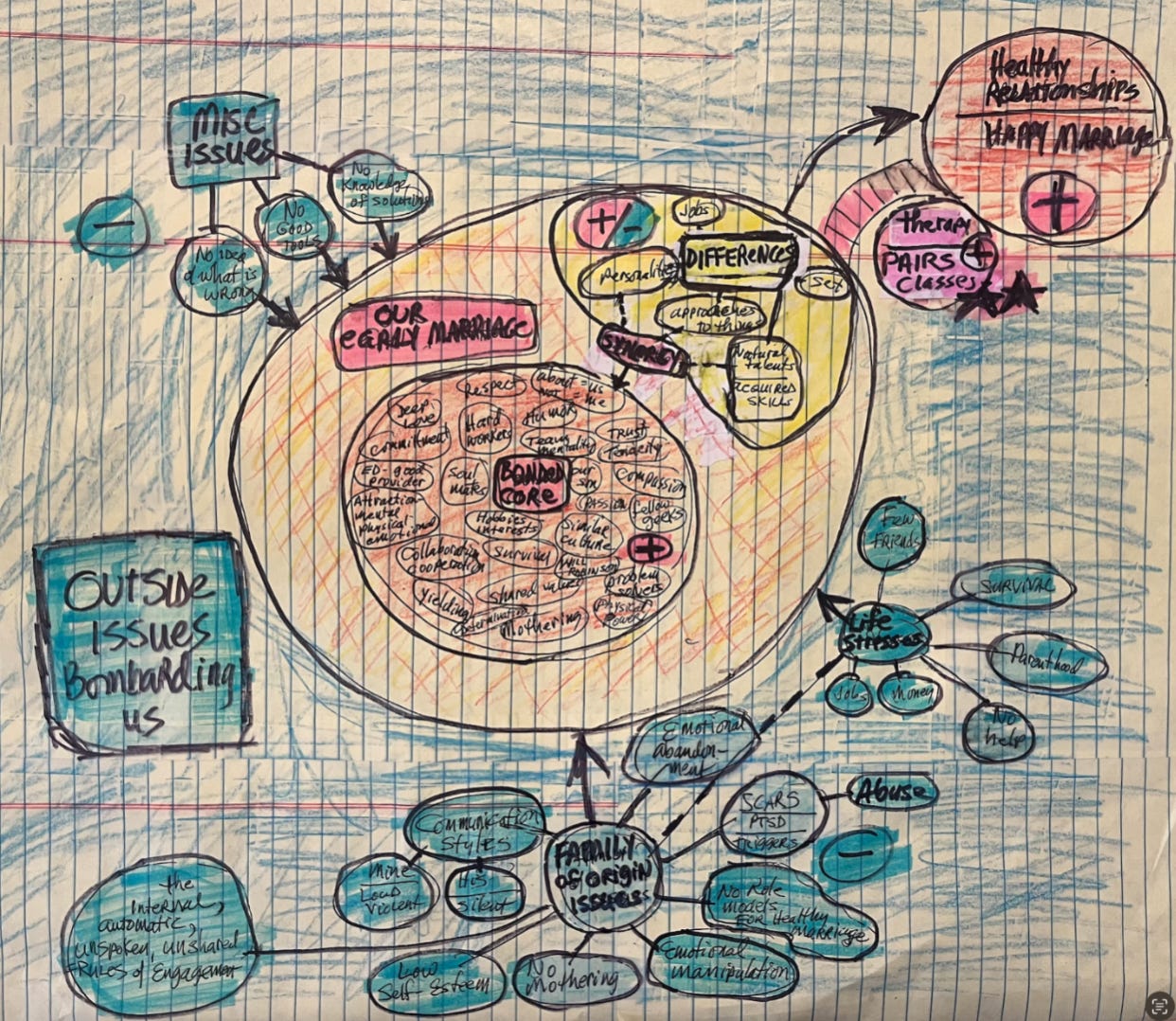
The two biggest areas were sex and the MANY issues “outside” of our direct relationship that were bombarding us.
About the sex, that was the symptom or red flag. The real issues were less about the attraction or connection or frequency or whatever, but more about the “polarization.” And the polarization had two components: 1) We didn’t know how to communicate and resolve differences. We were both operating from assumptions instead of from who we were. 2) We were both totally unaware of the existence of something called “Family of Origin Issues” and just how much that was affecting our relationship.
Add to that mix the miscellaneous issues: We had no good relationship tools or role-modeling. We had no idea what was wrong. And no clue about possible solutions.
Then, to finish this stew off, add a hefty dose of the regular life stressors everyone faces – jobs, money, parenting, and no help or support system…and we were beyond stressed, exhausted, and desperate. It’s a wonder we were still as bonded as we were in many areas of our lives.
My “Will Robinson”
For one, faced with the barrage of obstacles, we still tried to come at it as a team. That sense was deeply ingrained in both of us. Marriage was about more than just me, or him, or sex, or any other component. It was about the “whole.”
Unrecognized and unspoken, but definitely there, was a drive to build something bigger than both of us. Our efforts to save our marriage were about the success of “Bailey and Co.,” not just one individual. So no matter whether it was a serious thing or a fun thing, we were always about being a team.
Here’s one example of “fun teamwork,” based on love and the willingness to support each other’s interests. My husband wanted a satellite dish so he could tap into the myriad of satellites out in space that could connect us to hundreds of channels from all over the world. This was before small home satellite dishes were a thing. For us to have a satellite dish meant installing one of those large dishes on a pole, right behind our house.
That required Ed to figure out the exact right angle for the dish to be held at so that it would face all the satellites in space at the correct angle. Once he figured that out, it meant installing an 8-foot pipe to hold the dish, 4 feet of which would be buried in concrete underground. That meant digging a 4-foot hole, then securing the pipe in place one evening after work with over 1000 pounds of concrete.
That involved hauling MANY bags of cement down into the yard, mixing up each one in a wheelbarrow, then pouring it into that hole…all without disturbing the angle of the pole. All of this had to be done after our son was in bed with the monitor outside so we could hear him. And then once that was done, on another day, we had to assemble and mount the dish on the pole.
And when I say “we,” I mean Ed and me. We could just afford the parts and all the electronics. We could not afford to have someone do the installation. But he was deeply excited about this. He was my best friend. And like so many things he was interested in, I found it fascinating. So it never even crossed my mind not to help him. Of course, we would do this together, and then he would teach me the intricacies of running it all.
Or another example is from a rare date night. On the rare occasions we would get a babysitter, we’d go out to dinner. Leaving the restaurant one particular evening, we were strolling back to the car when Ed noticed something about a car near us. The backup lights were unusual. With great excitement, he proceeded to describe to me just why they were different, how they worked, and why they were made that way.
Anyone else might have thought that was a weird way to spend a date. I LOVED it. Frankly, it was such a turn-on. In those moments, I just saw this pure-hearted, best friend of mine, passionately sharing with me something he found fascinating. It was his love of learning, which I shared, and was one of the things that drew me to him right from the start.
I just loved those moments and felt such love for him. And, he reminded me of my childhood crush on the TV character of Will Robinson in the show “Lost in Space.” I was IN LOVE with Billy Mumy, the young boy who played that part. His character, “Will Robinson,” was a young boy stuck on an alien planet in outer space with his family. They were unable to get back to Earth. Will was not only cute, but he was the consummate geek, knowing how to take apart the ray guns and fix all the electronics. And he was brave, adventurous, and honorable.
Ed was that character in spades. In those moments, I knew that aside from being my best friend and soulmate, he was my “Billy Mumy.” I had married my very own “Will Robinson,” and that attraction was heartfelt and powerful.
And he, in turn, loved to tease me about the “12-page typed itineraries” that I would draw up for any vacation we took. I would map out routes and 2 alternates in case of accidents. Again, this was before GPS units. So I would list every rest stop, mileages between things, route and exit numbers, hotels, restaurants, and all the places we would visit. He would just laugh. But he always knew I would have all the logistics covered, so he didn’t have to worry about a thing.
We had a lot we loved and shared. We had synergy and teamwork. So, no, I wasn’t giving up on this. We were going to crack this relationship problem. I refused to fail.
Enter PAIRS
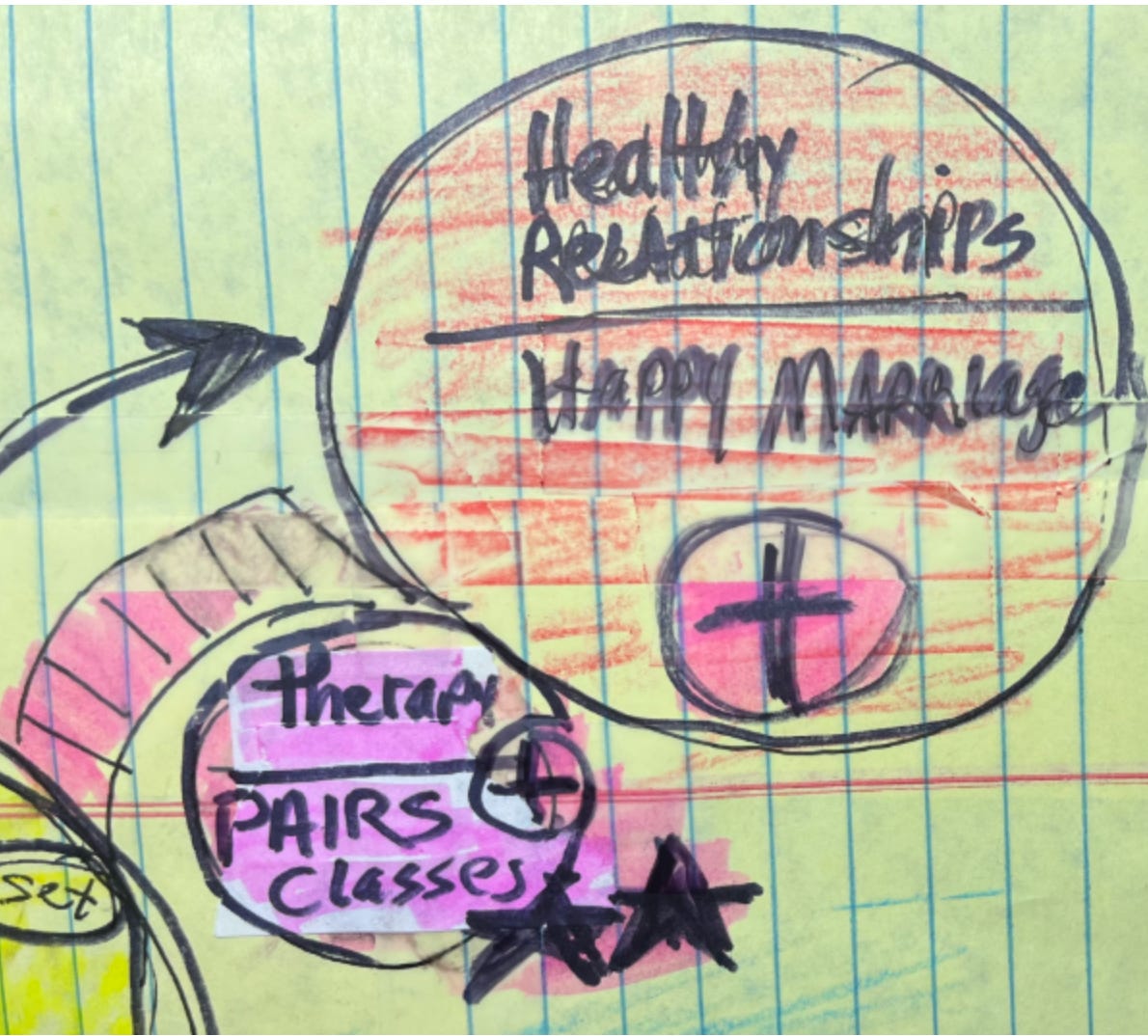
PAIRS. “Practical Application of Intimate Relationship Skills.” It was a set of marriage classes that we took every weekend for 3 months. It was a struggle to arrange for babysitters, and it was expensive, but PAIRS saved our marriage.
It covered so many areas of relationship skills in depth. And over those months, while it would teach everything from how to disagree, tools to resolve issues, how to affirm each other, and personality types, to the ways people fight, and intimacy, it started with the very biggest source of our problems, that whole “Family of Origin” issue.
The class started by having each of us make a map – a multigenerational family tree. But it wasn’t just a list of names, birthdates, kids, parents, or grandparents, but also “issues.” Who was an alcoholic? A gambler. Was there physical abuse? Affairs? Suicides? Premature deaths? …Incest….
It was mind-blowing when we finished that exercise…. stepping back and seeing the level of dysfunction present. And not just in one person here or there, but multiple people…in multiple generations. Seeing the trail of brokenness and dysfunction all over my family map, seeing it THAT clearly, was almost chilling.
I suddenly realized just how deeply rooted those problems were all through my family tree. I saw a CYCLE of dysfunction that just kept playing out over and over and over, without stopping. In that moment, I realized that unless something different was done, it would just continue. And all that pain would reverberate down through future generations. And even if a specific issue didn’t show up in everyone, each person was still affected by what was going on in their family members. You couldn’t escape the effects even if you didn’t display a particular pathology. Is THIS what I wanted for my marriage? To teach my son????
In that moment, I knew I wanted a change….and so did Ed. Because he saw it too. In both of our families. In fact, it explains in some ways why people match up with the spouses they do. Something in the other person is recognized as “familiar,” and so you go to it. That is how people from abusive households sometimes end up in a series of abusive relationships. It’s what they grew up in and what they are familiar with. But unless you know it, it all operates under the surface and starts all over again. Like a parasite you don’t even know is there. Insidious.
For us, somehow, we avoided finding abusive partners. The things we recognized as familiar were the things that strongly bonded us. So that was good. And that exercise became the beginning of a road back to further bonding for Ed and me. All those classes, exercises, and tools were our pathways to healing the rift in our marriage. They gave us a framework for what a healthy relationship looked like and how it could operate. And all of those things saved our marriage.
It helped too that the same practice that offered these classes also had therapy support groups geared specifically for men or for women. It was the beginning of my also becoming aware of just how many issues I had with women, mothering, and friendships. More on that later.
Did it make a difference?
In looking at that early marriage diagram (on the left), and comparing it to one I did now (on the right), there is a big difference.
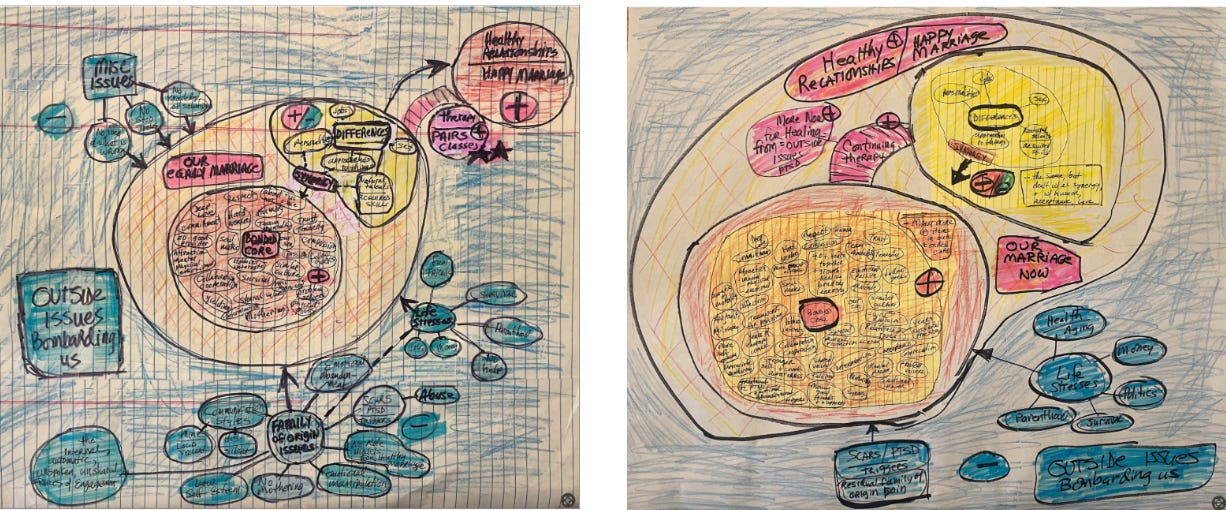
While we had a lot bonding us early on, we had a lot of challenges. And just an outside hope that therapy would save us.
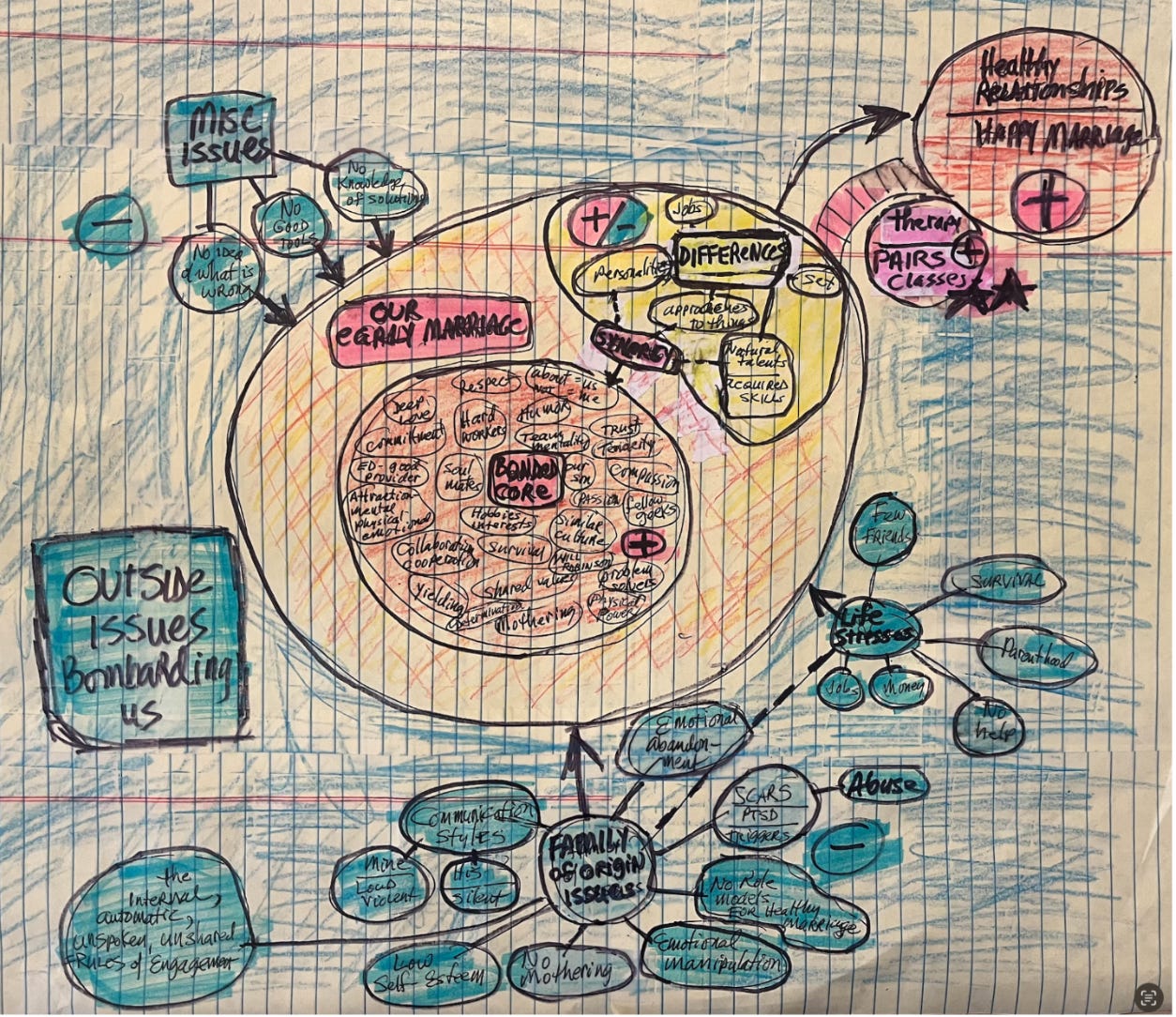
Now, years later, it feels so much less “cluttered and under siege.” And so much more has been brought into our relationship circle as a strength.
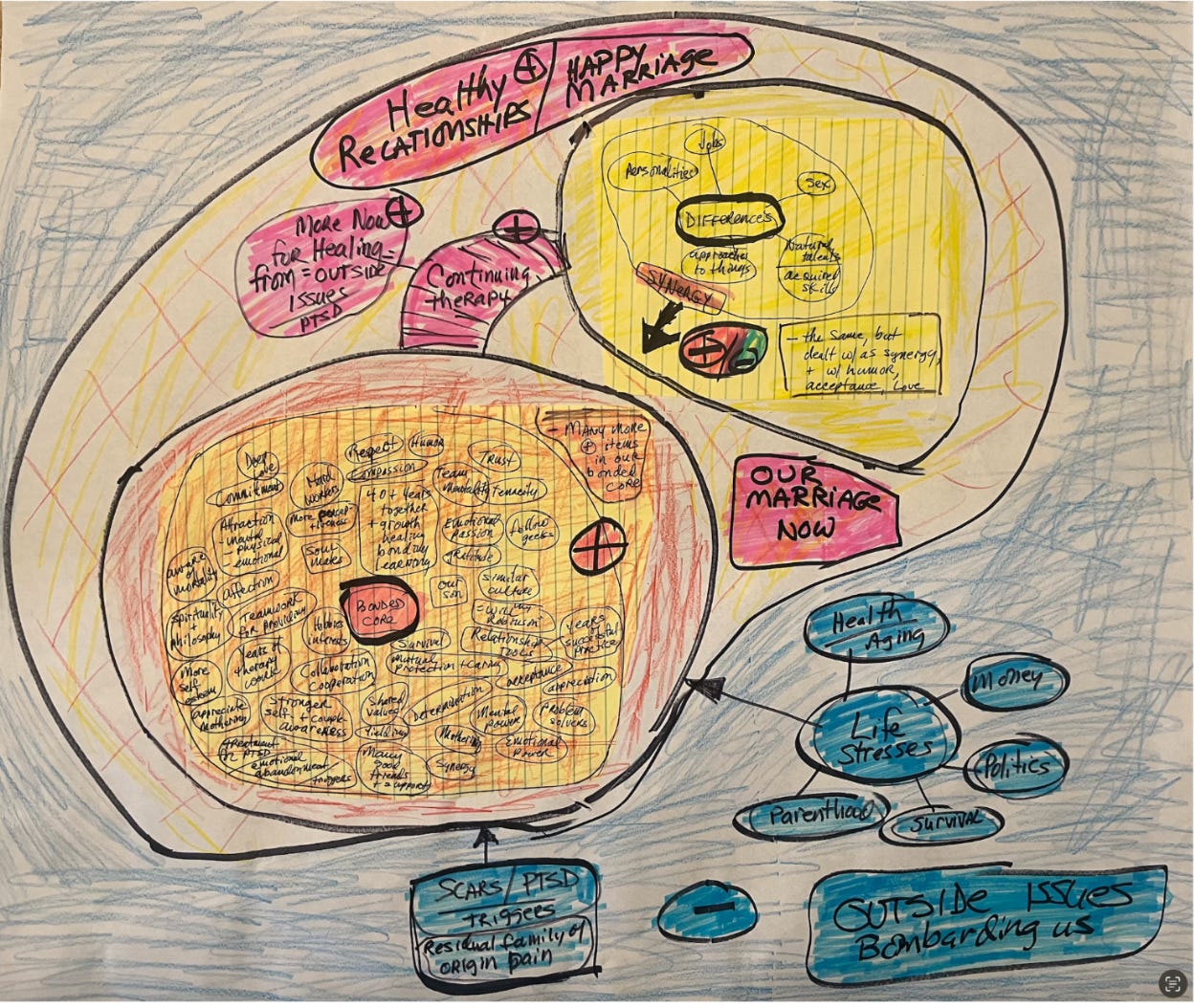
For sure, the regular life stressors remain. And add to them now issues of health and aging.
There are things like “scars of PTSD,” emotional triggers to manage, and the pain from that past that will always be there. But the many Family of Origin issues we had many years ago, and their impacts that we had not been aware of, are gone…addressed by the acquired tools, and continued therapy over the years.
Also, where before there were no tools, no awareness, and no solutions, now the number of positive strengths in the “Bonded Core” circle has grown.
Regarding “differences,” those remain the same. Our personalities, skills, talents, and approaches still have their differences. And yes, that includes sex. But even that one has changed over the years, and so has our handling of them.
The view of using our differences as synergy is even stronger. Better communication has been a godsend. And life itself has played its role.
The demands of jobs, menopause, parent deaths, our own illnesses…life… has altered everything from desire to spirituality. What we do have now is a much more flexible and kind approach. Now those differences can be places for joy, creativity, and even humor. And frankly, humor about many things in life, especially as we age, is a great asset.
The bottom line for both of us now is that life and each of us is never perfect. We are always a work in progress. But it is a work filled with much love, more acceptance, and much gratitude for all we have survived and healed.
As to the healing, it continues, and always will. I still work with a trauma therapist for the things from that past that cause pain. I will write more on this shortly. But therapy has also been especially important as I write this book. And on occasion, we both work together with a therapist if we have questions or want guidance. At this point, we consider it the equivalent of seeing a doctor for an annual checkup to keep us healthy.
I think the Buddhists would call our approach the “Middle Path.” In Buddhism, they teach that often the best solutions to a problem are not with one person or the other, but somewhere in the middle, something that combines the best ideas from both, woven together into personalized answers. So we strive for that.
About Buddhism, I will also return soon to the subjects of God, religion, spirituality, and the journey of my soul through this. But first, coming next: “The Warrior Years – Parenthood.”
 Soul Mosaic
Leave a comment