Summer, 1995 – The weekend of flashbacks
In 1993, Tears for Fears did a song called “Break It Down Again.” It was about recognizing that things are not what you thought, but are instead a time bomb building. And your only choice is to face it, and yet again, tear it down and start over….
The same was true for the cycles of Dad’s “promises.” Another family gathering. Another round of “seeming too familiar,” and too “in control of the situation.” Things that just seemed wrong.
On this trip, we were gathering to celebrate an uncle’s anniversary. Everyone was arriving and checking into their hotel rooms.
Stepping out of my room, I encountered him in the hallway. He was smiling, happy, and in a hurry. Commenting that he was going to arrange for a cot so that one of the kids could sleep in his room, he turned to rush down the hall.
“What?!” Fire flared through me. I had to have misunderstood him.
“What do you mean sleeping in YOUR room?!”
I hoped I was wrong. I WANTED to be wrong. I didn’t want to have to fight him yet again…but I couldn’t let this go unchecked.
He stopped in his tracks. Smile gone, he turned and stared at me for a moment. Then he just turned away and walked down the hall without saying a word.
I was reeling. Did I hear him right? I started questioning my reality. Was he just baiting me to see if I would rise to the challenge?
To say I was triggered was an understatement. But I was totally knocked off balance.
Shaking, I retreated to my room to try to pull myself together. I was just frozen, emotionally. I don’t recall if I even said anything to my husband. I just remember that at that moment, I couldn’t think straight. And the rest of that day was a blur.
As an aside, I will note that for whatever reason, none of the kids ended up sleeping in my parents’ room. Whether that had never been the intention, or he changed his plans, I have no idea. All I know is that he refused to even answer me. If you really cared about your family and wanted to show good faith, you wouldn’t walk away without answering a question like that. All of it smacked of mental mind games.
The next morning at breakfast, he glared at me from across the room. Terror shot through me. It was that LOOK. The one he used to terrorize me all those years. It was pure hate.
I froze, and my stomach twisted. It didn’t matter that I was an adult. The emotional flashback he set off in me was so powerful that it was as if he’d hit me. I was staggering, struggling to regain a shred of emotional footing or control. And losing. If this were a boxing match, I was the boxer going down from a head punch.
That weekend would continue to haunt me over the next few weeks. What was he doing?
Fall, 1995 – The agony…and the choice
For the remainder of that summer and early fall, I was in agony. I wrestled with what to do or believe. In talking with Ed, we slowly began to conclude that Dad had not changed. His actions seemed more like someone “testing the boundaries,” manipulating and maneuvering, or toying with me.
I couldn’t shake the conclusion that “the good dad” display had been an act. A facade. The real dad, whoever he was, seemed like a wisp of smoke that floated through your fingers when you tried to grasp his essence. He was a chameleon — something different to each person or in every situation. It was like that advice he gave me years ago in high school: “Find out what people want and need, give it to them, and they will like you.” He operated from the place of “be what you need to be for each person.”
Even as my certainty grew, so did my fear of confronting him. Was it me? Was I imagining it all? Maybe he WASN’T doing anything wrong this particular time…
But then, he never kept his word on doing therapy. He had admitted abusing me. And I remembered the therapist’s description of him as having no remorse and little ability to maintain love.
Also, I had read the research and knew the recidivism rates were high, especially for sexual crimes. With no therapy, why would he change? Why give up the power and the pleasure? What was in it for him?
In one book I read, Father-Daughter Incest by Judith Lewis Herman, I felt I had an answer:
“The offender should never be considered entirely ‘cured.’ Just as the alcoholic never loses his susceptibility to addiction, even after years of sobriety, the incestuous father can never be expected to lose sexual interest in his daughter entirely. Even after he has acknowledged full responsibility for his crime and recognized the harm he has done to his daughter, he will still crave the incestuous relationship and may attempt to revive it in subtle ways. A man who has had many years of practice in concealing, excusing, and indulging an antisocial compulsion cannot develop secure inner controls in a few months of even the most intensive treatment…some therapists have argued that it is naive to imagine that fathers can ever be safely reunited with their families. Even if the overt sexual behavior is brought under control, according to this line of reasoning, the father will never abandon his effort to dominate his family and to control his daughter’s life.”
The book noted that apparent transformations could be based on “…the father’s ability to assess their relative power in any situation and to vary their behavior accordingly.” In an example shared, it was noted that the father “changed only as much as he had to.”
While he was no longer after me, with no treatment, there had to be little to no chance he would stop trying to find someone for his compulsion.
I was at a loss for what to do anymore. I had tried directly confronting him in 1984 and 1988. I tried writing and threatening jail in 1993. And now, again, I had directly confronted him. Instead, he was acting as if he were back in power.
Could I count on others in the family to fight him? I only knew that no one was comfortable when I threatened him with jail 2 years earlier.
Why was it so hard for any of us, myself included, to see who and what he was, and to effectively stand up to him?
Another book, Alice Miller’s Breaking Down the Wall of Silence, offered an answer:
“Without a helping witness, a mistreated child does not regard the damage done…as psychic mutilation…A mistreated child must repress all doubt to survive. If it were to doubt the benevolent purpose of what it suffered, it would place itself in mortal danger….That is the logic of repression: ‘I refuse to know what my parents did to me and to others. I want to forgive them and not to condemn them…They are my parents…’”
She indicated that even as adults, “many choose not to confront the painful facts…People whose only experience has been the wall of silence cling to the wall, seeing in it the solution to all of their fears…”
So that explained why anyone who’d been a victim of such abuse, directly or indirectly, would struggle to fight him. Yet, I did keep trying in spite of my fear. Why?
There too, Miller’s book had an answer: “…if they (the victims) have once glimpsed an opening in it (the wall of silence), they will not endure its illusory protection…Now they wish to save others from the same fate…”
Whatever my fears, I wanted to protect everyone from him. While I still so wanted a healed and unified family connection, I couldn’t pretend he had changed. The more I read, and the more I spoke with our therapist, the more I realized…he was the same. All my previous efforts to get him to seek help had failed. And I had to do something.
The decision
In all of this, I also wondered if I had a responsibility to contact authorities to say I felt he was a child molester. But in discussing it with Ed and the therapist, we realized a few things. It was too late to charge him for the things he had done to me – statute of limitations. Second, he’d never been arrested or caught in anything. Third, I had no proof he had actually crossed a line with any kids, ours or others. And fourth, regarding anyone outside the family, the therapist mentioned that there are abusers who only go after close family members whom they can manipulate and control, but never go after outsiders. So, to call Social Services was not an option. And again, this was a time of little awareness or conversation about child abuse prevention. I was looking for solutions that didn’t yet exist.
After wrestling with this whole thing for over a month, I did the only thing I felt I had left. Write. This time, I was going to write an article for publication. Maybe by telling my story publicly, it could bring pressure on him to finally get help. And, if anyone else out there was struggling with the same problems, maybe it could help them feel they weren’t alone or crazy.
It took me over a month to research the topic. I found expert quotes, wrote very clear descriptions of the ways he abused me, used a pen name, and called the article: “Should We Trust Him?” And my conclusions were a strong, “No.”
I proceeded to send it out to various magazines in the hopes of getting it published. And then, I pulled together my remaining courage and mailed it to my family. I told them why I was doing this and that I was using a pen name. Lastly, I reminded everyone again that he could not, and should not ever be trusted around our kids.
And then, I waited….
The immediate answers I got back were rejections from the magazines. While they thought it was a good piece that needed to be out there, it “wouldn’t work for their particular publication.” I think it just wasn’t the time in the world yet for putting those kinds of words in print. Except maybe in obscure academic circles.
The family responses came a few agonizing weeks later.
It can be dangerous to be a truth-teller
My intentions with the article were honorable. And I had done my best. But my execution had some mistakes, the biggest one being that I shared details others had told me in confidence. Even with a pen name, that was a flash point.
There is also the fact that even just sharing my own details was a flash point. I was speaking openly about our family, even if I used a pen name.
First, one family member responded with yelling, rage, curses, and accusations. My husband said later that even though he was across the room and I had the phone up to my ear, he could hear the yelling clearly.
And about a month later, another followed – less rage but more accusations.
From my journal notes after those calls, the feelings were clear:
“What the hell is wrong with you?!”
“Who the fuck do you think you are?!”
“Why are you doing this?”
“You’re stuck in the past!”
“At some point, you just have to get on with your life!”
“Why don’t you work in a shelter?!”
“You can’t work in a shelter until you fix yourself!”
“But maybe working in a shelter will fix you!”
“Writing doesn’t help anything!”
“When are you going to stop this?”
“You have no right to write this!”
“You didn’t get the story right. Why didn’t you ask?”
“You just want everyone to feel sorry for you.”
“You’re just trying to make money and end up on talk shows!”
“Stop telling me what to do!”
“You’re dragging us into something that is between you and him!”
“He’s changed.”
“He’s never going to change. Just accept it.”
“Maybe if you had more kids, you wouldn’t have time for this.”
“Yes, there were bad things, but there were good things!”
“You’re just trying to destroy him out of hate!”
“They’re just two lonely old people.”
“There are people in hospitals who have it worse!”
The one thing lacking in all responses was any acknowledgement of the research I quoted, or of the horrors in the scenes I wrote showing his abuse of me….
Oh, and my father’s response? Silence.
But there is also the bigger picture
Before I go on, I need a moment to explain things that have taken me years to understand about that whole incident.
The way this played out is all about those family systems. They seek balance. If the abuser throws it out of balance, the rest of the system compensates. And conversely, if someone upsets the balance of silence by speaking, the rest of the system compensates…sometimes with attacks.
On that last point, there is one aspect, though, to keep in mind. In family or community systems, there are many victims. My father had abused me directly. But the damage he did went beyond me.
In any family or community system where there is abuse, anyone nearby is also hurt. Maybe it is because they are silent witnesses to it all, or because they hurt from the ugly energy in the household. Or maybe the abuser’s focus on one target means everyone else is given less attention and love. They may not understand why, but they feel it.
Certainly, my mother reacted with rage when she saw me having to pay more attention to Dad when I was a child. She didn’t get that if I didn’t show him that attention, he would make me pay for it later. She just saw something out of balance, and that the attention he paid to me, she didn’t get.
That said, she was another adult and should have called him on it. But she was an abused spouse, so beaten down and financially powerless. So all she could do was ignore it and glare at me. As to others in the family, they were even more powerless.
The bottom line is that everyone in an abusive household is an equal victim trying to deal with the situation the best way they can. Each person holds trauma and struggles to survive it in their own way. Just because I felt the best thing to do was openly confront and publish, doesn’t mean that was right for another.
For me, it was an impossible situation because there were kids involved. My own actions were going to always land on the side of never trusting him, and always sounding the alarm. Even if everyone else was being careful, I was still going to sound that alarm again and again.
The aftermath
In this case, by the time the dust settled, I was so terrified and visibly shaking so badly, I didn’t feel safe anywhere. After one of the phone calls, I went outside and just sat in the very darkest spot in the yard. Yet no place felt dark enough, isolated enough, or safe enough. I felt like the reach of that system would always get me, no matter where I was, and it would destroy me.
After this particular round, I struggled with thoughts of suicide. And I was thrown back into that place of feeling I had been totally wrong. I’d broken trust, rules, and hurt people. I was wrong. I was bad. I was crazy.
No matter how brave you are, or if your intentions were well meant, an enraged system takes its toll.
My husband changed our phone number so it was unlisted because he saw how afraid I was whenever the phone rang…my dread in answering.
And I feared that my father, feeling he had regained power, could somehow harm us – sue us. Come “get me”? Certainly, that was the terrified child convinced that his power was invincible. But I did change our house locks as my mother had a key. And it was clear Mom was never a protection against him.
In my mind, no matter where I went or hid, I would not be safe.
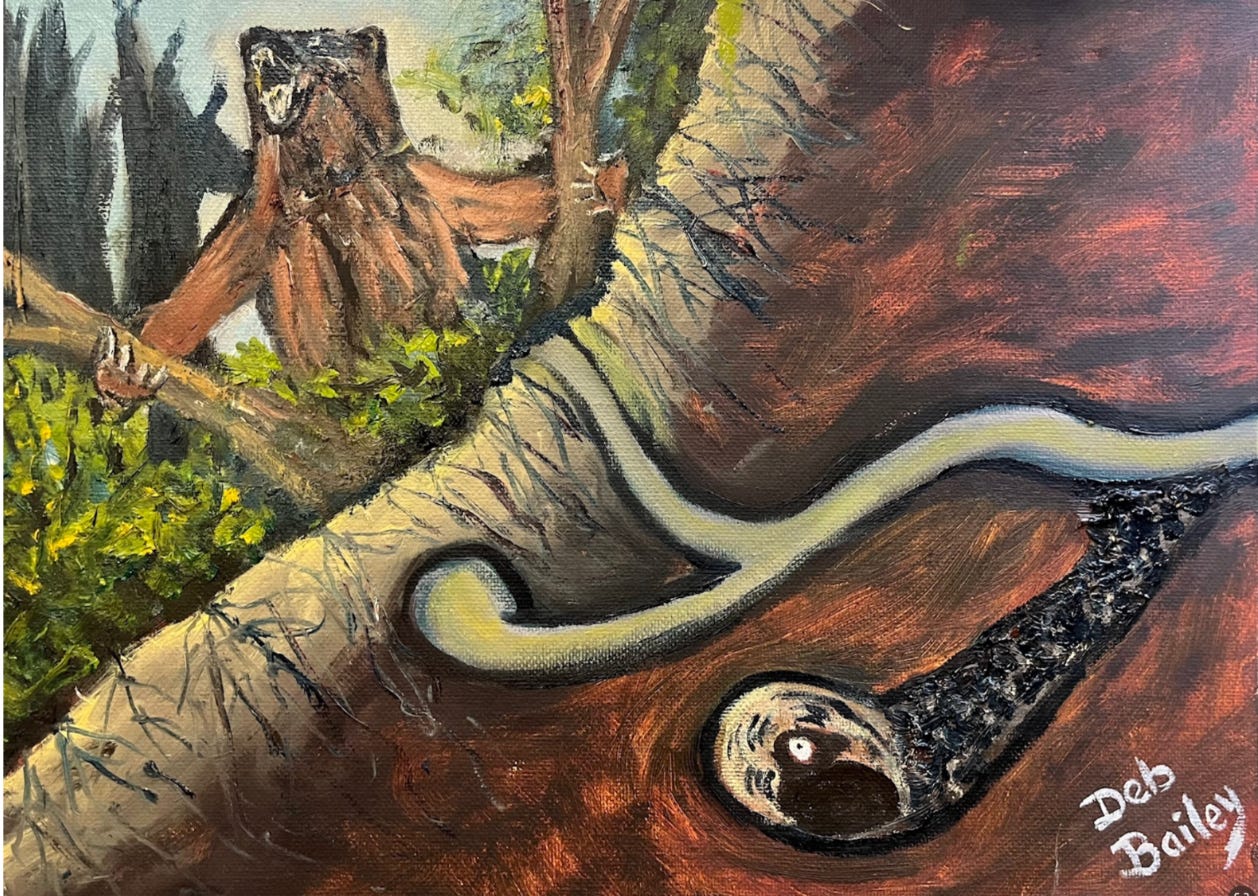
My journal entries from the time noted my struggle:
“I feel like the child who did something wrong and is frightened…So I’m careful and apologetic…I have to stop coming across as a needy child, but rather as a strong, aware, confident person…I forget that I sent that article out because it is my truth and opinion…my ‘Declaration of Independence’ from that system.”
I also wrote that I was concerned about whether I had caused harm. I even wondered if my father would crumble in this and blow his brains out. But that wasn’t him. He would always try to come out on top.
The bottom line was that yes, I had stirred up a hornet’s nest. I’d spoken out loud. Was I right or wrong? Yes. I may have assessed him correctly. I may have handled it all wrong. Or maybe it was right. Frankly, in these situations, there is no perfect way for any of us in that household.
For example, in looking back, I also realize no one asked: What about him? What about his being unwilling to change? To get help? If he loved his family so much, weren’t we worth that effort? Even some alcoholics decide to change because they love their family. And what about the horrific details I’d shared of what he did to me?
For myself, I only know that my desire to “fix the situation” was rooted in love. I really tried to get him to get help. I didn’t pursue legal action against him. I hadn’t sued him either. And I gave him repeated chances. I did all I could. I did the best I was capable of at the time.
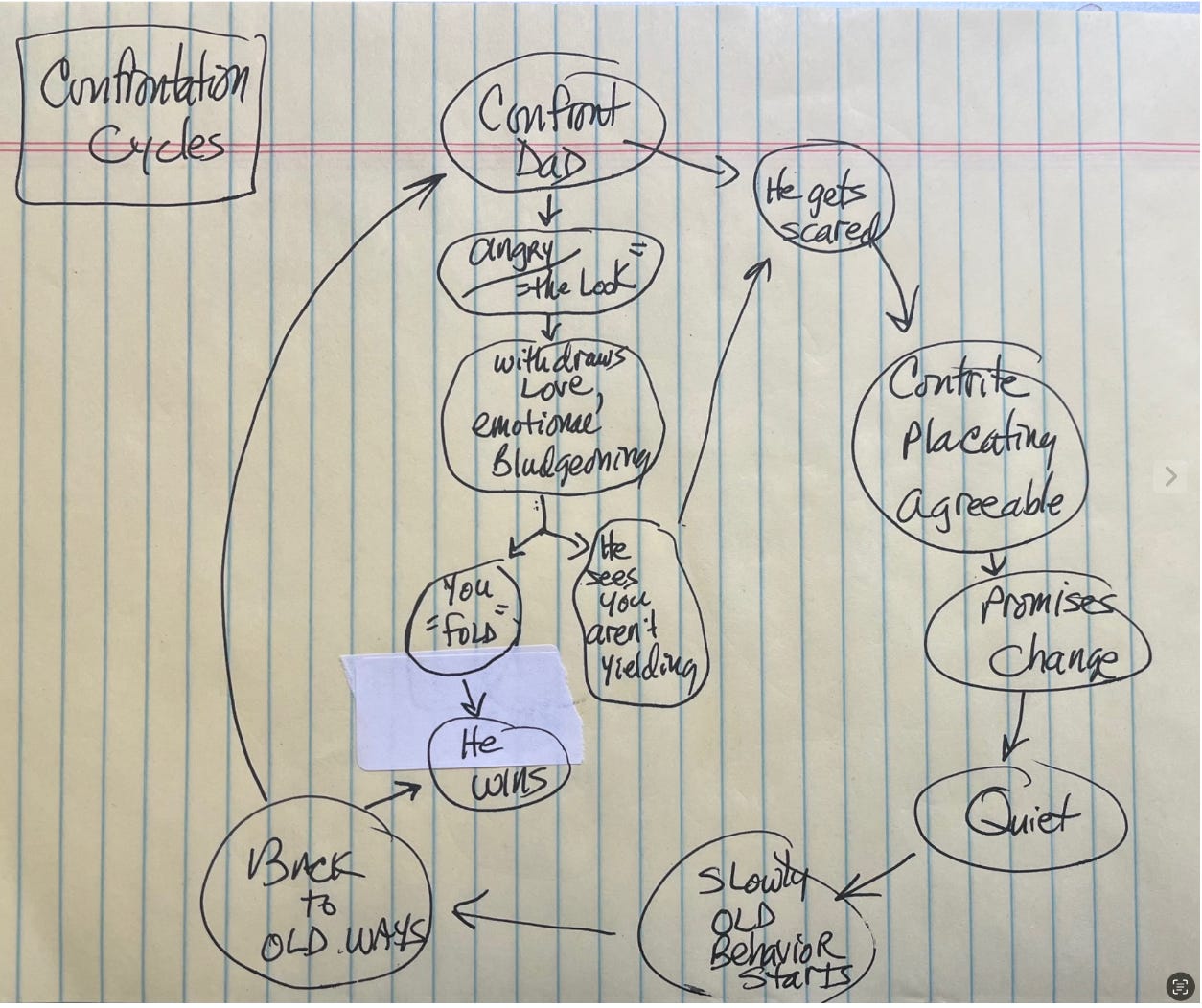
But, those repeating cycles…they just kept going round and round and round…
So, what came next?
One truth in life — things never stay the same.
 Soul Mosaic
Leave a comment