The naming ceremony
We stood quietly in the Temple, waiting in line as the Buddhist monk approached each of us in turn. We each had a “kata” – a traditional scarf meant as an offering to the monk – draped over our folded hands.
He stopped in front of each person, looked into their eyes, then wordlessly selected a small piece of paper with a Tibetan name on it and gave it to them. Whatever the monk saw in each person’s eyes determined the name he gave to them.
Finally, it was my turn. He moved slowly, with much peace. I was always amazed at how deliberately he executed even the simplest movement, as if he had all the time in the world. He looked at me, REALLY looked. His focus was like a laser boring through my eyes and into my soul. His expression was soft, and his own eyes were like clear, still pools of water. I felt serenity emanating from him.
His scan of me lasted only a moment. But he showed no hesitation as he sought out one particular decorative slip of paper and handed it to me. Whatever he saw in my eyes, apparently, he was very decisive in what name I should have. Handing him my kata, I bowed in gratitude.
It was only after he moved on to the next person that I looked to see what name he had chosen for me. Neatly printed on the paper were the words, “Tashi Dolma.”
The woman next to me saw my paper and said, with some level of irritation, “*I wanted that one!”*
Caught off guard by her comment, I just stared at her. The intensity of her reaction surprised me. It seemed out-of-place for a Buddhist Temple supposedly bathed in peace, non-attachment, and acceptance.
“Don’t you know what it means?!” She seemed even more irritated by my ignorance.
I shook my head.
“Tashi Dolma! Auspicious Tara!! You know, the Goddess of Compassion!”
At that moment, I considered that she was not exactly exuding compassion herself. I just thanked her for telling me, then turned away, actually taken aback at the monk’s choice for me.
I remember being in shock for a moment. This Buddhist monk, who did not even know me beyond what he saw in my eyes, had given me a name that was as esteemed as if he’d named me the Blessed Virgin Mary. In fact, Tara, the Buddhist goddess of compassion, is that equivalent.
Mary. He named me the equivalent of that spiritual mother I had turned to so many times in life.
I reflected on how many times I had looked to her for maternal care. Those years in childhood when I would go to Saturday Confession, then just sit by her statue for a while because I loved the caring in her eyes. The years of struggle and pain in our early marriage, where I cried for her to help me, because I’d had no other mother figure I could turn to. And even now, saying the rosary sometimes daily, on my neighborhood walks. For some reason, despite the fact that I was no longer a practicing Catholic, I still said the rosary as my way to just feel her help in my life. I didn’t feel so alone.
I smoothed my fingers along the paper and over his carefully scribed Tibetan letters and just felt awe. And responsibility.
This was no small thing. If he saw that in my eyes and my heart, if he felt I deserved that name, then that was not a coincidence. It meant I had a purpose I was supposed to fulfill. It meant I had a lot to live up to.
I still feel that way…even though I converted to Judaism, my final spiritual home. I will write about that soon.
But still, even today, I keep in my heart the awe and the responsibility that I felt from that day. Because he named me Tara, Mary, the Compassion Goddess. I can’t waste his faith in me.
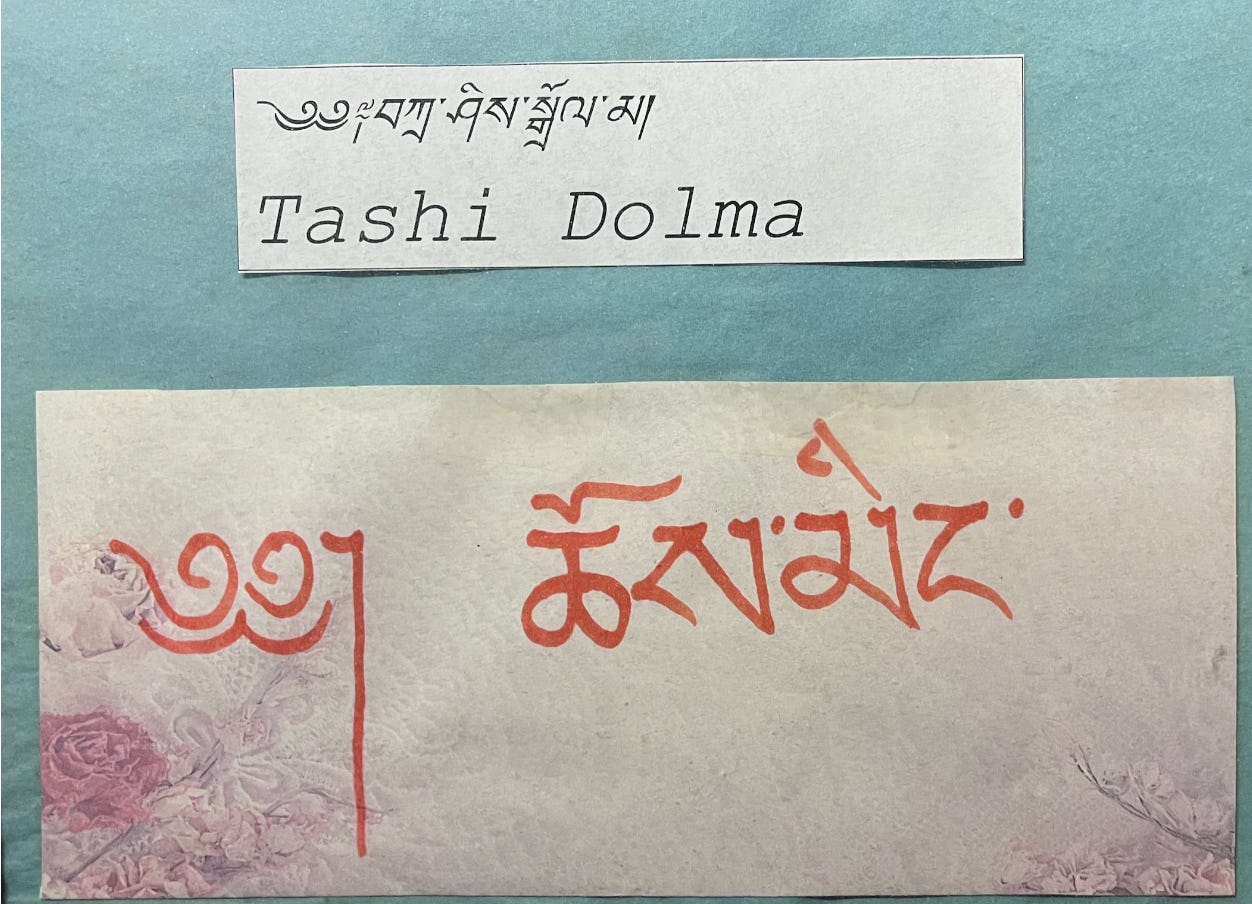
She who saves…
Out of curiosity, I just looked up “Tashi Dolma” in Google AI. The words fill me with awe still, as I soak up each one:
“Tashi Dolma (or Trashi Drolma) is a common Tibetan name meaning “Auspicious Tara” or “Good Fortune Goddess.” It combines Tashi (”auspicious,” “good fortune,” or “luck”) with Dolma*(the Tibetan name for Tara, a revered female Buddha of compassion and liberation). It signifies a blessing for a fortunate life, often representing the protective energy of the Green Tara.*
Tashi (བཀྲ་ཤིས་): Refers to good fortune, luck, or auspiciousness. It is often used in the greeting “Tashi Delek”.
Dolma (སྒྲོལ་མ): Means “she who saves” or “she who liberates,” referring to the female Bodhisattva/Buddha Tara.
Cultural Significance: This name is popular in Tibet, Bhutan, and Himalayan regions, representing a compassionate and protective force.”
I stopped at: “She who saves…or liberates…a compassionate, and protective force.”
If ever there was the purpose of my life, all those years, and now again as I write this story, that line is it. I tried to protect my family, save it. I was determined to give my son a better life. And for anyone I came across who was hurting, I always felt their pain and tried to soothe it.
My journey to find a spiritual path
By the mid-1990s, I had tried one last time to stay with Catholicism. Having a young son, I debated what to do for a spiritual connection with him. So I tried going back to Mass. Despite my anger and despair with God. Despite the priests who had told me as a child in the confessional that my father’s abuse of me was my fault. Despite those things, there was still Mary. So I tried.
But the last straw was the priest in that sermon on Sunday, scolding the women for not dressing up as well as the Baptist women at the church down the street. And then lecturing about the young mother with the baby who walked out of church right after Communion instead of waiting for the Mass to end. I almost got up and started yelling right then, “Have YOU ever tried to sit with an infant in church for a whole hour?! You’re lucky she MADE it to Communion!”
When I got home that day, my husband saw my mood and asked how Mass was.
I just snapped an answer: “No one should come out of church angrier than they went in!”
I felt like that lyric in Sting’s song, “All This Time,” where he asks where Jesus is if He is supposed to be here in the world. While I might have been angry at God, I couldn’t blame God or Jesus for the failings of that religion. And don’t even get me started on pedophile priests…..
So, with that, I was finished with the Catholic Church.*
Well, I put an asterisk there. I was finished with regular church and Sunday Masses with clueless priests. I did continue to search on my own for wisdom that went beyond them. I knew there had been mystics and saints who actually did have a clue about true spirituality.
So, I continued to say a rosary. Looked into the Spiritual Exercises of St. Ignatius. Read about St. John of the Cross and his Dark Night of the Soul, as well as the writings of his friend, the nun, Teresa of Avila.
I loved her comment, “May God protect me from gloomy saints!” Her thoughts that spiritual life should be joy, love, and hope, not rigid piety, convinced me that she was a person I’d have tea with now if she were still alive.
Continuing my search for answers, I read the poetic writings of the mystics – The Desert Fathers, the Dead Sea Scroll writings, and the Gospels of the Gnostics – Mary, Thomas, James, and others whose writings never made it into the standard Catholic Canon. Their thoughts went against the political hierarchy of the early Church, so their voices were muffled.
I flat-out decided that St. Paul needed psychological help. He had such hateful views about sex – essentially, get married if you can’t control yourself, but otherwise stay away from it. Nowhere did he offer wisdom on how to properly celebrate an aspect of life that God created.
Re-enchantment and celebration
However, thank God, I did come across the writings of a former Catholic monk, and now psychologist, Thomas Moore. His books, Care of the Soul, and Reenchantment of Everyday Life, were such a breath of fresh air, and a much healthier view of the role of sensuality in the world in everyday life:
“There is no reason why a workplace should not be a place of beauty, intimacy, pleasure, and desire — sexual values…The pleasure question is an important one and could be the most direct route to enchantment, because the line between sex and enchantment is a thin one. If we don’t live in a sexual world, then we place all our sexual expectations on a personal lover, and sexual love simply can’t thrive in such a loaded and desexualized context…in therapy, I listen to people trying to sort out their feelings of desire and sensuality in terms of their spouse or lover. They rarely consider the sexual nature of their work, their homes, or their experience in nature…involving aromas, memories, and sensations…When it is carried out without…power struggles and obsessions, sex can be an exploration of the soul.”
My God, here was a former monk who nailed the innate beauty and sensuality in all its forms and didn’t mention the word sin even once. These things he described, those had been my “Moments of Respite” — those moments where I found something around me beautiful and just reveled in it. Those Moments were the things I’d used all through my life to sustain me in that house I grew up in…through years of sexual assaults by my father, and now, through years of battling him.
My hat is off to Thomas Moore. He helped me put the world and sex in their proper perspective and learn to celebrate even the simplest things in life and nature.
Other dilemmas
As far as our son and church were concerned, we decided to do our own “church” at the table after Sunday dinner. For a little while each week, we’d read something and talk about it. Sometimes it was the book of all the religions of the world. Other times, it was arguing over a passage from the Tao Te Ching. And sometimes we’d watch those Great Courses classes on The Old Testament. Dr. Amy Jill Levine, who did that one, is funny, brilliant, and insightful. We loved her classes.
I continued to search for answers – to God, to my family battles, to the question, “Do I still maintain a relationship with them despite all the hurt of his abuse?” I read through the Course in Miracles book and Marianne Williamson’s book, A Return to Love.
Someone had to have an answer to the dilemma: “How do you maintain boundaries and healthy relationships when your family doesn’t have them? And can you still love them even if you hold them accountable?”
Life is Suffering
At that moment, I discovered two books, A Path With Heart by Jack Kornfield, a former Buddhist monk, and one by Lama Surya Das, Awakening the Buddha Within. They changed my life.
In fact, the first truth of Buddhism that they revealed to me also changed it: Life is Suffering. It was actually a relief, not a depressing thing for someone to just say it like it was. Life is Suffering.
Buddhism summed things up in “Four Noble Truths”:
- Life is Suffering
- Suffering Has Causes
- These Causes can be healed
- The way to healing is to follow the 8-Fold Path
Jack Kornfield’s book was about training your mind and heart to bring compassion to yourself and others. He showed how to make it through your own “Dark Nights of the Soul.” Kornfield’s approach is down to earth, as shown by the title of one of his later books, After the Ecstasy, the Laundry. To him, a spiritual path wasn’t just for monks, but most especially for those of us dealing with life’s myriad problems.
Covering topics in everyday life, from relationships and sex to psychological and emotional healing, it was like a manual to effective living skills. And he taught how to meditate, and answer the question: “Did I love well?”
Lama Surya Das’s book was a practical guide to living these ideas in the real world. There were great things like, “*As we think, so shall we become*.” And concepts on how to have good intentions and see the world more clearly, instructions on ethics, how to live well and peacefully, and how to meditate. His book opened my way to see the world with NUANCE. Life isn’t black or white, but a thousand shades of gray. It’s not just right or wrong, but what is something’s ethics in a given situation.
This training was what I needed to continue to both love and hold my father accountable.
I spent the next ten years studying Buddhism. Working with different variations of Buddhism over the years, and different meditation groups and temples, I found my way to some peace.
Reading books by Jack Kornfield and Sharon Salzberg, I learned about Vipassana or Insight Meditation methods. Shunryu Suzuki taught me that you keep a “Beginner’s Mind,” — that is, a true master approaches life always as a beginner because there is always something new to learn, even in the familiar. As long as you are open to new ideas, you can learn. Instead, if you think you know everything, you are like a cup filled to the brim with water. Nothing more can be added or learned. It just spills out, wasted. You leave room for the new ideas.
Pema Chodron, an American Buddhist nun, wrote many books in very frank and funny stories. But all of her writing conveyed the importance of “not running away from your truth.” She taught about how to handle “when things fall apart,” and also how to use a “tonglen meditation practice” to send out compassion into a hurting world.
And books by the Vietnamese Buddhist monk, Thich Nhat Hanh, were especially helpful. He taught how to accept ALL your emotions, how to hold your anger and calm it like a mother calming a crying baby. Most especially, here was a man who had every reason to hate Americans for what they did during the Vietnam War. Yet, he spent decades working with Vietnam veterans to help them heal their pain from their war experiences. Just an amazing example of compassion.
The lessons learned
What you think,
Is what you feel,
Is what you do…
(From my journal)
Through all of this work, I learned about unconditional love. About how to hold both pain and love in your heart. About what true “unconditional” love is. And how to walk a “Middle path” in life – neither a doormat, nor a rigid judge. And I learned I could take the pain, but not let it destroy me. The one area I will write about later, though, is the question of forgiveness. That question has a LOT of nuances, so I will write about that topic separately.
As to my family, because I speak my own truths, I suspect I am an anathema to them, and that can hurt. The rules are to follow the family system’s dictates, or you are not acceptable. All those years, his rules meant I could not be myself and be accepted. But through Buddhism I learned that I can, and MUST think my own way to truth.
Through all of this, I came to feel that God didn’t fail me, but that God has been with me through everything. My strength, my ability to still love my family, my willingness to fight for our kids, and even every one of those song lyrics or books that helped me and fed me when I needed support – to me, all of it came from God.
As to the evil done to me, well, my own feeling is that a God who gives us free will in life can’t interfere even if something horrible is happening. The best that I think God can offer is those subtle messages in the moment from “somewhere” that inspire each of us to give the world the best we can, even in the worst moments.
And About God?
Thus, coming back to the question – What sustained me? A world full of sages who wrote books about their own struggles in life and how they transformed hate and anger into love or healing. Many meditation masters. Stray song lyrics. Book quotes. Buddhist Compassion Goddess names….God.
And God would be the next step on my journey to my ultimate spiritual home – Judaism. I would eventually move on from Buddhism alone, because….I missed God.
About that family system
And coming back to my family? No, it has never been easy. And it was not going to be easy going forward, even as the coming next few years would be calmer.
For sure, I would still get comments like, “When are you going to get over this?” Or they wouldn’t really talk to me that much. Or my family would try to pull in my son by making a “joke” like, “Come with us. We know how your mother is.”
And I had failures and reacted badly at times. Or didn’t handle my communications with them as well as I could. But I tried.
The more I studied Buddhism and later, Judaism, the more tools I had to “see,” understand what was operating, and respond in a way that matched my soul. And even now, I remember that monk’s expectations of me as “Auspicious Tara.”
So, why did I stay or return and keep trying to find a way to have a relationship?
- It was my nature.
- It was my early training as the oldest.
- It was fed by stories from Catholicism, like: Greater love hath no man than that he lay down his life for a friend.
- It was reinforced with Buddhism, and its lessons in compassion, stretching the heart, healing the world, and facing truths
- It was cemented by the examples of those like Thich Nhat Hanh and Pema Chodron
- It was my belief that everyone has some shred of good in them
- It was the examination of why my father caused harm, even as I don’t excuse his choice not to try to fix his abusive ways or even admit them
- It was the help of therapists
- It was the LARGE doses of unconditional love, cooperation, and support from my husband
- It wasGod, and especially, Mary
Now, for a few calm years before things blow up….
 Soul Mosaic
Leave a comment