Archive for March, 2026

December 2006 – The Crisis – Part III – Miracles

March 6, 2026

Oxygen ping-pong

I’d sent my son downstairs to sit in the sunny atrium and call his friends. He needed a break. This was one time when I was glad for teenage friends on cell phones. A tiny touch of normalcy for him from the last couple of days.

All morning, we’d watched Ed’s oxygen numbers bounce up and down on the monitor. It was like watching a race where the lead was uncertain yet, but our “runner” might just bolt forward at any moment. Clearly, his levels were trending up. If they could just break through to normal….

I watched my husband sleeping in the bed. He was still on a lot of morphine to keep him quiet. However, given that his oxygen levels were inching toward normal, they started to bring the morphine dose down. As soon as his oxygen levels stabilized for sure, they wanted to get him off the respirator and bring him out of his coma.

The respirator had been a lifesaver for sure. But leaving him on it longer than needed risked infection. On the other hand, bringing someone out of their coma and removing the respirator is uncomfortable for the patient and excruciating to watch.

We wanted to be there to greet him on his “return from the coma”…and see, Was he still “Ed?” His brain swelling had not gotten any worse and was starting to improve. But the moment of truth would only come when he was awake. Then we would learn what all of this trauma had done to him.

They started the process. He groaned and became very restless. We couldn’t watch this part. It was too hard. Given that we had been on our vigil at the hospital for almost two days straight, we decided it would be okay to go home, shower, and change, and let this process unfold. The nurses agreed that we should do that and come back in a couple of hours.

That engineer brain

Ed is the sort of person who loves to figure out how everything works…and if it isn’t working optimally, to fix it. He was that way as a kid – collecting broken appliances and machines from the neighbors so he could take them apart and see what made them work. It was one of the many things I so loved about him. I longed to have that friend of mine back.

When I walked into his room on our return, he was asleep, resting quietly. He seemed much more peaceful than when we left, and it was a relief not to hear the rhythmic sounds of the respirator anymore.

Now he was being given oxygen through a mask, which happened to be lying on his face, crooked. As I reached over to straighten it, his eyes flickered, and mine bolted open wide. I just stood there, frozen, and held my breath.

Was my Ed, still Ed?

He hadn’t noticed me yet. Instead, his eyes were tilted down toward his nose, totally focused on the crooked mask. His brow was furrowed in seeming frustration and concentration.

I wanted to yell for joy! THAT was Ed. Without him even saying a word, I could see that his engineer brain was displeased by the “suboptimal” placement of his oxygen mask. He might have been groggy and still drugged, but HE WAS STILL ED, trying to figure out how to make some mechanical thing hew to his will!

Then he looked up, and for the first time since this began, I could see those beautiful, soft, blue pupils staring up at me. I couldn’t speak.

“Where am I?” His voice was gravely from the breathing tube, but he was clear and coherent. “What happened?” He had no memory of any of this since the ER.

Both my son and I were so ecstatic that we just cried. I gave Ed a short version of what had happened since the afternoon in the ER, and assured him he was doing great and would be just fine. Just seeing those beautiful, gentle eyes staring back at me and hearing his voice again were the best gifts in the world. I had started to despair of ever seeing and hearing him again.

“What happened in the ER?”

In that moment, I slammed the door shut on that conversation. I knew he was still weak and fragile.

“We aren’t talking about any of that right now. Not while you’re in the ICU. It doesn’t matter. All that matters is that you are alive! We’re just going to focus on getting you better now!”

He smiled, then drifted off to sleep. That was fine. I had seen what I needed to for the moment. Now, rest was what he needed.

Geometric figures

Once he was conscious, he started recovering quickly. It was like what the pulmonary doctor had said to us the first night: “Your husband is strong and healthy.”

In fact, strong and healthy was probably the reason that his sodium level had jumped up a bit too fast that first night. The doctor said that once the sodium had started to come back up, being healthy was a risk because the body would try to stabilize too quickly.

Given that, they still need to watch him for any signs of paralysis from that quick rise. And he still needed his vital signs followed to make sure his heart and lungs were okay. And continue to receive IV antibiotics for his pneumonia. They also wanted another MRI to see if the brain swelling had gone down and if there was any brain damage. So, we still had a ways to go. But things were looking up.

Later that day, they moved him into a “step-down” unit, where they could continue with close care, but more freedom than in the ICU.

I continued to stay with him, but sent our son home to spend time with friends and have some normal teenage life again. Ed was a little weird at this point because he was very weak. And he was mystified by the odd dreams he was having that were filled with geometric figures. We later learned this is common when you’ve had a lot of morphine.

Over the next day or two, we got him up and walking. Eating. And since he couldn’t get in the shower with all of his IVs, I sponge-bathed him. There are many ways to make love. As I washed his body and helped him feel like a human being again, it occurred to me that this, too, was another way. Each stroke of the washcloth was an unspoken expression of total love.

Thank you, Mariah Carey

His recovery sped up quickly. And at that point, I wanted him out of the hospital. He’d contracted a Staph infection, and I knew that the worst infections could be the ones you get in a hospital. So, once he was getting stronger, it was time to go home.

Of course, there was one last hitch. One of the lab tests was abnormal, so he had to have an ultrasound before they would discharge him. Fortunately, that turned out to be nothing.

Finally, words we never expected to hear – “We’re discharging you!”

It was cold out, and getting dark, as I drove slowly up the main street through town. I had the radio on, and that’s when that song came on….my absolute favorite song…the one I will ALWAYS associate with that moment in time, and with Ed: Mariah Carey belting out “All I Want For Christmas is You!” I’d always loved it. But NOW? THIS MOMENT? It said it all. Both Ed and I started to cry.

With Ed back in the house, life felt possible again. Our little family group was united again in our “nest.”

It didn’t matter if there was a tree, gifts, or anything. Nothing mattered beyond our joy to have Ed with us still. We’d wing the rest. In fact, when we got up the next morning, Christmas lights were strung up all over the inside of the house, like I usually did in the past. Our son had stayed up late to do that for us. It was Christmas in the very best of ways.

I never expected to see you up and walking again…

To express our overwhelming gratitude for all the nurses, doctors, lab and respiratory techs who saved Ed’s life, we went to a nearby gourmet grocery store and had them make up several gift baskets. And then we played Santa, going back to the ER, then the ICU to deliver the baskets of goodies and let Ed say thank you to them all, in person.

The young male nurse who had worked so hard on Ed that first night stared at Ed in shock…and then pleasure, as he shook Ed’s hand.

Quietly, the nurse said to me, “Frankly, if you had told me that night that he would recover and be able to walk in here on his own, I wouldn’t have believed it. I never expected it.”

I remember choking up as I told the nurse what I hadn’t said to anyone. “I feel like I failed him the night of his surgery….I listened to the doctor. I just felt like something was wrong, but I trusted the doctor. I should have brought Ed in here then.”

The nurse vehemently shook his head and stopped me right there. “Don’t even go there! You could have brought him in that night, and he might not have been bad, and we would have sent him home. And then you would have hesitated to come back when it really mattered. And he would have died. You did nothing wrong!”*

To this day, I still sometimes wonder. But it is what it is. I only know that on that afternoon, if I had picked up our son from school and gone home or even to the Urgent Care instead of right to the ER, Ed would have died. It was that close and that fast. The only reason he lived was because we were already in the ER when everything blew apart. And all of those wonderful people saved him.

So we went home. And celebrated our Christmas, and the best joy of our lives. We were all still together. We were determined to go on now, live our lives fully, and savor the gift of “us” still having a future together.
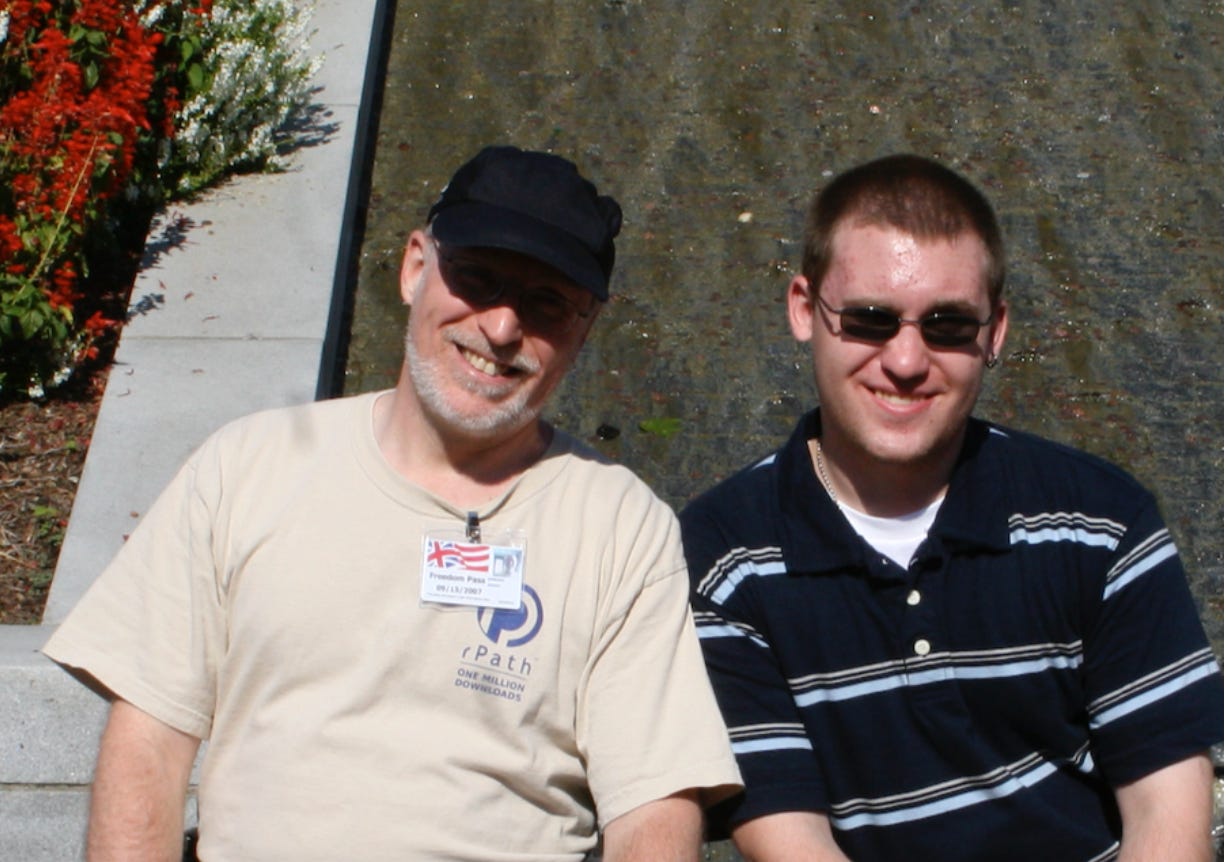
Photo by author

Four “certainties,” and a prayer

After all of the experiences through this time, there are a few things I was “certain” of, and one thing I prayed for.

The first thing I am absolutely certain of, is that on that afternoon, if I had picked up our son from school and gone home or even to the Urgent Care instead of right to the ER, Ed would have died. It was that close and that fast. The only reason he lived was because we were already in the ER when everything blew apart. And all of those wonderful people saved him.

The second thing I was certain of, I learned that afternoon in the ER. Life can go from normal to exploded in a matter of seconds. At that moment you are torn open to your core, and you realize that the only thing that matters is LOVE. Love. Love. Not the bills, not the irritations or the arguments. Not the plans, or the memories. Just…LOVE.

The next one is that our lives would never be the same. WE would never be the same. There was always going to be the “before times,” before this horrible event, and then, the “after times.” And who we would be, and how we would live, would be very different.

The prayer during all of this, was that when the time came, to please take Ed first, and not me. I don’t ever want him to know how those waiting room hours feel.

And the last certainty, was that I saw no need to ever tell anyone of the images I saw in the ER that day. Images that will be seared in my brain forever. In fact, I saw no reason to talk about that whole time. It was over and done with. Just move on and enjoy life.

Three certainties and the prayer were correct. That last certainty, though…not so much.
December 2006 – The Crisis – Part II

March 5, 2026
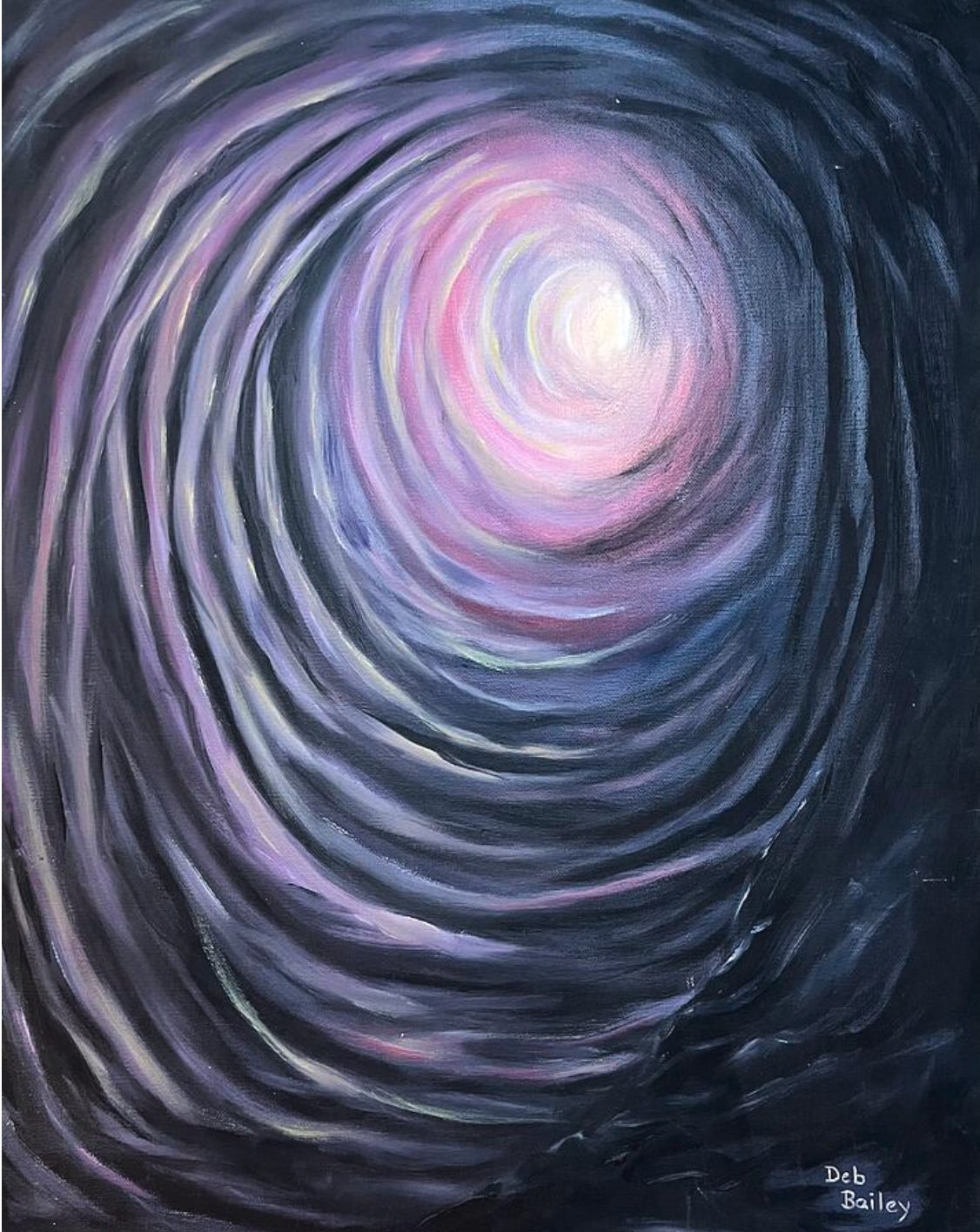
Painting by author

The place out of time

There is something about the ICU waiting room that I wish could be captured and spread throughout the world — unconditional love.

The ICU waiting room is a place out of time. While everyone hangs in limbo for an outcome, for a hoped-for word on a loved one, for relief from the intense pain of not knowing either way, life, as you know it, stops.

In that room, you enter the land of pain, fear, and sorrow – the great equalizers. No matter what walk of life you came from, rich, poor, or famous, no matter what color or race you are, when you enter the ICU waiting room, each one of you is the same — a hurting, terrified human being.

I sat there slowly becoming familiar with each person’s story. We became our own family, bonded in the understanding and compassion only pain can forge. Each of us waited for the 10 minutes every hour when we could either visit our loved one, or get a precious update on a test result that could mean life or death, and that seemed to take an eternity to come. Each of us celebrated any tidbit of good news for ANY one of us. It was like a victory for us all. Or, we consoled, knowing that at any moment, we might need to be consoled. If only regular life could operate that way – just full compassion and open hearts – what a changed world we could live in.

Our son spent hours there. When he couldn’t take another moment of watching his father’s “too-low” oxygen readings on the monitor, he would go into the waiting room to talk to the other “members of our cohort.” He knew their names, listened to them as they talked, and brought me updates on all of them. He has a sensitive heart and shared it generously all through those hours. And they loved us back…the way life SHOULD be.

The updates

After the pulmonary doctor left, we waited for word that Ed was settled in an ICU bay. Then I went right in to see him.

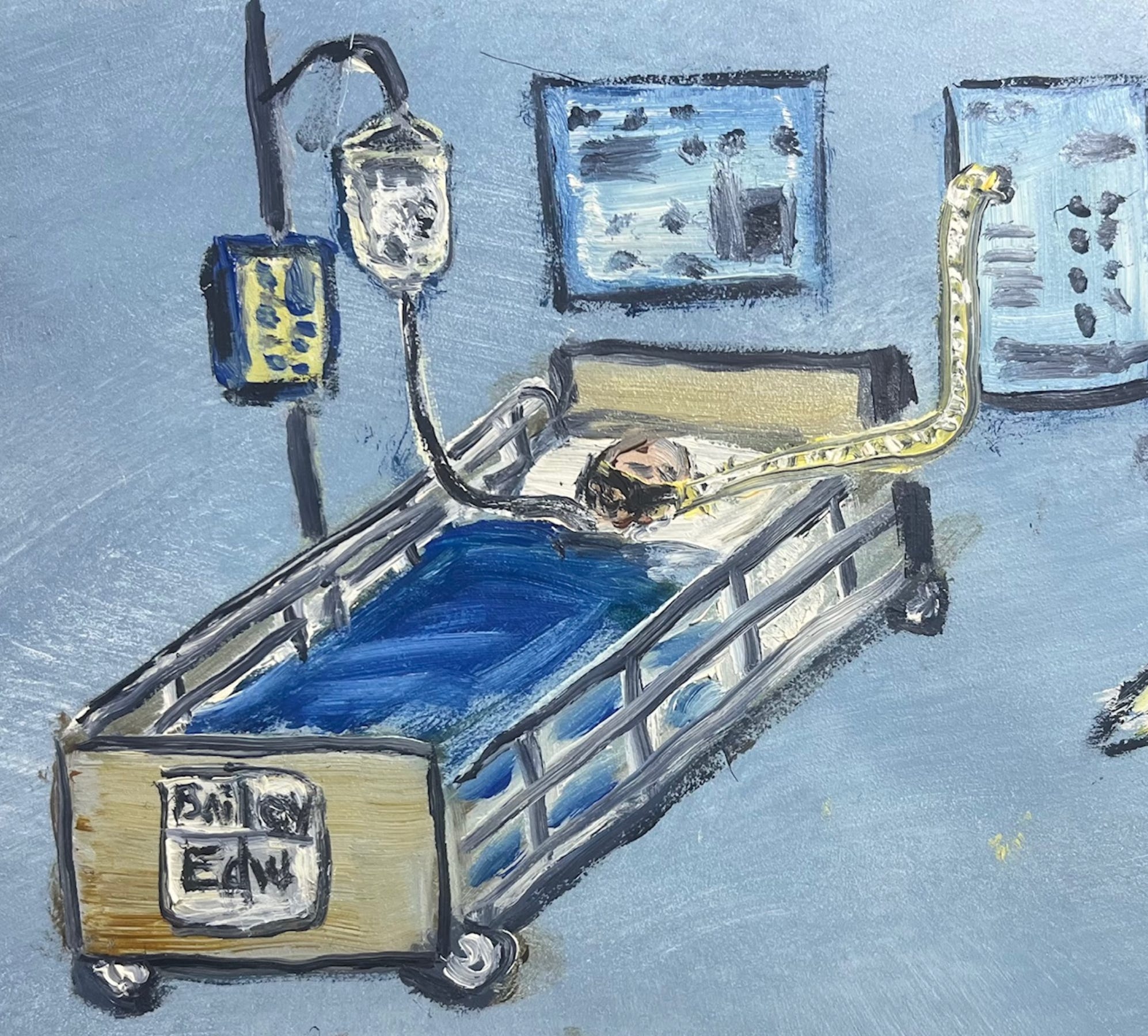
In the dark room, he lay motionless except for the rising and falling of his chest, which was orchestrated by an array of tubes and wires. Bags of IV solutions on poles with beeping controllers lined either side of his bed. Rows of numbers flashed and reloaded constantly on the screen above him, indicating any decrease in heart rhythms and his oxygen level. I stared so hard at those numbers, trying to use the force of my mental energy to make them rise.

The doctor, a nephrologist — kidney specialist — came over and started updating me. They were bringing up the sodium as slowly as they could. But now there was a new problem – his potassium level was plummeting. If it got below a certain point, his heart would just stop, and that would be it.

Yes, they were trying to bring up the potassium along with the sodium, BUT…the two were working AGAINST each other. Bring up one, and the other would drop. So it was a desperate seesawing battle to move first one up a little bit at a time, then the other one, all without dropping the potassium so low he died, or bringing up the sodium so fast he would be paralyzed.

The oxygen levels were abysmal. The fluids he had sucked into his lungs were blocking the air passages, preventing him from getting enough oxygen into his body despite the fact that they were giving him the maximum amount.

The bottom line? There was still no clear indication he would make it through the night. Ed’s life, our lives, were in the hands of this specialist.

A fluke

The doctor quizzed me: What was his medical history? What medications had he been on? And…by ANY chance, did I know what they gave him for anesthesia for the surgery??

Thank God I’d forced that damned anesthesiologist to tell me.

He pondered all my answers. Then asked, “Does he drink much?”

“Other than an occasional beer, no. He just drinks a lot of water every day…to be healthy.”

“How much?”

When I told the doctor that Ed usually took a gallon thermos of distilled water to work with him every day, the doctor winced.

“What caused this?!” I asked, still trying to wrap my head around all that had happened, as if knowing might help save him.

“Well, the anesthesia could have played a part. But then he was also on a month of high-dose steroids. That didn’t help. And his blood pressure medicine is notorious for dropping blood sodium levels. And, that’s a lot of water he drinks every day.”

He looked at me and said, “I don’t think this was any one thing. Any of those things by themselves wouldn’t do this. It looks like a perfect storm where several of these things just came together in a fluke event.”

A “fluke.” Yeah. Those things that “aren’t supposed to happen,” but just did. I had trusted the Universe, and that damned ENT, and trusted that all would go well. But…that didn’t happen.

The nephrologist told me he would be on all night and would be the one managing Ed’s sodium and potassium levels, which they were testing every half hour or so. And he promised to keep me updated.

I’d made it clear I was a lab tech, and I wanted to know EVERYTHING. And NO sugar-coating anything. Just straight facts.

Thanking him for all his care, I let him know we were not leaving. We were staying until…whenever. I was in lab-professional mode. This was not the time to fall apart. I could do that later. At that moment, I needed to be totally together so I could help in any way possible. I was “standing guard” over the love of my life…period.

Benign

As I turned to walk back to the waiting room, he said to me, “Oh, by the way. The biopsy on that unilateral mass…”

I held my breath.

“It was nothing. Just a benign cyst.”

I rolled my eyes at the irony of it all. “Great,” I said to the doctor. “If he lives, we’ll celebrate.” That damned mass that started it all was a non-issue. I was happy for that. But would Ed live to hear the news?

And, as an aside, to this day, he still has problems with that sinus….

The long night of life in the balance

Despite people telling us to go home, neither my son nor I was leaving. We were going to stay until we knew what would happen. We COULDN’T go home.

A neighbor left us with a sheet, blankets, and a pillow. We were the only ones left in the waiting room, so we spread out the sheet, turned off the light, and stretched out.

My son was restless. I put my hand on his leg to comfort him. He slowly relaxed and dropped off to sleep. I tried to lie down, but my heart was pounding so hard, and I was shaking. I had to sit up. So I closed my eyes and breathed deeply, trying to calm down.

As I sat there in the dark, I pleaded with God. “Please save him. But If he can’t come back and live a good life…..then take him. He would hate living unable to do anything or unaware…but if he can live a good life, please, save him. I don’t even care if he is crippled or has some permanent damage. As long as he can live a good life.”

And I also asked for help for me. I was afraid. Afraid I wasn’t sure I was strong enough to handle things if he were to be comatose or crippled. Afraid…just…afraid.

The blessed ICU nurse. He was wonderful. He came out to check on us now and then. And to update me.

He mentioned that the head nurse wasn’t happy we were there sleeping on the floor. But he told her, “Leave them alone. Look, if we lose him, we’re gonna lose all three of them. Let them be.”

I thanked him deeply. He was such a tremendous help that night, bringing me the steady stream of potassium and sodium numbers. Letting me know the nephrologist seemed to be making progress. Ed might actually be turning a corner.

Then, a couple hours later he came in.

“Your husband’s temperature is 104.”

I knew what that meant – the aspiration in his lungs was now a pneumonia. “What do you want to do?”

“He’s already on antibiotics, but…”

I waited while he looked me in the eye.

“If we could get his temp down, it would help. In the old days, we’d pack the patient in ice to bring the temp down.” He looked at me, one medical professional to another.

Without a trace of hesitation, I said, “Do it.”

“He won’t be comfortable.”

“Do it!” I knew the nurse was right. And this was no time for half-measures.

He nodded. Seemingly relieved that I understood and agreed with what he felt was the best chance to help Ed.

The night wore on. More labs. More temps. More O2 levels.

I never slept.

But his temperature came down.

The next day

Friends returned and sat with us. More updates on sodium and potassium. Those had finally stabilized.

The doctor mentioned that at one point during the night, the sodium level jumped a bit too fast. He was worried about the paralysis. “We won’t know for a couple of days yet.”

And his brain was still swollen. They would be doing another MRI to see if it was being pushed against his skull.

Still trying to verify just what happened to cause all of this, the doctor asked if maybe Ed’s sodium was already low before the surgery.

My “lab-tech” brain fired. I snapped alert, realizing this was something I COULD help with. “They did a potassium pre-op. I know the machine that does those tests. When it does a potassium, it also spits out a sodium result.”

He and the head nurse, who understood I was in the medical field, offered me a chair at the nurse’s station and a phone. “Call the Day-Surgery center and see if you can get a sodium level.”

They had him in the records. Yet strangely, nobody could answer about a sodium level. I told them I knew labs held blood samples for a day or so. Could they please re-run the sample and see if it was low?

I also knew that if that sodium was low, that meant the lab tech who ran that potassium test before Ed’s surgery should have picked up on that and told the anesthesiologist. It would be no excuse to say the doctor hadn’t ordered a sodium. If you run a test and see an abnormal result, you still tell the doctor.

Again, strangely, they never could find the sample. “It must have been discarded already….” Yes.

As a last resort, I called Ed’s doctor and asked for any previous sodium levels that he had on hand to see if there had been any trend down recently. But beyond that, there was nothing more I could do.

So I offered to help the nurse bathe and change Ed, so he could be comfortable. I stayed calm through all this because I knew the nurse didn’t need an emotional wife. If I could stay in control and help with his care, they would be willing to keep me well informed of any and every change.

For the rest of the day, we were either in Ed’s room watching monitors, keeping vigil in the waiting room with other families, or sitting with my friends and one of my siblings who came to visit. A gift of love despite our differences.

At one point, they sent us home to try to sleep. My son and I did go home, but it was painful to stay there. Neither of us could sleep. Everywhere we looked in the house, we saw Ed. The touches of him all around us just drove us out of the house and back to the hospital.

At least when we got there, he seemed to be stabilizing.

December 2006 – The Crisis – Part I

March 4, 2026

“Your husband’s blood oxygen has dropped. It’s hovering around 47% right now. Below 50% we usually see brain damage.”

The words hit me like a rock against my skull. All of us went so silent that the quiet crushed against my eardrums.

“Is my husband going to live?”

Those were words I never expected to hear coming out of my mouth at this point in life. Especially given Ed was only 47.

The doctor hesitated.

But I was blunt, direct, to-the-point, with words that meant I wanted no fluff answers. I had been in the medical field too long. I knew how doctors and nurses sometimes sugar-coated things or used evasive words so as not “freak the family out.” I didn’t want coddling or patronizing. I couldn’t bear “uncertainty.” Tell me now – Is he dying or is he going to make it?”

Even though Ed had just been admitted to the ICU from the ER, I thought we had a chance. They had finally diagnosed him in the ER as having severe hyponatremia — blood sodium so low it almost killed him. But they said they could treat him. So what had changed?

The doctor took a breath. My mind rapidly assessed his face, calculated in his delay in answering, and knew before he spoke his most carefully chosen words, that we were dealing with yet another descent toward Ed’s death.

“Your husband is young and strong…” was all he said.

That trip

I always struggled anytime Ed traveled on business. Struggled was an understatement. Phobic that something would happen to him is more accurate. I knew from the time my aunt was killed in a car accident when I was 9, that phone calls can come and inform you that the “thing that usually doesn’t happen,” just did. I never forgot my mom’s intense wail when she heard her sister was dead.

So, I held that same fear again in early 2005, when he had to travel with a few guys from his office to a meeting in New York City. And it was with that same huge sigh of relief I always felt on his return that I picked him up from the airport. It always felt like we’d been given yet another “reprieve,” until the next time.

And even though he looked exhausted and had caught some bug, at least he was back. The rest we could deal with.

For the rest of the year, though, and all through 2006, he had a constant sinus infection. All the usual things – nasal saline, nasal steroid sprays, antibiotics – wouldn’t touch it.

Finally, out of desperation, we went to an ENT. He, too, prescribed another round of nasal steroid spray. Then, when that didn’t work, he gave Ed a round of oral prednisone. Which should have worked…but it didn’t.

So the doctor moved up to his big guns: a very-high-dose, month-long round of steroids. Failure again.

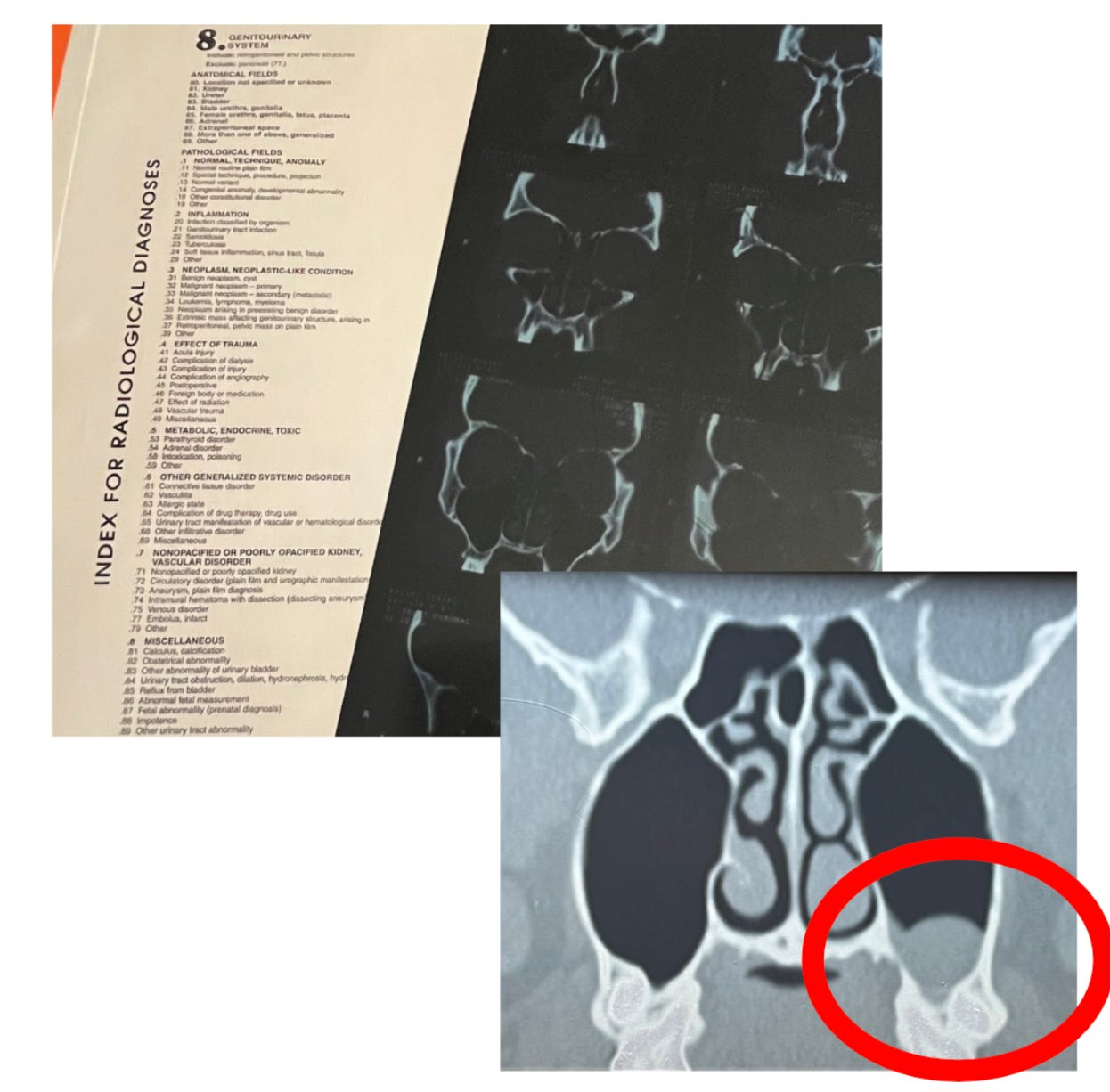
At that point, the doctor ordered CT scans of the skull. To this day, I absolutely HATE those large sheets with cross-section images of Ed’s skull. Because there in THAT image was something we couldn’t ignore – the “unilateral mass.”

That basically meant that there was “something there,” only on one side. Who knew what that something was? It could have been the cause of his problems or not. And it could have been anything from nothing at all to cancer. So, we couldn’t ignore it.

Photo by author – sinus xray of the “mass”

If there is anything I am even more phobic about, even worse than business trips, it’s me or anyone I love having to undergo any kind of surgical procedure. You would think I would be fine with that after 30 years in the medical field. But I’d seen too many things over those years. I didn’t want to be anywhere near a hospital, and I didn’t want anyone I loved near a hospital.

So every time I held that X-ray film up to the window and studied that image, I felt a hatred for that mass, and a sense of foreboding.

But knowing that my phobias, though understandable, could not run my life, I sucked it up and put on a brave face. When we got to the day-surgery center, I reminded myself that thousands of people have procedures every day and “things usually don’t happen.”

Yes, I grilled the condescending anesthesiologist about exactly what chemical they were giving him for anesthesia. Yes. I asked about his lab results that they did. Yes, I was terrified when they wheeled him away. But as I sipped tea in the waiting room, I convinced myself that my fears were overblown. Everyone else sitting there was reading a magazine, chatting on the phone, or looking generally bored. So, I told myself to just trust that all would be well.

And when they called me into the recovery room, he sat there, smiling, sipping soda, and chatting away. He seemed to have shrugged off the anesthesia well. And even though the surgeon had to operate in an area just a couple of millimeters under his brain…under his pituitary gland to be specific, all had apparently gone off without a hitch.

They told me what pain meds to give and when, how to take care of the wound dressing, and change it. We settled in at home for a quiet evening that should have seen Ed sleep off the rest of the anesthesia and pain meds, and wake up refreshed and alert in the morning.

Should have.

Just let him sleep it off!

The afternoon went sort of okay. He slept. But he kept wanting more water to drink. Seemed to be very thirsty. And he was acting off, not really with it. While I couldn’t put my finger on it, things just felt “wrong.” He’d had previous pain meds after dental procedures and had not reacted like this.

Trusting my gut, I called the surgeon and told him what I saw. The surgeon snapped at me. “He’s just out of it from the pain meds! Let him sleep it off!”

I was in a quandary. I knew Ed. Things seemed off. But I also knew I was nervous, so…I believed the doctor.

Just have them catheterize him!

The next day, I sent our son off to school. Ed got up, but was distant. Strange. Quiet. He seemed detached from things around him. But he answered me. Sort of.

But he couldn’t zip his pants. His abdomen seemed swollen. His feet, too, wouldn’t fit in his loafers. I called the doctor’s office. The equally abrupt nurse blew me off.

“He’s retaining fluid! Something is wrong.”

“Just take him to the ER then and have them catheterize him!” I don’t think she was listening to me.

“I didn’t say he couldn’t go to the bathroom! I said he is RETAINING FLUID! He is SWELLING all over his body!”

“Then take him to the ER.” She clearly just wanted me off the phone.

It was time to get our son from school.

“You’re coming with me,” I said to Ed. I had decided that we might need to get him checked by somebody.

“Do you want to go and get checked at the Urgent Care?”

He mumbled something unintelligible. I didn’t wait for his answer.

The moment our son got in the car, I said to Ed again, “We can go to the Urgent Care or the ER.”

He just stared at me and couldn’t answer. I went right to the ER.

What is this?

It was blessedly quiet there, a rare occurrence. They took him right back, and the nurse started to ask him some of the usual intake questions. He couldn’t answer. Then she did something that flooded me with terror.

“What is this?” she asked Ed. She was pointing at his watch.

Ed sat there, and I could see him concentrating mightily. Then he looked up at her helplessly, tried to say something, but couldn’t make sense

I thought, My God, he’s having a stroke.

She obviously thought so too, because she immediately admitted him into the ER, did all the vitals, and then sent him for a CT scan of his brain. I waited.

They wheeled him back a short time later. He was no longer conscious.

I sat quietly near him. Waiting for the results. That’s when all hell broke loose.

The bag of sneakers

In a matter of seconds, his eyes flipped wide open, and he looked at me like he was angry. His arm shot out hard in my direction like he was throwing a punch. His surgical site in the nose tore open, and blood was everywhere…including down into his lungs.

I thought, *He just aspirated blood into his lungs! He’s a dead man!* I knew from years in the bacteriology lab that when something like that happened, it meant you were at risk of a serious infection as well as damage from fluids going into the lungs that weren’t supposed to be there.

I yelled for the doctors, and though they told me to calm down, they were clearly in emergency mode.

First, they intubated him to get air in his lungs. They started administering meds and performing assessments to figure out what had happened.

I was off to the side. My entire body was shaking. My teeth gritted.

The doctor started firing questions at me: “What meds was he on? What had he been doing today? What was his surgery for? What’s his medical history? Diet?”

As fast as he asked, I answered. Despite the fact that my heart was pounding and I was barely staving off total panic, I knew in that moment that the only way I could help save my husband was to get a grip, think clearly, and answer every question. And…I did.

In between questions, I was saying as many Hail Mary prayers as I could as fast as I could, as well as flat-out pleading with God, and doing deep breathing to stay in control.

I watched as if things were in slow motion. The doctor pricked Ed’s bare foot. Ed didn’t react. I froze and knew what that meant.

The doctor turned to me and voiced the words I was thinking: “I think he’s had a major stroke.”

The room went quiet as they kept working on him. I never left the room. I was frantic, terrified, but in control. I wasn’t leaving him. That’s when the nurse walked in with lab results.

The doctor almost smiled with joy. “He didn’t have a stroke! He’s got severe hyponatremia!” He explained that they actually had something they could work with. They could turn this around, and he would probably be okay. But they had to give the sodium IV VERY slowly. If they gave it too fast and his sodium rose too fast, he could end up paralyzed.

My heart pounded, partly with relief, partly with terror over the risks. But at least we had a chance.

Things calmed for the moment. They brought me papers to sign. My hand shook so hard I could barely hold the pen, much less sign my name.

I heard later that the surgeon came by and they told him what was going on. He never came by to see me. I never spoke to him again. I should have sued him. But at that moment, and for the next many years, I would be too busy to deal with a lawsuit I couldn’t afford anyway. I just cursed the fact that I had EVER listened to him and didn’t bring Ed to the ER that night. I felt responsible for this.

I spoke to my teenage son and told him what was going on. Then I instructed him on how we were going to manage this. I said that “even unconscious people may hear you. I understand that you’ll need to cry. But you do that outside his room. When you go in to see him, you speak strongly, positively, and tell him you are there and love him. Do not cry when you are with him.”

I was shaking all over. Operating on years of hospital training and adrenaline. And the knowledge that we needed to keep under control to be there for Ed. And I needed to be there for my son. So, be strong.

Yet, in that moment, that lifetime of “STRONG” was starting to break apart. All my life, I just bulled through. I had gotten to the point where I didn’t need anybody. Didn’t want to be let down by someone again. So I just took care of things myself. But in these few minutes, everything had changed. I suddenly realized – What do I do if he dies? And I am alone? Who would actually be there for me? Maybe I can’t do it all?

My son and I decided to make a few calls. To a couple of old friends…even though we were no longer that close, I knew they would come. And to one of my siblings, even though she and I hadn’t been on good terms. To neighbors, who could look after our house. To friends of my son. And to my parents, who said they would pray.

At that moment, the doctor came and said Ed needed an MRI to see how his brain was doing. But they were going to have to fight to get him in the machine and would need several techs to help. Because he was on a ventilator, they would have to manually pump oxygen into his lungs when doing the MRI. So it would take a few minutes.

While they arranged everything, I sat there in the now darkened room. Ed was motionless, now changed into hospital garb, and hooked up to all kinds of monitors. His chest rose and fell with the ventilator. The room was silent except for heartbeats, the ventilator, and the beeps of oxygen level numbers up on the screen.

The nurse tapped my shoulder, then gently handed me a plastic bag, and then walked to the desk. I looked down. His sneakers and clothes.

I clutched the bag in shaky hands and thought to myself, Is this how it ends…a bag of sneakers?

To the ICU

People did come. A friend brought us sandwiches. Another friend sat with my son. A neighbor brought blankets and a pillow.

And the many techs were beyond angels. They heard what was happening. Several stayed late and volunteered to work together as a team. Rallied and got him into the MRI machine and kept his oxygen going, tag-teaming with each other to keep pumping the oxygen bag. God bless each one of them.

I watched it all through a small square window in the door to that room. I wouldn’t leave. I couldn’t eat. I needed to know he would survive the MRI.

Finally, they finished. He had cerebral edema – his brain was swelling with fluid against the skull. They would have to monitor him to make sure he didn’t incur any brain damage. It would be a long night. But if they could get his sodium slowly back up, he should make it.

So it was with that hope that I went up to the ICU waiting room with my son and our group of friends to wait while they moved Ed up there. They said they would let me see him when he was all settled.

And that’s when the pulmonary doctor stepped in to tell us about the low blood oxygen level, and hesitated when I asked, “Will my husband live?”

Midlife – WHERE did I go?!

March 2, 2026
Painting by author – “Heaven or Hell?”

What is happening to me?

It was one of those warm, fall afternoons, not sunny, but still, the array of colors splattered on the trees across the pond dazzled.

On the TV, my son was watching the old movie, “The Trouble With Angels.” It was a 1966 comedy with Rosalind Russell and Haley Mills about life in a Catholic girls’ boarding school, where Mills is the determined troublemaker, and Russell is the equally formidable Mother Superior. It is a funny movie, especially if you had the nuns for teachers as I did, and one that we played now and again for comic relief.

I was sitting at my painting easel in the corner of the living room, near the window that looked out on the pond. By all accounts, it should have been a serene afternoon. At any time in the past, with a similar setup, it was. And today started that way. But then, it suddenly changed.

The longer the movie played, the more afraid I became. Dread, foreboding, and this overwhelming sense of …guilt…being in trouble…bad things about to happen, flooded through me.

I tried to shake it off. This is stupid, I remember thinking. I mean, what the hell was wrong? Yet the longer I sat there trying to paint, the more afraid I got.

Worse. I had never experienced anything like this before. I mean, sure, when I was a kid at home, and my father was raging. But I was a 51-year-old adult woman having a peaceful afternoon with my son in my own home. So what was I suddenly so afraid of?

I tried to summon all that rigid strength I’d always had at my fingertips, to quell the fear. I could always depend on being strong. But that day, for the first time in my life, that strength failed me. Shocked, I realized I had no control over the intensifying terror racing through my body.

All I could think was, What is happening to me?!

I didn’t say a word to anyone. Just gritted my teeth, kept painting, and hoped it would pass. Eventually it did ease. But, I felt “different,” afterwards. Like something had changed permanently within me, though I couldn’t explain what, and life was never going to be the same.

The experience left me shaken, because I couldn’t attribute it to any specific cause. If I didn’t know why something happened, how could I know it wouldn’t happen again? It challenged my sense of always being in control of myself and my choices. And I was always, “in control.”

I’d always been able to bull through anything, no matter what. Even if I was exhausted, scared, or whatever, I did it. To me, life challenges were simply mind over matter. My mind drove the bus, the body delivered. No questions asked, no excuses allowed.

But this time, I hadn’t been able to. Why? I was as surprised and upset by my failure to stop those fears as if I’d tried to move my leg and it wouldn’t respond.

I sat there, racking my brain, trying to figure out what had just happened. Life had been pretty calm and stable these last few years. I hadn’t even needed to see a therapist for quite a while.

Yes, I had started menopause, but so far the symptoms hadn’t been too bad or unusual. Some night sweats. More fatigue than I’d expected. Otherwise, just business as usual.

Even as I couldn’t explain it, I remember hoping it was a fluke that would never happen again. But, it was just the beginning of something that would never be the same again.

Midlife status

It was the fall of 2005. Our son was entering his senior year of high school, and I will admit I was feeling this sense of grief. It was the realization that life was about to undergo a major change. He would go off to college, and the years of intense busyness that had filled my life with tutors, transporting him places, school activities, helping with homework, everything that had been the norm for the last 18 years, were almost over. On the one hand, it would be a chance for me to explore new directions. On the other…after a bumpy start during his infancy, I had really loved being “Mom,” and I was going to miss it all.

Other things had recently changed, too. We lost our beloved dog, a small rescue poodle named Gracie. And that was heartbreaking.

Work was also in flux. After ten years of protecting thousands of people participating in hundreds of research studies, I decided I needed a break. So that summer, I stepped down from my work on the ethics board. That left me adrift. But I was burned out. I just couldn’t read another research study on yet another medical disease. I would just need to figure out something else. Maybe now I would have the chance to do some writing?

And friendships with women…they were as problematic as ever. I just couldn’t seem to make things work. While I’d gained an understanding of the issues at play in that earlier friendship that I’d ended, I was still not meshing well with my friends.

The tangled knot of friendship failures

I’d had a couple of close friends from an earlier job. But when I left that job, even though I tried to stay in touch, things changed over time. Also, and I can say this looking back, I was needy. Clingy. Afraid of being “abandoned.” Abandonment and trust were huge, unrecognized issues from my childhood. No one had ever been there to protect me, and love was a very conditional thing to be earned. So I was always seeking a friend who I could trust would never abandon me. A tall order, and usually, I was seeking it from a friend who was emotionally unavailable.

I had other friends who were good to me. But I didn’t seem to acknowledge them as much. I was like I needed to prove to myself that I could get love from someone who wasn’t interested in giving it.

Again, looking back, I realize it wasn’t just my problems that caused those failures. I sensed that the individuals had issues of their own at the time that had nothing to do with me. I was determined to “be there for them” and thought if I did that, they would love me. It was a pattern familiar to me from the past.

These days, I think that was a “Mom” thing. My whole childhood, I’d gone without Mom’s attention or support. Her love was unattainable. And I wanted it, but it was always withheld. She was emotionally unavailable.

So I think I found friends who were the same way. And like with Mom, I kept trying to “earn their love,” a futile and unhealthy endeavor. I was just oblivious to that truth yet.

The other thing operating in me was that I was convinced that I was the broken one. That others had it together, and had all the answers — to life in general, and for me in particular. I had no answers for me that I trusted. Deep down, I always believed the real truths were outside of me.

My father had always dictated what I was supposed to think and believe. Since I’d never been allowed to have my own opinions growing up, or encouraged to trust my own instincts, why would I trust my own thoughts now? So now, I was looking outside of me, to the people around me, for answers, acceptance, validation.

I was starting to recognize that I was too clingy and needy. But beyond that, I still didn’t understand what was driving it all. And if you don’t even recognize there’s a problem, you can’t begin to understand what’s causing it, much less figure out how to fix it.

So over the last few years, I’d lost one close friend, and seemed to be losing a current one. It seemed no matter what I tried, or did, or said, I just pushed them away. All I knew was that it hurt, I was confused, and I was pretty much fed up with even trying.

Marriage

The one area that seemed to be going well was my relationship with Ed. We’d managed to move beyond the issues from early in our marriage, and the tools we’d learned in the marriage classes were serving us well.

Also, we’d had time for some fun things in life. With his parents gone, and with no recent battles with mine, we could focus on enjoying our own lives. There were trips to places like Gettysburg, where we even rode the battlefield on horseback one time, bringing the history of that battlefield alive.

Other trips brought us back to the rocky New England coast, Colonial Williamsburg in Virginia, and even some family get-togethers again that went uneventfully.

On a smaller scale, we loved to explore or discover odd things. On time it was exploring some backwoods areas near the Williamsburg airport to discover the overgrown 1950s Nike missile base command center, something only two history geeks could love. Or another time, it was searching online for what had happened to Toto, the dog in the 1930s movie, The Wizard of Oz. If you would like to know, check out my WordPress blog posts on the topic.

In any event, those years were a pure joy. Overall, our life together had settled into a more easy pace.

If there was one area where I still struggled with fears, it was when Ed had to travel for work. It was that fear of abandonment that drove that, and most especially, the fear that something would happen to him. I was terrified of losing him. He was my soul mate, best friend, and protector. I’d struggled with that phobia right from the beginning, and each trip, I just had to tough it out.

Where did I go?

After that episode while oil painting that day, those moments of intense fear started to rise now and then. I hated them. I couldn’t control them. I feared them.

I even remember having a full panic episode start up while at the movies with Ed one time. To this day I hate the movie, “The Curious Case of Benjamin Button.” The whole premise of the movie — a baby being born old, and out of sync with other children, then growing younger as he aged — felt out of control and freaked me out.

Aside from the anxiety attacks, I was also becoming aware of a tremendous level of fatigue, probably due to menopause. All my life, I’d depended on being strong…took it for granted. Now, unable to muster energy for anything, I kept remembering that question from earlier in my life: “What happens when I’m not strong anymore?” And it terrified me. That was my defense shield against anything that might threaten me.

All I knew was that the “me” of all my life, seemed to have disappeared. I remember telling a friend of mine that I suddenly felt like a stranger to myself and kept wondering: “Where did I go?”

She just laughed, chalked it up to midlife, and assured me that it would go away. I wondered.

Changed forever

However, very shortly, something else would temporarily derail that question. In December, I was going to face the biggest crisis of my life, which was about to change forever.