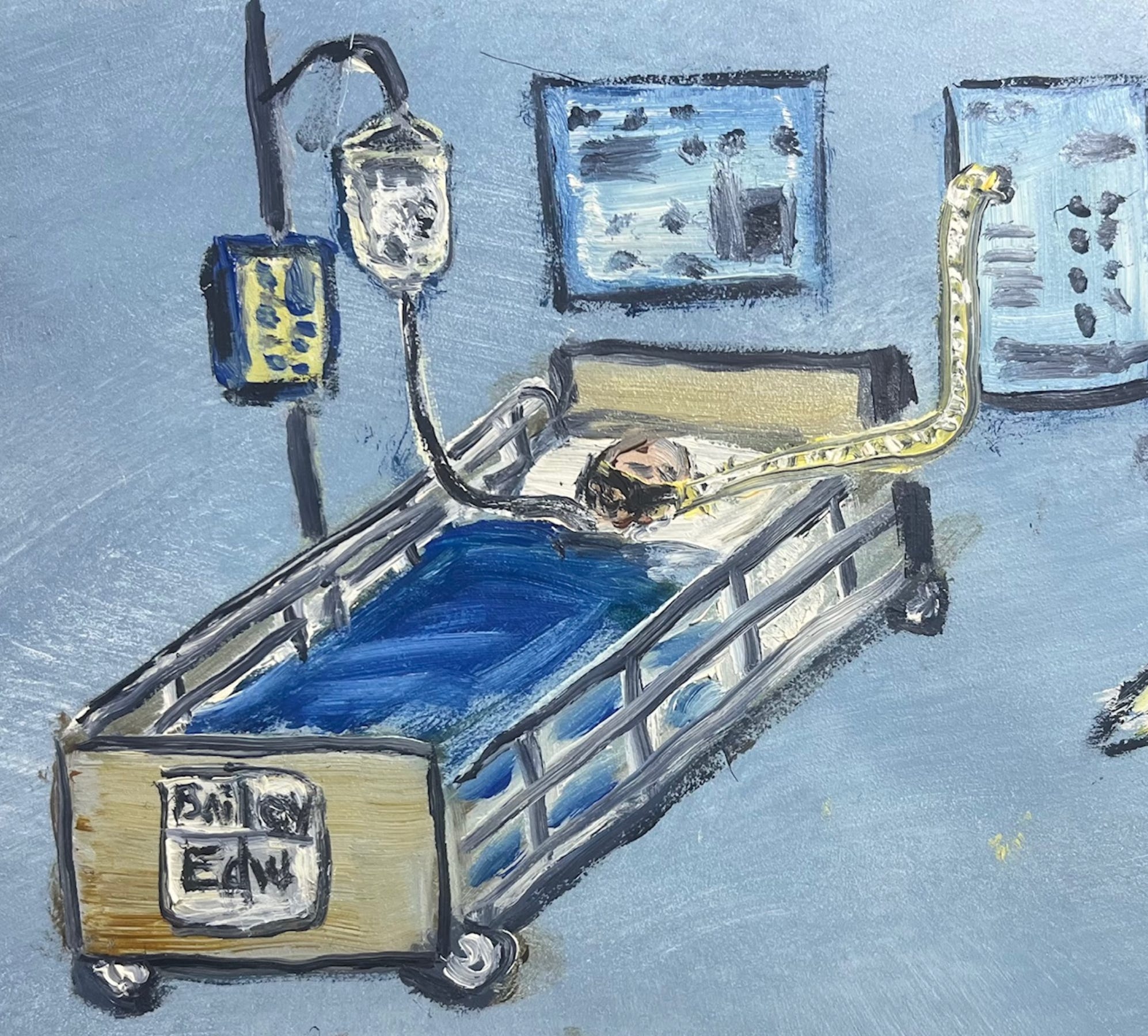
The place out of time
There is something about the ICU waiting room that I wish could be captured and spread throughout the world — unconditional love.
The ICU waiting room is a place out of time. While everyone hangs in limbo for an outcome, for a hoped-for word on a loved one, for relief from the intense pain of not knowing either way, life, as you know it, stops.
In that room, you enter the land of pain, fear, and sorrow – the great equalizers. No matter what walk of life you came from, rich, poor, or famous, no matter what color or race you are, when you enter the ICU waiting room, each one of you is the same — a hurting, terrified human being.
I sat there slowly becoming familiar with each person’s story. We became our own family, bonded in the understanding and compassion only pain can forge. Each of us waited for the 10 minutes every hour when we could either visit our loved one, or get a precious update on a test result that could mean life or death, and that seemed to take an eternity to come. Each of us celebrated any tidbit of good news for ANY one of us. It was like a victory for us all. Or, we consoled, knowing that at any moment, we might need to be consoled. If only regular life could operate that way – just full compassion and open hearts – what a changed world we could live in.
Our son spent hours there. When he couldn’t take another moment of watching his father’s “too-low” oxygen readings on the monitor, he would go into the waiting room to talk to the other “members of our cohort.” He knew their names, listened to them as they talked, and brought me updates on all of them. He has a sensitive heart and shared it generously all through those hours. And they loved us back…the way life SHOULD be.
The updates
After the pulmonary doctor left, we waited for word that Ed was settled in an ICU bay. Then I went right in to see him.
In the dark room, he lay motionless except for the rising and falling of his chest, which was orchestrated by an array of tubes and wires. Bags of IV solutions on poles with beeping controllers lined either side of his bed. Rows of numbers flashed and reloaded constantly on the screen above him, indicating any decrease in heart rhythms and his oxygen level. I stared so hard at those numbers, trying to use the force of my mental energy to make them rise.
The doctor, a nephrologist — kidney specialist — came over and started updating me. They were bringing up the sodium as slowly as they could. But now there was a new problem – his potassium level was plummeting. If it got below a certain point, his heart would just stop, and that would be it.
Yes, they were trying to bring up the potassium along with the sodium, BUT…the two were working AGAINST each other. Bring up one, and the other would drop. So it was a desperate seesawing battle to move first one up a little bit at a time, then the other one, all without dropping the potassium so low he died, or bringing up the sodium so fast he would be paralyzed.
The oxygen levels were abysmal. The fluids he had sucked into his lungs were blocking the air passages, preventing him from getting enough oxygen into his body despite the fact that they were giving him the maximum amount.
The bottom line? There was still no clear indication he would make it through the night. Ed’s life, our lives, were in the hands of this specialist.
A fluke
The doctor quizzed me: What was his medical history? What medications had he been on? And…by ANY chance, did I know what they gave him for anesthesia for the surgery??
Thank God I’d forced that damned anesthesiologist to tell me.
He pondered all my answers. Then asked, “Does he drink much?”
“Other than an occasional beer, no. He just drinks a lot of water every day…to be healthy.”
“How much?”
When I told the doctor that Ed usually took a gallon thermos of distilled water to work with him every day, the doctor winced.
“What caused this?!” I asked, still trying to wrap my head around all that had happened, as if knowing might help save him.
“Well, the anesthesia could have played a part. But then he was also on a month of high-dose steroids. That didn’t help. And his blood pressure medicine is notorious for dropping blood sodium levels. And, that’s a lot of water he drinks every day.”
He looked at me and said, “I don’t think this was any one thing. Any of those things by themselves wouldn’t do this. It looks like a perfect storm where several of these things just came together in a fluke event.”
A “fluke.” Yeah. Those things that “aren’t supposed to happen,” but just did. I had trusted the Universe, and that damned ENT, and trusted that all would go well. But…that didn’t happen.
The nephrologist told me he would be on all night and would be the one managing Ed’s sodium and potassium levels, which they were testing every half hour or so. And he promised to keep me updated.
I’d made it clear I was a lab tech, and I wanted to know EVERYTHING. And NO sugar-coating anything. Just straight facts.
Thanking him for all his care, I let him know we were not leaving. We were staying until…whenever. I was in lab-professional mode. This was not the time to fall apart. I could do that later. At that moment, I needed to be totally together so I could help in any way possible. I was “standing guard” over the love of my life…period.
Benign
As I turned to walk back to the waiting room, he said to me, “Oh, by the way. The biopsy on that unilateral mass…”
I held my breath.
“It was nothing. Just a benign cyst.”
I rolled my eyes at the irony of it all. “Great,” I said to the doctor. “If he lives, we’ll celebrate.” That damned mass that started it all was a non-issue. I was happy for that. But would Ed live to hear the news?
And, as an aside, to this day, he still has problems with that sinus….
The long night of life in the balance
Despite people telling us to go home, neither my son nor I was leaving. We were going to stay until we knew what would happen. We COULDN’T go home.
A neighbor left us with a sheet, blankets, and a pillow. We were the only ones left in the waiting room, so we spread out the sheet, turned off the light, and stretched out.
My son was restless. I put my hand on his leg to comfort him. He slowly relaxed and dropped off to sleep. I tried to lie down, but my heart was pounding so hard, and I was shaking. I had to sit up. So I closed my eyes and breathed deeply, trying to calm down.
As I sat there in the dark, I pleaded with God. “Please save him. But If he can’t come back and live a good life…..then take him. He would hate living unable to do anything or unaware…but if he can live a good life, please, save him. I don’t even care if he is crippled or has some permanent damage. As long as he can live a good life.”
And I also asked for help for me. I was afraid. Afraid I wasn’t sure I was strong enough to handle things if he were to be comatose or crippled. Afraid…just…afraid.
The blessed ICU nurse. He was wonderful. He came out to check on us now and then. And to update me.
He mentioned that the head nurse wasn’t happy we were there sleeping on the floor. But he told her, “Leave them alone. Look, if we lose him, we’re gonna lose all three of them. Let them be.”
I thanked him deeply. He was such a tremendous help that night, bringing me the steady stream of potassium and sodium numbers. Letting me know the nephrologist seemed to be making progress. Ed might actually be turning a corner.
Then, a couple hours later he came in.
“Your husband’s temperature is 104.”
I knew what that meant – the aspiration in his lungs was now a pneumonia. “What do you want to do?”
“He’s already on antibiotics, but…”
I waited while he looked me in the eye.
“If we could get his temp down, it would help. In the old days, we’d pack the patient in ice to bring the temp down.” He looked at me, one medical professional to another.
Without a trace of hesitation, I said, “Do it.”
“He won’t be comfortable.”
“Do it!” I knew the nurse was right. And this was no time for half-measures.
He nodded. Seemingly relieved that I understood and agreed with what he felt was the best chance to help Ed.
The night wore on. More labs. More temps. More O2 levels.
I never slept.
But his temperature came down.
The next day
Friends returned and sat with us. More updates on sodium and potassium. Those had finally stabilized.
The doctor mentioned that at one point during the night, the sodium level jumped a bit too fast. He was worried about the paralysis. “We won’t know for a couple of days yet.”
And his brain was still swollen. They would be doing another MRI to see if it was being pushed against his skull.
Still trying to verify just what happened to cause all of this, the doctor asked if maybe Ed’s sodium was already low before the surgery.
My “lab-tech” brain fired. I snapped alert, realizing this was something I COULD help with. “They did a potassium pre-op. I know the machine that does those tests. When it does a potassium, it also spits out a sodium result.”
He and the head nurse, who understood I was in the medical field, offered me a chair at the nurse’s station and a phone. “Call the Day-Surgery center and see if you can get a sodium level.”
They had him in the records. Yet strangely, nobody could answer about a sodium level. I told them I knew labs held blood samples for a day or so. Could they please re-run the sample and see if it was low?
I also knew that if that sodium was low, that meant the lab tech who ran that potassium test before Ed’s surgery should have picked up on that and told the anesthesiologist. It would be no excuse to say the doctor hadn’t ordered a sodium. If you run a test and see an abnormal result, you still tell the doctor.
Again, strangely, they never could find the sample. “It must have been discarded already….” Yes.
As a last resort, I called Ed’s doctor and asked for any previous sodium levels that he had on hand to see if there had been any trend down recently. But beyond that, there was nothing more I could do.
So I offered to help the nurse bathe and change Ed, so he could be comfortable. I stayed calm through all this because I knew the nurse didn’t need an emotional wife. If I could stay in control and help with his care, they would be willing to keep me well informed of any and every change.
For the rest of the day, we were either in Ed’s room watching monitors, keeping vigil in the waiting room with other families, or sitting with my friends and one of my siblings who came to visit. A gift of love despite our differences.
At one point, they sent us home to try to sleep. My son and I did go home, but it was painful to stay there. Neither of us could sleep. Everywhere we looked in the house, we saw Ed. The touches of him all around us just drove us out of the house and back to the hospital.
At least when we got there, he seemed to be stabilizing.
 Soul Mosaic
Leave a comment