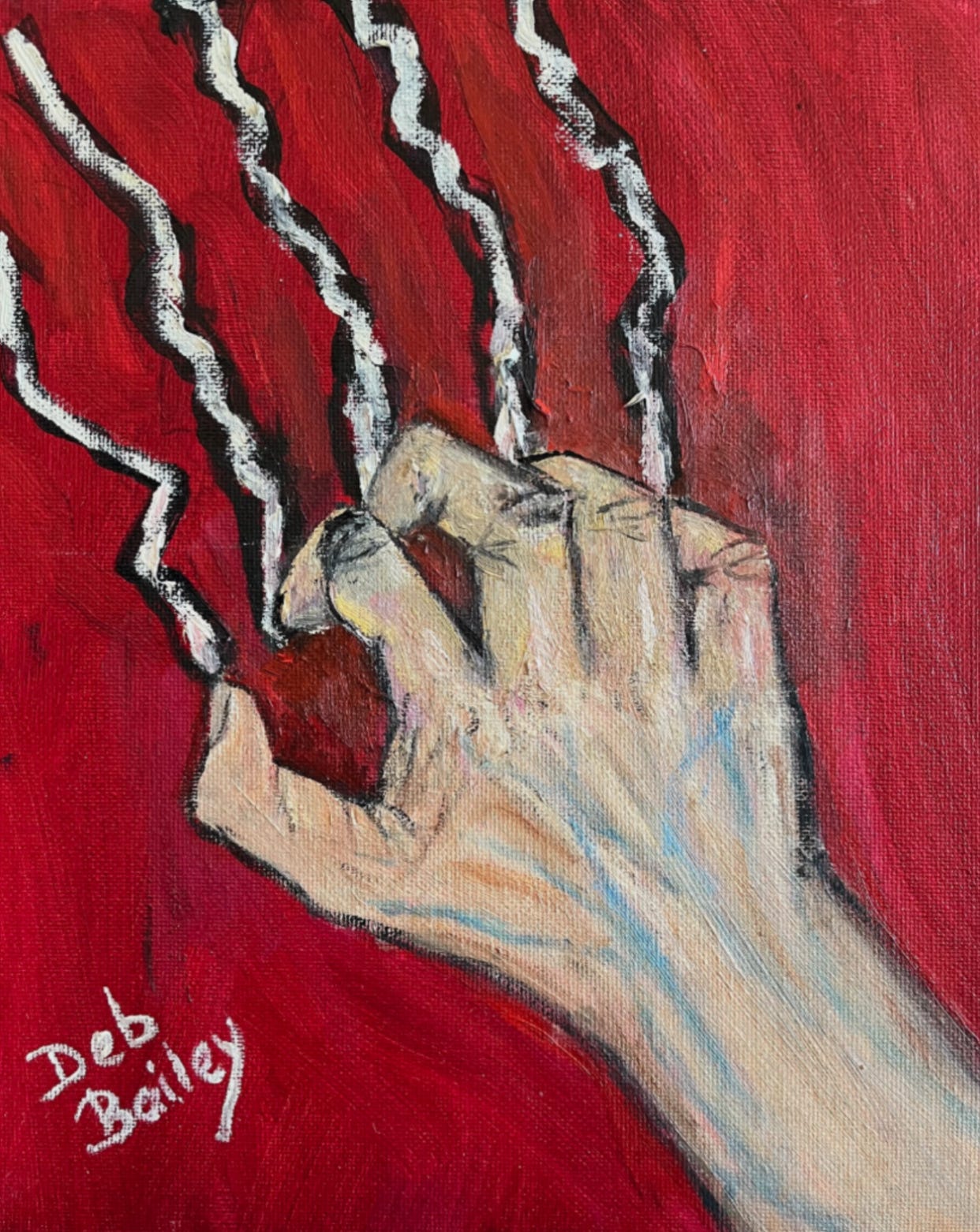
I can’t do this!
Maybe I didn’t dare speak those words at that point about my life situation…I felt it for sure. But as long as I didn’t admit them, I could go on. But I did have to say them about working in the memory-care center.
I had started volunteering there in the fall of 2008 and helped with the Christmas party for their residents. We danced, brought out food, and sang songs. I tried to keep my mood light and match the delight of all the patients. It was surreal, though. One moment, someone would seem worlds away mentally, then you’d play a certain song from decades ago, and they would come alive, smiling and singing along. While it was nice to see them have a moment of joy, it broke my heart because they would mentally “slip away” once the song was over.
Apparently, though, my efforts at that party were enough to convince the director to offer me a part-time position that January, working with the activities director. I showed up, even during a snowstorm – a familiar work ethic from my days working in hospital labs — and engaged the residents with art projects, word games, puzzles, and the morning recitations of what day and time it was.
Other days, I’d walk with one of the older women as she circled the inside walkways of the building and told me with total certainty that we were walking to her home in the next town. It tore my heart apart to see this former professional executive now think these halls were the way home from work.
Yet I was determined to stick it out, to find a way to make this be my purpose. I started taking the classes at a local community college to learn the rules and procedures to work in this type of facility, even as my gut roiled at the prospect of all these details.
Other times, I’d watch as the afternoon grew late, and darker, and “sundown” in the facility approached. At that time of the day, many of the people would become more agitated, cry out, or yell.
It finally choked the life out of me one day when helping to feed residents who could no longer remember how to use a spoon. I’d only been working officially for two weeks, but that day was the last straw. I just had to stop.
The director was compassionate and understood. This was not a job for everyone.
And for someone barely keeping panic attacks at bay and struggling to get out of bed every morning, it was not the job for me, even as I wanted it to be.
Are you old enough?
That previous December, aside from volunteering at the memory-care center, and getting freaked out by the Benjamin Buttons and Doubt movies, I’d also been given a piece of paper by my then therapist. It had the names of four local women therapists. He thought I might do better with a woman therapist and suggested I try to connect with one of them.
I was stressed because that put my “therapy lifeline” in my hands to work out. What if none of them wanted to work with me? What if none of them were even open to new patients? If I failed to get one, where did that leave me?
But over the evenings around Christmas, I started cold-calling these women. Yeah, it’s a great time of year to try to connect with anyone, much less convince them to establish a new relationship with someone they don’t know. But I did it anyway. I was desperate.
The first call was a non-starter. She was retiring. The second couldn’t seem to decide if she wanted to take me on or not. She kept going back and forth on the call, then said she would think about it and get back to me after the holidays. I was frantic. Only two names left.
The next day, I reached out to the third person. She at least had a website. In addition to offering regular individual and marital therapy, she was a trauma specialist and worked with people who’d suffered abuse.
She actually returned my call fairly quickly, and she sounded reasonable. But still, I wondered if she had the skills I needed. I was through dealing with people who didn’t understand just how much I was struggling with. So I asked questions.
“I need to know…How old are you? I want someone old enough.”
I think the question took her aback a little, but she laughed and said, “I think I’m old enough.” She then went on to describe her years of experience and her stage of life.
That was good enough for me. That was exactly what I wanted, so I let her know, using my less-than-sensitive approach: “Good, thank you. It’s just that I wanted someone who had been through some life experience. I just don’t want to work with some 30-year-old helping me through menopause with a textbook!”
We both have a good laugh now about my directness then. And about the fact that before I started with her, I sent her my resume. Not just medical history forms, but a resume. I might be coming unglued at the seams, but I wanted her to know that the person sitting before her had once been successful and wasn’t just this quivering mess that I was now. Yes, we laugh at that, too.
And we also laugh now about the fact that I wanted to keep my first appointment with her even though there was a snowstorm. I was so tense and just needed her help. So it was agony the day of our first appointment to realize it would have to be rescheduled. To me, driven by desperation, I didn’t care if it was snowing. I’d driven all my life through snow for my hospital job. But in retrospect, I appreciate that her wisdom to reschedule prevailed. Just because my anxiety was fueling my willingness to risk hazardous driving didn’t mean it was a good idea.
A gift from God
I will say that she was DEFINITELY worth waiting for. We clicked from the start. Both of us were from the Northeast originally and had a similar work ethic, conversation style, and no-bullshit attitude. She has tremendous compassion, but she is also firm. She is there to help you grow and doesn’t just say “poor you.”
In my case, however, she said, “With some people, I have to push them. But with you, I need to hold you back.” She quickly picked up on my intensity for wanting to work and “get this healing stuff going.” Yes. One of the lessons she would continue to work with me on is to take things organically, and at the speed the emotions need, not the speed I DEMAND. She was also quick to assess me and understand what was happening to me.
I shared with her my reactions about everything from friend conversations and weird interactions, to my “paranoid” feeling that they were watching me or judging me. I told her I was afraid I was losing my mind. She was awesome in her response.
This therapist assessed me and dispelled those fears. She immediately understood from my background and about the recent things with Ed, that I was suffering from severe trauma. That was the first time anyone had used the word trauma with me. I had always brushed aside my pain as just being too sensitive and weak, and not being strong like everyone else.
She explained about PTSD, and that I wasn’t paranoid or schizophrenic. But I was really hypervigilant due to all my trauma. After listening to the things I shared about various “friend” interactions and comments, she helped me understand that my gut reactions weren’t wrong. While neither of us could ever know what that person’s actual intention was, she could affirm for me that the things and comments going on around me were not “right.” I was correctly sensing “unhealthy” things, and that I was right in protecting myself and moving away from those relationships.
She also helped me start to understand that moving away from unhealthy situations was a good thing. I hadn’t wanted to hurt or abandon people. But as she pointed out, by staying in those types of situations, I was abandoning myself and letting myself be harmed. Those first sessions were the beginning of a whole new direction in my life, with true growth and finally, self-understanding and love.
But it was going to be a long journey. Years. I had no clue about that then, but looking back, yes, I get it now. At the time, I was just trying to survive.
So her first order of business would be for her to pull me back from the edge and “put out the fire in my brain,” as she described my current state. As she explained it, my brain’s danger signal system was wide open – like a car with the throttle stuck open. Tons of stress hormones and chemicals were flooding my system, hence all the anxiety.
The first thing she did was give me a couple of referrals to psychiatrists she collaborated with to get me on an effective dose of medication. She wanted to stem the deep depression I was in. It took 4-5 weeks for any new medication to even start working, and that’s if it was the right medication and the right dose. And that didn’t count how long it might take for me to get into one of the psychiatrists’ offices. So that was mission # 1. Fortunately, one of those doctors, another gift, was able to see me within a couple of weeks. He was the one who realized that the dose of Prozac the other doctor prescribed was totally ineffective. He proceeded to prescribe one, then a second “helping’ medication that would really bring me sustained relief.
The next thing she did was to see if one of her treatment methods could alleviate my panic. She had a number of tools she could use, and opted for one called EMDR — Eye Movement Desensitization and Reprocessing. Basically, she explained that trauma is a memory that did not have a chance to finish processing in the brain. It’s still there, alive, and on fire. Research studies showed that using one of the eye movement methods can result in calming my anxiety. In her case, she used a light bar.
I was to sit calmly in front of the light bar as a dot of light moved back and forth rapidly across it. I would follow that band of light by moving my eyes back and forth with it. Something about engaging the eyes and visual centers of the brain seemed to help the brain reprocess things left incomplete.
I would later go on to use this method successfully many times. And I still do when needed. I have a deep appreciation for it, whatever its mechanism. And I know the military employs it for use with soldiers suffering trauma.
But at that particular stage of my therapy, I was even beyond the help of EMDR. It triggered such a state of anxiety in me that she called a halt to it. She even met with me extra times that week, including on a Sunday morning, to help calm things down. It is just where I was at the time. She said she had many other approaches we could use, including deep breathing, Yoga, and CBT – Cognitive Behavioral Therapy — and that at least right now, EMDR was not a good match for me.
I will note that it would be almost 10 years of therapy work with her before I would be ready. At that point, we had made good progress using her other methods to define my issues and work through them one by one, like peeling back the layers of an onion. When we did try it again, I was the one who asked to try. I sensed that the thing I was wrestling with needed something more. She never pushed that. And we proceeded very carefully. But this time, EMDR would be a blessing. And as I said, we have used it a number of times when there is an issue that I just emotionally cannot get past.
I continue to work with her. Her insights are razor-sharp and have helped me grow. As a sounding board, she has been a source of wisdom, affirmation of my progress, and strength. And as a teacher of life and soul, a true seer.
Finally, I had met that guiding woman “mentor” figure I had been seeking my whole life. Slowly, with her help, I started to fill in the deep pit of that “Mother wound.” And finally, I was on the path to “thriving.”
Where is God in this?
In 2007 or 2008, I came across a book that deeply touched me — Here if You Need Me, by Kate Braestrup. As a wife and mother with young children, she had to navigate the untimely death of her State Trooper husband in a freak car accident. One minute, life was stable, and his cereal bowl from breakfast was still sitting in the sink, and the next minute, he was gone.
In the trauma and despair of the following months, she came to embrace what had been his dream — to become a minister. The book shares her path to not only fulfill that dream herself, but to become a minister “out of the ordinary.” Her calling was as a chaplain to the Maine Warden service.
She ministered to the search-and-rescue teams who risked their lives to find lost children in frostbiting cold, and others who endured shredded hearts when they instead brought out bodies. At the same time, she was there, sitting vigil with distraught families, through the dark, long nights, as they waited for whatever news was coming.
She tended to them all, in drownings, murders, and rescues, and brought them a real-life God who grieved with them, not some ethereal king in the clouds. Out of her grief and loss, she found purpose and peace.
I didn’t just read the book. I consumed it. After that December, I felt the same hunger for purpose. For a way to give meaning to the chaos we were living. I really thought long and hard about whether that was a path I could follow as well. Was there a way to move forward in life more meaningfully?
In her book, Deep Memoir, Jennifer Leigh Selig, PhD. shared a story about the Bushmen of the Kalahari Desert and their “two hungers.”
“There is the Great Hunger, and there is the Little Hunger. The Little Hunger wants food for the belly; but the Great Hunger, the greatest hunger of all, is the hunger for meaning.”
She goes on to speak of Viktor Frankl’s book, Man’s Search for Meaning, about his experiences during the Holocaust in a concentration camp. She paraphrases one of his conclusions about whether man should ask what the meaning of his life is, or whether he is being asked by life what his meaning is, and that it is a question he must answer:
“…it’s less about uncovering the meaning of our lives and what befalls us, but more about assigning meaning, answering for ourselves…”
Both of these books nailed one of the many things I was wrestling with during this time — my identity in life now…my PURPOSE. After all I had seen that December, I could NOT just wander through the days anymore.
While I ultimately decided that being a “woman of the cloth” was not the right path for me, the realization of living life with meaning definitely WAS my path. The question would become – How? And the seeds of that answer were already being planted during this year….
Not alone
The other book that came out the same year as Kate Braestrup’s was Lee Woodruff’s memoir, In An Instant. In that book, she chronicled the events of those awful days when her husband, journalist Bob Woodruff, was almost killed by an IED when he was reporting with the military in Iraq. It happened the same year as Ed’s crisis. And Woodruff would suffer severe brain injuries. It was a harrowing story of saving his life and of recovery after trauma, and what Lee went through wondering if he would live, and then, what kind of life it would be.
Both of them wrote from their perspectives, and reading it was like having a friend who knew exactly what it was to go through that kind of hell. Her book was like a bible for navigating life-altering trauma, and the reminder that “life changes in an instant you don’t see coming.”
I had the privilege later to hear her speak on a book tour. She was powerful, both in person and on the page. Her love, her raw emotional frankness, her pain, it was all there. And, it was a great comfort to me then.
Finally coming home
The meditation group, while it had been a stabilizing force, was just not filling what my heart needed. Despite its helpful discipline of non-attachment, compassion, right mindset and ethics, and impermanence, all great principles, it still left me “empty” at my heart. Something was missing, or rather, maybe, “someone”? ….God?
Whether anyone else believes in God or has different ideas of what a Divine presence in the world might be, I have no issue with that. I only knew that for me, after years of anger and blaming God for not saving me, I had come full circle, THROUGH Buddhism, to seeking Him out again.
I wasn’t sure what form that should or could be. But I knew that Buddhism wasn’t my final answer. And neither was being a minister, nor returning to Catholicism.
I thought back to my therapists. All but two were Jewish, and to a person, they had a different sense about them – compassionate, devoted to healing the world, and a down-to-earth way of meeting life. I’d had Jewish friends, all of whom also had a sense about them that made them stand out from others. In my childhood, I felt drawn to that same sense when I visited the local synagogue as part of an “ecumenical church group.” Even the time as a kid, when I toured the back areas of a meat warehouse and watched the rabbi perform his Kosher rituals over a newly slaughtered steer, I just felt “something,” a reverence…an appreciation for these people who followed their own hearts on a slightly different path.
Slowly, a tiny spark that had been growing burst into a brighter flame. Was there something in Judaism that I had been seeking all my life? I will write more on this shortly.
Seeds of a new direction
In the next few posts, I will share how my path from survival eventually opened to my path to thriving. A whole new purpose was about to reveal itself to me. And a new, slowly-growing resilience and compassion would sprout. It would be just in time as these coming years would stretch my heart in many ways.
I am seeking financial support to complete my memoir, work with an editor, and return home for fact-checking. Your help would mean the world to me as I take this step toward healing and giving voice to my journey.
Please like, comment, and share this post to help spread the word. The link for my fundraiser is on GoFundMe. Thank you for your support.
 Soul Mosaic
Leave a comment