The departure of that “presence”
Just as I had a lot of work to do to piece myself back together emotionally, Ed, too, was waging his own battles, physically and emotionally at the same time. But at least we were starting to work together to pull each other out of the darkness. And the word “darkness” doesn’t even come close to describing his ultimate dark place at that point…that “presence,” just off to his periphery.
At the worst of that time for him, that deepest, suicidal point, he could feel a constant “companion,” a black depression that was so crushingly real it felt like a living, breathing entity standing right at his elbow.
“It was right there, just out of my sight, off to the side. I felt like if I could just turn around fast enough, I would see that dark form standing right by my side. My peripheral vision was just frightening DARKNESS. Like I could touch it. It was ALWAYS right there.”
To this day, whenever he speaks about those days, I can see intense fear in his eyes and a deep revulsion in his facial expression. It is the expression of someone who came so close to the edge of a cliff that it still scares him to think about.
His only other comment is, “I don’t EVER want to feel that again.”
I am so deeply grateful for the fact that he hung on despite the taunting of that presence to just “finish himself off.”
The worst part of it then was that neither of us knew what was happening to him. And maybe even worse than that, the doctors didn’t either. In the early 2000s, there was still so little awareness of the aftereffects of what Ed had suffered. Nobody really knew or understood that while he lived through it, his brain was slowly dying.
The pissed-off “catalyst”
Ed’s regular doctor was no help. As far as he was concerned, Ed was on the mend and the worst of things was over in the hospital. Any questions we had about the symptoms we were seeing in Ed were brushed aside. As far as medical science at that time was concerned, Ed should have been fine. But we knew that something was deeply wrong.
Desperate, I actually took him to my gynecologist, because she was well-versed in hormonal issues. We knew that with Ed’s brain swelling around the pituitary, that might be a clue. She did a bunch of salivary hormone tests and discovered there were a number of abnormal results. So she prescribed some hormone creams as well as some supplements to improve adrenal function. While they eased some symptoms a bit, the crushing exhaustion persisted.
When we told his regular doctor what we were doing, he was angry. He responded by just tossing a couple of thyroid hormone prescriptions at Ed without much follow-up.
While I am still not pleased with that doctor’s response, I will thank him for one thing. In that moment, he catalyzed Ed and me into a unified team hell-bent on finding answers for Ed. And we would not take “there’s nothing we can do” as the final answer.
That doctor’s “dismissive” attitude taught us that from then on, WE would drive the medical bus. We would take charge of finding our own answers, no matter what it took, and we would never again take any doctor’s brush-off as the final word. If one doctor didn’t know what we needed or wasn’t listening to us, we moved on to the next one. We had no time for doctors with entrenched thinking, unwilling to consider new information.
From my background, I knew that there were ALWAYS new things happening at the edges of established medical practice. New research, new discoveries, and sometimes that new information proved old information totally wrong. So any attitude of “I am the ‘doctor expert’ so don’t tell me,” was a non-starter for us. There were plenty of other doctors out there. We just needed to find ones that had new information or who would work with us to get it.
New Medical words for our vocabulary
“It’s called a hypoxic brain injury…and it, just like a traumatic brain injury, is an actual physical injury to the brain. In fact, it has physical effects on the brain just like a stroke.”
As the new doctor said these words, suddenly, both of us were filled with a sense of relief. For the first time in all of this mess, SOMEBODY recognized there actually was a REAL problem in Ed’s body, AND it had a name – Traumatic and hypoxic brain injuries.
TBIs and HBIs – Traumatic brain injuries – such as head injuries in a fall, accident, or sports collision, and Hypoxic brain injuries – such as when the brain gets “hypoxic” because of low blood oxygen levels. Both had happened to Ed in the hospital. He’d had low blood oxygen levels, and his brain had swelled, squeezing fragile brain tissues, including his pituitary – the master controller of so many hormonal circuits.
Injury severity can range from mild and barely noticeable to paralysis, loss of memory or higher-level brain functions, and…strong emotional and mood changes.
There it was. Ed’s “dark presence” off to his side had a name. And a possible treatment.
As the doctor went on to explain, Ed’s black mood and severe depression weren’t just his imagination or inability to “snap out of it.” He had a physical injury driving it all. And he needed a medication that could help ease those things while the brain repaired itself.
Aside from TBIs and HBIs in our medical vocabulary, the doctor also gave us another one to file away: “Neuroplasticity” – the ability of the brain to repair itself. Even from strokes and other brain injuries, the brain can recover. It can create new pathways and circuits around damaged or destroyed ones. It can take time, and there is no certainty just how much it can repair, but given rest, some recovery is possible.
So in that one visit, the doctor gave us clarity, affirmation of what we were experiencing, and even hope. Then he took Ed off the various hormonal creams, supplements, and the thyroid meds the other doctor had given him. Instead, the doctor prescribed an antidepressant to help with his symptoms. In fact, the doctor was also very specific as to which antidepressant he wanted Ed to have, because he noted that some worked better than others for this type of injury.
For the first time in over two years, we walked out of a doctor’s office with hope. And that was good, because this was the time Ed finally let me know just how suicidal he had been during the previous months. Hope was the cushion for that news.
The medical issues continue
While this doctor was able to move us forward on the emotional front, he was not able to give us much more. Ed was still struggling with exhaustion and the inability to sleep. He was also finding he could no longer eat many foods without breaking out into painful, itching rashes that no medication could control. So we moved on.
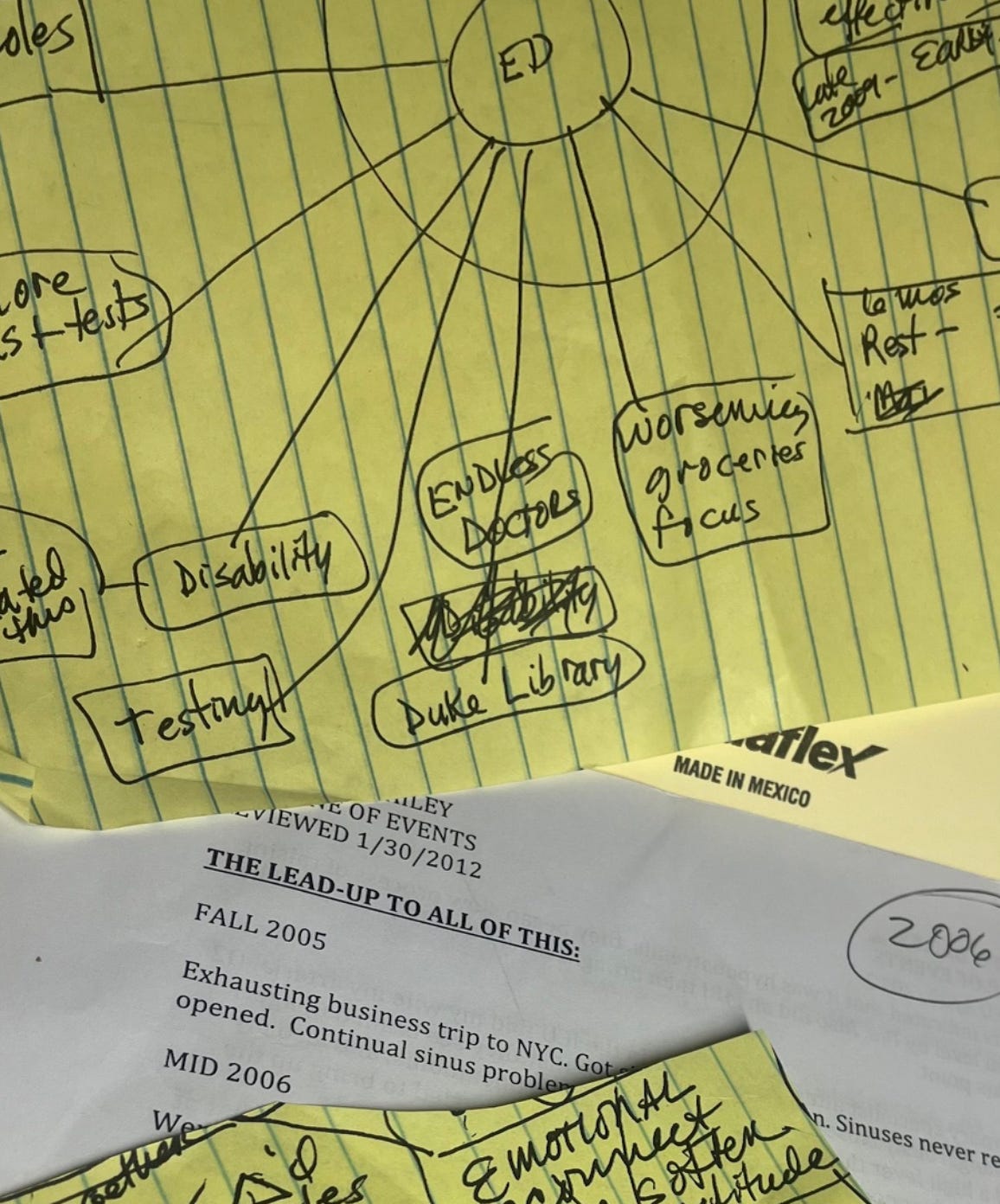
We spent many weekends at the Duke University Medical Library, buried in research journals. Since we knew he had a brain injury, our next goal was to figure out just what hormone or hormones might be affected, which doctors to see, tests to ask for, and also, what to do about the fact that he could barely eat or sleep. His weight was plummeting down to skeletal levels, and at one point he was a low as 110 pounds. It was like he was starving to death. So we just keep pushing.
And given the next event in early 2011, we would have plenty of time for that.
February, 2011
“I got laid off.” The words came out of him quietly, plaintively. As if he’d been physically gut-punched and was hoping I wouldn’t finish him off. But I could have jumped for joy.
The bottom line was that after his injury, he had literally dragged himself through four more years of intense, demanding work at a software start-up company, while being unable to sleep or eat. I was terrified because I was watching him literally die again, and I knew he would never leave his job willingly. So when he spoke those words, my first ones were, “Thank God! You would have died there.”
No, we weren’t rich. Yes, we had some savings. It didn’t matter. I didn’t care if we used it all up, so long as he would stop working and we could try to help heal him.
For him, at that moment, he was destroyed. Someone had told him he wasn’t enough. They had removed his identity as a provider, breadwinner, and computer expert. Now, who was he? Who could he ever be again? In the next piece, I will let Ed share his feelings about all of this, as he says it best. And he will even admit it was the best thing, as yes, he would have died in that job. But at that moment, suffice it to say he was emotionally bludgeoned.
A moment of R & R
After we discussed it, we agreed that this might be a good thing. He was exhausted. This gave us time to keep trying to find doctors to help us. And besides, this would give him time to just rest. Maybe with six months or so to just rest and recover, he could look for a job or do his own freelance projects.
We took a couple of trips that year just to rest. One in early Spring was to our restful place – Colonial Williamsburg. Then in the fall, we went back to our home area and visited Connecticut, Boston, Cape Cod, and even Nantucket, all places we had not been back to in years or decades. It was a quiet time of re-bonding emotionally for the two of us. The first chance we’d had to just savor time together as a couple in years. We also joined a local “maker-space” shop, where Ed could pursue some metalworking classes and hobbies he’d never had time for.
Our bond continued to grow. We were a solid team again, interdependent, supportive, more than ever before. He looks back at that time and notes that his sensitivity, heart, and emotions all became much stronger, deeper, and softer. And we both had so much gratitude that we were still together. It would take years for him to come to terms with losing his job and trying to discover a new purpose and meaning, but we just continued to walk side-by-side, one day at a time.
There would be other changes as time went on, and it was clear he could not return to work. Roles would switch again, as they had back and forth during our marriage, and I eventually became the breadwinner with a job at the science museum, something I’ll share about shortly. And I had to apply for disability for him, which he hated. It was necessary. He knew it. But he hated that it had come to that.
Yet, we were glued together in a way we’d never been before, and that would only deepen as the years have gone by.
Just live your best life
We continued to seek out doctors. And got responses such as:
“We did all the tests, but they don’t really show anything. Yes, you probably do have brain damage, but the tests just can’t tell exactly where it is.”
“Medical science just hasn’t caught up to what happened to you. You should just go home and try to live your best life.”
Needless to say, those responses were unacceptable. They might not have well-established treatments yet, but somewhere out there were researchers who knew SOMETHING. So, back to the library. And other doctors.
Years and years of doctors and tests…
We began with the hormone issues and went to multiple endocrinologists. To no avail.
Fortunately, we did find a new general internist who was wonderful and willingly worked with Ed to follow some of the research study testing recommendations.
Given Ed’s inability to sleep, the doctor sent Ed to neurologists, one of whom discovered through a sleep study that Ed was not getting any REM sleep. That is the part of sleep that restores the brain. You just can’t go on for years of no REM sleep and live a normal lifespan. So that doctor tried a variety of medications to get Ed to sleep. None of them worked.
At the same time that internist sent Ed to a naturopath to help him heal his gut issues and try to get him to gain weight. That involved a lot of testing, supplements, and nutrient powders, but it did slowly start to turn his weight loss around. This was followed by various gastroenterologists to test what was going on in his gut. That literally took a couple of years before one very astute PA at a local university medical center put him on a medication to stop intestinal inflammation. At that point, his gut pain and weight loss stopped.
There were more tests with allergists and immunologists about why he couldn’t eat most foods. There were immunology cancer tests. MRIs. We learned he had lost some physical dexterity function, but not enough to impact him. And then the forensic neuropsychiatrist, who got to the heart of Ed’s sleep issues and prescribed a treatment that has been effective.
However, somewhere during all of this, Ed’s wonderful internist died unexpectedly. So we were back to searching for a regular doctor.
And then we started working on why Ed could not eat most foods, especially no vegetables. Just meat. This, Ed, did all on his own. Through literally years of trial and error, following all the research, reading books and articles, and viewing presentations by various doctors, Ed learned all about the various natural chemicals in plants and what those were doing to his gut. Ed tried a variety of changes to his diet until he discovered that a simple meat diet — carnivore — not only stopped all his gut problems and most of his skin issues, but he started to feel better. Including…some of his brain functioning.
From sheer dogged fighting…amazing progress
Where Ed spent years with brain fog and an inability to concentrate, when he switched to the meat-based diet, those symptoms slowly went away. So Ed started challenging his brain more – first with reading, then participating in simple logic surveys for researchers, and then eventually progressing to what he is doing now….AI research.
Where he had lost his ability to do his software work, he was now literally doing AI testing to try to make the programs work correctly. That was something we had never expected. Before his injury, he could read a software book in one night, then use it the next day, and he could manage developers in high-pressure situations. After his injury, those abilities were gone. But now, over fifteen years later, he was doing some computer work again. While he still cannot manage high-pressure situations, and he cannot work as long as before, he has regained some of his software skills. His tenacity and persistence through so many years of struggle have been an inspiration to me. I have nothing but total respect for his determination to heal and his willingness to endure loss, pain, and years of struggle to be the best he can be. I am just grateful we are still here together. And I thank him.
In the next piece, I will share a post Ed wrote in 2016, ten years after his brain injury. At that time, he was still in the midst of so many struggles. His words tell the emotional toll better than I ever could. And, he will be doing a “twenty-year” piece soon. His progress from that initial post is nothing short of amazing.
Note:
I am seeking financial support to complete my memoir, work with an editor, and return home for fact-checking. Your help would mean the world to me as I take this step toward healing and giving voice to my journey.
Please like, comment, and share this post to help spread the word. The link for my fundraiser is on GoFundMe. Thank you for your support.

 Soul Mosaic
Leave a comment