I don’t like your father…
It was one of the visits to Pennsylvania. We were having lunch with my parents at their neighborhood’s community center across the street from their house. Every few weeks, the center would put on a full-course meal complete with salad and dessert bars. It was always a great spread, so my mother would always get tickets for it, especially if any of us were visiting.
I let everyone else go ahead and get their food, then I headed for the salad bar. Intent on scooping a ladle full of black olives, my favorite, I was oblivious to this older woman standing near me until I turned to move on.
“Are you the ones here to visit your parents?”
It was not an uncommon question, as word travels fast in a retirement community if someone different is there. And it was always considered a “status symbol” to have your family visit.
So I smiled and answered that yes, my husband and I were visiting, and who my parents were.
But I should have known she already knew who my parents were. That information spreads quickly, too. As soon as I answered, without missing a beat, she said to me, “I don’t like your father. I like your mother. But not your father.”
I was floored. A whole range of emotions flooded through me. First, I was just totally caught off-guard at the directness of her statement. The fact that she would come up to a total stranger, who was the man’s daughter, without knowing what I felt about him, and flat-out say that.
But the rest of my reactions were more interesting. Neck and neck for my awareness was both the sense that I agreed with her and was amazed at her perceptiveness, as well as a level of anger-fueled urge to defend him. Who did she think she was, talking about my father like that?! Only now do the words “trauma bonding and intermittent reinforcement” have meaning here. I will talk about those later.
But my reaction was an old one…instinctive, and immediate. Drilled into us for a lifetime was that rule of “family first,” and trust no outsiders. If anyone said anything against the family, you circled wagons, prepared to defend, and then went on the offense against that person. Kind of like, “Well yeah, he’s an abuser…but he’s OUR abuser.” It’s ridiculous, yes. But that’s the way the programming works.
And so, with all this running through my mind, I just stood there in shocked silence, probably with my mouth hanging open. She said nothing else and just walked away.
How many times do we wish we could have a do-over – stop time, go back, and ask, “Could you elaborate on that?” It was like that time I neglected to ask my grandmother years before, why there was nothing left in “her Old Country. I thought I knew and didn’t bother. At least this time, I was just so surprised I didn’t have the time or mental clarity to ask her why she felt that way.
Looking back, how I wish to God I had asked her to say more. Was Dad still hitting Mom? Was he demeaning or abusive? If that was showing up in public, that meant he was really slipping with his facade. But then, his mind was going. Maybe she just realized how controlling and annoying he was. But I so regret not asking her WHAT she saw or knew.
Some things never change….
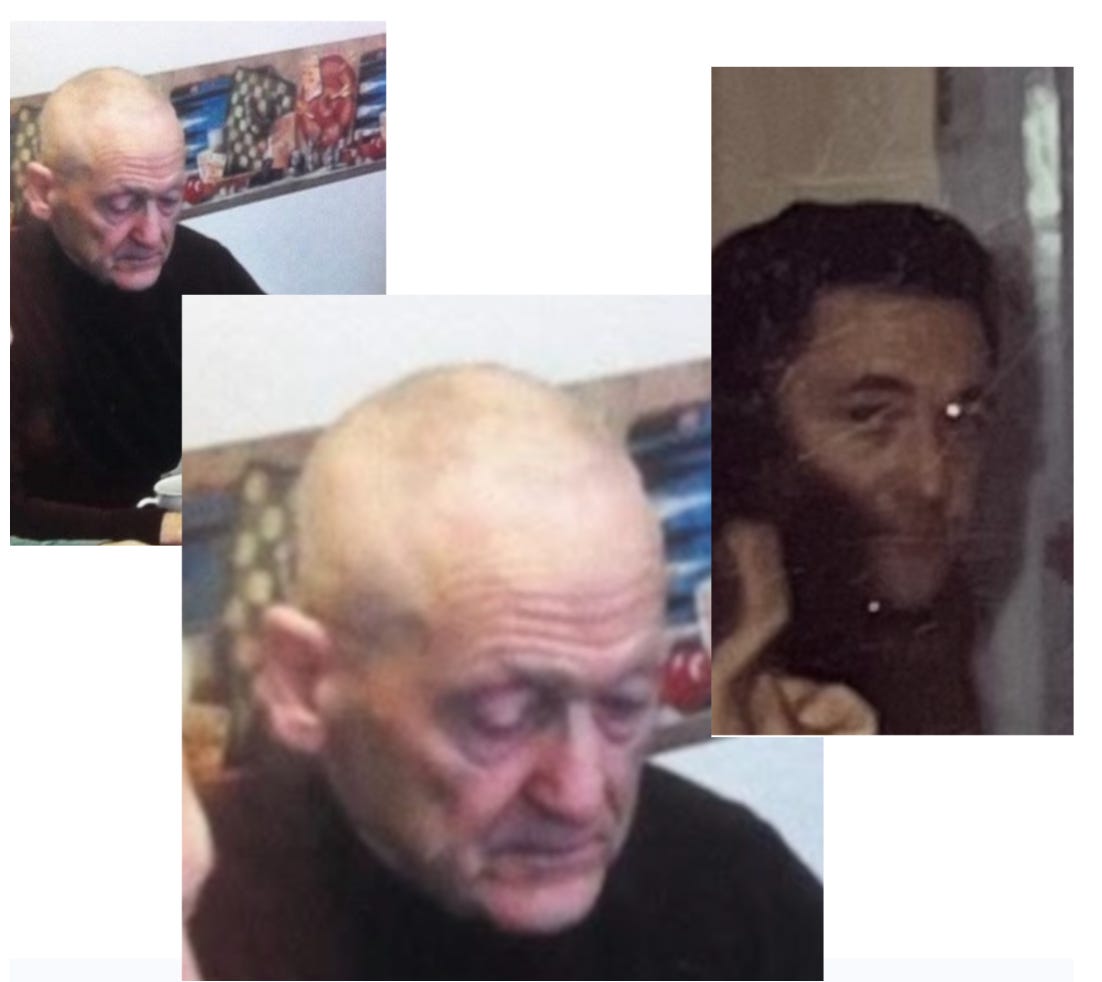
As to what Dad was like at this point? They say that you are, in old age, what you had been your whole life, only more concentrated. Looking at these pictures of him decades apart, that puss on his face, that look in his eyes, I think for him, some things never changed.
For the last few years, he’d played the “mellow Dad,” more patient, softer, questioning why he’d been so mean in his earlier years. He would joke and offer to be helpful. But I wondered so many times if it was a facade.
More and more, I would notice that his ability to keep up “the show” was slipping. Every so often, that “look,” that mean face, would show up. And he would slip in how he treated my mother.
Mom, all her life, was the sort of person who was up early and busy all day. Even in old age, she’d run around cleaning, doing laundry, cooking, or baking. In the evenings, she would, rightly so, be tired.
So while she would start the evening, ripping through crossword puzzles, slowly her head would start to nod, the puzzle book would lower, and the pencil would drop. Something about the lull of the TV shows would put her to sleep. No big deal. I am the same way many times in the evenings, and I don’t clean as much as she always did.
But Dad would fly into a rage. “Go to bed!!! If you can’t stay awake, go to bed!”
The words were delivered in angry disgust, a king dismissing a servant so worthless he couldn’t stand the sight of her. He certainly wasn’t concerned about her fatigue or health. Instead, it was like she was failing her purpose in life, which was to be there for him, pay attention to him, and be ready to serve his every need.
In those moments, I would be careful not to interject because his rage in those moments would only intensify, and it wasn’t worth it. She’d stayed with him all those years and put up with it. There was little I could do about that. But his dementia diagnosis added another wrinkle.
Did I hurt you?
It had been becoming more and more obvious that he wasn’t just forgetful. His mind was going. For a long while, I suspect Mom covered for him. But you couldn’t help but notice all the notes he had pinned up to remind him of everything, including our names.
And his driving. There was the car accident she never told us about, something we learned about when I bought his car and had it inspected. He didn’t want to stop driving, but I was afraid he was going to get them or someone else killed, so I convinced him to let me buy it. He finally agreed because I said our son needed a car for school, which was true. But I had to write a note about that and post it on the garage door, because otherwise he would forget he sold it to me and fly into a panic and rage when he went out there, and the car was gone.
It was the uncertainty of whether he would lose control of his temper that really had me worried for my mother. We would ask her if he was hitting her. Did she need any help? We told her we would help her. But always, she denied that he was harming her. As if to reassure us, she did say one time that when he was angry, he would go into the back room and stay there. Then later, he would come out and ask her, “Did I hurt you?”
That did not fill me with reassurance. So I started paying very close attention to things she said, or how he was acting. While I’d not had to be the “warrior standing guard” over our kids anymore, I started resuming that role for my 80-something-year-old mother. So the trips to Pennsylvania became more frequent, always to help Mom and “check on things.”
Other times, he would be deferential to her, aware that she was the person who was, more and more, running things. Which didn’t mean he still wasn’t mean to her when they would do bills together. She would finally tell him to leave her alone and let her do it HER way.
A matter of honor
One time, he did fearfully ask her, “What happens to me if you die first?” There was still enough of him present to know he was vulnerable. His moments of memory lapses would still alternate with long periods of mental clarity. But I do wonder if in those moments he remembered his abusiveness all those years, and if that behavior would come back to haunt him now that he was the weaker one. He had ALWAYS been aware of who had the power in any situation, and I suspect this was no different.
She assured him that his kids would make sure he was taken care of. And that was true. No matter what he had been like in life, we would do that. Yes, even me. I was NOT going to take advantage of a weak, old man.
Maybe it was a touch of the Buddhist compassion lessons…and in all seriousness, I remembered that the monk had named me Tara – the Compassion Goddess. Certainly, ten years on an ethics board reinforced proper attitudes and behaviors even in gray situations. But mostly, I can honestly say it was my nature. I never wanted to hurt anyone, and I didn’t want revenge. All those years, I had tried to get him to get help…not out of hate, but love. I knew he had a good side. I knew he was capable of some caring. The fact that he would never do it angered me.
But now, this was a whole different ball game. He was slowly losing his ability to manage himself. Over time, he would be more and more vulnerable. No matter what he had done to me, I was NEVER going to become HIM. I knew what it had been like to be at his mercy. It was a matter of pure honor to me never to fight an unarmed person or take advantage of a weakness. Yes, I would have loved to fight him, but always, it had to be a FAIR fight.
The wallet
The other thing about his dementia was the shock at seeing how this man, a powerful force all my life, was losing himself. We took my parents to Gettysburg one weekend, a place they had honeymooned at. We were discussing dinner plans, and Dad, as so many times in the past, pulled out his wallet for money to cover a chunk of the costs. But this time, there were no longer any credit cards or even money, except for a few singles. Mom had taken over the bills and the credit cards because she couldn’t trust he wouldn’t lose his wallet or remember what he was paying for. Yet, out of love and to give him dignity, she knew he was so used to having a wallet and being the “bill-payer,” that she made sure he still had a bit of cash for those times he wanted incidentals. He truly didn’t deserve her.
HOW do you fix a flashlight??
And then there was the day he spent HOURS trying to fix a flashlight. He sat there pulling batteries in and out, rifling through a pile of light bulbs, all to no avail. Here was a man who had been a ham radio operator since he was a teenager. An electronics technician in the Navy running the radio room. An electronics technician in his company. And..he couldn’t figure out what to do with a flashlight.
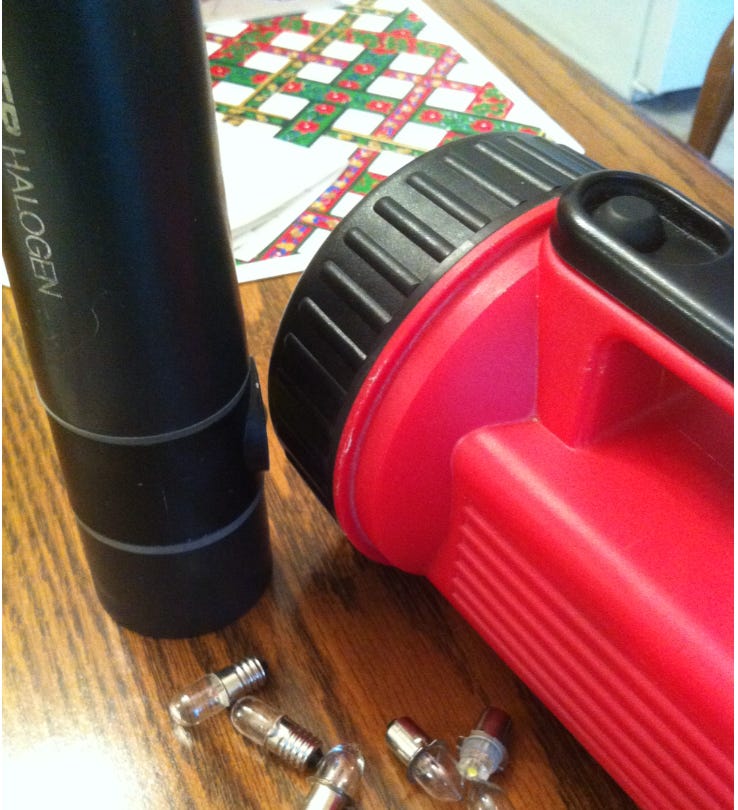
At his insistence, we took him to the hardware store to buy more lightbulbs and batteries. Frankly, the flashlight just needed to go in the trash, and I did buy my mother a new, high-powered one to have for emergencies. But we respected his need to “fix” that other one. I will be eternally grateful to the older man at the store. He quickly assessed what was going on and spent the next twenty or thirty minutes patiently explaining batteries and lightbulbs to my father, and making suggestions for “troubleshooting” the problem. He was a gift.
And I will admit that despite all, it broke my heart to see my father reduced to a child-like state, kneeling there quietly “trying to learn” from the man at the store.
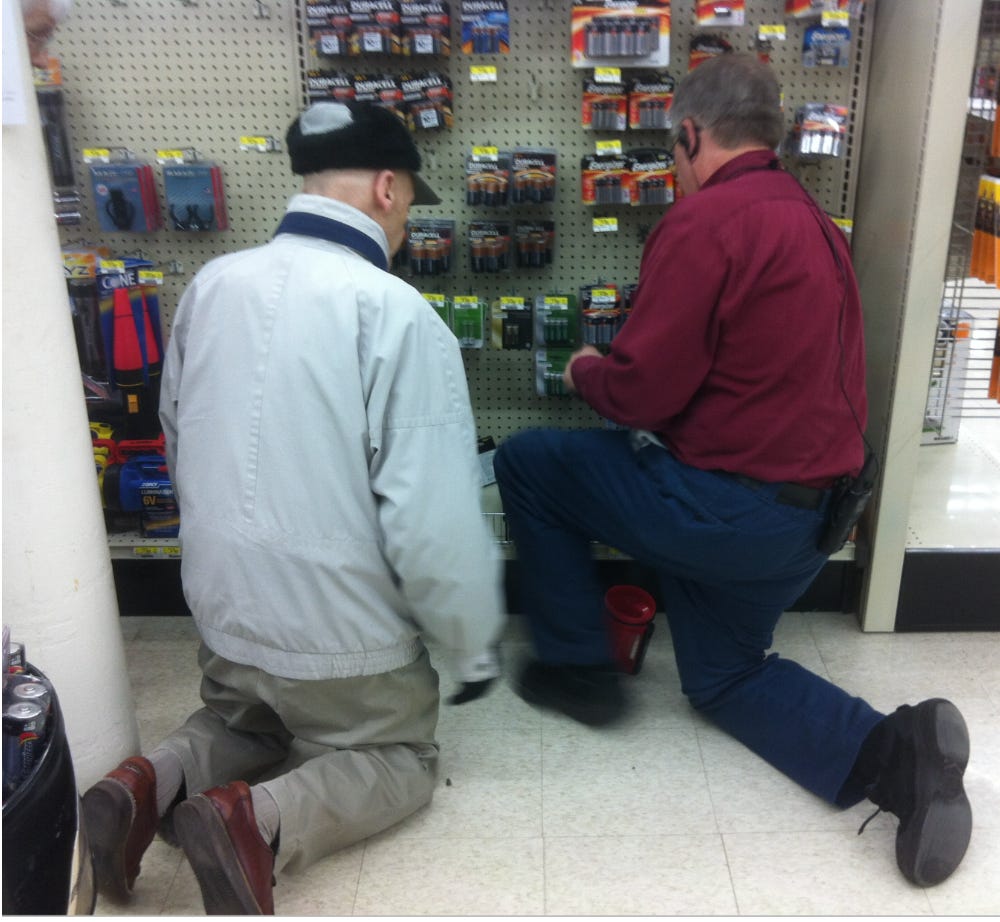
Dementia is summed up best, I think, by my father’s comment that day, “I know what to do…and I just can’t quite get my mind to remember it right now. I just can’t get to it.”
I don’t wish that on anybody.
There you are, you bastard…
But still, that “old Dad” was still there. He was losing his ability to control it, but it was definitely there.
On that same trip to Gettysburg, as I drove us there, he started getting agitated. He hit that “tone of voice” and shot me that angry “you-are-in-trouble” look. And I will say that the power of that old programming was still there. I immediately shifted into defensive mode, trying to placate and calm him. Ed looked surprised at my reaction. But I was, inside, still that traumatized kid who knew that if I didn’t do something, “Daddy” was going to lose it.
However, Ed later saw “that man” for the first time in his life. He told me later that he never doubted what I’d told him about how mean and intimidating Dad could be. But after dinner one evening, Ed saw that look for himself.
The rest of us were in the restroom or waiting outside. My father was standing in the lobby near the receptionist desk, and unknown to him, Ed was off to the side, just watching.
My father looked around, then reached into the candy bowl on the counter. Grabbing handfuls of the sweets, he started stuffing them into his pocket. At that moment, he saw Ed watching him.
As Ed describes it, it was like watching my father become someone else. Dad’s eyes were hard, and he shot Ed a look of “pure evil and hate.” Ed told me later, “I thought to myself – so there you are, you bastard. I’ve heard all about you…and now, there you are.”
Toward the end of his life, Dad was much weaker and using a walker. It was my turn to go up and give Mom a break and some help. As usual these days, he spent hours hunched over his bureau, rearranging his sock drawer. Ever since the Navy, my father had always had the most organized clothes drawers of all of us. By now, it was a repetitive habit. He just knew he had to keep that drawer in order.
But then he started walking away, again without his walker. He was driving my mother crazy because he didn’t want to use it, saying he didn’t need it. But he was wobbly, and if he fell, it was going to be that much harder on my mother.
I immediately told him to please use his walker…and again, his face deformed in rage, and he glared at me with that look that could freeze you solid while shooting terror through your nervous system. And, just like old times, that fist that came up. Then he made that same grimace he always did when he decided not to pummel me, grabbed the walker, and shuffled out of the room.
The final straw
In the end, he was spared the indignity of having his dementia take his mind away. Instead, it was stomach cancer. He had been anemic for some time, but all the gut tests they did came up negative for any bleeding. I asked why they didn’t check his stomach, and was blown off. That’s where the bleeding was.
The cancer took over fairly quickly. While one doctor suggested they could do surgery, it would have probably killed him in a very painful way.
Ed and I were the ones who went up to help my mother move him into the hospice facility. His temperament was standard for him. “So what do I do now?” was his angry question when we moved him into his room, followed the next day by, “How long’s this gonna take?”
The worst, though, was his yelling at the young nurse one evening. She was just trying to get him to do what he needed to be safe. But here was a young woman telling him what to do, and he lost it. So we had to drive over there to calm him down.
I said my good-byes and offered a quiet thanks for the good things he did for me in life. I was trying to find something positive to give him in that last moment.
There was no apology, no deathbed awareness of the harm he had caused. He just said, “Well, I always wanted to stand for something.”
We left the next day.
I was at work that Friday when the phone call came, and I heard the words: “He’s gone.”
Numbness came first as I tried to wrap my head around the reality that, for the first time in almost six decades, the heavy load I had always carried was gone. I guess I expected maybe a touch of sadness. But instead, a different emotion crept, then flooded in, and what came was not grief but overwhelming relief. Amazement. Even awe. The almost incomprehensible realization crystallized in my brain that FINALLY, after a lifetime of standing guard, I was now OFF-DUTY. The battle was done. I’d seen it through to the end…honorably.
The funeral was an exercise in biting my tongue. But I wasn’t going to take from my mother, whatever comfort it was giving her. People praised him. There was a glowing eulogy, and the priest saying the Mass, spoke of my father’s holiness and how Dad lived what really mattered in life.
As I sat there listening, I kept wondering, What was the measure of him? Good? Bad? Did he stand for anything?
Certainly, he provided. Taught us. Pushed us. I learned to fight, to reach for things, experienced things, learned to love learning, from him. He helped various family members through difficult times.
But his motives? Who knows. And…who cares…he was gone. I did my job. At long last, it was OVER, and I was free.
Whatever it was that WAS the measure of him no longer mattered.
But…yes, it did. As is the case in such moments, the real work was yet to be done even as I didn’t yet know it. It was unfinished business. And unfinished business will always return later to knock on your “mental door.” It is patient…and relentless.
However, in the meantime, there was still Mom….
Note:
I am seeking financial support to complete my memoir, work with an editor, and return home for fact-checking. Your help would mean the world to me as I take this step toward healing and giving voice to my journey.
Please like, comment, and share this post to help spread the word. The link for my fundraiser is on GoFundMe. Thank you for your support.
 Soul Mosaic
Leave a comment