Archive for the ‘Broken Bits’ Category

The Post – Michelangelo

April 20, 2008

If I have any disagreement with Michelangelo, it’s that in the deepest, purest, man paints with his soul. His brain and hands are more on the same level, tools of the soul to bring about the divine. First, you must feel, your soul must speak, a truth must break out from your heart and demand to be released into the world. Whether it comes out in word, in song, in oils, that is merely the language of expression. The hands execute it, directed by the knowledge in the brain of how to craft the message. But the soul, the soul is the true author and artist of what comes out.

I would add a footnote to this…while a creation may or may not come out beautifully, its execution is not the issue. It is not the reflection of the true magnitude of the divine in the heart. We may not be able to match the likes of Michelangelo on canvas. We might even create garbage. It does not mean that our souls haven’t seen and heard God, and that the yearning in our souls is not true and earnest. It simply means our hands may not be up to the task of putting God on canvas. But have no doubt of the ability of any man’s soul to hear and see the divine.

The Post – Leadership, Ethics, Action, and the Closed Mouth

April 19, 2008

Sometimes words are useless. Sometimes, no matter how much you try to explain, tell, answer, teach, or lead, words just muck it up. It’s like oil paints, the more you mix colors together, the more you end up with a muddy gray. No sharp edges, no clear images, no distinctions. As in today’s gift post about leaders, sometimes the only thing you can do, is close your mouth and show your truth through your choices and actions. You can tell someone what your ethics are, but it is only in the doing, that they will truly know and believe. It’s like the Desert Fathers said about needing spiritual training: “Begin by closing your mouth.”

The Post-Getting Back on Track

April 16, 2008

Just a quick note this morning to say hello. I’ve been away at a family wedding, and hence the lack of posts. In keeping with weddings, celebrations, and “gift-giving” mode, I did manage to make sure “Gift Posts” went up. 🙂 In any event, I need to get my head around getting back into routine and pick up where I left off on things. So stay tuned. More posts will be on their way soon!

The Gift

April 16, 2008

“…a diary or journal isn’t necessarily something that should be done daily so much as it is a clue to how to see the daily world around oneself differently.”

Alexandra Johnson, from Leaving A Trace, On Keeping A Journal: The Art of Transforming a Life Into Stories

The Post – The Fiddler Babies: Death, Another Pregnancy, and the “Status Quo” Experiment.

April 8, 2008

Okay. I’ve been silent on the fiddler crabs for the last week. It’s been a week. First, let’s cut to the chase. I lost again on the babies. But again, I have more knowledge on what worked and what didn’t, so next time, I might be closer to an answer. But before I get into that, let’s back up to where things were at last Wed afternoon:

Notes from Wed afternoon:

The ammonia monitor is still partway between “alert” and “safe.” The dipstick nitrite test is down from 0.5 ppm but “not quite” zero. There’s a “trace.” I redid the nitrite test using a tube test, which verifies that. The tube test result showed <0.25 ppm nitrites, but not zero. Still, an improvement.

Numbers of fiddler babies is down some more, but still many. I got some frozen baby brine shrimp and the fiddler babies seem pleased with that.

By the way, PetsMart had three or four kinds of frozen brine shrimp, all of which were little brown frozen cubes. Except for one, labeled baby brine shrimp and it was pink and clear. The lady there said it was the best of the three and was the only thing she gave her fish. It’s called Hikari Bio-Pure Baby Brine Shrimp. It has 40 little pink frozen cubes. I used about half a cube to feed the babies. They are smaller cubes than the ones in the other packages but then, they are really the Grade A Prime frozen baby brine shrimp. 🙂 So they survived not getting the live stuff.

RE the water quality, I also decided to add some of the API Stress Zyme liquid I have. It’s supposed to be a biological filter booster. The man at FishPros said those liquids don’t do that much as they don’t have the right bacteria, those only develop over time, but still said it doesn’t hurt things. So I added some. Figured any boost to the filtering wasn’t a bad thing.

And call me weird, but since the “clear water” in the tank represented a decline in water quality, and the turbid white cloud water was an improvement (turbid because thousands of tiny fiddler babies were churning up the aragonite sand), I decided to act like a “large fiddler baby.” I took my plastic spoon and stirred up the sand on the bottom myself. Curious to see if that helps things. It also stirred up food sitting on the tank bottom that hadn’t been eaten. Perhaps that’s a good thing too. I noticed many tiny fiddler babies flying around in the swirling food, so I think it’s the fiddler baby equivalent of a buffet….

Thursday:

Clear water. No babies. Ammonia level slipping back up to alert.

Friday, Saturday, Sunday

No babies.

Monday

Water quality – ammonia indicator almost back down to “Safe.”

So. What happened?

This time around, the nitrites never got anywhere near as high as the last time. The babies were doing great and loved the aragonite sand and the reef rock. All was on track. Then death was sudden. Now certainly I know you can lose a lot of them during their first few molts. No doubt that might have been some of it…though between the aragonite sand and the reef rock, they had adequate calcium for molting. The live rock was growing a healthy crop of algae cover. And they had brine shrimp to follow up the Small Fry liquid fish food and the Kent Marine ZooPlex, all good foods. So they were getting the right foods, and enough food. And they even got more air than the last group because I took the big air bubbler that was in the brine shrimp container and moved it and its air pump over to the babies’ tank. In fact, that may have helped keep the water quality between the safe and alert range for ammonia.

I think my engineer husband put into words my own suspicions, the one nagging concern I had all along, and it’s the one unanswered question in my mind. Salinity. Either the change in salinity from brackish to marine was too much for them, or that change affected something else in the tank that did kill them. The fact that they all died off in one fell swoop very abruptly, indicates again, something tank-wide that affected everybody.

Re changing salinity from brackish to marine – maybe out in the estuary, the transition from brackish to marine is slower and hence they adjust fine with being at sea. So perhaps even though I raised the salinity in stages, maybe it was still to abrupt for the tiny larvae.

Or maybe they really just don’t tolerate a marine environment no matter what the research papers say. These are the species of fiddlers that like things to be the ‘least’ marine.

Another problem though in switching the tank from brackish to marine, is that you are possibly disrupting the “stability” of the tank’s nitrogen cycle. For one thing, I read that as the salinity goes up, so does the pH. Once the pH rises, the nitrites and ammonia levels rise. As nitrites rise, the nitrogen cycle has to absorb that. Not a problem if you have a mature tank that’s been established for that pH and salinity. But if the balance is messed up by changing a parameter like salinity, maybe that disrupts things enough, at least for such tiny creatures as larvae.

I don’t know the answer…yet. I only know that I had a very successful tank going and happy babies, until I changed the salinity. Within a day or two, all were dead.

So. Next time, I am going to leave them in brackish water and see what happens.

Will there be a next time? Well….I’m fairly certain it’ll happen, especially since Scarlett O’Hara is PREGNANT AGAIN!!!!!!! I noticed that right after I put her back in the main tank, she took to living in the water filter. I thought, no, she can’t be getting ready to have more babies. She JUST delivered. I know that both times now, just before we saw Scarlett carrying around babies, she spent some time on top of or inside of the water filter.

Today, since I’d not seen her out in the main tank AT ALL for days, I pulled the water filter cartridge out and she jumped down into the tank water. I did a double take. SHE IS PREGNANT AGAIN.

In reading up on crab sex, apparently the female can store the sperm for months at a time. So I guess multiple pregnancies can happen even if she doesn’t mate again.

I have decided for this pregnancy to do the “status quo” experiment, ie just leave her in that main tank. I have no idea how far along she is, I have no time to turn the nursery tank around and re-prepare it for another delivery. So this time I am going to leave her in the main tank, which is brackish, leave the water filter on, and if any babies survive, great. If not, no big deal. And it’s the one set of conditions I haven’t tried yet – just leave it all alone and see what happens.

I frankly would be surprised to see babies survive, but, who knows. In the meantime, I will go ahead, clean out the nursery tank, re-establish it with clean brackish water, and I think I will even try that method of “fishless cycling” that the UK website mentioned – ie establish the nitrogen cycle without fish. At the very least, by the next time someone is pregnant again, the tank will be clean, mature, brackish, and ready for another try at this. NOT QUITTING YET!!!

The Post – Under the Pier: Let’s Get Technical, Part II-Environmental Issues

April 7, 2008

Let’s Get Technical, Part II: ENVIRONMENTAL ISSUES

Okay. We’re going to get REALLY detailed now, but I happen to LOVE the ocean, and in particular Narragansett Bay. There’s a lot going wrong, and a lot going right. It’s a passion of mine. So for those of you who want to know about all kinds of environmental things relating to salt marshes, bays, sea creatures, oil spills, global warming, and what man does RIGHT to fix things, keep reading.

And for what it’s worth, though I am speaking here of Narragansett Bay, these programs are going on in many coastal areas all over the US and the world. So this information is as relevant to people in North Carolina, Texas or California as it is to New Englanders.

The story involves, among other themes, a love of the bay, it’s creatures, and the very survival of those things. One of the character’s, Jerry, is passionate about “her critters.” Throughout the story, her “mantras” repeat like a church litany:

“It’s all about the critters.”

“No critters, no future.”

“Gotta save the critters!”

And she reminds people that the only way to achieve these things is to:

“Educate and Rehabilitate”

Is she over-reacting? Here’s a recent evaluation on the state of Narragansett Bay:

From the 2006-2007 Save the Bay’s STATE OF THE BAY Assessment and action plan:

“Six years have passed since we first answered the question “How’s the Bay doing?” in the landmark report State of The Bay 2000. While we have made tremendous progress toward our mission, new challenges to water quality and ecosystem health offset the gains of effective protection and restoration programs.

This edition shows that, despite considerable progress in some of the indicators, the Bay has declined slightly from an overall score of 4.5 in 2000 to a 4.3 today. The negative trend is driven by sharp declines of fish and shellfish resources, and a spreading area of low dissolved oxygen and unusually warm water temperatures creating a “dead zone” on the bottom”

So, the bottom line is that in spite of a lot of efforts, the trend is still somewhat backward. What’s going on?

According to Save the Bay, some of the problems are:

Eelgrass loss due to disease and pollution. This is significant, as there’s been a 40% decline in the grass since 1960. The importance of eelgrass in the bay is described on University of Rhode Island’s Coastal Habitat Restoration website:

“Rhode Island’s primary seagrass is eelgrass. Eelgrass provides many ecologically valuable functions. It produces organic material that becomes part of the marine food web; helps cycle nutrients; stabilizes marine sediments; and provides important habitat.

Many species of fish and wildlife depend on eelgrass. Eelgrass beds provide protection for bay scallops, quahogs, blue crabs and lobsters. Tautog and other fish lay their eggs on the surface of eelgrass leaves, and young starfish, snails, mussels, and other creatures attach themselves to the plant. Waterfowl such as brant feed on eelgrass. Studies in New England have documented the occurrence of 40 species of fish and 9 species of invertebrates in eelgrass beds.”

Nutrient Pollution: Primarily from storm water runoff and waste-water treatment plants, which result in too much nitrogen. This causes:

phytoplankton blooms, overgrows, can cause disease in fish and humans; when they die off, they sink to the bottom and can cause oxygen depletion resulting in fish kills

overgrowth of seaweed to several meters thick; blocks light and depletes oxygen in lower layers of water; excess seaweed washes ashore and rots, creating foul smelling, unpleasant beaches

precious eelgrass dies since light cannot penetrate to bottom of bay through all the phytoplankton and seaweed; without eelgrass, flounder and scallops disappear as do other invertebrates who need the eelgrass for homes and protection

Cesspools -The RI Dept of Environmental Management estimates there are 50,000 cesspools in the state, all substandard. Some date back over half a century. According to Save the Bay, “Many of these cesspools—underground pits or tanks into which untreated human waste pours—overflow into backyards and leak contaminants to groundwater, contributing to dangerous bacteria and nutrient loading into the Bay and drinking water sources. Cesspools have been linked to recent clam and fish kills, and nutrients from their overflow contribute to the floating sea lettuce mats found in open water, as well as the increase in green slime and stench that invades coves and inlets.”

Wastewater: aside from the hazards from raw sewage being discharged into the bay, some of the water treatment plants themselves are substandard, or at or near capacity.

Other problems include:

Oil spills, such as the Prodigy Oil Spill, and North Cape oil spill. Not only were marine life killed, and fishing grounds contaminated, and but the eggs and larvae of fish and invertebrates were affected. Fishermen and lobstermen lost considerable income as well as they were unable to fish in their usual areas.

Trawler damage to the sea bottom habitat and fishing stock depletion – Newer trawling gear and more powerful boats allow areas of the sea bottom previously inaccessible, to be fished. In addition, the gear can often collect much larger numbers of fish and by-catch (the other creatures not desired, that were caught along with the species being sought). Fishing stocks are depleted, areas that used to shelter baby and juvenile fish and shellfish are being scraped clean, and the very bottom structures and normal flora are being changed or destroyed in the process. This topic will be discussed in the next section on commercial fishing.

Dredging, or rather, where to dump what’s dredged up. Many harbor areas require periodic dredging to keep the channels open to shipping. Natural processes in these quieter waters results in the sediments being deposited so that over time, the channels would close up. A big problem is that many of the sediments in the area may be contaminated with heavy metals, man-made chemical compounds and other serious pollutants. The real issue is “where to dump what is dredged up.” In the past these were just disposed of close to the site of dredging, usually wetlands, marshes, etc.

Toxic waste sites that leak contaminants into the land around the bay and the bay itself. Rhode Island Superfund sites include a large one at the Newport Naval Education/Training Center. It was used as a fuel depot since 1900, and the 11 acre portion known as McAllister Point accepted wastes that mostly included domestic refuse, acids, solvents, paint, waste oil and oil contaminated with polychlorinated biphenyls (PCBs). This went on from 1955 to the mid-1970s. Sludge from fuel tanks was dumped on the ground or burned there, and there was groundwater contamination and ocean water disposal as well. Related sites nearby were also contaminated.

Global warming : Rhode Island House Bill 7884, The Rhode Island Global Warming Solutions Act, introduced in January of 2008, Chapter 83, 23-83-2 (a) states that the general assembly finds and declares global warming to be a threat:

“Scientists predicted global warming will exacerbate air quality problems, decrease or eliminate the habitat of indigenous plants and animals, trigger accelerated beach erosion and sea level rise resulting in the displacement of businesses, residences and key infrastructure like bridges and drinking water and wastewater treatment plants, damage marine and freshwater ecosystems and the natural environment, and increase the variety and incidence of infectious diseases, asthma, and other human health-related problems.”

Save the Bay’s Baykeeper, John Torgan, testified before the legislature about the global warming effects, and added the following specifics:

“Narragansett Bay’s average water temperatures have increased more than 3 degrees Fahrenheit in the last century; severe storms have increased 88% in Rhode Island in the past 60 years. Warmer waters have fundamentally disrupted the natural balance of the Bay’s ecosystem and have dramatically changed the assemblage and distribution of plant and animal species. Shellfish and lobster diseases, once considered a problem only in more southern estuaries, have now found their way into the Bay at problem levels. Reproduction and recruitment failure of oysters, mussels, lobster, winter flounder, scallops, eelgrass, and other species correlate with these increases in temperature. Nutrient pollution and low dissolved oxygen levels, nuisance algae blooms, and related water quality problems are similarly exacerbated by higher temperatures. Disruption of the traditional plankton bloom cycle impacts the very currency of life in the Bay. Sea level rise and storm-related coastal erosion threaten our beaches, shoreline, and coastal properties and businesses. “

Salt marsh depletion and poor fish runs to spawning grounds. Some of the bay’s many salt marshes started forming as long as 3500 years ago. Currently about half of those marshes have been filled in. Salt marshes serve not only as habitats for a variety of creatures and breeding grounds, they also clean and filter water, protect shorelines from floods and storms and can keep up with rising sea levels to offset those effects.

Fish runs are an important part of maintaining fish stocks in the bay. Save the Bay’s website explains the evolution of the current problem:

“River herring, Atlantic salmon, rainbow smelt, sturgeon and American shad depend on fish runs for survival. They are anadromous fish, meaning they are born in freshwater rivers, streams, brooks and ponds but mature and spend their adult lives in Narragansett Bay or the ocean. Each spring, these fish instinctively fight their way upstream to return to the freshwater rivers and streams where they were born in order to spawn. The journey to spawning grounds is not an easy one – along many streams and rivers in Rhode Island, dams and culverts act as barriers, preventing fish from swimming upstream to reach spawning habitats. Furthermore, the instinct to return to a particular place of origin is too strong to allow them to choose another river, creek, or stream. Narragansett Bay previously supported commercially valuable Atlantic salmon and alewife (river herring) fisheries. However, the Industrial Revolution combined with overfishing created havoc with the migratory patterns of these anadromous fish. The Blackstone and Pawtuxet Rivers each ended up with one power-producing dam for every mile of river by the middle of the 19th century, and therefore many fish runs simply disappeared. The Atlantic salmon was completely eliminated from its Narragansett Bay spawning runs by 1869…There are 18 existing fish runs in the Narragansett Bay watershed but most of these existing runs are in need of further restoration. Historically, at least 45 runs existed in the Narragansett Bay watershed Among these are four of the most significant freshwater tributaries of Narragansett Bay – the Taunton, Blackstone, Pawtuxet and Ten Mile rivers.”

Because many of the dams no longer serve the useful purpose for which they were built, they have been allowed to decline into a serious state of decay. This not only threatens public safety, but makes it just about impossible for fish to make their way upstream.

Shellfish loss: Bay scallop numbers are low, due in part to the loss of eelgrass in the bay. Lobsters, clams, scallops, and oysters have had their numbers seriously depleted due to oil spills and water quality issues.

So, is there any hope for the bay? Are there any ‘educate and rehabilitate’ efforts happening? Or should Jerry just give up and move to Alaska?

There are a number of very active forces working hard to save Narragansett Bay. Some include:

· Save the Bay
· Narragansett Bay Estuarine Research Reserve System
· Narragansett Bay Estuary Program
· University of Rhode Island Environmental Data center
· SeaWeb
· Rhode Island Sea Grant (on resources page) see bookstore re fishing dredging info
· University of Rhode Island Coastal Institute

Some actions include:

Eelgrass restoration: Both Save the Bay’s Eelgrass planting program and the URI’s Coastal Restoration Program are actively trying to reverse the loss of this precious plant.

Salt marsh restoration: A number of salt marsh restoration projects through Save the Bay are in progress. Their site also explains how to restore a salt marsh.

Fish runs: A very recent set of projects to restore fish runs have begun. To learn more about these restoration programs click here.

Shellfish RestorationSave the Bay’s Scallop Restoration project uses seed scallops from a local aquaculture farm, and distributes them not only in salt marsh ponds, but now into open areas of the bay. The North Cape Oil Spill restoration project included considerable restoration of quahogs (hard-shelled clams), oysters, and bay scallops . Seed stock for these shellfish were obtained from upweller sites in the state. Upweller sites take advantage of tidal currents in their aquaculture setups. Aquaculture itself, is the art, science, and business of farming aquatic plants and animals, including shellfish.

Aquaculture and upweller information can be found in the booklet, Rhode Island Aquaculture Initiative PDF, as well as at their main initiative site. Other sources are: the University of Maine Sea Grant site , Coastal Aquaculture Supply, the upweller page for the town of Bourne, MA (on Cape Cod), AND…..

****For any YouTube enthusiasts: check out this You Tube page with live underwater footage of an upweller operation!!!!

Creation of Coastal Buffers: Save the Bay is working to educate the public in using bay-friendly landscaping and yard techniques for watering and fertilizing plants on properties bordering the bay. Also they are planting trees and bushes that would serve to be a buffer between built-up areas and the bay, which can prevent erosion and inhibit storm water run-off

Dredging sediment regulations: Since dredged up sediments can represent an environmental hazard, new regulations have been enacted on where materials from dredging sites can be dumped. For example, in 2004, the US EPA designated a site nine miles south of Point Judith, in Rhode Island Sound, to be used as the designated dumping site for all harbor and channel dredging in the region. The site will be regularly monitored by environmental officials and could be used for about 20 years. Monitoring of such sites now includes research on how the materials will affect local wildlife, and may include “capping” the sediments dumped there with clean sediment to isolate the material from the surrounding wildlife and sea water.

Brownfields Restoration is another way to restore formerly polluted landfills and waste sites, by converting them to non-polluting uses, such as golf courses, parks or commercial buildings. The Save the Bay Center construction project is an example of such a conversion.

Oil Spill and Toxic Waste Restoration programs: Projects, such as the North Cape Restoration Program , Prodigy Restoration Program, and the Newport Naval Eductation/Training Center call for things such as eelgrass planting, re-establishing shellfish beds with seed clams and oysters from aquaculture farms, capping waste sites to prevent rainwater from seeping down through hazardous wastes and getting into groundwater, removal of waste drums, and constructing a golf course over a formerly contaminated site. The Northeast Fisheries Science Center’s Narragansett Laboratory, which conducts research on changing environmental conditions, growth and survival of fish stocks, also is the Restoration Center that oversees some of these projects.

Global warming: Save the Bay’s global warming program includes working with the state legislature on a regional greenhouse gas initiative, promoting green building technology, using biodiesel fuel on their education craft, and educating the public.

For those of you who love Google Maps and want to SEE some of these projects and places, check out this recent email I received from Save the Bay. They’re now on Google Maps and you can see a map of the area, or zoom down with a satellite image to see ground level, the places they’re working at.

We’ve put Save The Bay
on the Map

Get a better look at our efforts to Protect, Restore
& Explore
Narragansett Bay and its watershed

Thanks to Google Maps, the big picture is just a few keystrokes away. Remarkable technology allows you to zoom right to ground level to check out our restoration sites, policy hot spots, programs and event locations. To get started, just click anywhere on the map on the right. When it loads, click on a map pin or search for what you’re looking for in the index on the left side of the page.

Save The Bay on Google Maps

NEXT UP: COMMERCIAL FISHING – GEAR VS. ENVIRONMENT, REGULATIONS, CHALLENGES
The Post – Under the Pier, The Emotions of Narragansett Bay

April 6, 2008

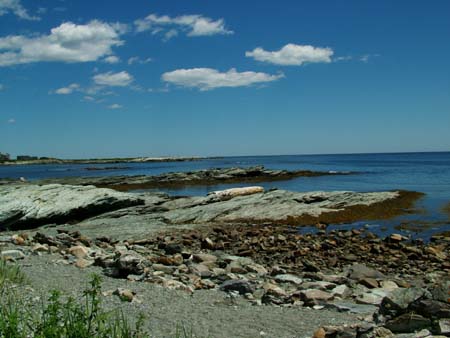
What does standing next to Narragansett Bay feel like, and what do I feel inside?

Okay, first no wisecracks like “Narragansett Bay feels wet.” I’m serious here. I love the ocean. I LOVE Narragansett Bay. I could stand there all day long….just stand there, watching it. Every day. Hour after hour. No swimming, snorkeling, scuba diving, kayaking, windsurfing, fishing. Just stand there watching each wave come up, flex its fury, fling its body full force against shale and granite, slide down off the rocks defeated and broken, then drift out to sea. Yes, I could watch it all day long.

I figure at this point, you’re either ready to throw a net over me, or declare me the most boring person on earth. Who LIVES, to stand there and watch water move around. I do.

There is something primal, spiritual, vulnerable, deeply human, that I feel. First, we spend our first nine months of life in utero, sloshing around in a primal liquid. The sea is the womb of all life, from the microscopic to whales. Life started there, and in a spiritual way, it still does. We left God and entered the current world through the portal of water. It’s where God meets Earth.

I go to the ocean to find God. I know He is everywhere, He is within us. But as I stand there watching the raw power of something beyond me, I feel small, vulnerable, simply human, dwarfed by a majesty I could never create, control, or be part of. I go to the ocean to be awed. And I am.

I know I am not alone in this. Henry David Thoreau knew what this meant. He captured it beautifully in this excerpt from his book, Walden:

“We need the tonic of wildness, to wade sometimes in marshes where the bittern and the meadow-hen lurk, and hear the booming of the snipe; to smell the whispering sedge where only some wilder and more solitary fowl builds her nest, and the mink crawls with its belly close to the ground. At the same time that we are earnest to explore and learn all things, we require that all things be mysterious and unexplorable, that land & sea be infinitely wild, unsurveyed and unfathomed by us because unfathomable. We can never have enough of nature. We must be refreshed by the sight of inexhaustible vigor, vast and titanic features, the sea-coast with its wrecks, the wilderness with its living and its decaying trees, the thundercloud, and the rain which lasts three weeks and produces freshets. We need to witness our own limits transgressed, and some life pasturing freely where we never wander.”

So…he understood we require that all things be mysterious and unexplorable, and need to see our own limits transgressed and life going on where we never see it. I think deep down, we WANT nature to win. We’re like a two-year-old having a tantrum, and actually being relieved when the all-powerful parent comes in and says, “That’s enough,” and takes over. I think what Thoreau described is God, and I think it is those moments standing at the shore watching waves do things beyond all our control or power, that we “see” God.

I think any place at the shore, no matter the location, carries this sense for me. The thing my soul finds special about Narragansett Bay is that it also has my other loves in life….rocks, and sea creatures. Unlike the serenity of open sandy beaches, rocks get in your face. They are confrontational, they raise the stakes. A wave rolling up onto sand is relaxing. But even on a sunny peaceful day, a wave crashing defiantly against granite boulders is raw battle. Each shoves back against the other, flexing their own power in a match to see who will win. The rocks blunt, dissipate, and obliterate the power of the waves in the short-term, but the waves wear down and obliterate the rocks over the long-term.

Rocks feel solid, safe…a taste of the eternal, and so again, they feel like God. Many cultures over the millenia have considered rocks part of their spiritual rituals and altars. They are another unfathomable power where our limits are transgressed. Just try and lift a boulder. It is like trying to lift the earth itself. It represents safety, strength, permanence, as noted in the following comment for the book, The Art of Spiritual Rock Gardening:

PRAISE FOR THE ART OF SPIRITUAL ROCK GARDENING

“Simon Dorrell is one of England’s premier garden painters.” —The Blue Guide to Museums and Galleries of New York

“To find sanctuary in the permanence of stone may give us needed respite from a seemingly chaotic, ever-changing world.

The rocks that form Narragansett Bay did not all originate there. They were deposited there, by the raw slow-moving power that were glaciers. Large bodies of ice gouged, carved and dredged out these “pockets” that later filled with sea water. Just to see the size of the boulders strewn around the bay is to again witness limits transgressed, God.

And then the creatures – the infinite variety of everything from algae to crabs, to clams to sand fleas to whales.

The combination of all three humbles me. Takes me out of my comfort zone. Awes me. To walk across the rocks near the shore’s edge, is to feel “precarious.” Your feet though on solid rock, are by no means taking “stable” steps. The rocks are coated in a slippery slimy film of black algae that renders sneaker treads useless even when you’re not being soaked by the spray of waves hitting the shore. The rocks jut and abut each other at odd angles with crevices and open pits between them that make traversing a pile of boulders in search of tidepools, a business requiring total concentration. You can’t look “cool” picking your way across a rocky point. It’s all you can do to stay upright as you leap from rock to rock and not break your neck if you miss.

And the periwinkle, barnacle, and blue mussel coated boulders ring pools of sea water left behind from high tide, pools that house and nourish an abundance of varied life beneath their surfaces.

So, I could stand there forever and watch ocean wave fury, feel the solidity of immovable rocks, and have great joy and gratitude for nature’s abundance. And all of it is thrown right there at my feet at the shores of Narragansett Bay. I feel small, dwarfed, insignificant. For once in my life, someone else is in control, and I like that.

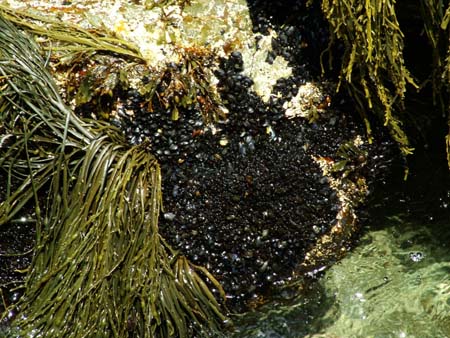
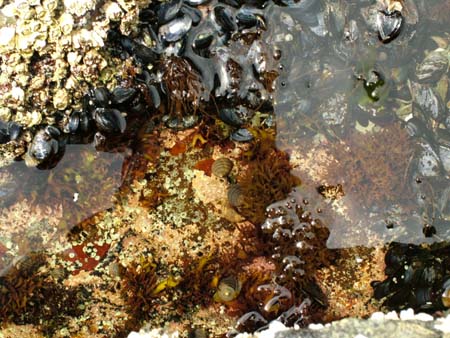
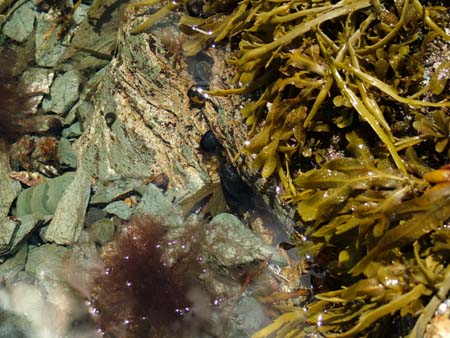
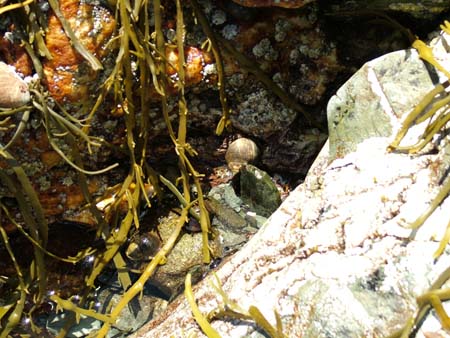
For your viewing pleasure some shots of the “tide pool” level in Narragansett Bay:

The Post – Oops

April 5, 2008

I realize in my introduction to Narragansett Bay, I left out the most important thing…what does it feel like…and what do I feel around it.

That I will address later today or tomorrow. I’m off to a pastels class…..

The Post – Under the Pier: You Know, I Never Properly Introduced You to Narragansett Bay

April 5, 2008

I realized that I’ve talked about a lot of the book characters including the crustacean, Carpus. But the biggest natural character, Narragansett Bay, I’ve failed to introduce to you. So before I get into the next book’s post about the Environmental Issues of Narragansett Bay, I should probably tell you a little bit about the place.

Many of you have probably never heard of it, unless you are old enough to remember Narragansett Lager Beer commercials from the 60s and 70s where they talk about making their beer on the shores of Narragansett Bay. But even if you remember the beer, you probably still didn’t have a clue where Narragansett Bay was.

So where is it? How big is it? And where did it get that weird name?

For some vital statistics, including such riveting things that only I find neat, like average salinity and flushing time of the bay, click here. (And by the way…29-31 parts per thousand, compared to the ocean which is 35 ppt; and 26 days)

If you’re a map kind of person, go to the Narragansett Bay Home page. There are maps for surfers, maps of eelgrass geographic data, restoration maps, lobster migration maps, maps of oyster disease prevalence, bay sediment distribution, and fishing areas, and my personal favorite, a series of maps showing the “house counts in South County Salt Ponds Watershed, from 1939 until 2003.” It’s a nice green map that gets redder over the years as the number of houses increase. So if you have nothing to do on a Saturday night, here you go! Actually, there’s lots more there than just maps, but that happens to be my favorite.

For satellite images you can zoom in and out of as well as road maps, go to Google’s map page for Narragansett Bay

Those of you who like your visuals more at “sea level” here’s the web page for Google images of the bay, including this really neat aerial view (as opposed to satellite) of the bay.

There is a great book online that covers everything from the bay’s history – ie people history: Indians, settlers, rumrunners etc., to its geological history – what the glaciers did to form it, what rocks the glaciers left behind, etc. It’s called: Narragansett Bay: A Friend’s Perspective. Again, if you’re like me and like tweaky obscure facts, go for it.

For those who are interested in Narragansett Bay and it’s survival, here’s some resources to check on:

· Save the Bay
· Narragansett Bay Estuarine Research Reserve System
· Narragansett Bay Estuary Program
· University of Rhode Island Environmental Data center
· SeaWeb
· Rhode Island Sea Grant
· University of Rhode Island Coastal Institute

Save the Bay blogs: Curt( executive director), Abby (Explore the Bay education staff), John (Baykeeper program)

Oh, so you still want to know where the weird name came from? It’s from the tribe of Indians who lived in that area for thousands of years, the Narragansett Indians. Yes, I did say, thousands. The tribe’s website indicates that archaeological evidence, rock formations, and oral history establish their existence in the region more than 30,000 years ago. Click here for the tribe’s website. In any event, the bay is named after them.

Ah, yes, last but not least, the BEER.

Narragansett Beer was made by the Narragansett Brewing Company. A bit of trivia – the Robert Shaw character in the movie, Jaws, apparently was holding cans of Narragansett Beer. Apparently the Falstaff Brewing Company bought it out in 1965, and it changed hands a few times over the years before closing its doors. Short version, the brand was bought back by a small group of investors in 2005 and is now available locally in the Southern New England region.

Now that you’ve met Narragansett Bay, I can return to the Technical posts for Under the Pier. Next up: The Environmental Issues of the Bay. Until then:

I leave you with this link, which is a picture looking out at a buoy on the bay at sunset. Pull up a chair, crack open your Narragansett Beer, and enjoy.

The Gift – A Gentle Friday Extra

April 4, 2008

I was just standing bleary-eyed at the kitchen sink staring out at the back yard when I saw movement on the pond’s dam behind our house. Looking closer I spotted 4 young female deer, strung out in a straight line across the dam. I knew deer had been around because for the last month, I’ve seen the characteristic hoof prints in the soft earth behind our house.

They moved out a bit further onto the dam, then halted for several seconds. Their light brown coats almost totally blended into the background of tree limbs and bare bushes that have only the hint of baby green leaves on them yet.

They stood motionless for several seconds, then tentatively, almost fearfully, they put one dainty paw in front of the other. Two of them crept across the dam, scanning for danger as they made their way to the cover of some bushy trees on the other side. The other two, small, very young, gently picked their way down the steep slope toward the pond. They seemed to want a drink but every time they got close to the water’s edge, they backed away and tried a new spot. I don’t know if they were just too skittish to relax enough to take a drink – after all, in the wild, drinking holes are places of ambush – or if the slope just felt too steep and they feared lowering their heads and losing their balance.

These two finally joined the others under the canopy of tree branches and I could see them approaching the water again. Given they were so sheltered, I couldn’t tell if they succeeded. The next thing I saw was one or two of them slowly circling the swimming pool that belongs to the condos across the way, then all of them disappeared down into the wooded area below the dam.

They were beautiful, peaceful, vulnerable, gentle. I just thought a Friday might need to start out with something serene and pastoral….

If you’re more visual, I found this picture on the web at Pictopia, that resembles the young deer I saw this morning.

Happy, gentle Friday.