Archive for the ‘Broken Bits’ Category

The Post – The Sea Monkeys Sleep With the Fishes, and Some of the Babies Sleep Down the Drain

April 2, 2008

A fiddler update

First, here’s what I wrote yesterday, based on those “festivities” :

Okay. I know everybody says that live food is best for growing larval crabs. But you know, life is not perfect. I have advice for anyone who wants to raise live brine shrimp to feed to their crab larvae…buy one of those hatcheries the petstores sell. It’s worth it.

The alternative is to:

– take a 2 liter Coke Bottle and cut off the bottom (trying to do this with a pair of scissors without slitting your wrists by accident is no easy affair)

– invert it, because for some reason known only to brine shrimp, you want a “funnel-shaped” apparatus to make it easier to collect the little hatchlings later.

– when you’re standing there holding this inverted apparatus, you will then realize you need to find something to set the upside-down Coke bottle in so it’s stable…unless you want Sea Monkeys all over your kitchen floor. I do not.

– run the air bubbler and tubing, attached to a pump, down toward the bottom of the Coke bottle…excuse me, I mean the “top” of the Coke bottle…which is now, the bottom

– add the sea monkey mix (brine shrimp eggs with ocean salt in the packet) into distilled water

– since you have no heater find a way to shine a 60 Watt light bulb into the bottle to warm the babies…trying not to fry them

– did I mention find a bowl to set the whole bottle and supporting thing in (to catch the water that splashes out on your floor along with chunks of dead sea monkey eggs)

– if and when the babies hatch, shine a flashlight at the BOTTOM of the bottle (remembering of course, that the bottom is really the top, inverted) to attract the baby shrimp so they’ll congregate there. Of course it would be so much easier to be able to shine the light at the top of this whole setup…the wide open, easily accessible top (which used to be the bottom). But that won’t work. Apparently the empty egg shells float to the top and you can’t tell the brine shrimp from their egg casings

– while continuing to hold the flashlight with one hand to keep the little shrimp at the bottom of the Coke bottle, find something to suck up the babies hopefully congregating down at the bottom of this whole unstable apparatus…while avoiding more empty egg shells that sunk (I thought they were supposed to rise to the surface) and avoiding tipping the whole thing over

– try to deliver this aliquot of baby shrimp (I was using a turkey baster because I didn’t have a third hand to allow me to hold the pipette, operate the pipette bulb and keep the flashlight on the babies) into your crab larvae aquarium without spilling it on the floor

– oh and do all this while bent over and on your knees because the only place you could set all this up was on the floor UNDER the main aquarium…

– ah, and yes, make sure to suck out the little baby brine shrimp to feed to your crabs as soon as possible after they hatch because if you wait too long, they’re dead and you can’t tell their swirling corpses apart from their useless egg shells….

Do I sound less than enthused about hatching brine shrimp, at least in this makeshift setup? You bet. So. At least in my opinion, buy yourself a setup that’s easy to deal with, heat, extract the baby shrimp from…buy something that was designed and made for this ordeal…a brine shrimp hatchery. They’re not expensive – I saw some for about $5. To me, well worth the cost. No matter what you do, you’ll still have to buy the bubbler and air pump anyway, so you’re not saving much by trying to do it the home-made way. And you might do your knees a favor by not having to crawl around on the floor.

Anyway, tired and fed-up with this whole affair, I picked up the Coke-bottle-turned-hatchery, marched down to the pond behind our house, and dumped them in the water. Since they’re already dead, they and their shells might at least be food for some of the baby fishes in the pond. So…the sea monkeys sleep with the fishes….to paraphrase a line from the Godfather.

Tomorrow, I go buy those fresh-frozen cubes of brine shrimp we used to get for our tropical fish when I was a kid. They smell to high heaven, but I don’t have to hatch them, feed them, catch them, separate them from their shells, or struggle to get them in the crab nursery tank. Sounds good to me…..

One positive out of all this….I moved the air bubbler rock into the crab nursery. It moves a whole lot more air into the tank than that pretty but somewhat ineffective ‘curtain bubbler’ in the back of the aquarium. Perhaps that will be a good thing for water quality, which I will comment on next….

I got up this morning to be greeted by clear water again in the nursery. I’d gotten used to the idea that white cloudy water was good, even though it’s counterintuitive to think that. And frankly, white cloudy water HAS been good. White cloud, no nitrites. So when I saw clear water this morning, I felt this sense of dread. Again, a counterintuitive response since most people strive for crystal clear aquarium water.

When I tested the water, my counterintuitive gut response was right. Clear water, nitrites were up. And the ammonia monitor had changed from yellow to green, ie, “safe” to “alert.” Now alert means it can be like that for days and not cause harm, at least not to adults. I don’t know about babies.

Given the rise in nitrites, even though slight, I decided to do a water change. I was going to let water drain out of the bubbler, down the tubing and into a bowl by reversing the check valve in the tubing (the check valve prevents water from backing up down the tubing and into the air pump; by reversing the valve, I would be letting water drain from the tank out the tubing, hence a way of getting water out of the aquarium without sucking up babies) however this flat out didn’t work. I don’t think the air bubbler can suck out enough water to actually get a “pull” going down the tubing.

Next idea was to use some cheesecloth over a plastic cup so when I poured out water I’d taken out of the tank, down the drain, I wouldn’t lose any babies. Sounds good in theory and maybe most of the baby crabs didn’t go down the drain, but I expect some did.

The rest were safely trapped in the cheesecloth. Great. So. How do you free crab larvae from cheesecloth? I think it’s probably best to take that cheesecloth and put it in another plastic cup with some aquarium water so the baby crabs can get free of the cheesecloth and swim out into the water in the cup, then pour the cup water back into the aquarium.

I, not thinking, just dipped the cheesecloth in the tank water directly. Duh. I expect I probably sucked up a bunch more babies into the cheesecloth than I got out of it. So scratch that idea.

I need to go back and read Laurie’s suggestion in her comments to my post, to see how she kept the babies out of the container she used to take water out of the tank for water changes.

In spite of these fiascoes, I still have many baby crabs swimming around alive in the tank. The nitrites and ammonia are no worse. I added a gallon of water to the tank that was marine in salinity (1.022) , which made the tank 1.018 overall. I don’t think I’m going to raise the salinity any higher. If the nitrites stay down and the babies survive for one more week, maybe less, I’m going to just start bringing the whole affair back down to brackish (1.012) and lower the pH from its current 8.2-8.4, down to 7.8. I read somewhere that as the pH comes down, so do the nitrites.

By last night, I waved the flag of surrender and retreated to the bath tub. One small ray of hope though. On my way upstairs, I glanced at the ammonia monitor. It is no longer green (Alert zone). It’s color is now closer to yellow (safe) than green, so with any luck, the tank conditions are moving back to the safe/normal zone. We’ll see what the morning brings

This morning:

Well, a ray of hope. Unlike the first time I did this experiment of trying to raise the crab larvae and the nitrites just went up out of control, this morning I seemed to have turned a corner.

The ammonia monitor, which last night seemed to back off just a little from the alert level, this morning is mostly yellow – almost safe. It’s not all the way there, but predominantly yellow. It’s no longer green.

I rechecked the nitrites and today they and the nitrates are both zero again!!! I don’t know if it was the water change, or the additional bubbler which is really moving oxygen into the tank, or both, but improved conditions.

The number of crab babies in the tank continues to drop, but that is to be expected. That’s why they have so many to start with. There are still many swimming around in the tank. We’ll see how this goes. Now, off to PetsMart to buy that fresh frozen brine shrimp!!

Have a nice day.

The Post: Under the Pier – Let’s Get Technical, Part I

April 1, 2008

LET’S GET TECHNICAL

What grows on a pier piling? What are rockhoppers and how do fishing trawlers use them? Why are fishing areas being closed off? How do you restore an oil spill or toxic waste site? What happened to all the eelgrass that used to be in Narragansett Bay? What in God’s name is an “upweller,” and is a robotic octopus arm powered by artificial muscles, science fiction or truth and why does the military care?

There’s a lot of technical detail that went into this story. Some of the story involves science researchers working with the environment or the military. Half of the story involves a world of animals under the pier. The things presented in the story are based in fact – they exist already, are in development, or are at least plausible. When a story involves technology, it has to first, be accurate or your readers will lose faith. It also has to have a richness of detail. The technology is a character in itself and the rich details are the characterization that brings it alive.

I’ve put the technology topics into one of five categories: Physical Details, The Environment, Commercial Fishing, Techno-whiz, and Miscellaneous. For today, let’s talk about “The Physical.”

And just an FYI – before I’m done with this series on this novel, I will compile a bibliography of the books, DVDs, research papers, websites, news articles etc., that went into the writing of this book, whether on technical subjects, writing techniques, Narragansett Bay, New England, diners, ghosts, or whatever.

THE PHYSICAL: Seeing the world under the pier.

We’ve already talked about how to see a fictional town. You take the things you know and expect to be there, arrange them in an imaginary location, then use your imagination from there. Something similar needs to happen under the water.

Though the story that takes place under the pier is fiction, the wildlife that live there, and even the main characters, aren’t. You may have put your reader inside the “fictional” mind of the hermit crab, but everything around that crab is nonfiction, and has to be accurate. How do you do that? Start with questions. You can’t know what that animal might feel, do, or respond with, if you don’t even know what he looks like or has for body equipment.

As the hermit crab – how do you walk along the bottom? Do you hop? Step sideways? Slither? What do you see on the sea bottom as you step across it? For that matter, how do you see? Do you have eyes? Can you blink? What is your range of vision? Do you have teeth to eat with? How do you breathe?

I found a lot of the specific scientific details and descriptions in nature guides, such as the National Audubon Guide to North American Seashore Creatures, Fish, Whales, and Dolphins, Birds, etc. By knowing that the average size of a long-clawed hermit crab is about ½ – 1 inch long, I know I can’t have Carpus fighting off sharks or out-swimming whales. From the descriptions in the guides I know that he has two eyestalks that can swivel around in all directions or be pulled back down to protect them. There is an open eye at the end of each, and two different-sized sets of antennae nearby for sensing and smelling the world around him. I learned that he eats a variety of things including the rotting flesh of long-dead animals. I know that he is most likely found in a periwinkle shell and that a moon snail shell is probably too big for him. He breathes through gills and chews up food with mandibles near his mouth.

Take this process and expand it. Who else does Carpus run into under the pier? What do they look like? Who does he fear? What is the ground like under his legs? Where can he hide?

From Narragansett Bay: A Friend’s Perspective, I learned the bedrock in the area is mostly sandstone and black shale, with some coal, graphite, granites, and schists scattered around. The average depth of the bay is 26 feet, it’s an estuary meaning it is a place where freshwater and seawater meet, and the bottom is a mixture of sandy plains and gravel. So I now have a pretty good idea that the area under the pier has a similar composition.

From the Peterson Field Guide to the Atlantic Seashore, I found a detailed description of the New England tidal zones and a great chart showing what creatures lived at what point down the length of a pier piling. This told me who Carpus would encounter as he climbed down the piling, to the sea bottom below the pier.

From the Uncommon Guide to Common Life in Narragansett Bay, I discovered who else Carpus will meet on his travels as well as what plants or seaweeds are around for him to eat or hide in. Also, since he is pretty low on the food chain, he has a LOT of creatures to fear, including the lobster.

From The Secret Life of Lobsters I learned that a lobster loves the dark, finds prey and mates by sniffing the water with its antennules, and shoots its urine out its face at its opponents or prospective mates, to identify itself. Hence I can determine Carpus isn’t safe from a lobster just because it’s dark out, and I can tell how the lobster is going to act in a given encounter with friends and foes.

From the Marine Animals of Southern New England and New York, I found photographs, sketches, identification keys and thousands of bits of technical information on just about any creature Carpus might stumble across.

In addition to books, there are nature websites including Narragansett Bay specific ones, such as the Narragansett Bay Biota Gallery done by the US EPA, the University of Rhode Island Office of Marine Programs, and the Narragansett Bay Commission. The site covers everything from seaweed to seals, with pictures and information. Organizations such as Save the Bay and the Narragansett Bay Estuarine Research Reserve collect and publish information on all the wildlife in the bay area, as well as perform wildlife counts, monitor the health of the bay and do scientific research studies.

I have to say that my ultimate favorite was to curl up with a DVD I purchased from Hamilton Marine, a discount store in Searsport Maine specializing in equipment for professional boatbuilders, commercial fishermen and lobstermen. The DVD is: The Realm of the Lobster. It was filmed in the Gulf of Maine in 2006 and you are basically right there with the anemones, sea urchins, lobsters, crabs, wolfish, and kelp. You get to watch how they move, who they fear, who hunts who, and what the world at the sea bottom there looks like.

Once you accumulate a bunch of technical details about the environment, plants, animals, geology…you have a start. You know you have pincers to work with not wings, so you have some facts to know “what physical options your animal has at his disposal” in any given situation. The next step is to figure out as best you can, how would the main characters feel and respond to anything from a good meal to nearly being eaten. Here the process requires a mix of emotions, extrapolation, and imagination.

Do you know what if feels like to fear for your life? To run from a bully or a mugger? To eye a stranger with suspicion?

Do you know what it feels like to choke? To be so exhausted from fear or running that you can’t keep your eyes open, no matter how hard you try or how dangerous the situation?

Do you know what it feels like to starve and grow so weak you can barely keep going?

Even if you haven’t experienced all of the above, chances are you know someone who has or you have read news reports about someone who has. The point is, you combine the technical details of the creatures and their world, with the technical details of your world, and use your imagination to extrapolate what you might see, feel, and do if you were a hermit crab about to be eaten by a lobster.

For example, to guess what it might feel like to be a hermit crab in cloudy water where sediment particles are choking you by clogging up the fibers in your gills, imagine what you would feel if you were in a desert, the tissues in your throat are dry, stuck together, and sand particles keep rubbing against them every time you try to swallow. Or what did it feel like the time you choked on a pill? What would you be feeling right at that moment, emotionally?

Now imagine what it feels like if the hermit crab suddenly falls into a pail of cool clean seawater that saturates its dried-out tissues and flushes its gills clean. You can visualize something similar, like drinking a tall cool glass of iced tea in that desert situation. Suddenly all your throat tissues soften, stop sticking together, the passages open, and overheated mucosal linings feel cool and refreshed.

So the point is, find enough technical details to know what the animal has for equipment, how it uses them, then put the animal in different situations. Try to imagine how the animal would move, fight, eat, breathe, hide, and then try to extrapolate from your own moments of terror, illness, hunger, or fatigue, how you would feel and act. From there, it’s all imagination.

Next up: Environmental Issues

The Post – A Short Fiddler Update

March 31, 2008

Just a quick update today – so far many babies continue to survive. It’s still early – we’re just into the third day so far. Looking back at the last batch, I lost them around day 9 or 10. So proceeding cautiously on projections here.

As of this afternoon, I can see that the numbers are lower than initially after birth. To be expected. Some die during molting, the larvae are carnivorous and will eat each other, and some just flat out die. That said, there are still hundreds or thousands of very active larvae swimming around that tank. MANY are clustered in the pockets of the reef rock. They seem to LOVE that reef rock. And another large group is clustered on the aragonite sand surface on the bottom near the heater. Just mystifying.

The water, though cloudy, is clearer today. Water parameters remain as before – dead on target: pH 8.0-8.2, alkalinity and hardness 300 or more, chlorine, nitrites and nitrates all zero. I will retest the salinity later and see if I need to raise it just a bit more or if we are close enough to the 1.020 salinity mark.

I continue to feed the Small Fry liquid food. This time, instead of the Kent’s Marine ZooPlex, I remembered I had frozen mini-krill in the freezer. I ground up a small amount of those and spread those around the tank. It appears many little black dots swim up to the granules of floating ground up mini-krill, then swimming off. So it at least seems like they’re chewing on the krill.

I checked on the “brine shrimp hatchery” – it’s hard because if you turn off the air rock, everything still swirls around and the question in my mind was – “how do you tell swirling brine shrimp eggs apart from hatched tiny brine shrimp?” If I shine the light directly in the bottle, I can’t tell any difference. I noticed though if I looked in the bottle after shining the light indirectly (at an angle toward the floor), I could see shadows of things actively swimming around, as opposed to just eggs spinning in the water. So it seems the shrimp are hatching. I thought tonight I’d take a closer look and may siphon some of the shrimp out for tonight’s crab baby feeding. It will be interesting to see if the babies are up for catching live moving shrimps. They seem able to catch “floating” ground up krill so we’ll keep a good thought.

Till tonight……

The Gift – A Writer’s Extra: A Writer’s Market “Blog Goldmine”

March 31, 2008

This morning I came across a gold mine of information for writers – the blog for the editor of the Children’s Writers and Illustrators Market Guide from Writers Digest.

In addition to information for the children’s writing market, she also has the following links:

The Gift – An Under the Pier Extra: Why Rosa Hates Dean Martin

March 30, 2008

Even though we all know by now that Rosa hates “that bum Dean,” of course the rest of us don’t necessarily have to feel the same way. For those of you who love Dean Martin, here’s a blog site I came across from a reader who wanted to know what Rosa had against Dean Martin. The website is “Ilovedinomartin.”

And for anyone who wants to know why Rosa hates Dean, well, my answer to the person who wrote me was:

“You know, that’s probably an ‘age has its privilege’ thing. Rosa is old and opinionated. I suspect she must have liked Jerry Lewis and blamed Dean Martin for the duo’s breakup. And being Rosa, she is very loyal to those she loves. So in her eyes, if Dean crossed Jerry, he crossed her, plain and simple. ) Thanks for the note and rest assured, Dean is not banned in my house.”
The bottom line is that you can never know what your characters will like and dislike. You just have to respect that they have their own minds and won’t always agree with their authors. 🙂

And by the way, credit where credit is due. It was a comment of my husband’s that first clued me in to the fact that all was not well between Rosa and Dean….

The Post – Fiddler Babies Thrive in the “White Cloud.”

March 30, 2008

The white cloud in the babies’ tank continues, yet the water quality is GREAT.

What mystifies me is the absolute ?attraction the fiddler babies have for the aragonite sand and the reef rock. They swarm all over areas of the sand, stirring up clouds of dust, and bouncing down against the aragonite sand, then move on to another area. They are equally attracted to the reef rock, which is nothing more than a hunk of petrified coral.

On the flip side, while they swim by the live rock, they do not seem to be interested in it to any great extent, even though there is a wide variety of algae growing all over it.

The aragonite sand is Seachem’s Meridian Marine Tidal Substrate. The reef rock is “Carib Sea Reef Rock.” Both products help to maintain proper pH and calcium levels, as well as encourage the growth of coralline algae and beneficial bacteria. In fact, I suspect it is the cloud of aragonite dust in the water that may have helped spur the bacteria on, resulting in the nitrite levels in the tank dropping to zero. It just seems counterintuitive to me, to have a tank of water I can barely see through, yet have it be so healthy by the numbers.

I shine the flashlight in the tank and can see thousands of babies swimming around, digging in the sand, or clustering on the reef rock. All are in motion, so they are most definitely alive. I have to wonder if there are already lots of microscopic algae on the surfaces of the sand and the reef rock, and the congregating of the fiddler babies is about eating what’s there.

I am currently feeding them 4 drops of Wardley’s Essentials Small Fry Liquid Food and a 1/4 tsp of Kent Marine’s ZooPlex, 3 times a day. I’m being very careful not to overfeed, and monitoring ammonia and nitrite levels 2-3 times a day.

I’ve also started the live brine shrimp hatchery going, though I have to say, I’m not sure if that’s something I want to deal with on a regular basis. Just one more job I have to do and as one of the sites mentioned, if you can’t get live food, frozen brine shrimp is the next best thing. I know I saw cubes of frozen brine shrimp at PetsMart and I may yet change to that. But for now, I’ll see the “sea monkey” hatching project through and see how it goes. I expect I’ll have hatched brine shrimp by tomorrow so I will try some of that instead of the liquid feeds and see what happens.

Just as an aside, I found a page on About.com that mentions their top picks for “small fry” food.

While these are primarily small fry as in baby fish, they all contain the multitude of nutrients need, and in an accessible, easily digested liquid form for young aquatic creatures. So I’m not too concerned.

Frankly, even though the Kent Marine ZooPlex is supposed to be for larval invertebrates, I have to say I’m more happy with the “dispersal” ability of Wardley’s Small Fry food. Wardley’s is a milky liquid that spreads completely and uniformly through the tank, so the most food and nutrients are available to the most number of critters.

The Kent’s on the other hand, is like ground up bits of brine shrimp in a pink liquid. The instructions say a teaspoon per 50 gallons, and since I’ve only got a 10 gallon tank, I am giving 1/4 tsp of the stuff. However it seems like precious little food, that probably isn’t getting to anywhere near the number of baby fiddlers that are hungry and needing to eat. So at least so far, I’m not that impressed with the Kent Marine ZooPlex and will stick primarily with Wardley’s. From there it’s live or frozen brine shrimp.

I raised the salinity of the aquarium yesterday to 1.017 from 1.012. I’d be happy to get to 1.020, which is close enough to a marine environment. I’ll leave it there for a couple weeks then, and gauge the appropriate time to lower it back down to brackish. I want to match that to the development of the more advanced crab forms from the initial larval stages.

As to the adult crabs – they’re doing fine in the main tank. Admiral Byrd, flush with mating success these days, never stops waving his claw. In fact, yesterday, I no sooner put Scarlett O’Hara back in the main tank, and he was right there saying “hi.” She hid behind the water filter to eat…though not too hidden, he actually lay backwards and slightly upside down on the water heater near her, and waved his claw at her upside down. Talk about “never give up.”

Anyway, so far, so good. We’ll see how this progresses over the next few days. It would be nice to keep many alive to actually make it to adult crab stage. Stay tuned!

The Gift

March 29, 2008

Even though the weather today has taken a turn colder, I know summer will come, so…some more ocean shots, only this time, at the “micro” level.

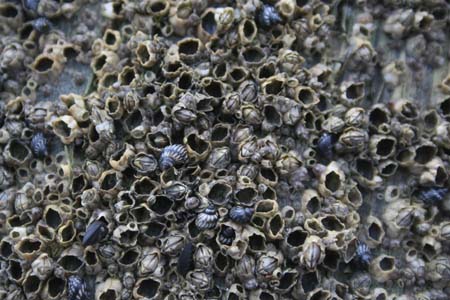
In keeping with the Under the Pier book posts this week, some shots of “pier piling residents.” The first one shows baby snails nestled amidst the barnacles:

img_1767.jpg

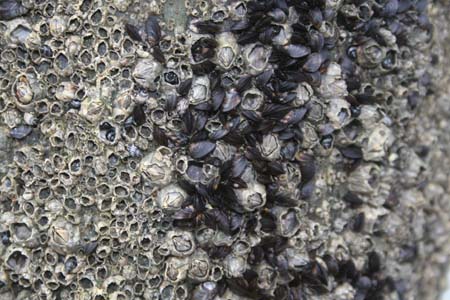
This next one shows primarily barnacles, with a ridge of baby blue mussels:

img_1762.jpg

The Post – New Fiddler Babies

March 29, 2008

I was amazed to see babies born before Monday. Monday was 2 weeks to the best of my knowledge. So she delivered a couple of days earlier than I expected.

Anyway, yesterday started with me doing a 30% water change as nitrite levels in the tank since Scarlett has been in there, have been hovering between 0.5 – 1.0 ppm. I kept the water filter running to give the water the best chance of staying nitrite free and letting the nitrogen cycle mature.

This evening though, I noticed that Scarlett was very agitated. She kept running back and forth in the tank, climbing up onto the air bubbler and waving her claws in front of her as if trying to spread something in the water. There did not appear to be anything in front of her though. I noticed that the center of the egg mass seemed to be swelling. Given that, I went ahead and shut off the water filter.

For the next hour or two, Scarlett O’Hara kept moving around, seeming very uncomfortable. Around 8:30 p.m. I looked over at the tank and noticed she was sitting quietly in the front of the tank eating. She seemed “slimmer.” Looking closer, I realized, she no longer had the egg mass. So I missed the delivery again. However, a quick look around the tank and I could seen thousands of tiny little dots swimming around.

I fed them a small amount of Small Fry and ZooPlex. I wondered if this will go okay since I couldn’t get the nitrites to zero before they were born.

This morning I got up and looked at the tank. It was a white cloud. I thought, “Oh God, the water quality got worse with all the babies in there and the nitrites are probably through the roof.” I looked at the ammonia monitor and it is in the safe zone. I shined a light into the white murk and could see thousands of babies swimming around. So they’re still alive and ?healthy.

Wondering why the tank is so cloudy, I decided to recheck water parameters:

pH 8.0 – good; alkalinity 300, hardness >300, chlorine 0 – all great results, AND the REAL KICKER OF ALL: NITRITES AND NITRATES ZERO!!!! Puzzled, I repeated the nitrites test using a tube test instead of the dipstick. Again – nitrites are ZERO!!

So water quality is actually BETTER??? I looked in the tank and saw all the babies flitting around and MANY on the calcium sand at the bottom. That’s when the light bulb went off in my head. The water cloudiness is “white” like the bottom sand….could it be cloudy because thousands of little tiny guys are bouncing around against the sand at the bottom, eating whatever’s in it (since it’s ground up from live coral…possibly some microscopic food bits there?), and eating it for calcium for their molting?

If they were out in the ocean they’d have “bottom stuff” to dig around in so maybe this is a good thing? Though it certainly makes it harder to see them. For whatever reason, baby fiddlers seem to like to “head for the bottom” – at least some of them. That happened last time with many burrowing into the gravel and dying. So I will see how this calcium sand thing goes. I am PLEASED though that the water quality is so good.

For today – I need to go feed them again and I will need to start raising the salinity to ocean level. If that IS what should happen, they should survive. If not, well, we’ll find out. One step at a time.

The Gift – Fiddler Extra!!! We’re Grandparents Again!

March 28, 2008

Just a quick post tonight to announce the birth of another 100000 fiddler babies!!!

Mother is doing well and is back in her regular tank. Babies are swimming around like crazy and have been fed some liquid Small Fry food and a few drops of Kent Marine ZooPlex. I’ll give a more full report in the morning.

The Gift – A Weekend Extra

March 28, 2008

This being the weekend, no doubt some will have social occasions to attend. For sure you’ll want something interesting or witty to say. Given that, here’s a start to your “party contributions.” It should make you the hit of the party:

1797 (March 28) Nathaniel Briggs of New Hampshire patented a washing machine

From “On This Day – Today’s Highlights in History” by the New York Times On The Web Learning Network