“She would of been a good woman,” The Misfit said, “if it had been somebody there to shoot her every minute of her life.”
Flannery O’Connor, story, “A Good Man is Hard to Find”
He woulda been a good man if…
It was that same book I was given by one of my elementary school nuns from her college English course. The one that opened my mind to the wide new world of literature. The one I drank up like it was water, and I was dying of thirst.
There was that one story in the book, though, by Flannery O’Connor, called “A Good Man is Hard to Find.” I was both repelled by it because of its violence and unwillingly, but powerfully drawn to it. I could never let it go. All my life, it gnawed at me, but I never knew why.
It was about a family that took a wrong turn on a vacation trip, all because the manipulative grandmother badgered them to go find some old house she wanted to visit. So, to placate her, they made a detour, turned down a rutted dirt road, and ended up in an accident. At the same time, they crossed paths with a killer named The Misfit, who was on the run. Because the grandmother recognized him and announced it, the entire family would end up dead, shot, one by one. The grandmother would be the last one to be killed.
But the crux of O’Connor’s story was about that last moment right before The Misfit shot her. It was in that last second before the bullet tore into her that she finally had a spiritual awakening.
After he killed her, the Misfit observed that “She would have been a good woman, if it had been somebody there to shoot her every minute of her life.” The comment resonated with me for years, even as I didn’t know why.
But I finally understand. She was Dad. He was manipulative, self-absorbed, and thought he was better than everyone else. Smarter. More clever. Just like the grandmother in the story. And the only time he would act differently was if he felt the power balance had shifted against him in an encounter. Then, instead of bullying and being abusive, he would be kind, magnanimous, charming, even. He would behave.
While I don’t think he ever had a change of heart or spiritual awakening, I realized that he “could a been a good man if it had been somebody there to threaten him with jail every minute of his life.”
A purpose, re-examined

On my forearm, I have a tattoo that clearly states my purpose in life — Tikkun olam — the Jewish directive to “Heal the world.” When I taught science at the museum, my purpose was less about teaching science and more about reaching kids who might be hurting. I did all I could to reach them, inspire them, and heal them.
I am writing this book, these entries, for the same reason. I start by healing myself and making myself whole again, but I also share the story to help anyone else heal.
The struggle here is to tell the story, with deep emotional truth, while protecting the privacy of others. At the same time, I have to tell the story as it happened, and as fairly as I can. This is not about making me the hero.
Cycles of “If only”…
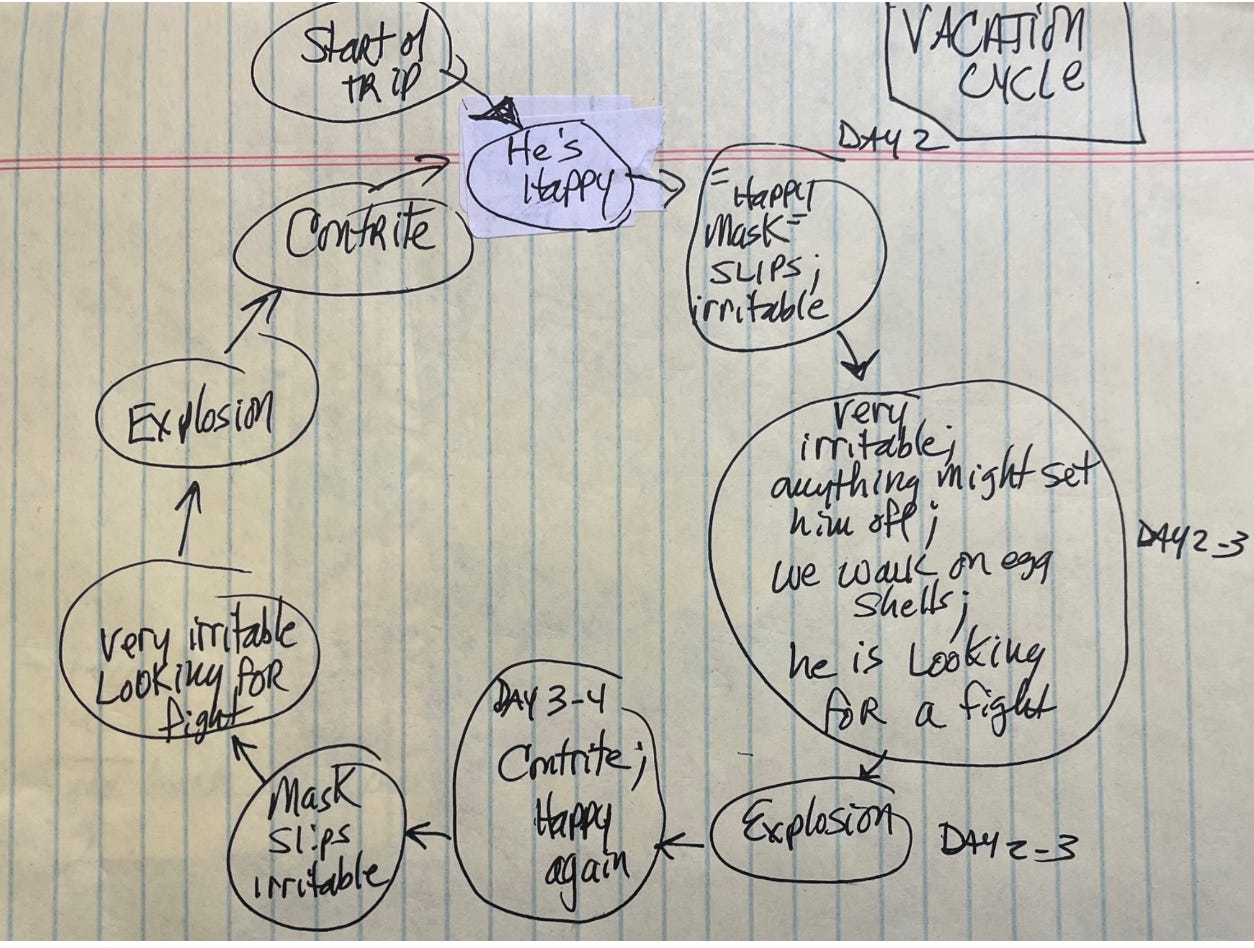
Dad’s behaviors, when I look back, show up as an unchanging pattern of cycles. For example, whenever we went on vacation, the first day was wonderful. He was happy, relaxed, and we were excited. But within the next 24-48 hours, that mood would slip, his irritability would rise, we would walk on eggshells more and more, until the inevitable explosion would take place. Then he would be contrite, calm, and happy, and the rest of the cycle would start again.
In the same way as vacations, there was another cycle operating, though I didn’t realize it then. And it was going to play out again and again in a series of confrontations over the next several years.
My goal in confronting him was not to destroy our family, but to save it. I loved my family. Despite all the harm he had done to me, he had also done good things, and I still loved him. By challenging him and trying to open up the silences, I hoped to protect and preserve our family.
Silence had been one of his powerful tools. The rule of the family. In our house, our family system, it was made very clear from a young age that life was meant to be hidden. Secret. Back then, I didn’t realize what was operating or how much harm that silence enabled and protected. But once I got out of the house and began to understand what he was and the harmful things he did, I could no longer remain silent.
“When something exists in a family that is not discussed, it goes into what Carl Jung termed ‘the shadow,’ the unacknowledged aspects of the self…the shadow is called the ‘elephant in the living room.’ Everyone knows that something is wrong, but no one speaks it. Everyone accommodates the presence of what is unspoken and verbally talks around that territory, avoiding it as though there really is an elephant in the living room. Everyone knows better than to cut directly from point A to B because he or she would bump into a huge obstacle. That obstacle is silence; that obstacle is fear; that obstacle is facing the unknown.”
Christina Baldwin, Storycatcher: Making Sense of Our Lives through the Power and Practice of Story, pg 148
My thinking at that time was that if only I could figure out the right things to say or do, I might make him understand. If only he would get help, he could realize how much better our family could be. If only he could see the harm his actions caused and how they needed to change, there was hope for a better life. If only our family bonds, the things that were good, could be preserved. If only. If only. If only.
I didn’t understand then, you cannot make someone change when they don’t want to. There were no “right things to say or do” on my part. And it didn’t matter how many “good things” he did, that didn’t change what he was or what he might be capable of in the future.
So, like vacations, so began a cycle of confrontations over the next several years.
1984 + 1988 – The preceding confrontations
I’ve already written about two times that I challenged him to get help. The first one was in 1984, shortly after I began therapy. The second time was in 1988 when I was pregnant.
The 1984 effort was a failure as he either outright refused or paid it lip service by visiting a counselor once. Then he moved to Texas and refused any help from my therapist to find a new provider for him in Texas.
In 1988, when I confronted him during my pregnancy, he said he would get help. In looking back, I realize he never did apologize. But my therapist gave him phone numbers for other psychologists he could contact, which my father accepted.
At that point, I severed contact with him because I was too busy with my infant son. Whether he used those contacts, I don’t know. I doubt it. In those years, he wasn’t required to prove anything to any authority.
I saw my mother after our son was born, but I did not see my father again until early 1990. By then, our son was over a year old. It was a tentative visit, mostly to see my mother. But also, I truly hoped that maybe there would be a change…a chance for rebuilding our relationship.
It was difficult to know what to do with him, or what to think. He had seemed sorry. Contrite. Kinder. Changed. He didn’t offer any further information, and again, I was so busy with our son, I did not pursue it.
I will note that it is very hard when you have been both abused by someone, and also given the only real “love” and attention in your childhood, by that same person. Yes, he did bad things, but he also did good things. He is your father, and there is still love. And that family loyalty that was drilled in for my entire early life.
In looking back, I can only say it was so confusing. There was no clear guidance on what to make of him. I really wanted things to just “get better” and heal. I’d second-guess myself all the time. Was he a bad person, or just so misguided he thought what he’d done to me was actually some kind of love? Yet, I remembered that Nova Scotia trip years ago, when he admitted he knew he’d abused me.
But lately, he seemed to have changed. I wrestled with doubts. Was it possible he was sorry? COULD he change? Would it be okay because he was older now?
Yes, there was that cluelessness about sexuality in older people. At the time, I thought, well, he’s in his early sixties. Of COURSE he’s no longer interested in sex…right? He was too old. Yes. Clueless.
So it was just such a confusing mess. And again, there was so little known or talked about back then about sexual abuse. I just took it one day at a time.
1993 – The third one
Somewhere in that same period, we moved to North Carolina and were very busy with all the issues and responsibilities I’ve already talked about. Meanwhile, Dad had retired, and so my parents would periodically visit different family members, and there also would be family get-togethers.
Whenever they came down our way, they seemed to be on their best behavior. No angry “second-day-of-vacation” Dad, or any whiff of inappropriate behaviors.
It is that most difficult quandary that the therapist would explain to me, that when an abuser shows both love and abuse, it is the hardest kind of situation to navigate. He said it would be easy if Dad had been all bad, because then you could just walk away with no issue. But when there is goodness and love, mixed in with the abuse, it is the hardest situation. If you fight them, you look unreasonable when they are kind. And you can never be sure which person is showing up or how to react.
I was trying to maintain a connection with my family. For a few years after I first got out of that house, I had shut everyone out completely. But as time went on, I realized that wasn’t the answer. Total avoidance, as if they were all dead, didn’t work. I loved them. While I had no desire to be reeled back into enmeshment, I was trying to find some kind of “middle ground relationship” rules.
We were also trying to give our son some semblance of extended family experiences. There was no chance of that on my husband’s side. He had no siblings or extended family. His parents were older and sickly. If there were to be any extended family connections, it would be with my family.
It was hard, for sure. Our son really liked those visits and loved seeing everyone in the family. And he thought my father, especially, was a lot of fun. I had to balance being constantly on guard with letting him enjoy his grandparents.
The visits were mostly family group get-togethers, and we always stayed at a hotel. It was the best we could do to achieve some kind of “normal,” while protecting. But it drained me. A neighbor of mine at that time observed, after we returned from one of our family gatherings, that I always came home from those trips absolutely exhausted.
As our son started to get older, I would give small amounts of information, a bit at a time, as age-appropriate. Instructions on how his body was his own and what others weren’t allowed to do to him. I’d also explain that Grandpa could be nice, but he had also been abusive and hit us when we were kids. And, of course, we never sent our son for any stay-over visits with his grandparents.
But it was hard. Especially the time our son pointed out to me that he understood that I had one set of feelings about my father, but that he had his own relationship with him, and our son wanted that relationship. On the one hand, it meant Ed and I were succeeding in giving our son that extended family experience he craved. But it made it that much harder to make sure no lines were crossed.
For a few years, things seemed okay. The dad of the past seemed to be absent. He was calmer. Gentler. I wondered if maybe retirement removed some life stressors that had driven his abusive behaviors? Had he gained some wisdom as he got older? I hoped so.
Then a communication with a sibling trashed that assumption. While he was on his best behavior around me, he might not have been so with the others in the family. He was apparently trying to spend time alone with one or another of the kids. Offering to do clothes changes. Offering things that on the surface might be innocent enough, unless you consider that he was a lifelong child abuser. And some of the kids in the family, my son included, were now around the same age that I was when Dad molested me in the car as a toddler. No small trigger point for me.
Also, about that same time, I learned that he had not been to a counselor like he said he would. He brushed it off by saying that he and my mother had gone to see a priest. Who knows if that was even true? And even if they did, to my mind, that was a useless substitute for treatment by a mental health professional for deeply ingrained abusive behavior.
It hit me full force that here was the man who sexually abused me for decades and who had not done any therapy. Given no help, why would he be any different now? He still had to be a risk.
I reacted very strongly. Afraid that I might be overlooking a real problem, I consulted our therapist. His description of my father was chilling:
“…personality disorder…antisocial behavior. Conscience and empathy were absent, or present only in small and inconsistent amounts. Even though he could be kind and caring at times, he had no ability to sustain those emotions.”
That terrified me…and it also made sense. It was why he could start out on our vacations all happy and nice, but by the second or third day, he was back to “miserable Dad,” and there would be fights. He could never sustain good behavior. And in like manner, he never got help for his abusive behaviors. So while he had been acting as the “good, changed” Dad, was it even true? Could he sustain healthy behaviors?
My siblings and I all agreed this needed to be dealt with. So I confronted him, yet again, this time in a letter. I told him clearly that he had failed to honor his word to get help. That meant he was a risk to any kids in the family. Given his failure, I told him that if he touched any of the kids in the family, I would make sure he was prosecuted and sent to jail.
Frankly, I was shaking as I did that. I didn’t even know if I had the strength to go through with that threat. I was still a work in progress myself and fragile. It hadn’t been THAT long since I got out of the system.
My own emotional power was shaky, and my self-esteem was low. Every confrontation with him, with his family system of rules, terrified me and triggered fear, anxiety attacks, and nightmares. He still could make me question my very reality. I’d second-guess my perceptions and feel guilty that I was reading things wrong and creating unnecessary discord in the family.
Also, while we all agreed he needed to be “controlled,” that unity was shaky at best. I’d get comments such as, “You need to get over this,” or “Stop living in the past.”
I’d sit there, totally confused. Was I reading this all wrong? If everyone else felt it wasn’t a problem, and that “those problems” were all in the past, were they right that I was just hanging onto my own issues from the past? Or was everyone just ignoring the elephant in the room, hoping that if nobody talked about it, it would just go away?
I so wanted to let things go. I just wanted peace in the family. But I kept coming back to two things: I knew what he was. I had experienced, firsthand, just how manipulative he could be and how much damage he did. And…there were young kids now. Even if I was overreacting, I’d rather that than risk trusting him.
Sometimes, you walk the path you feel is right, even if you walk it alone. It was just that if you add in all of those issues on top of our marital therapy, jobs, Ed’s parents’ illnesses, and our son’s needs, it was such an overwhelming time.
The family system reactions
In all fairness to everyone involved, each was doing the best they could.
Jen Cross, in her book Writing Ourselves Whole, noted that “…sexual abuse doesn’t just happen to individuals…but to families and communities.”
While I’d been my father’s “sexual target” all those years, the energy in the household touched everyone. Each was a victim in different ways. And each had to deal with that trauma and damage in their own way. The reactions to one person speaking up, or another remaining calm, silent, or enraged, can vary widely. So there are no villains here, except my father.
1993 – There will be no more silence on this
Meanwhile, Dad was apparently scared enough by my letter that he made a trip down to North Carolina to discuss my “concerns.” I requested he stay at a hotel. My mother was put out about that because they were retired and had to watch their money. This, despite the fact that they had just bought an RV and were traveling around the country, including to Alaska. But whatever.
I confronted him about the fact that he was trying to get close to kids and be alone with them, things he, as a sexual abuser, had no business doing. I blasted him for not keeping his word about getting help. And I made it clear that a priest didn’t count. As far as I was concerned, he lied. He betrayed. And as usual, there was just silence and secrets.
He apologized for the silence on the subject and said that he was now working with a woman therapist. She had given him a book to read. He promised to speak openly about this to all of us in the family and said he would keep me updated on progress. Before he left, he promised, “There will be no more silence on this.”
And that was the last he ever said about it.
Reflecting on things more recently, I’ve wondered: Had he even gone to a therapist? Or if he did, had he been honest with her? What was this book she gave to him, and did she think a book was enough to unravel the deep-seated problems of a 60+-year-old man who was a lifelong wife abuser and child molester?
But at the time, I took him at his word…even more guarded, but still hoping…
Words from the Universe
Even as I struggled to stand up to him, there seemed to be help “from beyond.” I can look back and feel there were times the Universe sent messages not to give up. I’d come across some powerful quote, a line from a book or movie, or a song lyric, that seemed to be talking directly to me.
One time, it was Madonna’s song, “Live to Tell.” To this day, that song just strikes a raw nerve in me. Its haunting lyrics just screamed out about men’s lies, secrets, and who would tell the truth.
Another time, it was a quote in an article:
“Be the woman you needed as a girl.”
(Attribution: Often attributed to various motivational writers, bloggers, and influencers, including blogger Caprice Kwai and [lifestyle writer Jayne Moore](https://www.jaynemoorenyc.com/blogs/news/be-the-woman-you-needed-as-a-girl). )
There was even Dad’s programming in me, speaking from my childhood. He drilled in things like: “You’re the oldest. You know better. You’re responsible for them.”
So, I “stood guard,” always watching and listening for any of those “familiar signals” that might indicate kids were at risk. And no matter how afraid I was of him or of a confrontation with him, if I saw something “odd,” I was going to challenge him. If his “feelings got hurt,” well, he lost the right to be given the “benefit of the doubt” a long time ago.
At that point in my life, even if I was struggling to build emotional strength, I was physically strong. I was in my prime, and that was the one quality I could always count on. If I needed to confront him, I’d harness that part of me that was the fierce, male energy. Then, afterward, I would collapse and have to rebuild myself again. But at least I could always draw on that physical power. It was my battle armor, just like Maureen Murdock wrote about in her book, *The Heroine’s Journey*:
“Our heroine puts on her armor, picks up her sword, chooses her swiftest steed, and goes into battle.”
Murdock, pg 6-7,
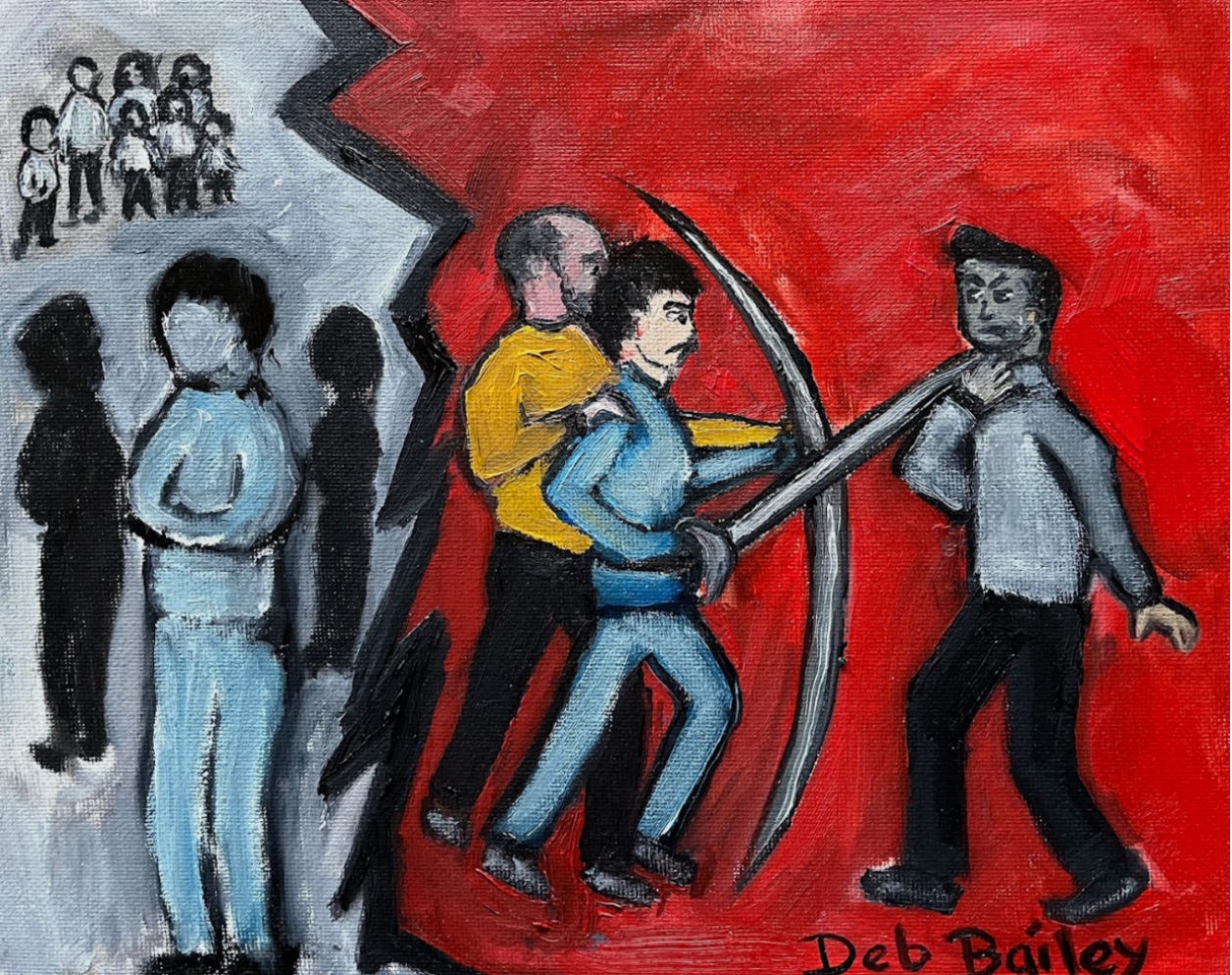
It’s just that underneath that armor, I was still quaking jelly inside. And my biggest fear was, “What happens if I am no longer strong?” What if my fears got the better of me? But so far, I’d been able to keep fighting him. I stayed focused on the kids, “put on my armor,” and pushed my fears to the background at the moment of battle.
My hope was to convince him that he was no longer the only power base in the family. There was a lyric in the song by the Police, “Wrapped Around Your Finger,” that I strived for — that moment when the manipulator turns white because he realizes the tables are turned, and he’s no longer in control.
So every time one of these stray messages floated into my consciousness, I absorbed them like food into a starving person. They were my gifts from God.
All through the 1990s until the early 2000s, I would remain “on guard.” Only then, with kids growing older, and Dad’s health and cognition starting to fail, did I dare start to stand down.
But before that time would come, there would be one more confrontation, the largest of all, in 1995.
Tags: family, life, love, mental-health, writing
 Soul Mosaic
Leave a comment