Some emotional “aftershocks” from that trip…
After the trip, I still wasn’t able to start “sorting and assessing” right away, because the flood of “things boiling to the surface” continued for a while. All I could do was let it come. Write it down. And when it started to settle, figure out what to do next. Those reverberations held some clues:
Journal entry: Sun, Oct 1, 2017:
- Feelings of anger, rage, not going to put up with anybody’s sh-t
- When a drawer knob catches my shirt and pulls at me, or I bump into something – I rage
- When anyone treats me like they think I’m stupid or they are pulling something over on me, I rage
Journal entry: Mon, Oct 23, 2017:
- I DID compartmentalize (back in that house and life). I dissociated. I had no voice.
- Now, I HAVE a voice.
- *I DON’T want to be silenced or stay in a closet any more, because of anyone not liking what I have to say
- I don’t like compartmentalizing anymore – I spent sooo much time dissociated.
- My work now is to reintegrate all and be whole.
- And the “Me Too” things …doesn’t answer for me, “So what is next?”
Journal entry: Sun, Nov 12, 2017:
- Ed asked me what my earliest childhood memory was that was not of the abuse.
- My earliest memory WAS the abuse.
- I can’t remember a “before time.” There never was a “before time.”
Journal entry: Mon, Nov 13, 2017
- Where am I now? I am ALREADY TRIGGERING my PTSD, just writing these things
- What do I expect to come out of writing this book?
- Change. Though I don’t know what form it will take.
- I’m optimistic it will be a good outcome.
- *But my guess is it will be something I won’t be expecting. That kind of change is never what you think
- *The purpose is not getting to the end of the book, its outcome, or money. It’s the process that I will experience through the writing and the changes that will come from that.
- *I have to pace it.
- If I rush and don’t touch emotions, I’ll be “okay,” but the experience won’t be worth anything.
- If I bull through and hit too many emotions too fast, that is emotionally DANGEROUS for me.
- Need a “middle path” approach
- I must learn to let it take as long as it will – and it WILL take longer than I want
Stopping the runaway freight train
Working with my therapist after my return, we focused on slowing down the abundance of emotions and thoughts coming up. They were all to the good, and I’d write them down as I knew they would have value….at some point. But we needed to slow things down enough to take stock of what I’d experienced.
Experiences are useless without reflection and then, some way to organize them and see the insights and patterns they hold. I’ll talk about reflection in a minute. But first, order.
For me, putting things down in some kind of step-by-step order as a flow chart helps: Something happens, then it leads to this, then this, then that, and then, somewhere in there, a reaction or insight pops up. That is my way of creating order. It doesn’t matter if I start in the perfect place, just so I start with something. It’s that whole concept of “pick a spot, drive a stake in the ground, then work from there.”
So I did a mind map first of just the main experiences I had on the trip – the orange paper on the right in the picture. Once I had a starting place, then I could move to the next part – what were any thoughts I had in those experiences, which was the page to the left. Then, I collected what my feelings were over the next couple of weeks after the trip – the top page colored in pink and green.
This let me see in an orderly flow: “What happened? What did I feel about it right away? And last, what did I feel a bit later after I’d had time to chew on things a while?”
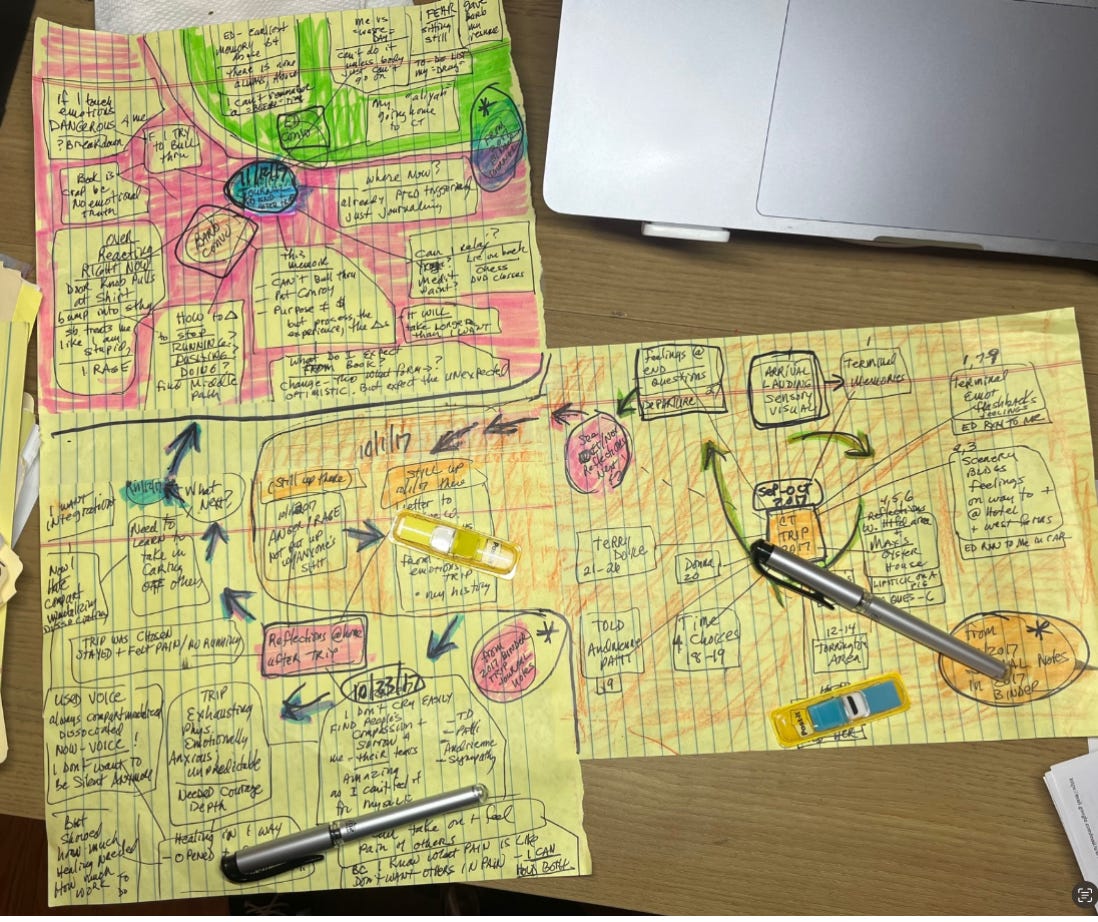
By doing that, I came to the end of the map with the final, bottom-line question:
WHAT NEXT?
After all, I didn’t do the trip just to do the trip. What was I supposed TO DO with all of those experiences that would move the healing and the writing forward?
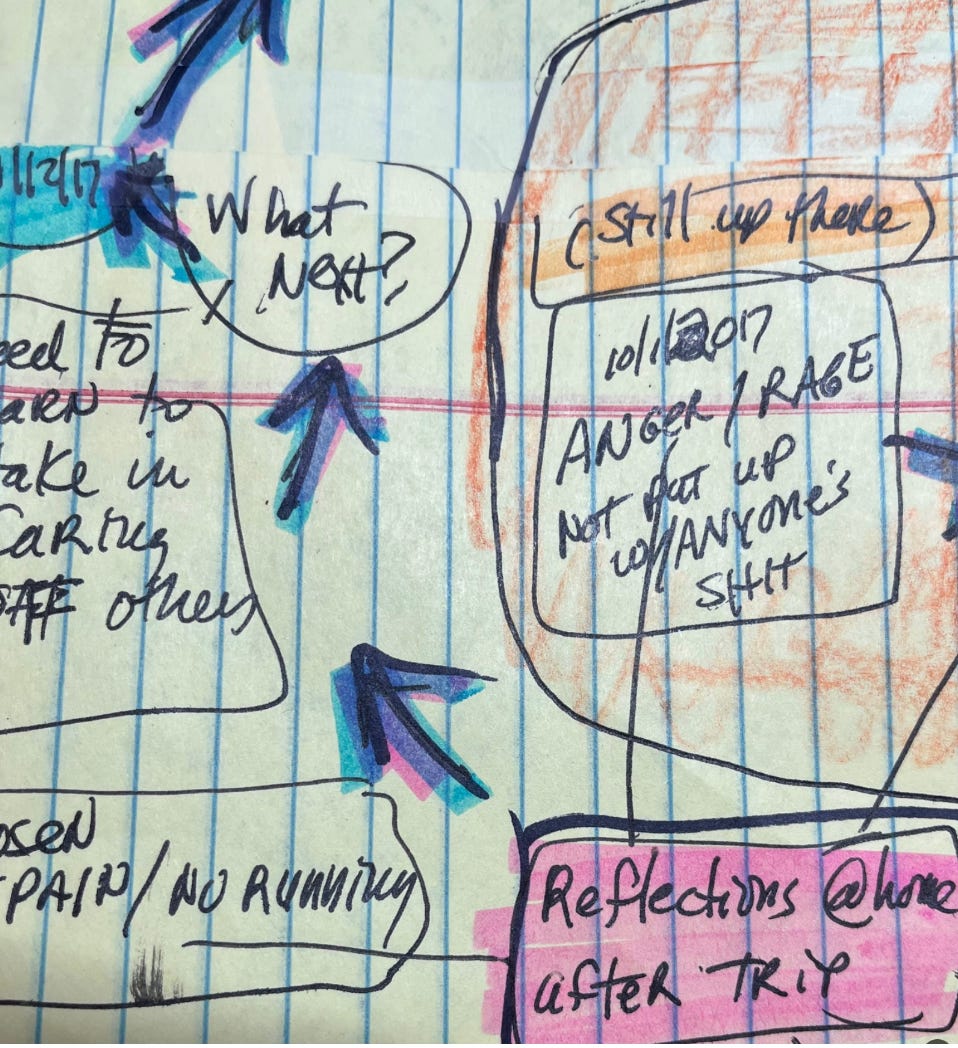
Something about just seeing it all laid out in one big sheet in front of me then helped me start to formulate a plan for how to slowly and sanely examine each of my experiences.
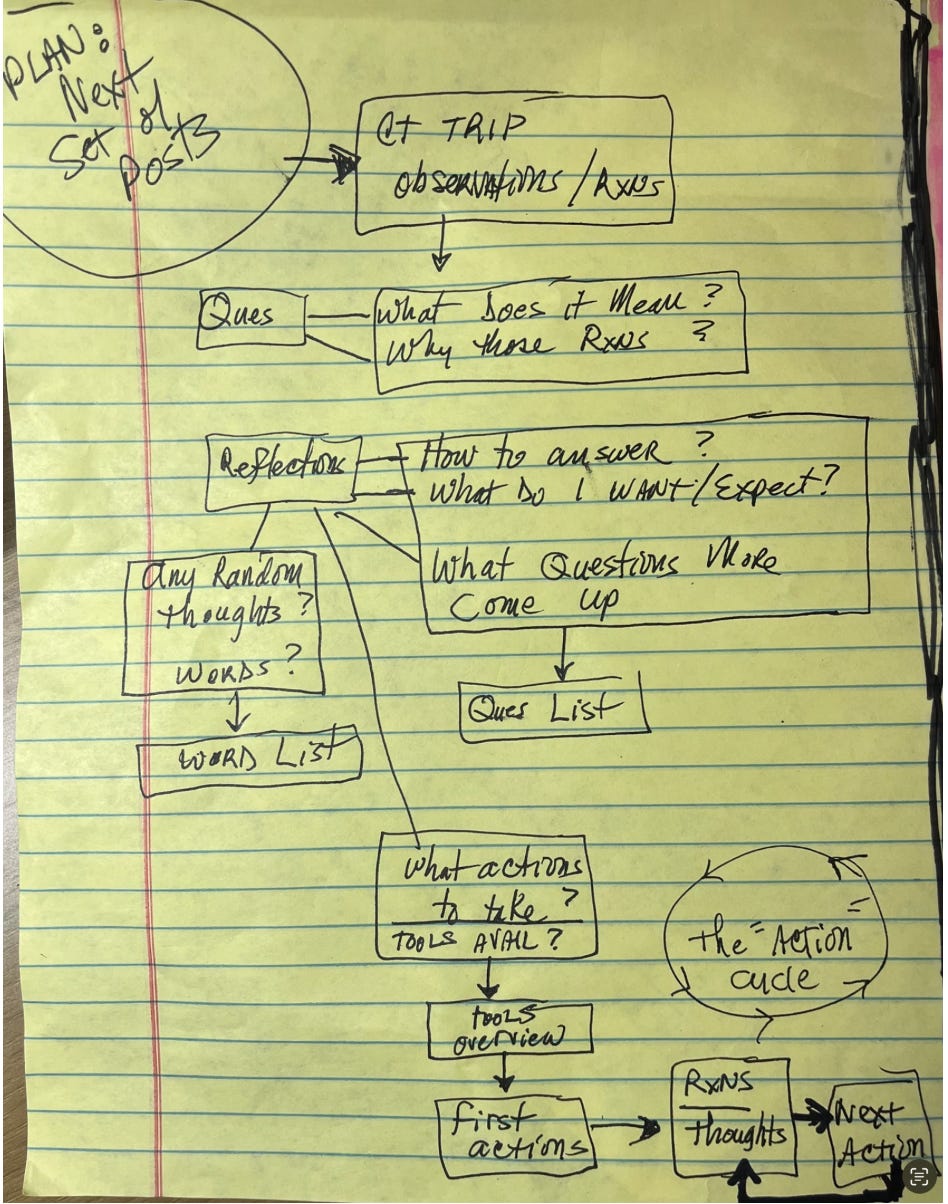
Two phases I’ll point out: The Questions and Reflection Phase, and the Action Cycle down at the bottom.
The Questions and Reflection phase is the “Where-do-I-put-this-and-what-might-it-tell-me?” part. Lots of questions. Some answers. More questions and pondering. It is essentially the quiet part – THINKING.
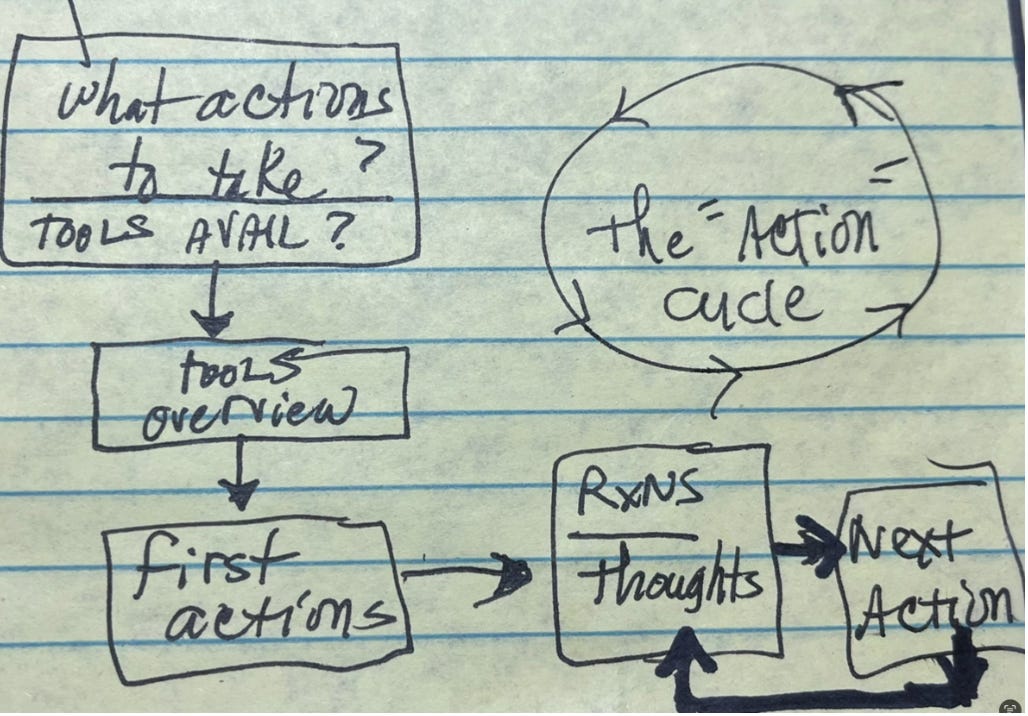
The Action Cycle was where I hoped to get “products” – answers, insights, or more questions to cycle around again to think about before moving on.
It’s like in biochemistry class, we had to learn about various cycles that repeat in the body or in nature – the carbon cycle, the nitrogen cycle, the Krebs cycle, and so on. Those natural cycles take chemicals from one set of biological processes and turn them into something else that’s needed. The cycles are like miniature living factories. Their whole point is to take one set of chemicals and keep turning them into the vital things needed for the body or plant to go on living and growing. And as those things get used up and turned into waste, they go back into that cycle to start all over again.
In the case of my journal notes, I would take all the information, ask my questions, and reflect on possibilities, then act – was there a lesson I could learn, or an action I could take to improve things?
About that reflection part
Psychiatrist Dr Paul Conti who has worked to help many patients, including those suffering with trauma, notes that we need to observe and reflect on things in order to make a change in our life.
Yet he also observed that we are often so busy just trying to keep up with life that we have no time to observe or reflect. And even when we make the time commitment, self-reflection is hard. It’s asking yourself questions…lots of them, and hard ones, then pondering what comes up. Over and over again. As you do that, themes and topics will become clearer.
Author Christina Baldwin wrote that “Reflection is the first step in making sense….Reflection helps establish a sense of mental order. Order is a relief….” (from Storycatcher: Making Sense of Our Lives through the Power and Practice of Story)
Self-reflection is all about gaining knowledge and understanding.
“Knowledge of the self is the mother of all knowledge.” Kahlil Gibran
From my trip to Connecticut, it was clear there were a lot of questions. And rage. There was the desire to never be silenced again. And there was a determination to bring about some kind of change in my life, even if I didn’t know what or how yet.
What I needed when I got home, once I stemmed the flood of reactions still coming up in me, was to take some time to THINK, INTERROGATE MYSELF – self-reflection. It’s a place where you push the “pause” button and stop to really look at things. What motives might a person have for acting or reacting a certain way? WHY did something go the way it did? Are there faulty attitudes and beliefs? What are my weaknesses or habits that don’t serve me well?
It’s not a fun process. You question yourself as hard or more than you would question the things around you. Honestly. Not evading. Not blaming. But just putting it all out on the table and seeing things for what they are. Owning it all. And not just what you thought or did, but even more importantly: How did your actions and thoughts affect another – what havoc might you have caused?
While I was a victim of many kinds of abuse, I didn’t understand that as a child. Which means that I was unaware if I acted in a mean way. I was trained to think that physical or verbal intimidation was okay to use.
I remember one time verbally bullying a girl on the playground until she cried. She had been harassing one of my siblings — constantly picking her up, hugging her because she thought my sibling was so cute. But all of this was unwanted by my sister. So I “took care of things,” as I had been taught in my family. Yes, I was a kid and didn’t know any better. But I remember being first surprised, then sad, when I made the girl cry.
That’s a simple example, but for sure I have many more over my life. Times I might have meant well. Or times I acted out of my own neediness so that my actions overstepped boundaries.
I know in my friendships with women, for so many years, I did not realize that I was actually seeking a mother or sister figure, and the unconditional love I didn’t get from them. To operate that way puts a tremendous pressure on a friendship, is unhealthy, and creates expectations that can never be met. It took years of therapy to fully recognize I was operating from a deep wound of “Mother hunger.” It was only then that I could finally start to change how I dealt with friends, learn about boundaries, and start to mother myself in a healthy way.
This is not to say you beat yourself up for doing things wrong. At any point in time, I was doing my very best with what I knew. I just didn’t know any better. Until I got tired of cycles of friendships not working out, and I started looking deeply at what was going on. And asking “Why?”
Again, this is a simplification. Because not all the issues were mine. There were things operating in the people I chose for friends that were also wreaking havoc on the relationship. Again, I didn’t know any better then. It was only as I slowly grew and learned that I started making better choices in friends and having healthier relationships. I’ll come back to friendships and the many emotions I had to work through in upcoming posts.
For now, simply said — Self-reflection. Not fun. But absolutely critical. You ask better questions that way. And I read somewhere that it wasn’t just about asking questions, but the RIGHT questions. Sometimes, the questions were more important than the answers.
So, what next?
Decision time: It was time to go back to that process I’d reacted to so badly in 2009 – EMDR…Eye Movement Desensitization and Reprocessing. Yes, back then, our EMDR work had triggered my anxiety, depression, and overall PTSD in a HUGE way and not in a good way. But it was eight years and a lot more learning since then.
I felt like I was at a standstill without taking a bigger step. Just as I was called to go to Connecticut, I was being called to step forward and try EMDR again. Maybe it wouldn’t make a difference. But maybe, it could make ALL the difference.
The toolbox recap
Before I start relating my experiences with our EMDR sessions, as well as what I was learning in my ongoing therapy sessions, I’ll take a moment in the next post to recap all the various tools my therapist and I put in our “toolbox” for our upcoming intensive work.
Note:
I am seeking financial support to complete my memoir, work with an editor, and return home for fact-checking. Your help would mean the world to me as I take this step toward healing and giving voice to my journey.
Please like, comment, and share this post to help spread the word. The link for my fundraiser is on GoFundMe. Thank you for your support.

 Soul Mosaic
Leave a comment