The overloaded cannon
When we started planning for the upcoming EMDR session, I had no idea what to expect this time. Would it trigger another panic reaction like in 2009? Would it fix ANYTHING? I only knew I wanted to try because my psyche was demanding it.
For sure, I wasn’t even thinking about whether this would need multiple sessions. I wasn’t trying for any specific goal other than some relief. The pressure on my chest and the choking sensation in my throat were immense. And I so wanted to cry. But I couldn’t.
It was an understatement to say that with all the rage, fear, and pain building up, I felt like a loaded cannon. In fact, the better description was that I was a cannon barrel that had been OVERloaded with SEVERAL shells rammed tightly against a triple charge of gunpowder…and that lit fuse was dwindling closer to the gunpowder by the second.
No small challenge
In our final preparation meetings, we went over my rage and emotions again and again, trying to narrow down the list of issues and memories to one main event. As my therapist explained, EMDR can work better if we clearly define one issue, along with a specific associated memory or event, and the statements I held about that episode — Things like: What did I currently believe and feel about that event…and about me? And what would I prefer to believe in the future?
She explained our approach and why we would handle things that way. In cases where the trauma was a single, more recent event, improvement might come fairly quickly. On the other hand, with complex trauma like mine, it would take more work and time.
First, there were so many trauma events to choose from that we had to narrow our focus to avoid trying to do too much in one session. I had a mountain of trauma to tackle. We weren’t going to attack the mountain full-on in one session. Instead, it would be more of a slow, chipping away of one “rock” at a time. So we would select one clear, strong memory for our first target.
Also, we needed to be patient in this. My abuse was deeply entrenched and reinforced over decades. She explained that factors like duration, frequency, and intensity, as well as whether it was new or old trauma, all affected how this would go.
For sure, this would be a challenge — both for her guiding me, and for me doing the work. I had been abused for twenty-eight years, so it was long-duration. It happened frequently – often multiple times a week. The emotional intensity of those events was often off-the-charts because of the associated terror from his rage.
And finally, it was all old trauma as opposed to a recent event, so there had been a lot of time for the trauma to cement itself in my nervous system and wreak havoc there. Messages such as “I am powerless. I am unloved. I am unsafe,” were deeply embedded for decades. So our best shot in this was focused, detailed preparation, and a slow approach, dealing with one message or event at a time.
Since we had already decided my main target for this first session was that white-hot rage at my father, we discussed what would be the one or two most powerful and emotion-laden memories to employ. From my journal pages, I went over the possibilities with my therapist, as I wasn’t sure exactly what she was looking for:
7/31/2018
DAD:
- RAGE at DAD – overwhelming sense of HOW COULD YOU DO THIS?
- DO YOU KNOW WHAT YOU TOOK AWAY?!!!!!
- I lost my entire youth;
- I had to rebuild me
- You made it messy. It didn’t have to be messy
- You always loved pretending to be the macho military man
- You were a coward. A bully. You pretended you stood for something when all you did was take from a small child.
WHAT MEMORY/IMAGE TO CHOOSE?
- Whenever he and I were alone in the car when I was 11-14
- He would look at me with that eager and lurid expression and ask: “Do you have hot pants?” – To this day, that phrase fills me with revulsion, disgust, and anger
- Sundays all through childhood:
- When I avoided his attempts to molest me, he would come into my room, yell at me, terrorize me, and dump out the closet and my bureaus, then make me stop my homework and put everything away.
- “The look” of pure hate on his face during those moments, and then later, his “silent treatment.” Aside from that hateful look, he wouldn’t talk to me, acknowledge me, or even look at me. I was filled with intense pain, fear, desperation, need for love, attention of some kind, one drop of kindness, and panic – what would I do if he totally shut me out? I was a kid.
- And after he left my room, my mother wouldn’t look at me or check on me. She was a turned back. And I was totally abandoned and alone…until he came back in the room a bit later and started all over again. Then he would repeat the silent treatment.
- Me now, as the adult, looking back at my toddler self in those moments:
- Looking at what he did to a 3-year-old!!!! – FURY. Wishing I could throttle him…confront him NOW as a powerful adult. IN WHAT WORLD DID THAT SEEM RIGHT TO YOU?
WHAT IS UNDER THE ANGER?
- Always, there is another emotion under anger. What is it?
THE ANSWER:
- It’s about the loss. The time, the life experiences. I hurt. Feel so sad. It is grief.
- It is the same emotion that came up that day I heard the song “If” by Bread.
- That overwhelming sense of grief and pain as “What could my life have been if it hadn’t happened?”
- So it is intense pain of grief and loss.
- It chokes my throat with that sense of an unscreamed primal wail of pain.
Ultimately, the one that was the strongest and most concrete memory, and one that happened a lot, was the Sunday afternoon events. Just talking about it hit such a huge well of fear, rage, and grief, so we decided that one would be the starting point, and then we would see where things went from there.
Aside from the emotions, the inner messages I carried from it — that I had hurt him, I was bad, I was totally powerless, I had caused this — were equally intense….and wrong. So they needed to be replaced with more empowering ones.
Places of safety and control
The last area of preparation involved methods to stabilize and calm me if strong emotions came up. It was important that I remained grounded in the present moment, even while revisiting past memories, and not get overwhelmed. So we needed to have ways to reinforce my sense of safety, control, and calm. This included defining a “place of safety,” having tools to handle the emotions, and reinforcing that I was in full control of the process and could halt it at any time.
The website for a group, Cannon Psychology, describes these parts of the process well:
“The Safe Place exercise, sometimes called the Peaceful Place, is one of the most commonly used resourcing strategies in EMDR preparation. In this exercise, the therapist helps the client identify a location associated with feelings of calm, safety, or comfort. The place may be a real location, an imagined one, or a combination of elements from several memories…
Before beginning trauma reprocessing, clients must be able to maintain dual attention. This means they can access emotionally charged material while remaining oriented to the present moment. Stabilization techniques help develop this capacity by strengthening emotional regulation, increasing present moment awareness, and giving clients reliable ways to return to balance if distress increases during or between sessions….
Grounding strategies help clients reconnect with the present moment when distressing memories, emotions, or body sensations begin to intensify. Trauma responses often involve a temporary shift away from present awareness. Clients may feel pulled into intrusive memories, emotional flooding, or dissociative experiences that make it difficult to stay oriented to their current environment.”
One thing I consider myself lucky in is that I have several places in my present life that are not only safe, but anchoring, love-filled, and totally comforting.
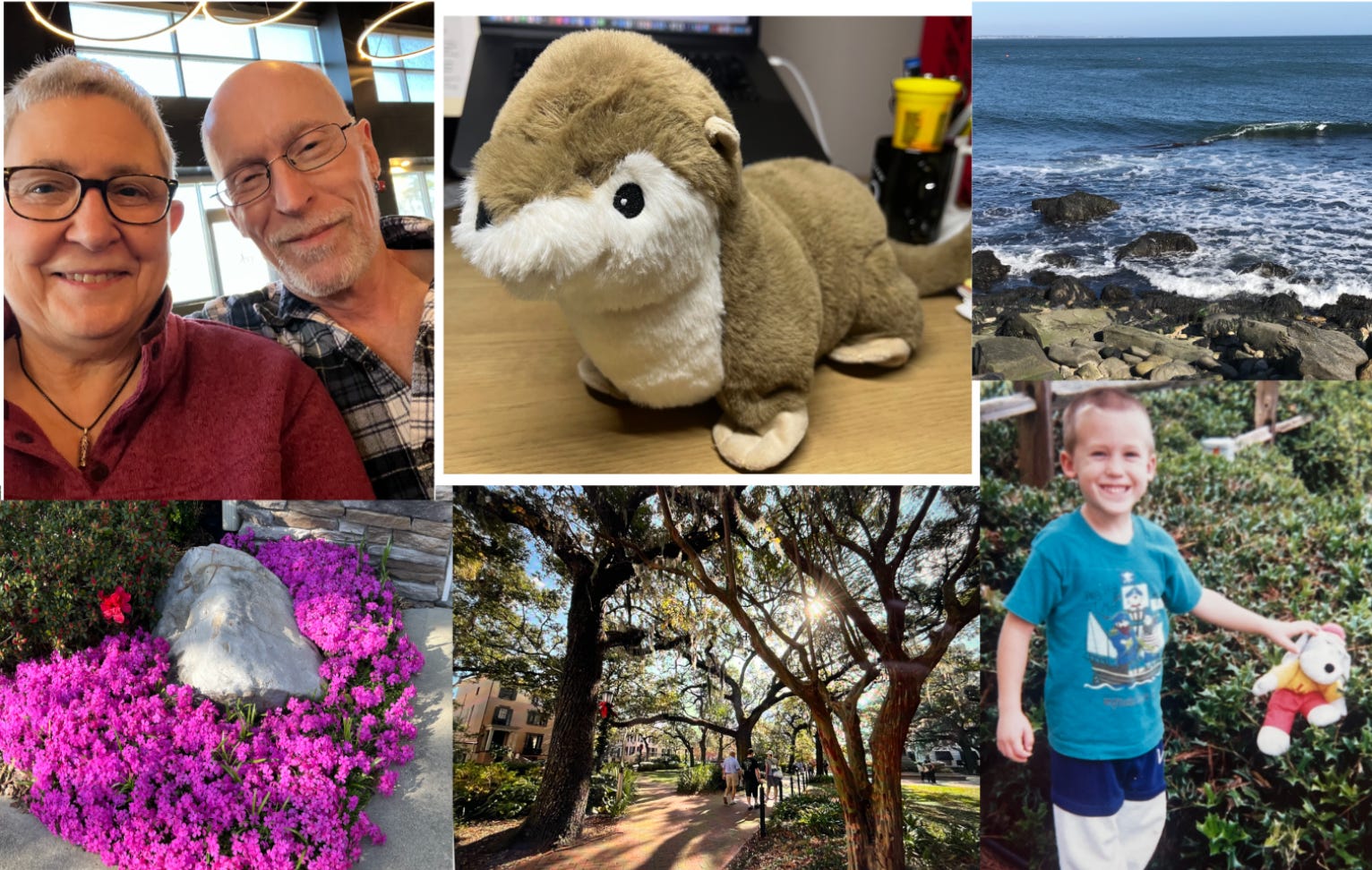
So there was present-day safety in abundance and control. I felt completely at ease with halting things if I needed to. I TOTALLY trusted my therapist to guide and protect me in this. And…I trusted myself that this time, I was ready.
Note:
I am seeking financial support to complete my memoir, work with an editor, and return home for fact-checking. Your help would mean the world to me as I take this step toward healing and giving voice to my journey.
Please like, comment, and share this post to help spread the word. The link for my fundraiser is on GoFundMe. Thank you for your support.

 Soul Mosaic
Leave a comment