“Moments of Respite”
The last two weeks have been extra stressful with some medical things going on with my husband. While all remains “stable,” ever since he nearly died in the early 2000s after a “routine one-day surgery,” I never take those for granted.
Given the trauma from his medical emergency back then, on top of all the abuse trauma I carry, it is not a surprise that I don’t handle new “possible stressors” with ease.
It is also true that writing these memoir entries now about the deep emotional pain I felt in the EMDR sessions is hard. I re-live those emotions. It is necessary to write about those times and to extract new meaning from them. But it is also necessary when things get too intense to just take a breath and resort to one of the tools I used to survive all those years of abuse: Moments of Respite.
I have mentioned them briefly earlier, and I will talk more soon about them — what they are, and why I love them as a coping mechanism. But for right now, given that I needed to resort to that tool with current goings-on, I will share a sample of my newest one – a little “break in the action” for all of us.
The chaotic mess of mammalian breathing
So, we all breathe. Big deal. Inhale — diaphragm pulls the thoracic cavity down, the lungs expand, oxygen-rich fresh air flows in. Then the diaphragm snaps back up, forcing air out of the lungs. In the middle, red cells get rid of CO2 and take in fresh oxygen. Sounds simple enough. But in reality, it’s a pretty chaotic process.
First, there’s the new air trying to push its way down through smaller and smaller bronchioles until it ends up at the dead-end sacs called alveoli. And there, the air is trying to shove its oxygen molecules through alveolar walls and into the blood cells in nearby capillaries.
At the same time as those oxygen molecules are trying to get into red cells, they are getting slammed and blocked by CO2 molecules equally intent on getting OUT of the capillaries and INTO the alveoli. To add to the mess in the capillaries, you have the oxygen-depleted red cells rushing to dump CO2 as fast as they can so they can then grab any stray oxygen that flies by.
It’s like a rush hour gone horribly wrong in Grand Central Station. It’s amazing that we get the oxygen we need. Fortunately, nature provided some assistance. Since our atmosphere at sea level contains almost 21% oxygen, and enough pressure to push that oxygen into our lungs, the whole mess manages to work well enough. But the bottom line is that not as much oxygen gets into the red blood cells as it “could.” And not as much CO2 gets out of the lungs as it could. It’s all just “good enough.”
Now. Imagine you are a bar-headed goose flapping your wings as you literally fly over Mount Everest. At that altitude, while the air still has the same percentage of oxygen, the air PRESSURE is only a third of sea level. So, there is no way most creatures, humans included, can get enough oxygen out of the air unassisted. They wouldn’t survive.
Meanwhile, the bar-headed goose has no oxygen tanks and is busy with the exertions of flapping its wings. If birds had the same chaotic lung-breathing process as we do, they’d never make it. Even migrating birds flying at lower altitudes are still dealing with lower atmospheric pressures than at ground level and the work of flight. So — how do they do it?
The short answer is…thank God they don’t have our mammalian breathing system.
“Butt”-breathing.
That’s how one article described the process of bird respiration. And as strange as it sounds, it is a really efficient system in spite of its oddities.
Oddities? Well, for one, birds have no diaphragms. And their lungs are actually very small. In fact, they play only a small part in the breathing success. Even worse, if you consider that their lungs are rigid and cannot expand and contract, it makes you wonder why birds are even alive. That’s where “air sacs” come in.
Birds have 9 air sacs in their bodies that take up a large amount of space – 15% by volume of the entire bird’s body. But if you assumed that’s where the “breathing” takes place, you’d be wrong.
Those air sacs are just that – sacs. Bags. They are empty containers made of connective tissue, surrounded by muscles. And they have no alveoli. So what good are they?
They form the basis of a very powerful, straightforward air pressure system that makes sure oxygen-rich air is ALWAYS coming in to all the tissues. Unlike our human messy mixing of fresh and old air in the lungs, the bird system is UNI-DIRECTIONAL, which means there is no mixing of both types of air. And this makes things a whole lot more efficient and quick. For clarity, let’s look at the anatomy of this system first.
A miracle of anatomy
At the top of the system, there is the nose and mouth. Air enters primarily through the nares in the beak, but also through the mouth. Both sources funnel air down into the oral cavity and past the larynx.
A bird’s larynx is not like ours, as it is not used for making sounds. Instead, it ensures that air enters the trachea and food enters the esophagus. In that way, it functions much like the epiglottis in a human throat.
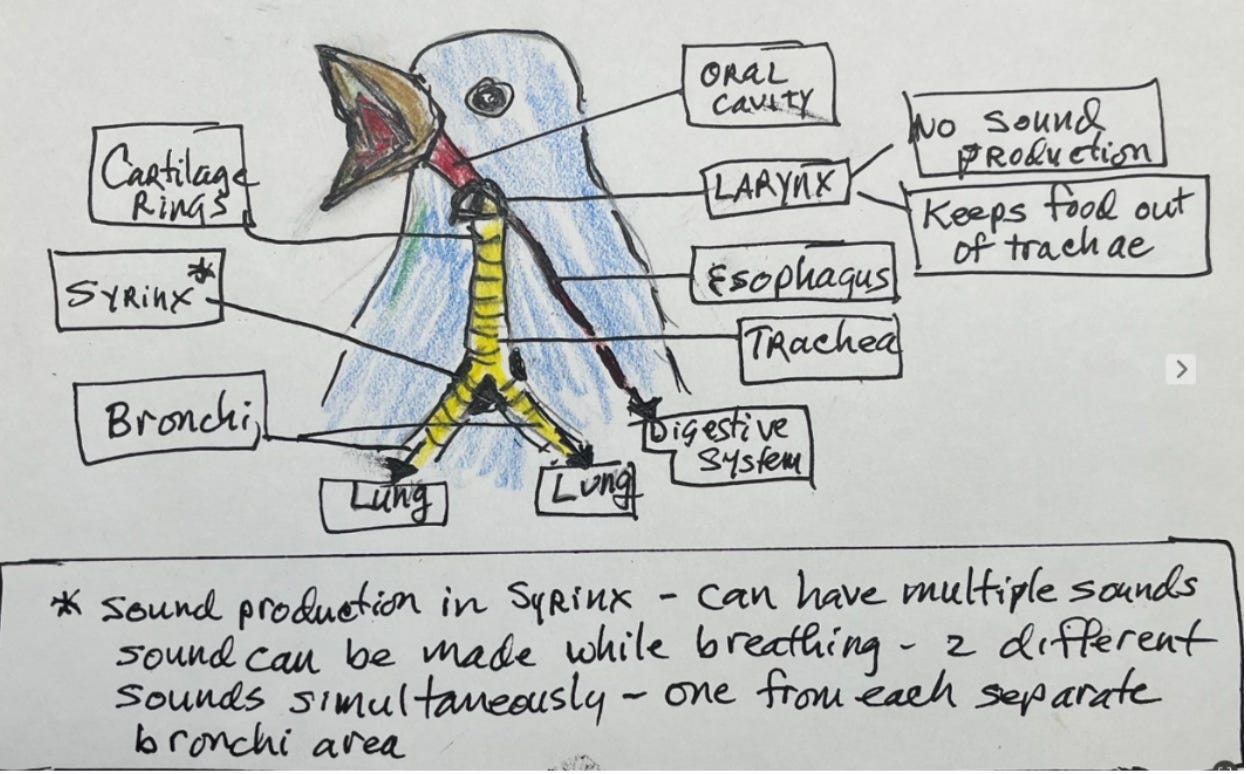
Once past the larynx, air continues into the airway or trachea. This structure is ringed with cartilage rings to give it rigid support so it won’t collapse. The trachea then splits into two bronchial tubes, one to each lung.
As an aside, right at the branching point of the two bronchi, there is a structure called the Syrinx. THIS is the structure responsible for bird vocalizations. It is wedged between and around the two bronchial tubes. The muscles there can operate independently, squeezing and releasing either side of the syrinx at the same time. This enables the production of two different sounds simultaneously. And if you vary how the muscles squeeze the syrinx, you can vary the notes. Also, this system allows the bird to sing at the same time it breathes. So it is quite a nuanced and clever system for sound production.
But to resume on breathing, each large bronchial tube starts to split into smaller and smaller passageways, just like in our lungs. But that’s where the similarity ends. Because now, this is where things get interesting.
Enter the air sacs
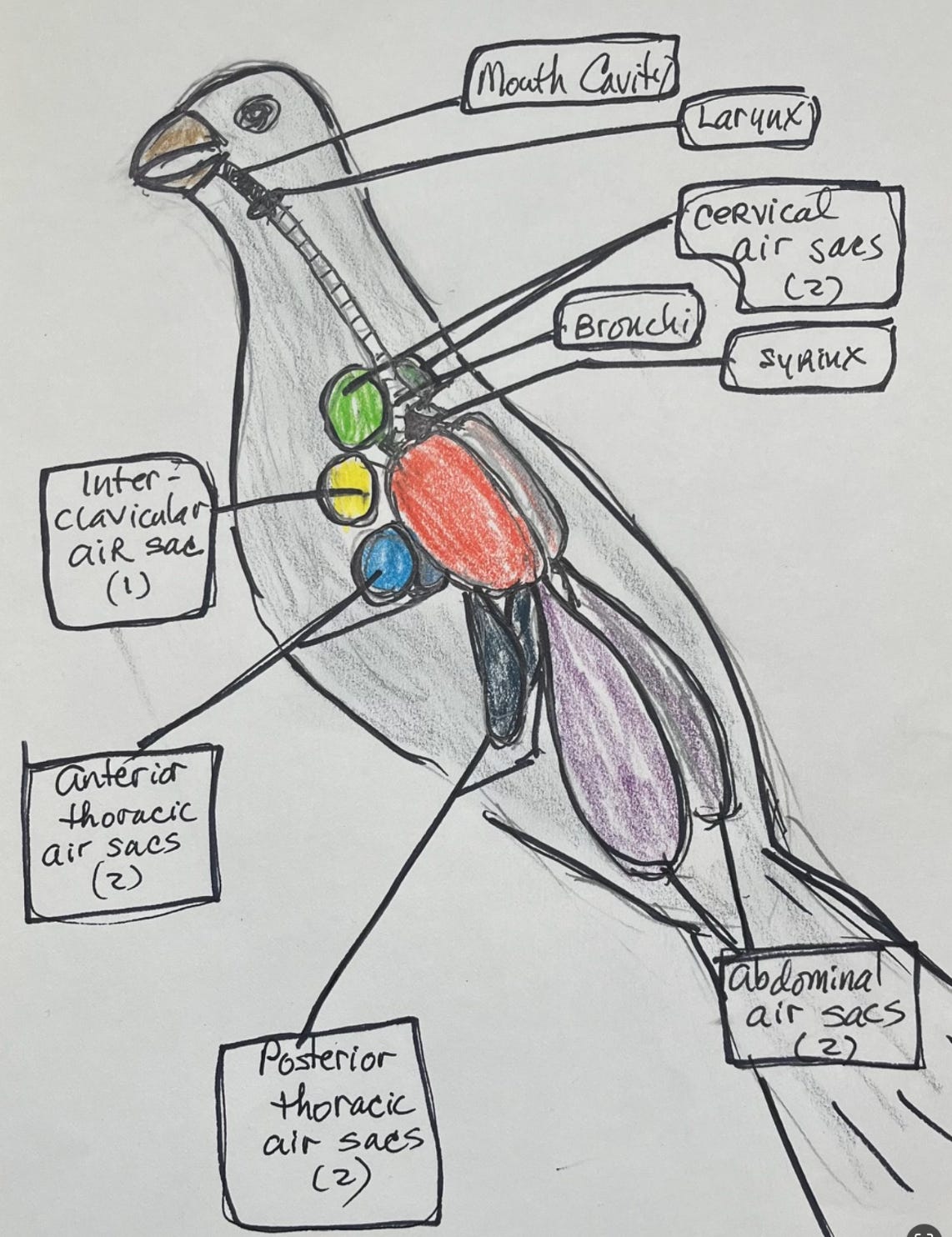
As mentioned earlier, there are 9 air sacs. There are 2 sets of “anterior” sacs and 2 sets of “posterior” ones, one set of each for each lung. There is also one “interclavicular sac between the clavicles. We’ll set the interclavicular one aside for now, as it functions slightly differently than the others. And we need to explain where the “butt-breathing” concept fits in here.
First, up at the lung level, there are the two cervical and the two anterior thoracic sacs. Slightly below the lungs are two posterior thoracic air sacs, and below those, the two abdominal ones. Here is a side (lateral) view of the various structure locations:
Here is a front (ventral) view of the structure:
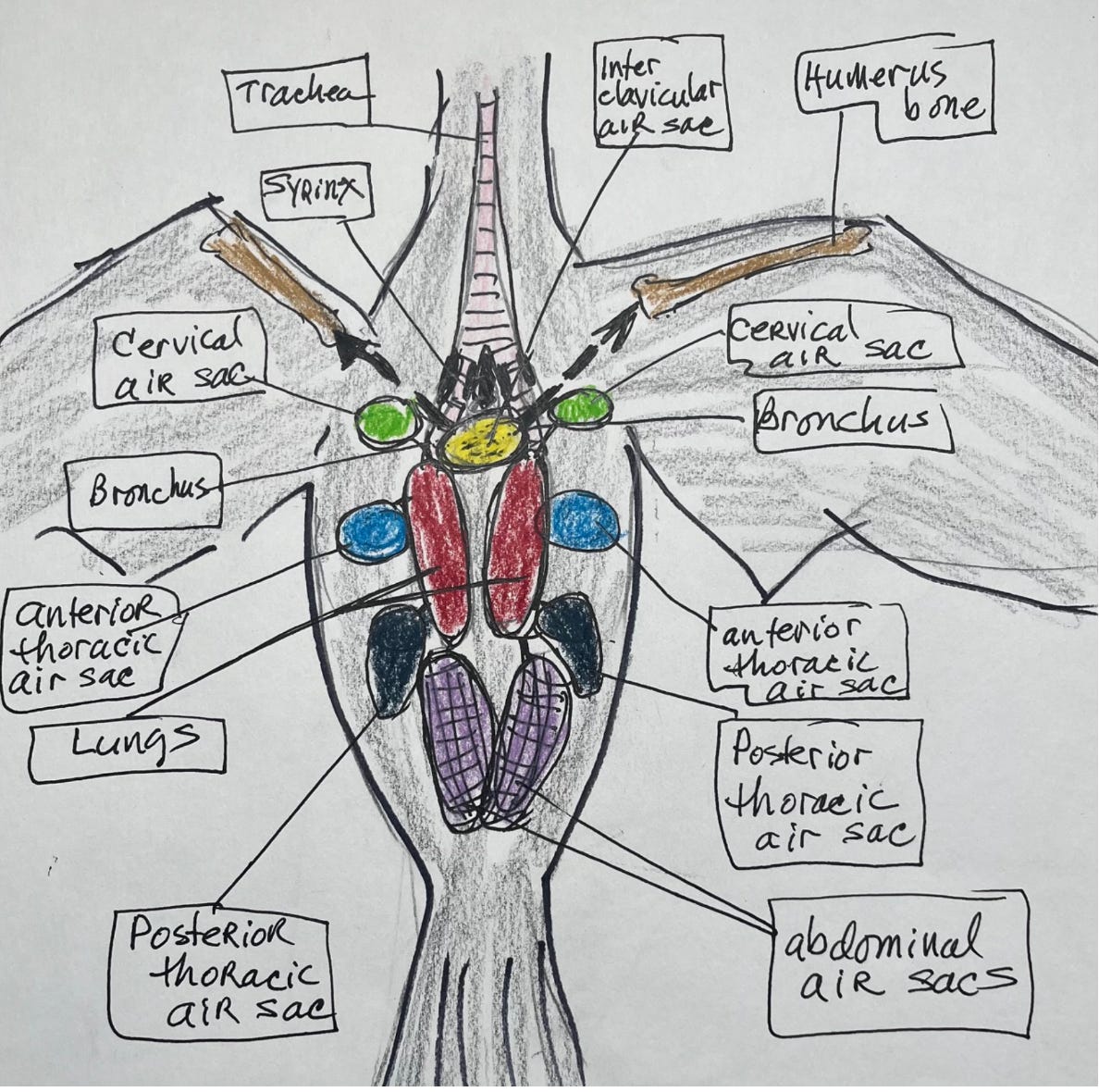
In this front view, note the arrows from the Interclavicular (yellow) air sac to both humerus bones in the wings. This particular sac operates with the rhythm of the wings. As the wings spread, then close, air is forced first into the sac, then from the sac into small air spaces in the humerus bones, and then back out again. This not only provides extra air space in the bones, allowing them to be lighter, but also extra ability to move oxygen through the various air sacs of the bird’s body. In addition, as the interclavicular sac opens and closes, it exerts pressure variations on the syrinx, which gives that structure extra tonal variation possibilities.
Now, the diagram below shows how air moves in only one direction through the bird’s body. The interclavicular sac is not shown in this image, as it is tucked a bit behind the cervical sac in this orientation. But just assume it is working in conjunction with the cervical and anterior thoracic sacs.
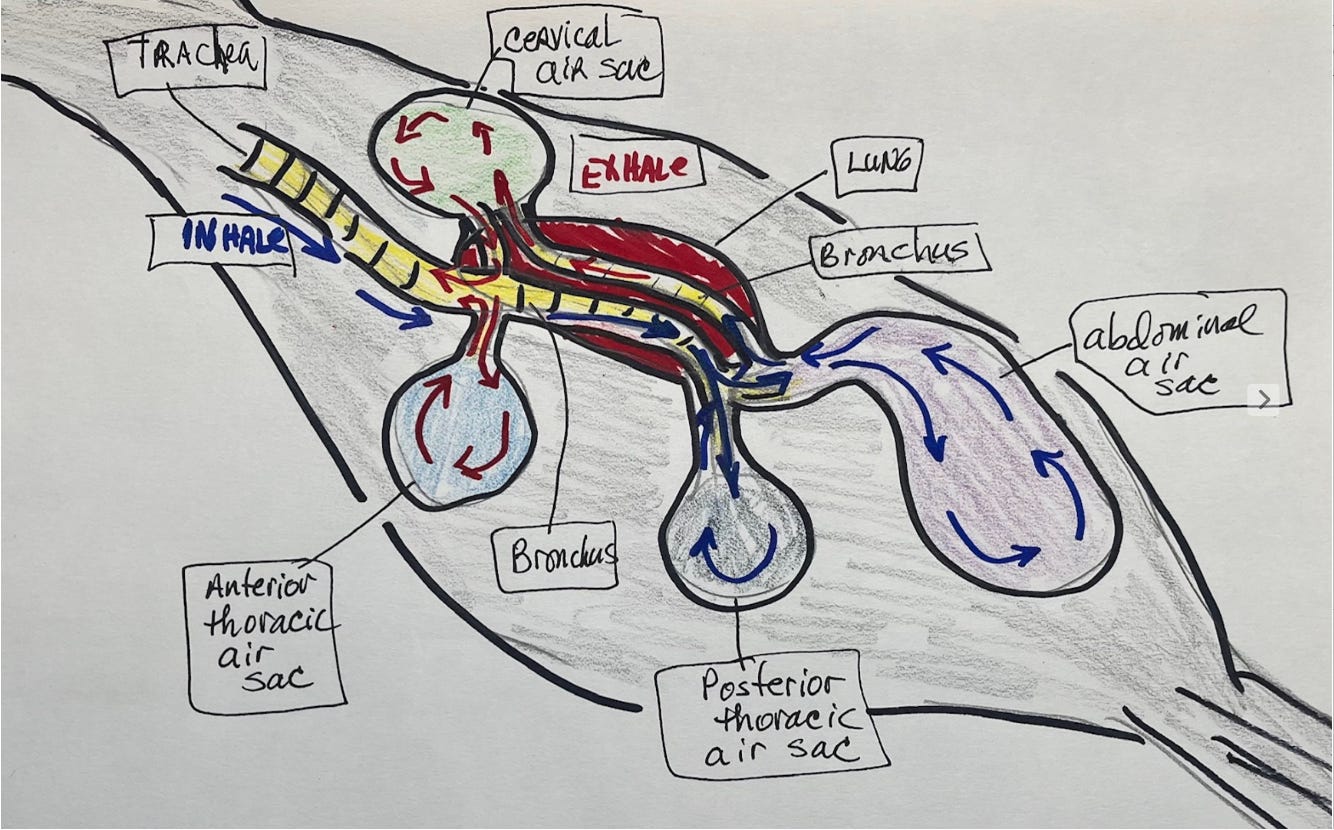
Many of the websites describing bird breathing express it as two inhalations and two exhalations. But this is not totally accurate and somewhat confusing, because the two inhalation steps are actually happening simultaneously. And the same for the two exhalation steps. So, I am going to just describe everything that happens during inhalation, and then everything that happens during exhalation.
Inhalation:
When the bird inhales, air is drawn down the trachea. It then splits and enters both bronchial tubes. (From here on, I will just describe what happens on one lung’s side)
From that first large bronchus, the air continues into a smaller bronchial tube that runs through the lung, and directly into the posterior thoracic and the abdominal air sacs. The air sacs, which are flexible, large, and surrounded by muscles, act like powerful bellows.
With each inhalation, the muscles around those posterior sacs exert pressure on the sacs like a bellows, allowing fresh air to be pulled directly down into them, and then on into the lungs. This series of things is usually described as the “first inhalation step.” But it is actually happening at the same time as the next item.
AT THE SAME TIME that fresh air is pulled down into those posterior air sacs and then into the lungs, air that was already in the lungs gets pushed up into the anterior air sacs (cervical, anterior thoracic, and interclavicular). This is the step usually described as “second inhalation,” but it is happening at the same time as the first inhalation step, down into the posterior air sacs.
Exhalation:
Now, when the bird exhales, the muscles around all the air sacs contract. Air that had been pushed up into the anterior air sacs (cervical, anterior thoracic, and interclavicular) from the lungs is now pushed up the trachea and out of the body.
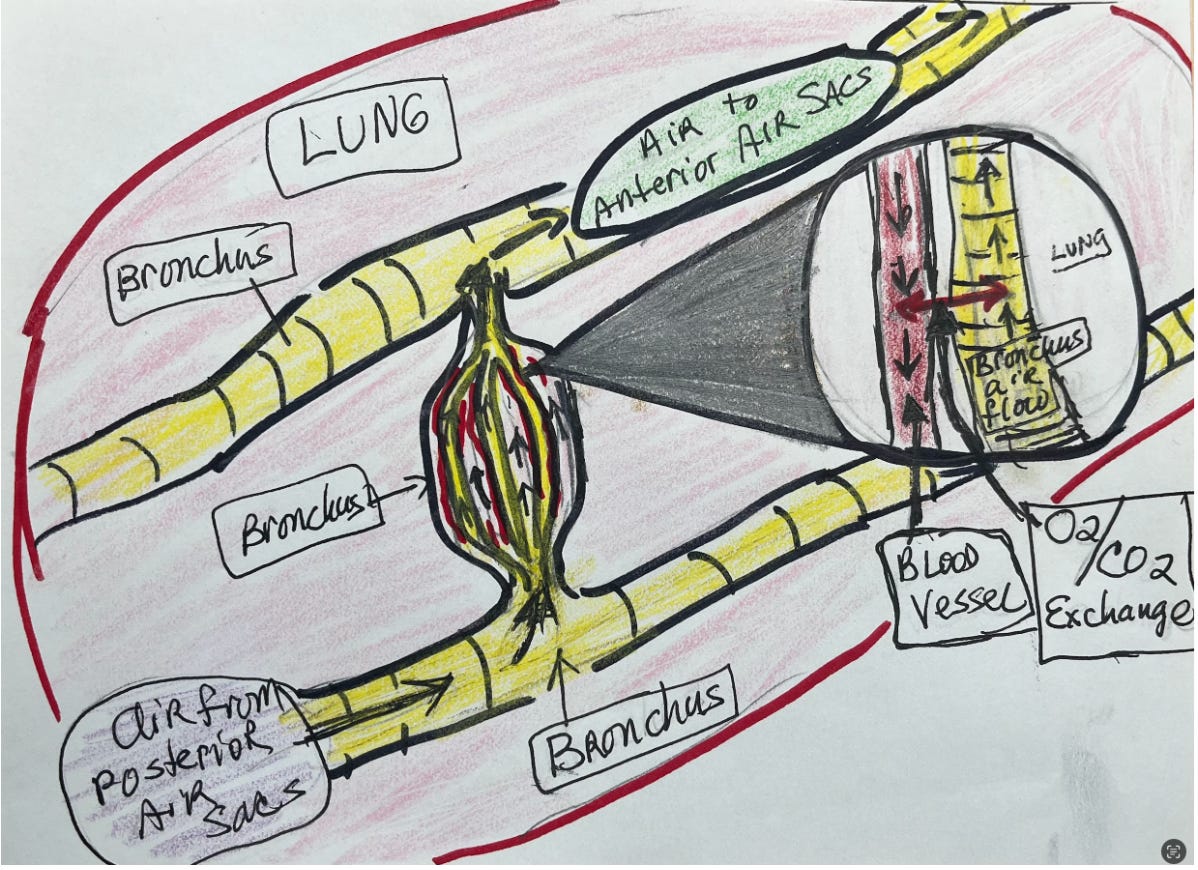
AT THE SAME TIME, air that had just entered the lungs from the posterior sacs on the inhalation is now forced through smaller bronchial tubes in the lungs – parabronchi – and this is where the oxygen/CO2 exchange takes place. In essence, these small bronchial areas do the same work that human alveoli do, only much more efficiently.
Because the lungs are rigid and don’t have to expand like human lungs, the membranes of the parabronchi can be very thin. This allows for very close contact between the air in the parabronchial tubes and the blood cells in capillaries lying right next to the bronchi. Thus, gases can transfer easily between the two tubes.
One other factor that makes this a really efficient process is “counter-current gas exchange.” Since the air is moving in one direction through the parabronchi, and the blood cells are moving in the opposite direction, this allows for a “concentration gradient” of oxygen and CO2 along the two surfaces. This ensures a much more orderly, complete, and efficient gas exchange. In fact, this system allows for a nearly 100% extraction of needed oxygen from the air and into the bloodstream.
Other miscellaneous info
As a bonus, the air sacs also help to regulate the bird’s temperature. A great deal of internal heat is generated through the bird’s flying efforts. Since they don’t have sweat glands, they would have a problem shedding this extra heat. The fact that air moves only in one direction into and out of the bird allows for excess heat to be released through exhalation. Thus, the bird’s internal temperature can be kept in an optimal range.
And why “butt-breathing”? Because it is the posterior air sacs that are the powerful set of “bellows” that pull air into and all the way to the bottom of the bird. And then the muscles around them so forcefully push that air into and through the lungs, into and out of the anterior air sacs, and finally, out of the bird. So, people humorously describe this as “butt-breathing” because those back-end sacs do a huge amount of the “powering through” of air in the respiratory cycle.
While all birds use this type of respiratory system, there is variation in the efficiency depending on the type of bird. The above-mentioned bar-headed goose is probably the most efficient at extracting needed oxygen in low-pressure situations. It has special adaptations that make it so efficient, such as larger lungs, hemoglobin that can take up oxygen more quickly, thinner blood capillaries for quicker gas diffusion, and its muscles are more efficient at oxygen uptake.
And diving birds, which have to endure extended periods of not breathing, have a larger blood volume with a richer supply of hemoglobin to carry extra oxygen. They can also tolerate higher CO2 levels in their blood, they can slow their heart rates underwater, and other body parts, including the brain, can reduce their oxygen demands at those moments.
…Now, properly re-centered energy- and stress-wise, I can get on with the post about trying again to do an EMDR session in 2018.
Tags: fitness, health, nutrition, respiration, wellness


Leave a Reply