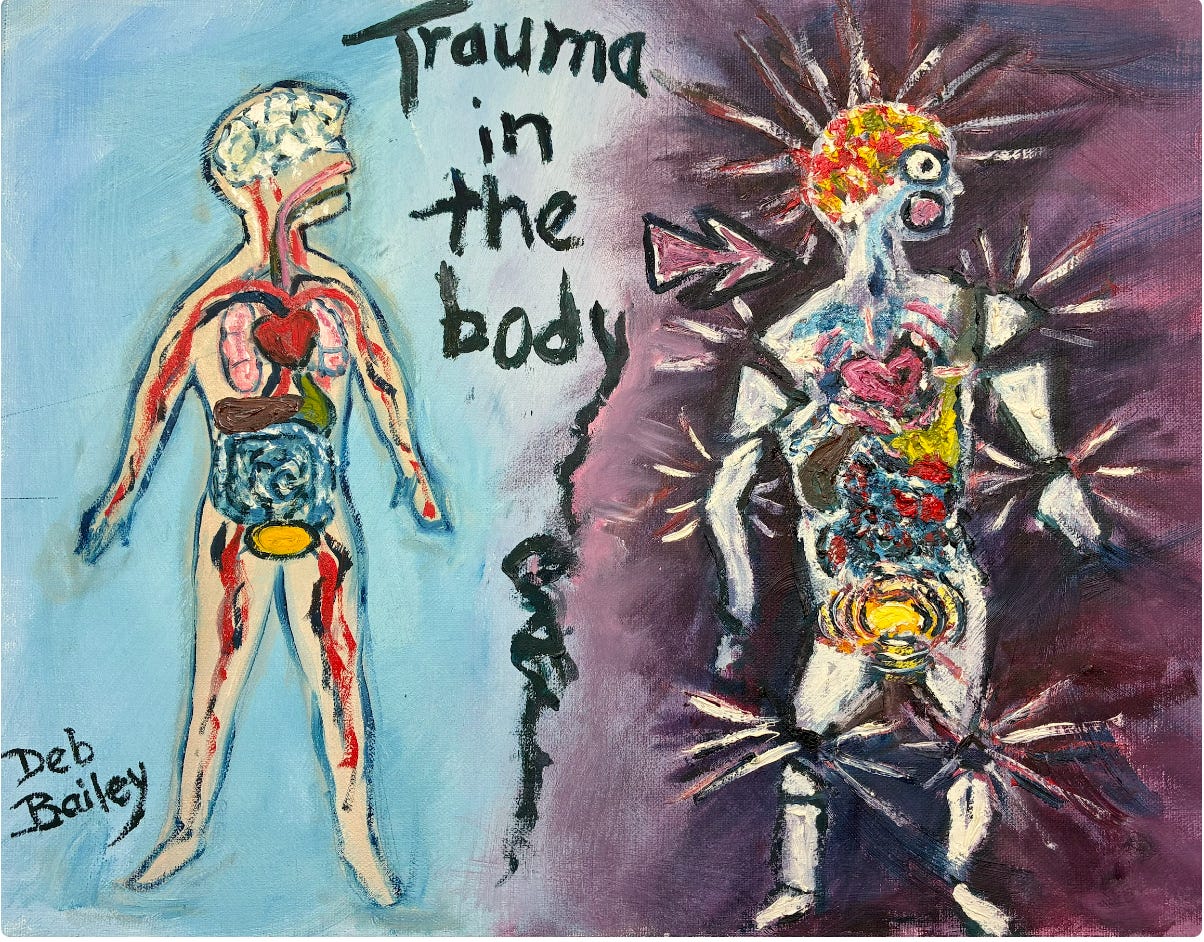
Somatic/Body Health Issues
In the last post, I showed how high stress and trauma have the nervous system and emotional issues running at high intensity. Given that, it follows that the rest of the body systems somehow get pulled into the chaos, too … and end up paying a price for their involvement.
For anyone who says stress is all in your head, here is my strong rebuttal….
I’m not going to go into each system but instead do an overview of the “biggies” for health issues. I’ll note some of these when I write the post about my own personal costs from trauma. And to most effectively summarize here just how much the body gets pulled into the trauma, I give you the “HPA” axis.
Suffice it to say that the “HPA axis” is a loop of three organs that work together to run so many vital body functions. They are the hypothalamus, pituitary gland, and the adrenal gland.
The hypothalamus is a tiny gland weighing only four grams – not even a quarter of an ounce. It is the connecting link between the nervous system and the endocrine (hormonal) systems.
When the nervous system is on fire, it starts screaming to the HPA axis, in particular, to the hypothalamus, to literally “DO SOMETHING!!!”
The hypothalamus governs everything from sleep cycles, appetite control, temperature control, and stress responses, to the body’s very homeostasis – keeping “all the lights on” and the critical systems operating and in balance. Its hormones direct everything from blood pressure and water balance, social and sexual behavior and childbirth, to growth, metabolism and reproduction. So when it gets an emergency alert from the nervous system, it goes into “emergency mode” itself, and starts shouting commands to the pituitary gland.
The pituitary is a pea-sized gland that takes its orders from the hypothalamus and is known as the “master gland.” It produces or controls hormones for growth, reproduction, body metabolism, and blood pressure. It is literally in the driver’s seat for most of the body’s hormones and their functions. So when the hypothalamus screams at the pituitary, it starts sending emergency hormones out and/or commands to the next glands in line, the adrenals, to get THEIR hormones out and running.
The adrenal glands are two small, triangle-shaped organs that sit on top of the kidneys. They respond to hormonal “orders” from the pituitary gland. The hormones in the adrenals control your blood pressure, digestion and energy production, balance salt and water in your body, AND MANAGE STRESS REACTIONS.
So the three work together in a loop, from the hypothalamus to the pituitary to the adrenal glands, then back again. And as various hormone levels rise or drop during emergencies, they send messages to each other for needed adjustments.
The adrenal glands alone have tremendous power over our stress response. They produce large amounts of the glucocorticoid hormone, cortisol, and two amino-acid-based hormones: epinephrine (adrenaline) and norepinephrine (noradrenaline).
The latter two initiate the fight-or-flight response and can increase heart rates, blood flow to the muscles and brain, relax airway muscles to improve breathing, adjust blood pressure to changing stress levels, and adjust glucose levels for energy needed during a threat.
Cortisol directs how the body uses the main energy nutrients (fats, proteins, and carbohydrates); regulates blood pressure; increases blood sugar; decreases bone formation; and controls the sleep/wake cycle.
It also has one other vital task – it must suppress inflammation in the body. This is an important job because inflammation in the body is responsible for diseases such as autoimmune disorders like rheumatoid arthritis and lupus, metabolic diseases like type 2 diabetes and obesity, heart disease, asthma, inflammatory bowel disease, Alzheimer’s disease, and certain types of cancer. And whenever stress levels rise, inflammation levels and its body damage also rise. The only way to minimize those disease threats is for the adrenals to produce enough cortisol to keep the inflammation in check. And that is the tricky part.
The longer intense stress goes on, the more cortisol is demanded from the adrenals. However, the body’s ability to keep churning out high quantities of cortisol is not limitless. Too much stress for too long, the body just can’t keep up, and cortisol levels drop even as the HPA axis is screaming for more. And then it becomes like a house of cards. One by one, those various feedback loops and calls for help start to break down. And then, given enough time in stress, the body begins to malfunction.
So. Lungs…GI tract…heart…metabolism…blood pressure…breathing…muscles…nerves…blood chemistry….hormones….
Given all of these body systems, hormones, or functions that I just mentioned, I think that makes the point that stress affects the whole body…that stress damage is REAL…and that it is NOT in your imagination.
And it doesn’t end there…
Inherited/Transgenerational Trauma
The human body has millions of genes and chemicals that control them. This is our “epigenome.” Anything that affects those things will cause possible problems in how the genes work. The research into this area of health is called “epigenetics.”
Research studies now show that intense or long-term stress can be handed down to the next generations through these epigenetic changes. These include:
Biological/Environmental – The stress chemicals in the body of a mother/grandmother that are circulating during a pregnancy can affect the development of the fetus — its own organs and body systems, even the health of the eggs/sperm in that developing fetus. Hence, the health of the following generations may be affected.
Living Environment/Emotional – The care from parents/caregivers, the safety of the environment a child is being raised in, the type of food and nutrition; education; the very circumstances of that child’s life can affect their nervous system, brain, and body development. This, in turn, affects their growth and future health issues, which can be passed down to the next generations as well. Researchers have, in recent years, developed a scoring system to determine the risk of various conditions to a child’s health (See ACE SCORES BELOW)
Body hormones/chemicals that alter DNA molecules and thus, gene functions – While the actual DNA code is not changed, a couple of physical changes to the DNA molecule can result in incorrect chemical tags being added to the DNA molecule. Some of these DNA tags may instruct various genes to turn on or off at the wrong time, or to work less effectively, all of which can result in body malfunctions or disease. Others may affect how the DNA wraps itself around a protein called a histone. They may instruct the DNA molecule to wrap too tightly or too loosely around the histone. This, in turn, makes it difficult for the cell to read a gene’s instructions, resulting again in a cellular malfunction. With the wrong instructions a cell, such as a skin or nerve cell, may not know how to function as a proper skin or nerve cell, thus preventing it from acting normally.
Aiding that future – Predicting patterns and targeting help
Given all the evidence building for such long-ranging health impacts from child abuse, neglect, and trauma, isn’t there any way to head off future health problems? That was exactly the question Dr Nadine Burke Harris asked herself in 2008.
After reading a pivotal 2002 study — “The Relation Between Adverse Childhood Experiences and Adult Health: Turning Gold into Lead”— on how adverse childhood experiences impacted the health of children into adulthood, California pediatrician Dr. Nadine Burke Harris noticed the same thing happening with her patients. She began to implement the measures used in that study and pioneered the clinical use of “Adverse Childhood Experiences (ACE) scores” in her practice.
By using a battery of questions about the types of traumatic experiences a child experienced – from child abuse, watching others be abused, etc. – she could start to identify those who might be at high risk for later health issues. She then began to work to find ways to try to change those situations in the present, rather than just letting them go and causing problems down the road. She later expanded this effort into other San Francisco neighborhoods, eventually founding the Center for Youth Wellness.
Her 2014 TED Talk, “How Childhood Trauma Affects Health Across a Lifetime,” brought even more recognition to this problem and to date has over 14 million views. She later became the first Surgeon General of California.
Since those earlier efforts, there are also questionnaires now to measure positive childhood experiences in the child’s home situation (PCE scores) that might offset some of the risk. And more recently, there is also a battery of questions that investigates any beneficial childhood experiences (BCE scores) that especially come from influences beyond the family, such as with teachers, neighbors, and friends.
While no questionnaire is perfect, it was a major step forward in trying to identify problem situations and do something about them in the moment. And those newer questionnaires added more nuance to evaluating all circumstances in a child’s environment and how they might affect the scores.
For example, I have taken all three test batteries. I have a high ACE score, which means I was exposed to a lot of abuse and trauma, and hence a high score indicates a high risk for health issues. I have a low PCE score, which confirmed that there were very few positives in my home environment to offset the emotional trauma. But I have a high BCE score, which indicated that I was fortunate to have a few key adults – and especially a key teacher – who made a big difference to me as role models and in giving much-needed encouragement. There is TOTAL truth to the saying that even one person can make all the difference.
Up Next
So the next topic after the nature and effects of trauma that I wanted to understand better was about the behaviors in abuse survivors – how we reacted then, how we react now. Because before I could change something, I needed to clearly lay out and understand those “automatic responses” in life that kept coming up.
Lastly, for anyone looking for more information on any of these things:
First, a good therapist. Also, more information can be found in books, Google searches for interviews with specialists, podcasts, videos, and research papers. Some books, people, and topics I’ve found are:
Trauma and Recovery, Judith Herman, MD
The Body Keeps the Score: Brain, Mind, and Body in the Healing of Trauma, Bessel van der Kolk, MD
The Body Bears the Burden: Trauma, Dissociation, and Disease by Robert Scaer, MD
Other researchers and authors for sexual trauma, child sexual abuse, rape, violence, complex PTSD, etc.:
- Ellen Bass
- Laura Davis
- Mary P. Koss
- Jennifer Freyd
- Chérie Armour
- John Briere
- Gabor Maté
- Peter A. Levine
Topics to research:
- How the nervous system works/reacts to trauma
- Trauma and PTSD
- Epigenetics
- Sexual abuse
- EMDR
- Health issues related to trauma and sexual abuse
- ACE scores, PCE scores, and BCE scores
Note:
I am seeking financial support to complete my memoir, work with an editor, and make a visit to my home state for fact-checking. Your help would mean the world to me as I take this step toward healing and giving voice to my journey.
Please like, comment, and share this post to help spread the word. The link for my fundraiser is on GoFundMe. Thank you for your support.


Leave a Reply