“So, is it anger or is it anxiety may be a misleading question! It would be more accurate to say it is the threat system activation gone haywire…”
Shlomo Radcliffe, RP, DCP, CAMS-II, Radcliffe Blog and Resources, “Anger and Anxiety: Is It Anger or Is It Anxiety?“
The Albedo discovery
Previously, in the “Nigredo/Dark Night” posts for this book’s “Undiscovered Country” section, I wrote at length about the emotion of rage. There was a July 2026 assessment of my rage in that moment. There were posts on the nature and the why of rage. And lastly, there was an entry about the choice and gift it offered. So, not a small amount of time has been spent on this topic.
Yet there was one aspect of rage I hadn’t ever considered, something I just recently discovered. The article was entitled: “Why Anger is Nothing More Than Repressed Anxiety,“ by Leon F. Seltzer, PhD, and its subtitle read: Anger is best perceived paradoxically as an “offensive defense” against anxiety.
Given that anxiety was the last emotion that I associated with rage, I knew I needed to investigate this more.
My triggers, behaviors…and needs…
My journals are filled with moments of rage.
People driving slowly in front of me. The moment I realized the snake above our doorframe ate the bird eggs in the nest there. Memories of my father abusing me. People feeding me platitudes, lies, or gaslighting me…taking me for a fool.
And then there were the messages I lived by for so long: “To not fight is to fail, again…If I don’t fight…anyone, I am complicit – letting some bully get away with things, again. To not fight is to be weak…a victim…again.”
Proxy battle after proxy battle after proxy battle. Fight. Rage. Defy. None of that spelled fear in my brain. Until I looked closer and started discovering some surprising facts.
From that same article above: “…keep in mind that what drives your response is the perception of threat…Our threat system cares about just one thing: resolving the threat and finding safety.”
And whatever differences or similarities anger and anxiety have, “the tie that binds them both involves the desire to have control.“
Blue Valley Behavioral Health, “Anxiety vs. Anger: Two Sides of the Same Coin.”
Anger versus anxiety
A number of sources describe anxiety as a fear or worry reaction to either a real or perceived threat. Its main focus is to escape or avoid the threat.
Anger is a reaction of frustration or indignation at the threat, and its focus is to fight back against it.
Anger has also been described as a “defense mechanism” against the sense of vulnerability and being overwhelmed that anxiety causes. In fact, it often serves as a “shield” for anxiety, concealing it. It doesn’t get rid of it but masks it. Psychologists note that people may switch from anxiety to anger so quickly they never even realize that anxiety was there. And many prefer anger because it gives the illusion of power… of taking back control of a threatening situation versus running away.
One reaction can trigger the other, or both reactions can come up simultaneously to another trigger. And one’s thoughts in those situations can amplify the fear, and by extension, the anger one feels. In fact, anxiety can amplify the anger reaction, with both then continuing to feed on each other.
Leon Selzer, PhD, described them as “kindred states of ‘agitated unease,’ …two sides of the same coin.” He further added that anger is more like “turbocharged anxiety” or “anxiety with a chemical kick.” And he noted that anger comes up because threats make us feel out of control, and that “…most people would prefer to ‘mutate’ their anxiety into anger, for at least anger creates the illusion of regaining control of the circumstance so unsettling to us.”
“Why Anger is Nothing More Than Repressed Anxiety,“ by Leon F. Seltzer, PhD,
How does that threat system work?
The brain suddenly perceives a threat. It may be real, imminent, anticipated, or a mistake – an overreaction to a normal situation seen as threatening because of our thoughts and experiences from a past trauma.
Whatever the cause, the brain kicks off the threat response system – the body’s fight/flight/freeze or fawn reactions. Immediately, our system is flooded with stress hormones – adrenaline (epinephrine), cortisol, and noradrenaline (norepinephrine). These hormones, which use the same neural pathways regardless of whether the reaction is anger or anxiety, trigger us to prepare for and respond to an attack.
Our heart rate goes up, muscles tense in response, and blood is shunted away from areas perceived as “unimportant” in that moment – the brain, GI tract, and our ability to be aware of anything else but the threat.
Instead, the nervous system’s “reflexive survival center” – the midbrain area and the sympathetic branch of the vagus nerve – takes over at the expense of logical thought. And that neocortical area where rational thinking takes place (ventral vagal state) is closed off. Thus, anxiety triggers panic or anger. The bottom line is that anxiety is the fuse that can ignite into anger at a single spark, and at a time when rational controls are diminished.
Why does the body react this way?
These reactions, both anger and anxiety, have their roots in our past. If we grew up in abusive households with caregivers who used anger a lot, or in threatening or unpredictable situations, our system was taught to “be on guard.” As such, our bodies will be quicker to activate to any threat, real or mistaken.
In fact, anger has often been associated with diagnosed anxiety conditions like Generalized Anxiety Disorder (GAD), depression, and similar conditions. In GAD, for example, the nervous system is overloaded from being in a constant state of vigilance. Overwhelmed by chronic stress, we grow increasingly frustrated and then angry and irritable.
Risks and impacts
One of the problems with anger is that it can be an addictive force. And because anger effectively masks the anxiety, we are unable to access that anxiety and work to resolve its root cause. So it is a cycle that just keeps going.
Also, anger uses a lot of energy to suppress that anxiety, producing negative neurological and physical effects.
Yet another aspect of anger is that it can be related to abusive behaviors. The rational brain is not fully engaged during the stress reactions, and the triggered brain may incorrectly assess someone as a threat. Flooded with rage, righteous indignation, or moral superiority, as well as a sense of justified self-preservation, it can be easy to rationalize improper behavior. A person may view themselves as the victim and shift blame to the other person, rightly or wrongly. Anger that blows out of control can result in behaviors ranging from inappropriate and impulsive to dangerous.
“The blood supply to the neocortex…is shunted to lower parts of the nervous system (to prepare you to do battle with the supposed enemy). You are also throwing off inflammatory proteins called cytokines that directly inflame and sensitize your brain. You are offline, and it is impossible to think clearly. You lose awareness of the needs of those around you, which is a step toward abusive behavior.”
“Why Anger is Nothing More Than Repressed Anxiety,“ by Leon F. Seltzer, PhD
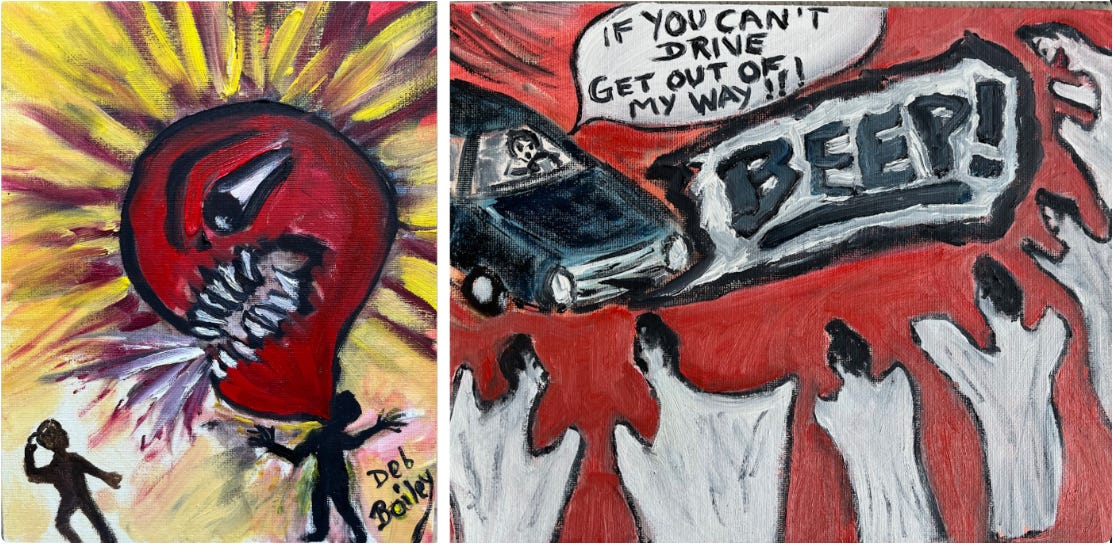
Beyond the impacts from anger, there are also negative physical health effects to the body from chronically elevated stress hormones in the system, regardless of whether the reaction is anger or anxiety:
- High blood pressure
- Heart disease
- Lung problems including worsening asthma
- Headaches
- Insomnia
- Fatigue
- Chronic pain/fibromyalgia
- Metabolic diseases
- Immune system dysfunction
- Autoimmune diseases such as arthritis
In addition to these effects from chronically high levels of stress hormones in the body, many of these and other disease states can also be attributed to unresolved stressful emotions trapped in body tissues.
What I would prefer
In a lot of ways, I am actually grateful for finding those articles and writing this post. I am even RELIEVED to discover that anger and anxiety are two sides of the same coin. It explains so much about why I react the way I do. Where it came from. And I feel hopeful now about managing it better.
My therapist had already helped me learn to embrace and accept that anxiety will always be with me, and that the best way to manage and help heal it is to draw it closer with compassion. In the same way, learning that my rage was really the same scar and needed the same approach – care for it with love – was a relief. And it is actually lowering my reactivity. When I feel it coming up now, I am finding it easier to take that pause. And I know now that I don’t HAVE to fight. I am not a failure if I choose to respond in a different way.
Going forward, I would like to keep expanding those “pauses to consider options,” and transforming that rage into “outrage.” Outrage is a force that can be usefully directed into positive action when a situation calls for it. Which means I don’t just roll over and play dead to a bully. Instead, I can tap power mindfully to stand up when I have to.
Can it be healed?
Yes. There are many techniques for learning to slow these reactions, bring more pauses into thinking, and choose more effective responses. The first step was this post – to finally understand what has been happening in me. Knowing these things, I can change the faulty messages inside of me that demanded that I HAD to fight or I was a failure. It’s using that motto of mine – What I think is what I feel is what I do – in a new way.
In an upcoming post for this Albedo section, I will be writing about “Healing from Trauma.” I don’t just want to leave things as “here’s what trauma is and does,” and not offer equal time to “here’s how to help trauma.” So, that will come soon.
Up next
But before I wrap up this “Albedo/Beginning Insights” section with that post on healing, I want to address two more topics:
- How – Some thoughts about HOW I survived that house
- Costs – What did surviving that household, and recovering to thrive, cost me…in all senses of the word?
So, those will be next.
Note:
I am seeking financial support to complete my memoir, work with an editor, and make a visit to my home state for fact-checking. Your help would mean the world to me as I take this step toward healing and giving voice to my journey.
Please like, comment, and share this post to help spread the word. The link for my fundraiser is on GoFundMe. Thank you for your support.


Leave a Reply