Soup
As my father told it, one day, as a young boy, he was at his grandmother’s house. He and a few of his uncles were sitting at the table eating soup. In response to what they were saying to him, and despite his young age, he snarled back at them and told them to “Shaddup!”
My father’s nasty delivery of that word left no question in my mind that he was totally proud of his bravado back then, and that he felt he had every right to talk to them that way. The unspoken message to us was that we, too, should be that tough in life.
Even as a kid myself, hearing that story, I wondered about his nasty retort to the grownups at the table. I knew what would have happened to me if I talked to him, or my grandparents, or any other family adults like that. But then, my grandparents and relatives were nice.
Were his uncles really being nasty to him, or were they just joking around and he was being the nasty one? And what did they think of the way he answered them? Were they angry? Surprised? Or, given that side of the family, proud that he already showed such “backbone” at a young age? Maybe they were trying to toughen him up.
As with all of Dad’s stories and lectures, I took it in and kept my counsel in reserve. By nature, I wasn’t inclined to be that way, and I think I decided that if I was ever in such a situation, I’d wait to see how the adults acted. If they were nice, I would be nice. If they weren’t…well, Dad was giving me permission to be disrespectful…expected me to be, in fact… and I figured he would back me up if I was. He was always good about us fighting “outsiders.” Just not fighting him.
Mindset…and personal choice
Mindset, motivations, and decisions – the individual choices we make with a given set of circumstances – and how we make those choices are all topics of deep interest to me. They were the things my conscience has obsessively explored when looking back at my actions.
Maybe it was the Catholic streak imbued in me over years of going to Confession – that whole directive to “make a complete and full examination of your conscience” that the Church dogma drilled into us. You were supposed to analyze what you did. Ask yourself why you did it…REALLY ask. And ruthlessly ask yourself whether you tried your best or just took the easy way out. And most of all – did you KNOW in that moment you were compromising yourself and taking the easy way out? KNOWING and still choosing was the key moment at the core of any decision.
I was always rigorous in that self-examination – maybe too hard. But I preferred to be too hard on me than later realize God disagreed with my conclusions. Even now, I apply the same strong self-interrogation about how I handled something, striving hard not to give myself the benefit of the doubt, and still sometimes being too hard on myself. So it’s no surprise that the whole concept of a person’s mindset, beliefs, and the choices they make in life has fascinated me.
Character motivation
To that end, I’ve read books on the subject ranging from spiritual tomes to psychology texts to books on how to write, especially the subject of character motivations. And it was the author of one of those – K.M. Weiland – who gave me some clues about my father.
Weiland has written novels in a wide range of genres, including adventure, fantasy, historical, and speculative fiction. She also teaches writing through online classes and her blog: “Helping Writers Become Authors.” And she’s written a number of how-to books for writing, including Creating Character Arcs. What I love about her approach to her books is her deep understanding of not only the powerful mythic themes operating in great stories, but how those operate in and drive the characters’ decisions and actions.
In particular, she speaks of “character arcs,” which are how the character develops across the story given the circumstances they are confronted with. Based on their beliefs, their motivations, ethics, and what they want, the characters make choices that determine whether the arc of their “story life” is a positive or negative one, and whether they change for the better or worse. A recent entry on her blog riveted my attention:
“In storytelling, few arcs are as gripping — or chilling — as the Corruption Character Arc. In this arc, characters don’t just fall, they choose to fall (although of course, they don’t generally think of it like that). Whether driven by fear, pride, or desire, they trade their integrity for a Lie, believing it will give them what they want. Even when this is true, the cost is an ever-deepening descent into self-delusion and, often, self-righteousness… most insidiously dangerous…a character who chooses the wrong path and justifies it every step of the way.”
K.M. Weiland, The Most Dangerous Arc: Breaking Down the Corruption Character Arc
What I have learned is that this type of character is driven by a mix of things. They operate from hubris as well as a desperate need for power.
For one, they feel power over a situation is necessary – almost a “survival need” in the moment, whether it truly is or not. So they operate from the mindset that the end justifies the means – maybe just this once. Except that it’s a slippery slope that goes from “now and then” to being a standard way of life.
What I have learned is that this type of character operates from hubris as well as a desperate need for power. They are driven by a mix of things. For one, they feel power over a situation is necessary – almost a “survival need” in the moment, whether it truly is or not. So they operate from the mindset that the end justifies the means – maybe just this once. Except that it’s a slippery slope that goes from “now and then” to being a standard way of life.
That need, and those choices, are reinforced by the hubris. It enables a person to view themselves as smarter than others, whether they are or not, and certainly smart enough to handle stepping away from integrity. Also, because of whatever “wound” or lack of fairness life has dealt them, they feel that they deserve to bend the rules.
They can be hard workers who know how to stick to a goal and achieve it. So they gain a level of community respect and integrity in life. Something they crave.
At the same time, impatience, a lack of impulse control, or frustration may also drive the decisions, especially if their life is not going the way they want it to…or is not going fast enough in the direction they want. To them, it is the smarter way to take shortcuts now and then, even if morally questionable.
They view it as “sometimes you just have to do what you have to do.” And maybe it’s only this time…or maybe a couple of others. But after all, they can return to integrity anytime they want. So they trade truth and integrity for power and expedience.
But life keeps testing them. And more and more, they slide from integrity and wholeness into delusions. The self-justifications pile up and become larger and more extreme. They know what’s going on, but they keep making excuses and telling themselves that they are in the right.
At its core, it is moral weakness growing out of an inner emptiness. It is driven by needs that subvert integrity and replace it with ego, pride, and self-entitlement. They confuse the power they need with wisdom. After all, their choices get them what they want, so they must be smarter than the average human, right? Only fools follow the rules all the time? Now and then, to “cheat” is to be expected?
Eventually, life hands them an ultimate test of who they are, what their truth is, and whether they will choose the ethical thing. But by that time, they are so entrenched in their rationalizations and lies, and supremely convinced that what they want is what they deserve, that they refuse to accept “truth’s challenge.” That self-righteousness has become so all-consuming, fed by a pride at how clever they are, that they willingly choose to sell their soul. Their life becomes nothing but a lie.
“Those Corruption Arcs that do not end with the character achieving a redemptive sense of humiliation at what they’ve become will instead end with the character in a state of grotesque self-righteousness. They will justify their choice by any means necessary, no matter the consequences heaped on others… The Corruption Arc reminds us that character arcs are not just about change but about CHOICE. Of all the Negative Change Arcs, the Corruption Arc may be the most haunting. It doesn’t happen TO the character; it happens BECAUSE of the character. The central danger isn’t ignorance or even resistance to the Truth, it’s the conscious decision to turn away from it… to embrace a Lie despite knowing the Truth.”
And Dad?
He went from that surly kid at the soup table to a high school dropout. The truant officer had caught up with him working in a bowling alley pin machine. My father’s excuse? The English teacher told him to come back after school for extra help. And, self-righteously, he noted her ultimatum: if he didn’t come back for help, don’t come back at all. So he went to play football that day, then stayed out of school. And his father defended him and blamed the teacher.
The household itself was chaotic. His mother had grown up with an absent mother who was sick, in a household with rampant alcoholism, and I suspect sexual abuse. She HATED one of her brothers, the one who was always trying to gift us little necklaces at family gatherings and get us alone.
I was told she and my grandfather had to get married, then went on to have seven children, losing one daughter to tuberculosis. They struggled through the Depression, lack of work, food, and money, through World War II, and family losses.
My father told me she gave him his own room because he was the oldest. And she also liked to administer lots of enemas to him. Apparently she felt that a good “physic” fixed everything. So she isolated my father, then seemed to control his very bodily integrity.
She also felt angry and abandoned by her husband, who often spent too much time getting drunk and into fist fights at a local Slovak club. And so she was physically violent with both my father and her husband.
Her husband was an alcoholic most of his adult life. And between his time at the club and working long hours in a munitions factory during the war, he was often an absent father. My dad particularly raged at his father’s apparent “impotence” to control his drinking, and then to let himself get beaten up by his wife.
So no surprise my father became the teen who shoved a guy’s head in a toilet bowl and flushed it. No question he carried the pain of his household.
Finally, at eighteen or so, he joined the Navy. His pain is clear in this picture from 1951, when he was about twenty. And in looking back at him, I do not deny he had many traumas inflicted on him. But I have my reasons for not letting those stand as a justifiable excuse for what he became.
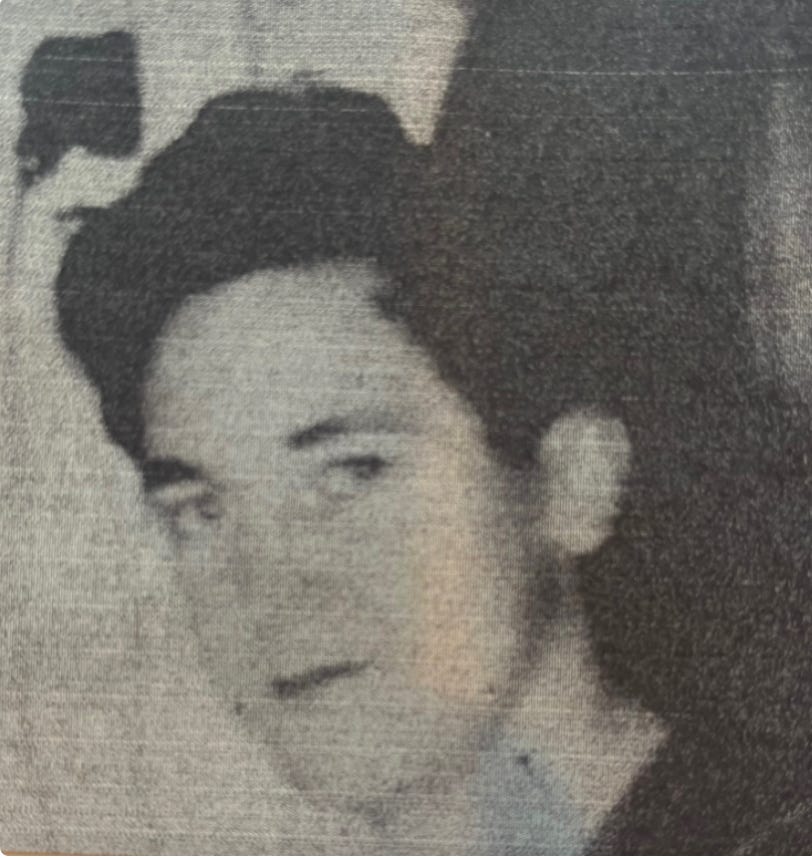
In any event, he didn’t get off to a good start in the Navy. He shared stories with us of ending up in the brig more than once, and of snapping back at the Marine guard taunting him. One time his Navy Chief, no doubt in a desperate attempt to burn off my father’s bad attitude, handed my father a toothbrush and ordered him to clean the entire cafeteria floor with it… on his hands and knees. The only thing that saved my father in the Navy was that my father had his Ham Radio license and eventually got to work in the radio room.
From there, he straightened out apparently, got his GED, and married my mother when he was discharged. Next was having kids right away, working full-time in an aircraft engine factory while going to school full-time for electronics, getting active in our church and the men’s groups there… all the things that proved to others what a good, upstanding family man he was.
Now, no question. And I honor this. He had turned his life around. He worked his tail off to make a better life. He knew how to set a goal and gain it. And he had achieved that level of community respect and acceptance, along with the integrity that he so craved. He just had to keep the “other side of him” hidden from outsiders.
That other side was the man we lived with at home. The man we got could be loving, doting, fun. And cold. Raging. Predatory. Violent. Dangerous. You just never knew what you were going to get on any given day.
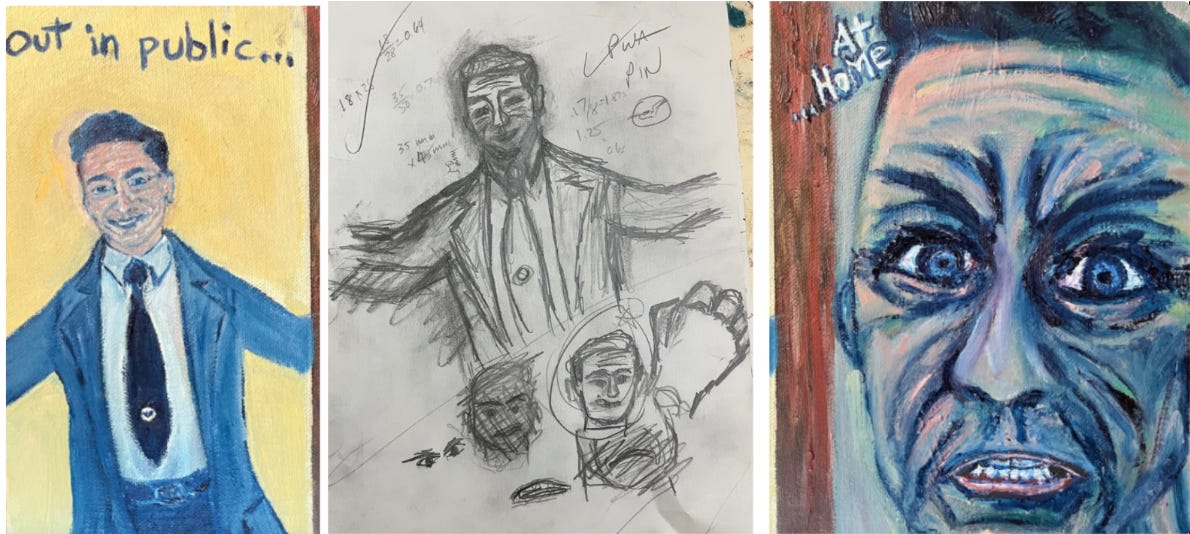
My father.
The man who explained to me, when I was in middle school, how men cheat and at first feel bad, but get over it after a while and with repetition. What kind of story do you tell yourself to make that one right?
The man who, at midlife, suddenly freaked out because, for a brief moment, “Truth” broke through his self-justifications when he was due to attend a religious retreat. But whatever the priest said to him there reassured him, and Dad came back convinced he was a good man… and started all over again on me. He conveniently chose HIS truth.
The man who, on a vacation trip to Nova Scotia when I was in my twenties, saw a news report about how a man’s daughter had him arrested for abuse. He immediately challenged me, demanding to know if I would do that to him because: “I had been abused.” He KNEW it was abuse. All along, despite his proclamations of love and goodness for the family and ….he…KNEW…it…was…abuse. Yet his only concern was getting caught.
So that was Dad. Loving. Lying. Cheating. Caring. The good family man – the man who, as he told me on his deathbed, “always wanted to stand for something.” And the man who maintained an iron grip on all of us so he could keep his outside “mirage” a reality.
His method was the family system rules he created, and his “tools of abuse. I will talk about all of that soon.
How did this affect my mother?
To the outside, he was Dick Phillip. Good family man. Usher at church. A member of the Holy Name Society. Worked in a research lab at the aircraft engine company. Made a decent income. Came home every night to his wife and kids.
At home, his family system was like a black hole in outer space. The system took on a life of its own. Insidiously, the forces of that system used confusion and mind-warps to eventually direct everyone’s behavior in the way he wanted it. That system, like a black hole, did grotesque things to anyone too close to it. Just like the one in outer space, that family system’s power began to warp, undermine, and distort us. Then, just like celestial bodies next to a black hole in space, you are sucked in, deconstructed, and lost.
And for us, by the time we might have realized it is messed up…which we didn’t…it’s too late. We were like a fish on a line ready for my father to reel in.
“…the Corruption Arc character’s self-delusion in the end may be so complete and compelling that it also warps the perception of others, pulling them down into the darkness as well.”
K.M.Weiland
For my mother and me, we may not have liked what was happening, but when it’s your “normal,” you just view it as “that’s life.” Some good. Some not so good. And you live with it the best you can.
It was only close to her death that I think my Mother realized the magnitude of the choices she yielded to him. I’ll speak more of her later. But I know that in her last year or two she was going to Confession weekly even as she hated it. She confided that she was afraid she was going to Hell.
Going to Hell for what? I think she knew she had made some bargains with his Devil to survive and to keep the family intact.
And yes, she did. But I will write more soon about what “options” faced her in that time and place. For now, I will simply introduce what was wielded against her in that house.
A narcissist in marriage – Insidious
I am going to speak in the next posts about the tools Dad used on all of us to brainwash and control us. And I will include the items below as they apply. For now, I just want to introduce a few concepts, which were perfectly distilled in a recent article I read:
- He decides what counts as an overreaction
- He rewrites arguments after they happen
- He keeps a running tally of what you owe him
- He makes your independence feel like betrayal
- He apologizes to keep you, not because he means it
Fahim Chughtai, Psychologist, Writer, and Abuse Survivor, “5 Disturbing Things Narcissists Do To Their Wives”
All of the above happened in our house. Regularly. Sometimes daily. And these were just the beginning steps of his demolition of our identities, independence, and very safety – the setup. They were followed up with his violent tools, which were the “slam dunk moves” to cement his control.
As the article above put it:
“You want to know what marriage to him actually looks like behind closed doors? Not romance. Not partnership. Not the version he performs at dinner parties and family holidays. Something quieter. Something that doesn’t announce itself as abuse because it never has to. It just has to work. You’re slowly being rewritten into someone easier to control, and calling it ‘just how he is.’”
What the article doesn’t say, but another goes on to describe, is that after the slow, insidious, quiet part above, comes the scary physical violence. For that abusive narcissist that was my father, whatever tool he needed was the one he would use. Sometimes, all of them at once.
Up next
There is no question that the upcoming Citrinitas posts will be the hardest, most mentally taxing section of the book. I have a lot to sift through. Process. Take in and integrate. His story is the essence of “How did this happen?” and “What do I do with him now?” So I will take my time as I write to reflect and think deeply.
Up next, I will begin to share his “toolbox of abusive control” shortly, and the methods he used against all of us in that house. For sure, he wielded them masterfully and played us all.
But before I get into that, I will take a moment to say a few things about “Family Systems” and “Domestic Abuse” first.
Note:
I am seeking financial support to complete my memoir, work with an editor, and make a visit to my home state for fact-checking. Your help would mean the world to me as I take this step toward healing and giving voice to my journey.
Please like, comment, and share this post to help spread the word. The link for my fundraiser is on GoFundMe. Thank you for your support.


Leave a Reply