Coercive Control
As I wrote in an earlier post, the ultimate goal of POW captors and domestic abusers is to dominate their captives through coercive control of their minds and behaviors. There are three main elements that captors need to create in their prisoners…or spouses and children…that will give them the leverage needed for ultimate control:
- Dependency
- Debility
- Dread
And in either instance, that’s where the methods listed on Biderman’s Chart of Coercion come in.
Here, for comparison, is a chart from an article in Psychology Today, “Biderman’s Chart of Coercion Applied to Domestic Violence,” by Lisa Aronson Fontes, Ph.D. It shows how the exact same methods from POW camps are used by domestic abusers:
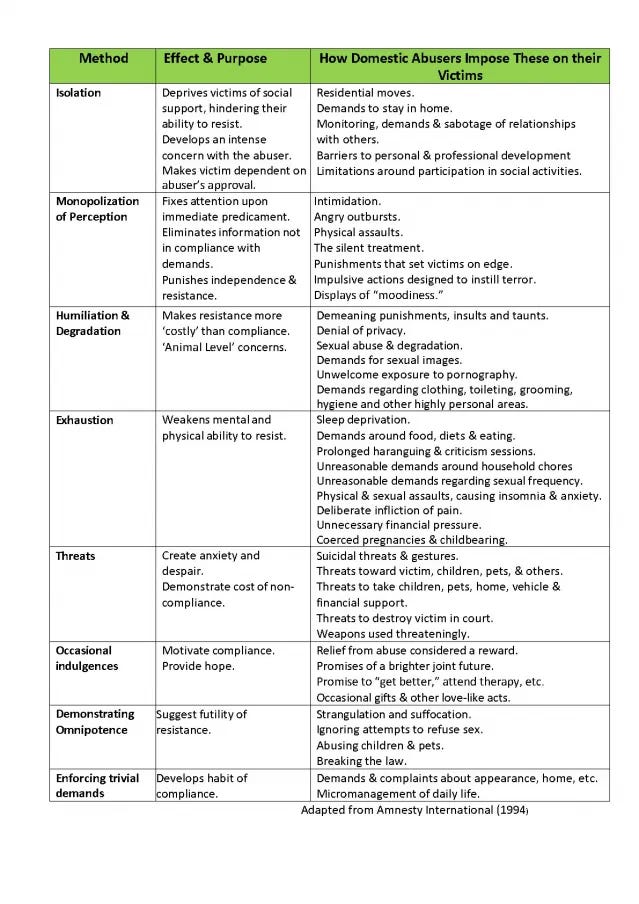
So, like a prisoner, a spouse may first be reduced to dependency through emotional, psychological, cultural, religious, physical, or financial means, as well as the responsibility for any children in the house. In such a situation, repeated emotional and psychological badgering wears them down to a point where they give up trying to fight back. And this is reinforced by instilling fear and terror through threats, intimidation, and/or violence. Such was the situation in our house.
My father’s tools
I spoke of my father creating a “family system” that ensured he got what he needed through the use of his “rules and tools.” Given my science background, I liken our family system to a cell, and his tools for abuse to the cell’s organelles – the structures inside a cell that do the work:
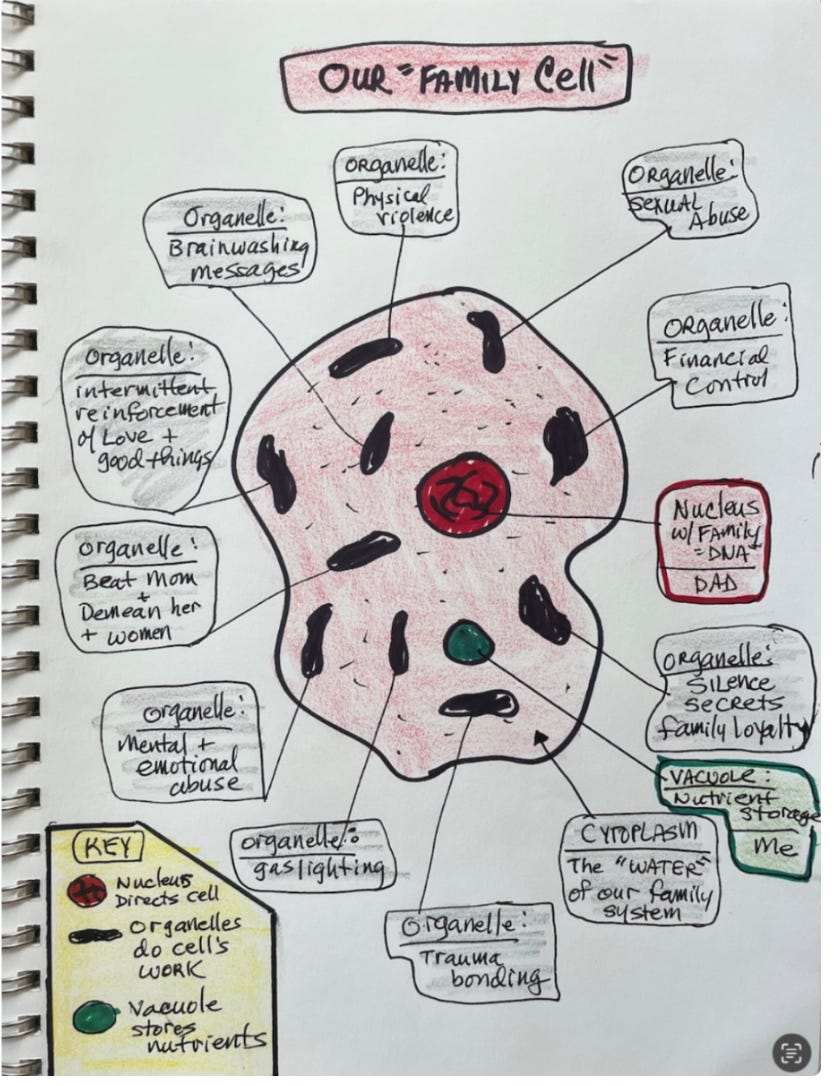
In the previous post, I listed the many ways my father enforced his dominance over us. Many are self-explanatory. But as I noted previously, their REAL power was not as individual tools but applied in groupings designed to achieve certain major goals of control.
Behavioral/operant conditioning and “training,” especially to induce “learned helplessness”
One of the main tools to gain control of a household is to get everyone clear on what behaviors you deem acceptable and what behaviors you won’t allow. Then add the next touch of eroding someone’s will to fight back, and the abuser becomes all-powerful, and resistance, futile. And in all of this, a victim’s body is a willing ally. A victim responding to these methods is not weak or just imagining things. There is actual body chemistry at work undermining a victim’s ability to fight this off, which then leads to their ultimate capitulation.
“In psychology, learned helplessness is a state that occurs after a person has repeatedly experienced a stressful situation. They believe they cannot control or change the situation, so they do not try, even when opportunities for change are available….Once someone…discovers they cannot control events around them, they lose motivation. Even if the opportunity allows people to alter their circumstances, they do not act.”
There is a technique called “elephant crushing” that is used to break the spirit of baby elephants so they will obey the commands of the elephant’s keeper and not try to fight back, even though the animal is much more powerful than its keeper. The elephants are restrained, either by being hobbled with ropes or chains, tied to a structure, or placed inside a tight wooden corral where they are unable to move. And sometimes, they are beaten. Given all of this, and with repetition, eventually the animal doesn’t even try to fight back. It just responds to the keeper’s commands.
Initially, it was thought that this was a learned response, but later research found it was actually a biological and chemical reaction – an innate defense response originating in the animal’s brain stem. Reacting to the sense of danger and stress, the animal’s brain stem produced serotonin, which caused the animal to become passive and not engage in normal behaviors.
This initial information came from the 1960s work of two University of Pennsylvania graduate students, Martin E.P. Seligman, PhD, and Steven F. Maier, PhD. In their experiments, they compared the reactions of dogs who received electrical shocks and had no way to escape them to dogs who were able to escape, or who could hit a lever and stop the shocks. The dogs unable to control the shocks gave up trying after a while and just lay there passively while they received more shocks. In contrast, the other two groups took action and either escaped the pen or hit the lever to stop the shocks.
Before I go on, I will state I don’t like those experiments and wonder if ethics boards today would allow that kind of pain to be inflicted on animals. But for here, I’ll just share what the scientists learned about stress reactions and the brain.
In that initial research, the scientists assumed that the passive reactions of that one group of dogs were a “learned” helplessness reaction. But through additional experiments over the years, they discovered that the animals were showing a biological/chemical reaction with serotonin coming from the brain stem in response to stress.
In 2016, they updated their conclusions about biochemical versus “learning” reactions. Any “learned” helplessness came from misguided thinking processes, which took place in other parts of the brain, including the prefrontal cortex. And the “learning part” was related to how the captive tried to take control of the stressful situation. The researchers also realized that the key to the success or failure of the learning aspect was whether the victim felt that any control was possible. So the passivity was due mainly to a faulty thinking/decision-making mode, after the biochemistry set the stress in motion.
Once the victim recognized a threat and their brain stem, through serotonin release, set off a stress reaction, the choice was to try to learn how to manage the stress and the situation and regain control. But there is that catch – control.
The success of this effort depends on whether or not the captive feels they have any chance for control of the situation, and how debilitated they become in trying. When a person lives in the constant state of stress and threat from domestic abuse, their brain stem, along with other organs, is flooding the body with stress chemicals. The cognitive effort to overcome those stress-inducing chemicals becomes massive. The more an abuser shows that THEY have control of the situation and resistance is impossible, the more stress chemicals are released, and the more a victim is debilitated, grows exhausted, and finally gives up hope. They stop trying.
This behavioral method is also called “operant conditioning,” and it is defined as:
“…a learning process that uses reinforcement or punishment to increase or decrease an organism’s behavior. It involves positive reinforcement, such as providing a reward for a desired action, and punishment to discourage unwanted behaviors.”
From ScienceDirect – “Operant Conditioning”
For my mother and me, we were subjected to huge amounts of stressful abuse that generated equally large amounts of stress hormones in our bodies and, hence, a strong fear and that “passivity” reaction in our behaviors. Other parts of our brains tried to fight back by looking for ways to ameliorate the situation, such as trying to anticipate what might set him off, or finding ways to placate him and keep him in a good mood. But it was to no avail.
His constant punishments – withdrawal of love, threats of violence, emotional punishments such as the silent treatment or guilt trips — wore us down…debilitated us…to the point we grew exhausted. The frequency, intensity, and duration of the abuse made resistance seem futile and the ability to control, hopeless. So we stopped trying.
While this tool alone might be enough to achieve submission, Dad made sure to bring in other methods to cement his omnipotence.
Humiliation, isolation, and identity destruction
Constantly shaming and demeaning someone demolishes their self-confidence and self-esteem. By continuing to chip away at a person’s sense of self and self-worth, they begin to doubt themselves and slowly begin to wonder if maybe the abuser is right. Little by little, they are invalidated as a person worthy of rights and respect.
Every time my father told my mother she was not desirable, or told us in front of her not to grow up to be a “stupid woman,” it had to crush her self-esteem more and more. Even worse, his tactics suggested to us how to view my mother and even gave implicit approval for us to be dismissive of her.
I look back on this and realize how many times I felt superior to her if I did something she wouldn’t have. And by doing so, I also gained his approval. In a house where so much punishment was handed out, anytime he gave praise, you soaked it up like a desert plant in a rainstorm. So I can remember being dismissive of her as a role model and considered her weak, afraid of things, and not the person I wanted to grow up to be.
Isolation was another great auxiliary tool to bring in to demolish her autonomy because, with no one else around to support my mother or stick up for her, she was alone against him. She was not really allowed to go out with friends at night or even to join the church choir. Any of that would have meant time not given to Dad, and also would introduce the risk that other people’s way of thinking would reduce his control over her.
Add in that the Slovak culture, the Catholic faith, and 1950s and 1960s attitudes toward women all meant she was subservient to her husband. Back then, women couldn’t work if they got pregnant, couldn’t get a loan or a credit card on their own, and so unless they were independently rich, they depended on their husbands for financial support.
Put all these things together – isolation, no support, and a system that actively disempowered women- and she was trapped. She had no independent identity, personal freedom, or agency to control her life. CONTROL – that key element – seemed impossible to achieve.
Even if she tried to fight back, he would bring the threat of violence, or actual violence, into the situation. She had no one to protect her from his temper. We were young. Her parents did not interfere during any fights. And no one else knew what was happening.
She was being emotionally, verbally, or physically bludgeoned, and was on her own against it all. After a while, I think she believed she was worthless, and over the years she became less and less of a person in her own right.
It didn’t help that he also made sure to reinforce that HIS needs, wants, and opinions were primary. The family system was totally geared toward him as the shining star. We were totally focused on gauging his moods and needs. Everything was about making sure he stayed happy, and violence was avoided. With a setup like that, there was no room left for anyone else. After a while, you just learned to ignore your needs, or even better, to shut them down. Better not to need anything.
And if you dared to need, or express upset with him for what was happening, that brought in the next set of tools…the “big guns”
Up next
Part II – The “big guns” and the rest of the toolbox….
Note:
I am seeking financial support to complete my memoir, work with an editor, and make a visit to my home state for fact-checking. Your help would mean the world to me as I take this step toward healing and giving voice to my journey.
Please like, comment, and share this post to help spread the word. The link for my fundraiser is on GoFundMe. Thank you for your support.
 Soul Mosaic
Leave a comment