Women with it all — raw power, wisdom, love, and loyalty
In her book The Receiving: Reclaiming Jewish Women’s Wisdom, Rabbi Tirzah Firestone lamented the lack of stories of women in Judaism. She demanded to know:
“Was there not even one Jewish counterpart to the Hindu poet Mirabai, the Islamic saint Rabi’ah, or the Catholic guide into the soul’s interior Teresa of Avila?….sorrowfully, Judaism was entering the twenty-first century with no named women mystics or spiritual guides.”
So she set about to find them, because they were there. Then she proceeded to write the stories of seven amazing Jewish women. Each of their stories added something to a particular aspect of Jewish mysticism, and also showed how each represented a component of feminine wisdom.
I knew what she meant…about the need to find stories of women who masterfully combined all the elements of a mystic – love, loyalty, wisdom, AND raw power. They were the ones who balanced all the parts of feminine wisdom, giving them true strength. They weren’t just warriors, nor were they only soft-hearted. They weren’t passive, nor did they steamroll an opponent. They knew how to blend all the ingredients into perfection. And I had managed to find a few of those in my life.
Divine Mothers
For ten years I studied Buddhism and learned about holding both love and anger, pain and compassion. And in those years one of the monks gave me the name “Auspicious Tara.” I had to look up the significance of the name, and I was blown away by the fact that Tara was the Buddhist goddess of compassion. Essentially, she was an Eastern equivalent of the Blessed Virgin Mary in Catholicism.
Initially, I wasn’t sure how I felt about this as I’d come to view Mary as somewhat of a milquetoast kind of woman – passive, obedient, meek, all-accepting of whatever the male culture threw at her. But it was actually in researching Tara, and then Judaism, that I came to realize my view of Mary was totally wrong.
Tara, while a compassion goddess, was nobody’s pushover. To be a mother figure and compassionate didn’t mean being a doormat. Sometimes maternal figures can be fierce protectors. And to show compassion didn’t mean just smiling at everyone. Sometimes true compassion means standing up to abusers and wrongdoers. Not jobs for the faint of heart.
As one monk explained – to allow someone to be abusive to another because you are trying to be nice is NOT compassion, either for the victim or the abuser. By allowing someone to be abusive, you are allowing them to not only harm another, but even themself. True compassion is to confront with empathy and strength, and seek to instruct and correct. And…sometimes flat-out fight.
The more I saw that compassion did not equal being a doormat or passive, the more I started to take another look at Mary. Here was a strong Jewish mother, someone who watched her son confront injustice and be killed for it. When all but one of his male followers abandoned him at the cross, Mary and her close women companions stood there with him. And after he died, she held that body, a Mother bearing the weight of crushing sorrow. THAT is no weak, passive, milquetoast woman.
I thought back to my days as a child in the Catholic church, standing by that statue with the “watery eyes” of Mary holding the crucified Jesus. I would stare at that statue, her grieving expression, her tear-filled eyes.
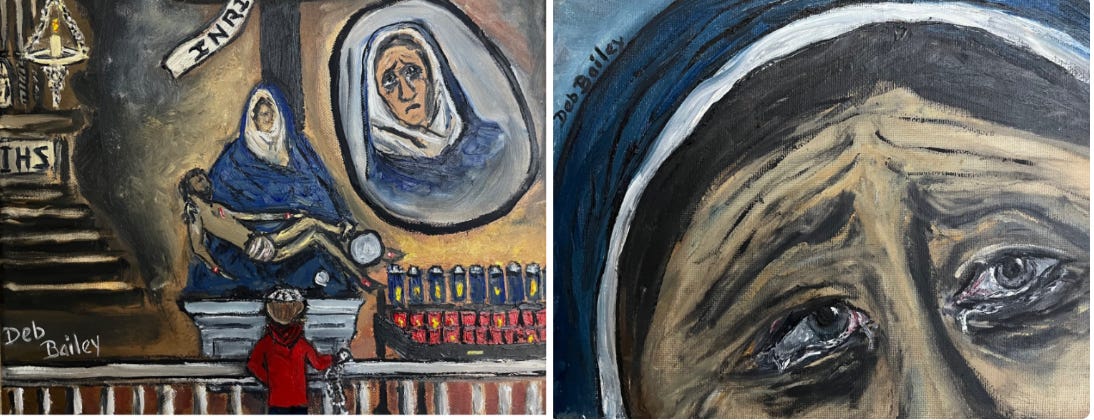
The Catholic church fathers had turned her into some blank-minded woman who blandly accepted all they did and said. But I have a feeling the real Mary didn’t mince words with them and had more than a few things to say about their cowardice that day.
They may have thought they, as the men in the church, knew all the answers and held the power. But they didn’t have a clue. Here was the woman who carried, gave birth to, raised, and then watched her son killed. Then HELD him…when the men of the church couldn’t be bothered to even show up. What kind of strength did it take for her in those moments? Those church fathers couldn’t hold a candle to her.
I was angry at them for what they had turned her into by restricting the Gospel stories to what they wanted them to be. They snuffed out the stories of all the women in the early church that Jesus relied on and gave leadership roles to.
So it was in meeting, then understanding Tara, that I started rethinking Mary. And that process taught me the TRUE meaning of compassion and the nature of true spiritual warriors.
Then, I discovered the Black Madonna. These were paintings and statues of Mary and the infant Jesus, only with black skin. The reason for the darkened skin tones is not clear, and explanations have ranged from soot from candles in the church or aging wood pigments of the sculpture, to intentionally representing the women of color struggling for justice:
‘’…these images illustrate a text from the Song of Solomon that reads, ‘I am black and beautiful’” (Song of Sol. 1:5)
Christine Valters Painter “Learn to take your troubles to the Black Madonna,” US Catholic, 04/28/2022
Painter’s article went on to add:
“Christian feminist theology sees the Black Madonna as revealing aspects of the sacred feminine that are generally not represented in traditional images of Mary. These dark representations of our Lady expand Mary’s image beyond her usual depiction as a docile white woman. The Black Madonna roots Mary in the struggle of her Black and brown sisters for justice. Even more than a connection through skin color, the Black Madonna reveals a dimension of the sacred feminine as one who is able to stay present with us through our own times of holy darkness. Mary in her beautiful blackness offers us a love in which she unequivocally claims that every oppressed person should be nourished, cherished, and welcomed. She compels us to act for justice out of this witness of expansive love.”
I LOVED THAT version of Mary. Fierce. Strong. Able to carry heavy weights, and to understand ALL of us when we struggle to carry ours. And unwilling to stand for injustice. What an image to hold up for what a woman should be.
Also, I found that the author of this article, who was grieving over the too-early loss of her mother, felt the same way about how the men of the church had stripped Mary of her power. Put off by that image, she instead found the Black Madonna to be the real comfort. The Black Madonna reclaimed power and redefined Mary’s true nature:
“I found myself crying out to Mother Mary in ways I had never done before. I had always admired Mary but retreated from the docile and pure images that churches promote of her. In my lament, I began to encounter a fiercer Mary, one who knew the weight of loss and how it strips away everything you thought you needed to navigate in the world. I discovered Mary, Mother of Sorrows, who could sit with me in my anguish and disorientation. It was in these underworld days that I was introduced to the Black Madonna. Her image felt substantial enough to meet my pain. This dark mother knew the weight of her own son’s body in her arms.”
So it was by finding THESE ultimate divine feminine symbols that I fed my need for the “Divine Mother” in my soul. Here in them I found the perfect blend of love, loyalty, and grief, along with the raw powers of the fierce protector, all while balanced with compassion and gentleness. And, as Tara led me back to Mary and then on to the Black Madonna, all of them led me to Rabbi Firestone and her book of seven Jewish women who make up the Divine Feminine.
Why all of this talk of crones, goddesses, and heroines?
So why am I talking about mystical and mythological goddesses when I am writing a book on healing from sexual abuse?
Well, why NOT goddesses, powerful mystics, and seers?
Why not write of us as women bearing the fierce power of the earth’s very core?
We’ve been demeaned, abused, made to feel dirty, and broken. We’ve had life’s possibilities taken from us and our very innocence.
And yes, while the practical first needs we have for healing truly need a therapist, what about also feeding our soul? As we work through therapy, finding jobs, trying to keep going each day when we would almost rather give up and die, why NOT start to envision ourselves as powerful goddesses who’ve been through hell and emerged, transformed? Maybe even “transfigured,” to use a biblical term applied to the moment a deity reveals to us the fullness of their indescribable magnificence.
Why NOT view ourselves for once with awe, honor, and respect, and acknowledge our POWER! Because if we are still here, WE HAVE POWER!. And we should hold our heads high, and give ourselves love, kindness, and admiration.
So are we goddesses? Hell, yes! Goddesses of survival and transformation, for sure. Given that, why not add in some mysticism along with our therapy work?
So what have I learned?
These stories showed me the pain. The poor choices. The heroic and powerful ones. I got to see women who succumbed to their suffering, women who found and used raw power, and then, women who combined all of it – wisdom, love, loyalty, compassion AND raw power – to achieve something on the level of divine love.
At the end of this Rubedo section, I’ll speak more completely about things I have learned through writing this book. But I do want to share here a few thoughts on reclaiming the power of that mystical and mythological feminine force in life.
In the Foreword of the book by Kris Spisak, Becoming Baba Yaga, I found a great summation of this:
“Baba Yaga and her kin bring the magic back. And with that magic comes bravery. Bravery to see wonder amid pain. To never stop searching for meaning in the everyday. To stop running. To stand up. To do the deeds that justice demands be done.”
GennaRose Nethercott
Sometimes, there just aren’t people around us in our everyday environment that can help us, guide us, offer us support. But at least for me, as long as there were women of story, spirit, and myth that I could connect with, I had a chance to hang on. I felt I wasn’t alone.
I found in those tales what author Sharon Blackie calls “a kind of ‘Council of Grandmothers,’” feminine forces to pull me back toward them, and back to my long-ago abandoned powers and insights. In that book, Wise Woman, Blackie talked about the elder years as “a time when we might become more ourselves, rather than less,” and a place where we can “embrace the idea that the second half of life is a whole new adventure.”
So rather than seeing myself, or letting anyone else characterize me as, that worthless old “stara baba” hag, I feel fired up and ready for new challenges…for MEANING, and with less fear.
Where my journey began with a search for identity and so many doubts about whether and how I could take up a new role, now, each day, I focus on developing the powers that will let me do just that. Maureen Murdock wrote in her book The Heroine’s Journey that:
“The heroine must become a spiritual warrior. This demands that she learn the delicate art of balance…the patience for the slow, subtle integration of the feminine and masculine aspects of herself…She will then begin to use these skills to work toward the larger quest of bringing people together, rather than for her own individual gain.”
Jean Shinoda Bolen’s book, Goddesses in Older Women, was a godsend of wisdom for me about navigating this elder stage of life. It is the time for meaning…for choices, for accomplishing the tasks that demand a life’s worth of accumulated experience and knowledge.
For now, I will share one quote from her book that sums up the goal:
“To be a choicemaker in the third phase means that what you choose to do or be must correspond with what is true for you at a soul level. What you do with your life is then meaningful; it is something you know in your bones, at your core, in your soul.”
Identity. Meaning. Choices. Truth. Courage. Focus. All of these are coming to the fore in me just as ideas for what I want in life are also solidifying.
Actress Bette Davis once commented that “Old age ain’t no place for sissies,” and she is right. There will be coming challenges of illness, decline, the indignities life inflicts, and of course, death. But until that time arrives, I don’t want to waste one bit of my healing. Because, to quote a man, Yogi Berra, “it ain’t over ‘til it’s over,” and I refuse to yield a moment of possibility and adventure until then.
Up Next
Now, returning to that mention above about integrating the feminine and masculine, it’s time to consider how to marry both…
Note:
I am seeking financial support to complete my memoir, work with an editor, and make a visit to my home state for fact-checking. Your help would mean the world to me as I take this step toward healing and giving voice to my journey.
Please like, comment, and share this post to help spread the word. The link for my fundraiser is on GoFundMe. Thank you for your support.


Leave a Reply