Archive for the ‘Broken Bits’ Category

The Post – Turtle Talk, One More Thing: Globe-trekking

January 13, 2011

In my last post I talked about a turtle rescue facility here in NC, the Karen Beasley Sea Turtle Rescue and Rehabilitation Center . One of the things they do is to attach satellite tracking devices to some of the turtles being released. A link on the site explains how satellite tracking works, and best of all, has links for each of the turtles tagged!  You can see the story of that turtle, how they were injured, and then see the map of their activity after being released. It’s pretty cool!

There’s also a link to another site, seaturtle.org, that is just FULL of all kinds of turtle and their journeys – HUNDREDS of turtle journeys all over the world!!!!  One of the maps shows the routes along Florida taken by about 12 turtles. The map looks like rainbow–colored fireworks! The site description reads: “SEATURTLE.ORG’s Satellite Tracking Program has been developed in cooperation with the Marine Turtle Research Group (MTRG).”

If that isn’t enough, there was an article on Yahoo.com , Sat-nav turtles go on trans-ocean trek, that also has information and maps on sea turtle journeys tracked by satellite. I don’t know for sure if they’re part of MTRG, (possibly, since these researchers were at the University of Exeter in England, and MTRG has a group there), but they’re doing the same kind of work.

If you love turtles, if you’ve ever stayed awake at night wondering where sea turtles go once they scramble off the beaches and slip beneath the waves, if you’ve ever wanted to be a sea turtle and wondered where they go….these sites are for you! Enjoy!

The Post – Let’s Talk Turtle

January 12, 2011

Let’s switch animals for a moment and move to sea turtles, another favorite of mine. And maybe a personal connection. My mother-in-law always promised to come back as a sea turtle and I bet she kept her word.

But anyway…. being an oil painter, that means I keep 4-6 oil paintings going at a time. Given that the paint takes a while to dry whenever I do something, I would be sitting around waiting a week to do something next. Having several going at once means I can keep moving projects forward.

In that vein, aside from the seagull/seascape pic I’m currently working on, and a painting for my niece of the place she’ll be married at in CT next July, I finished everything else. So hence the plans for the dolphin painting. I also want to do a painting for a friend and she loves sea turtles too, so time to start that as well.

I’m not going to get into a discussion…YET…about what canvas and composition for that one, a little pressed for time today. But I would love to share a place with you all that’s one of my favorites on the coast here in NC, the Karen Beasley Sea Turtle Rescue and Rehabilitation Center, on Topsail Island, NC.

Though I don’t have the full details, I know it got started with the efforts of Karen Beasley rescuing sea turtles on her own and expanding her efforts. She sadly died young of cancer and her mom took up the mission. The facility has been going since the mid-90s and is now building a new turtle hospital.  Sometimes fishermen give them injured turtles, often they find them. They care for the creatures, heal their wounds – physical for sure, emotional hopefully, but they care for them professionally and with great love. This includes a large number of college students who vie for the opportunity to intern there in the summers.

If you click on the link above you can visit the home page, where there are links to pictures, an index of all the turtles they ever rescued (and their status – MANY success stories), and even a list of turtles you can adopt. As the site states:   All donations are directly applied to food, medical supplies, and operating costs of the hospital. We receive no state or federal funding

Focus is to release except for turtles so badly hurt they can never be released. I’m trying to track down details right now about one turtle I met at a reptile and amphibian show at the NC Museum of Natural Sciences in Raleigh, NC a couple of years ago. A lovely, gentle creature who was blinded by human actions, but had a robust spirit and seemed very content in their care. If I can learn more, I’ll share the story.

They also participate in the turtle nesting project – locating and marking turtle nests to protect them, engaging volunteers to find and mark them and watch over them, helping newly hatched turtles find their way into the ocean waters, etc.

They even fit some of the turtles with monitors to satellite track them and there’s some data at the website under Satellite Tracking!!

Its’s a great facility. If you have a soft spot in your heart for sea turtles, please visit their site. Consider donating, but at least visit the site and learn about all the wonderful works they do. Such beautiful creatures…..and people. 🙂

PS If you ever get to go to Topsail Beach on Topsail Island, NC, GO VISIT THEM!!!! They do tours of the facility in the summer.  Even though it’s popular and you may stand in line in the sweltering hear for a couple hours, it’s worth it to see the turtles AND to see just how professional and caring these people are!

The Post – Dolphins: What canvas, What image?

January 10, 2011

Okay. So the easy part is over. I know I want to do a painting of dolphins, to capture their beauty, fluidity, personality, intelligence. Now we come to the hard part – how to execute that?

I will say that the short answer is – it comes down to gut feeling about composition and canvas size and shape. And that nothing is cast in concrete. One can get halfway through the painting only to realize you need to turn the painting 90degrees and start again, or paint over the whole thing and get a new composition. However – I do try to narrow some things down then follow my gut. Probably the best I can hope for is to answer three first questions , then identify what other questions need answering as I go through this process.

The first three questions are-

1) what size of canvas?

2) what orientation (vertical or horizontal)

2) what composition?

The size and orientation are determined by the composition, though composition is  determined by the size and orientation of the canvas. To get to the final choice, at least for me, it is a  working back and forth, see-sawing between all three until the choices are narrowed down to a decision.

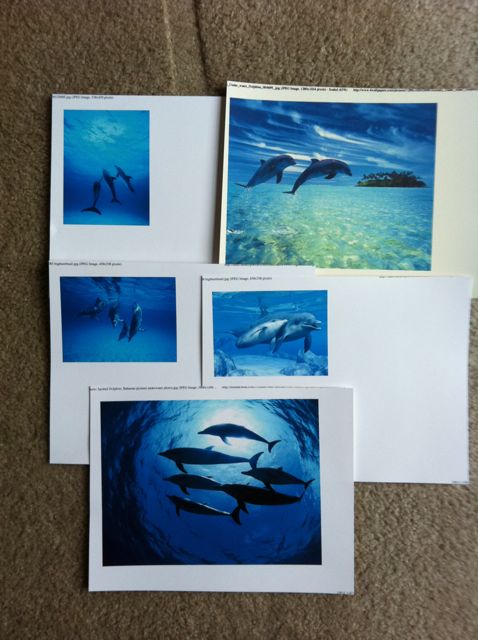
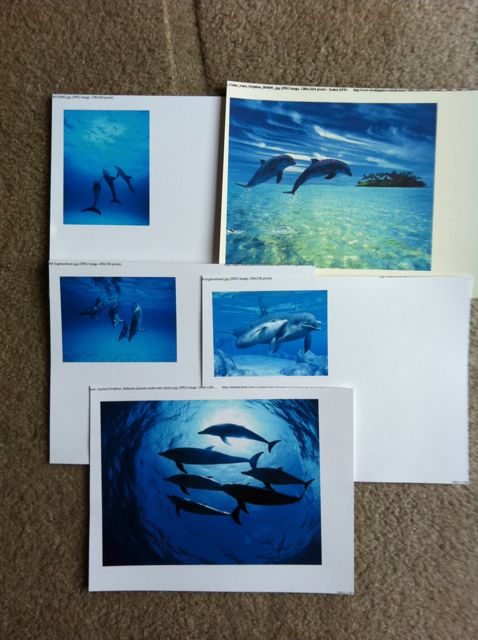
I start by going to Google images and just printing some pics of dolphins that “spoke” to me to get an idea of what compositions might work and what they even look like.

Some were “vertical” in orientation, some horizontal. Most had at least a couple dolphins, some had several. All had the “underside of the surface waves” at the top of the picture. So I have a “vague” idea of my own composition –

In thinking about my “vision” I know I want the top of the painting to show that we’re just under the water’s surface – so the top of the painting has to have that quality of “seeing the underside of surface waves.”

Also, at this point my gut tells me “simple vs. cluttered,” so I’ll keep the number of dolphins low. One solitary dolphin feels wrong as they’re social creatures, so I think I’ll keep the composition to two or three at most.

At least one dolphin has to to give us that “look it in the eye” connection, so they all can’t just be a “far away view.”

In looking at the pics I see I could do horizontal dolphins in a horizontal canvas, and it has potential. I can also do vertical ones in a horizontal canvas. However that means dolphins far away. Vertical dolphins on a vertical canvas feels better than on a horizontal one. You can get closer to them. So which is it? horizontal dolphins on horizontal canvas, or vertical dolphins on a vertical canvas?

And of course, my gut pipes up with – you could do something odd like a vertical canvas with an angled down but mostly horizontal dolpin or…..ARGGGHHH! 🙂

Let’s take a break and consider what size canvas.

Re the canvas size:

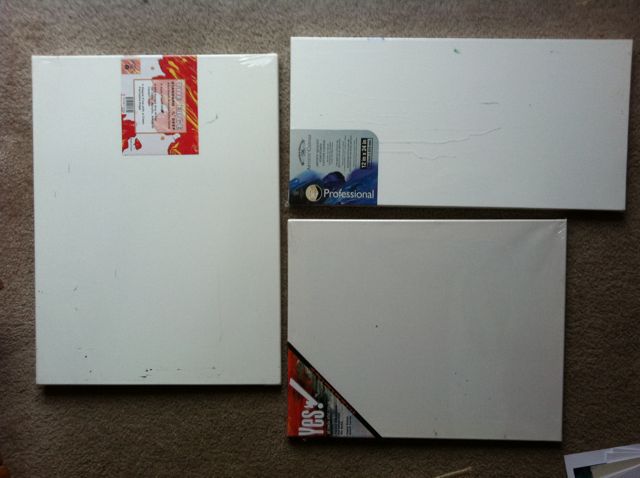
Let’s face it. This painting could go from 2×4″ to 4’x8′ or a wall fresco. But I work in more intermediate size ranges and avoid the extremes.

My favorite size often is 8×16, which is an odd size but I like it. It’s usually just big enough to capture creatures or seascapes and I just “like” that shape.

But I think that will be too small for what I have in mind here. So we’ll go for a size a little bit bigger.

My other frequent choices are: 18×24″, 16×20″ or 12×24″. So I think one of these will be my choice. Let’s leave size for a minute then and hop over to orientation.

Re: orientation” for the canvas used: Will I paint it with a “vertical” approach, meaning taller than wide? Or will I paint it “horizontally” meaning wide with a narrow height?

If I go tall and narrow width, that means I’m showing many layers of water and I’m probably going to have to paint smaller dolphins….unless I have several in the background and one more forward, diving deep and straight down so I could make the full length of the dolphin apparent. Overall, it’s more of a “long shot of the whole area” with a focus on one dolphin. It could work as a way to show the personality of one closeup. Also, a dolphin is long and narrow, so I could use a vertical oriented canvas and have a diving dolphin to show that.  But I’m not sure.

If I go long on the horizontal and shorter on height this means I’m painting a narrower slice of water. Thus any dolphins shown will be larger and more the focus of the painting for sure. However, then the focus instead of being on one dolphin, becomes all of the dolphins  as they’ll be about equal in size and close in proximity. And keeping with the long and narrow on the dolphin shape, a horizontal canvas means no diving dolphins – they would have to be horizontal as well to get across that whole “long and narrow” feeling.

Okay, so I haven’t yet identified “which canvas and orientation” but I HAVE listed some pros and cons of each. And in reality, the canvas shape is really a choice between two. The 16×20 and 18×24 are almost identical in ratio, just for a little bit more size on each dimension on the 18×24,whereas the 12 x 24 has a much longer vs narrow feel to it.  So the decision really comes down to 12×24 or one of those two.

In the hopes of clearing up the confusion, maybe it’s time to go back to composition.

To recap – most likely, vertical dolphins on a vertical canvas, or horizontal ones on a horizontal canvas. With the surface showing above. With two or three dolphins. And a canvas either 12×24 or one of the other two.

I sense that I want a focus on one dolphin with the others possibly in the background. And to have a full-size dolphin horizontal feels boring. More drama in having one of three “plunging” down to the deep sea. Action. Not just being.

What to do right now?

Feel. Stare. Digest. Incubate.


Stay tuned for ….decisions. At least “best guesses”  🙂

The Post – Dolphins: Artist Approach Step 1- Soul

January 9, 2011

I am not a marine scientist so I cannot weigh in on the scientific merits of the free vs. captive dolphin debate. However, I am an artist and there, I can serve the marine mammals. If seeing them in captivity is supposed to forge an emotional connection, then maybe seeing them lovely portrayed in a painting can do the same.

I also have a friend who expressed an interest in having a painting of a fish underwater. I think the original will have to be hers, but the prints will become my gift to the world and to dolphins in particular.

This morning, on a quest to see how I might approach this endeavor, I spent some quality time on Google images. Did a search on the term “dolphins underwater” and went to the “images” heading. There I found many photos to inspire me. I never actually copy a photo, but I do glean a “feeling” of the animal, it’s emotions, how it holds itself in the water, its soul.

But it’s not just the animal I need to “feel” but it’s environment. I need to “feel the fluidity, denseness, and motion” of the water around it along with how the light cuts through the layers of liquid. I need to feel the “temperature” of the environment – cold Arctic waters or warm Caribbean. And is it clear or cloudy with plankton, debris, dirt.

I often print out a few key pictures and just stare at them. Soak up their soul, shapes, colors….until I’ve internalized the animal and its space.

Next will be “Step 2 – Composition”  Stay tuned.


The Post – Octopus Ballet

January 8, 2011

After the intensity of the last post, here’s something relaxing, beautiful, and meditative….an underwater ballet: The Cirrate octopus undulates through the dark depths of the Taney Seamounts, west of San Francisco. This gem comes to us through Boingboing, and was shot by the Monterey Bay Aquarium Research Institute (MBARI).  Click here for the article and video, and enjoy.  🙂

The Post – Dolphins: An Ethical Problem

January 8, 2011

Has anyone ever thought about dolphins in amusement parks / aquariums and wondered if they were happy?  I have to admit I never thought about it much. I figured if they were kept humanely, fed well, kept active and busy, that was good. But maybe that’s not the case.

I came across this article in the Times from January 2010 that said:

“Dolphins have been declared the world’s second most intelligent creatures after humans, with scientists suggesting they are so bright that they should be treated as “non-human persons”……The researchers argue that their work shows it is morally unacceptable to keep such intelligent animals in amusement parks or to kill them for food or by accident when fishing. Some 300,000 whales, dolphins and porpoises die in this way each year.”

This gave me pause, especially since for 10 years I worked on an ethics board protecting human beings in clinical research studies. I am supposed to think outside the box to make sure all are treated ethically. So I dug further into the topic of dolphin ethics and found a bit more.

An article by Kris Stewart on the Ethos website, states:

“The ways that dolphins are captured, transported, and kept for research, display and/or entertainment raises many ethical concerns. Family groups are broken up when one or more dolphins are taken from their home waters in traumatic takings, and the effects of changing the social structure of the wild population once those individuals are removed from the community are unknown. Many captive dolphins display physiological and behavioral indicators of stress such as elevated adrenocortical hormones, stereotyped behavior, self-destruction, self-mutilation, and excessive aggressiveness towards humans and other dolphins. To be sure, captive dolphin facilities vary around the world, but even if Panama provided the very best in captive dolphin care and management, the decision to keep healthy dolphins in human care at all disregards their moral value. Captivity denies dolphins their psychological, physical, and social integrity, inflicts untold kinds and amounts of stress, and drastically alters the fundamental life experience of being a dolphin.”

I looked into the Times article further and found this on one of the researchers quoted in the article:

Emory University neuroscientist Lori Marino, states that: “Dolphins are sophisticated, self-aware, highly intelligent beings with individual personalities, autonomy and an inner life. They are vulnerable to tremendous suffering and psychological trauma,” …The growing industry of capturing and confining dolphins to perform in marine parks or to swim with tourists at resorts needs to be reconsidered, she says.”

Marino presented these findings along with another researcher, Dr. Diana Reiss, professor of psychology at Hunter College, City University of New York, at the American Association for the Advancement of Science conference (AAAS) in San Diego, on Sunday, Feb. 21, 2010. Click the following two links to read an article about Dr. Marino’s presentation, and to hear her speak on video about this topic: her article and a video of an interview with her

Dr. Thomas White, professor of ethics at Loyola Marymount University, Los Angeles, and a fellow at the Oxford Centre For Animal Ethics, apparently also spoke at this conference. An excerpt of his speech: click here

Giving a response to these topics was Dr. Jerry Schubel, Director of the Aquarium of the Pacific. At the website, Physics Buzz, there was an entry by the blogger, Alaina G. Levine, Much Ado about Dolphins, even if they don’t wear physics t-shirts, that contained some of his comments. She also gave a somewhat critical discussion on whether this effort is going too far. Her summation of Dr. Schubel’s comments though, shows a man who is not the anti-Christ in this, isn’t trying to harm dolphins and actually has some good criteria for when dolphins might be ethically served by being in captivity:

“However, Jerry Schubel, President and CEO of the Aquarium of the Pacific in Long Beach, CA, who served as the “Discussant” for the session on dolphins, had some fascinating comments on the matter.

He agreed wholeheartedly that ethics should prevent us from having dolphin hunts (called drives, these are brutally shown in the Oscar-nominated documentary, The Cove). But he posited that there might be ethical scenarios that would support captivity. If a dolphin was born in captivity, or had been rescued and needed rehabilitation, Schubel argued, then detention would be an acceptable situation. Furthermore, if a dolphin was chronically ill and release would surely lead to death, then again captivity would be ok.

But Schubel was quick to point out that any dolphin captivity must come with “the right conditions, and…have the right conditions to enable it to connect with humans,” such as at aquariums, he said.

“Aquariums have a powerful role to play if we view our collections of these animals as ambassadors to the wild…,” he declared. Aquariums that have dolphins have a wonderful opportunity to affect policies to prevent slaughters, and …to raise the bar to try to get [people] to agree on how to keep these animals in captivity.” He joked that the fish in his aquarium have much better health insurance than he does.

Schubel went on to say “when families watch these animals perform, they are emotionally connected [with the dolphins].”

The blogger noted, and I agree, that emotional connections can go either way. Dr. Schubel’s  comments appeared a week before a staffer was killed by an orca, in a Florida aquarium. I suspect that shifted public emotions too, but possibly not in a good way. So depending on public emotions to prove a point can be a variable thing.

A report on that conference (click here) revealed that although the various researchers disagree on what is the best thing for dolphins, there was a lack of polarized or extremist attitudes in their discussion:

“There was a distinct lack of any animal-rightist stridency or blanket extremism among these experts. They disagreed as to whether holding dolphins and their relatives in any type of captivity was morally defensible. Dr. Marino argued that even the best captive conditions offer an environment one ten-thousandth of a percent (that’s 0.000001) the size of their native habitat.

Dr. Riess and other discussants – in particular, Dr. Jerry Schubel of the Aquarium of the Pacific in Long Beach, CA – countered that limited and extremely sensitive keeping of the animals not only allows us to learn more about their biology but also to engage people of all ages in caring about their survival.”

In fact, a number of the researchers, regardless of the side they are on, wrote jacket text for a book by Thomas I White: In Defense of Dolphins: The New Moral Frontier.
At this stage it seems that this is an exploration of the topic, a learned discussion of pros and cons, with an eye toward making sure these beautiful brilliant creatures are recognized as highly intelligent sentient beings and treated properly. However even though I lean toward the side of not having them in captivity, especially just for entertainment purposes, the criteria Dr. Schubel gave for situations to have them in captivity, seem reasonable to me. As in many arguments of ethics, there is often some “black-and-white” and a LOT of gray.
The Post – Pretty Jellyfish and Citizen Scientists

January 7, 2011

Something to relax with on a Friday afternoon after a long week…..some pretty jellyfish.

Click here for jellyfish article and video

One of the researchers in the video, Steve Haddock, has the public assist him in tracking jellyfish in the ocean. The website: http://www.jellywatch.org/ is a place to check out if you want to be part of his citizen science effort. The website is used to collect sightings of jellyfish and other marine creatures by the public. You can just go to the site and submit a report of what you saw. You can even establish your own account and become a regular contributor to his research efforts.

If you’d like to learn more about Steve Haddock, the Monterey Bay Aquarium Research Institute scientist who studies jellyfish, just click here.

The Post – Ants, Baby-Boomers, and the Greater Good

January 7, 2011

The BBC Online just published an article: Leaf Cutter Ants Retire When Their Teeth Wear Out. Now given the title of this post I can imagine you’re connecting ants to Baby-Boomers and protesting that we have better dental care so no forced retirement for us! 🙂  But not to worry.

Quite to the contrary, in reading the article, I was struck by a similarity between the two groups that has nothing to do with teeth, but a lot to do with continuing to have a valuable contribution, even as we age.

The BBC article summarizes research done by scientists at the University of Oregon and that was published in the journal, Behaviour Ecology and Sociobiology. I know, sounds like a real page-turner. But bear with me just a bit.

Apparently, using electron microscopes, they were able to verify that pupae of the leaf-cutter ant from Panama, Atta cephalotes, have mandibles as sharp as any razor blade we’ve developed and hence work great for chopping up leaves. Older ants, however, have much duller mandibles, about 340 x duller than pupae and it takes them twice as long to cut up leaves. Some of the older ants only have about 10% of the sharp cutting material left.

The leaves, by the way, are used in food production for the colony. The ants apparently use the sap for food, and they also use the leaf material to grow a fungus, also as food for the colony. (The fungus is a member of  the Lepiotaceae family.)

Anyways, given that the most labor-intensive job in the colony is the chopping of leaves, the ants have developed a system where the youngest ants do the cutting, and older ants carry the leaves back to the nest. They have devised a means where an older ant with little cutting ability left, can actually make a contribution to the colony doing a job they are better suited for. This serves the greater good by allowing the younger ones to what they do best – keep on cutting.

I thought about our society where often Baby-Boomers want to continue in a career path well into their later years rather than just heading out to pasture.  But often we need to reinvent ourselves a bit – pursue that career from a different angle, use our years of experience as a pro to make the whole effort more efficient. Do tasks we are best suited for.

I have a 30+ year medical and pharmaceutical research background. More recently I wanted to continue using that background but in a new way. I am now volunteering at a local science museum, using those 30  years of science, to reach out to the new generation coming up and fire them with a love of science. It is work I am better suited at now. I admire those my age who can still work double shifts or all-nighters at the local hospital lab.  It is no small achievement. I have been given the chance to avoid that, so I find my usefulness in other ways.

It carries over into other areas of life too, not just careers. It snowed recently and my husband and I were preparing to go out and shovel the driveway. Our 22-year-old son stopped us and told us he had it covered. In a short period of time he completed a job that I am still able to do but which would have taken me much longer. His willingness to step up to something he was best suited for, allowed me to work inside on things I was better suited to do. I felt tremendous gratitude.

So when I read about the leaf-cutter ants, I think, re-invention, and remember my son and the snow. 🙂

The Post – Bird Deaths, Another Take

January 6, 2011

Here is an article that quotes a Smithsonian bird expert as stating the large bird deaths around the country and world are not necessarily surprising or concerning. The author proceeds to offer different possibilities for what happened and why these events are probably not related or cause for worry. Whether you agree or disagree, it is an interesting read, and the author does raise the issue that humans have a penchant for pattern-finding, except many times the “patterns” aren’t ones, and the “connections” don’t exist. I share here for a different point of view.

From Boingboing:    Bird expert: Don’t worry too much about the Deadbirdpocalypse   by Maggie Koerth-Baker

The Post – Animal Deaths and Mental Shutdown

January 6, 2011

I’ve been following somewhat off and on, the massive fish and bird die-offs being mentioned in the news. I kept up with it when it was the red-winged blackbirds in Arkansas, then the additional birds in Louisiana, and even kept up with dead fish in Sweden and dead crabs on the coast of England. I was trying to create a mental picture of it all to see if there was any “connection” or “pattern” or even how they all related to each other geographically.

But if you’re like me, you can take in just so much “data” and then the mental picture evaporates, the brain seizes up, gives out one last exasperated gasp folds in on itself in a quivering mass of jelly. Needless to say, one too many animal death groups appeared in the news and suddenly, it was all one chaotic blubbering mass of info that my brain could no longer process.

At the science museum I volunteer at, we are working on displays for a new lab area. This area is called ‘visualization.’  Essentially it is the use of technology to display visually, large amounts of data points that are beyond the ability of the brain to contain, much less put in any kind of meaningful order. It is used in science and a variety of other situations where you need to review a lot of data, try to find some meaning or understandings so as to draw possible conclusions or form theories. Without these tools it would be impossible to deal with the huge about of information. To read more on this subject see the entry at Wikipedia.

Anyway, I was lost in the morass that was a growing number of reports of mass animal deaths around the world. Enter the amazing tool that is Google Maps and lo, there is salvation. They have a map that shows all the various animal death events around the world along with a sidebar giving details.  So I share with anyone out there who wants to see the big picture but can no longer do it in your head, the Google Maps “big picture” link. Just  click here.