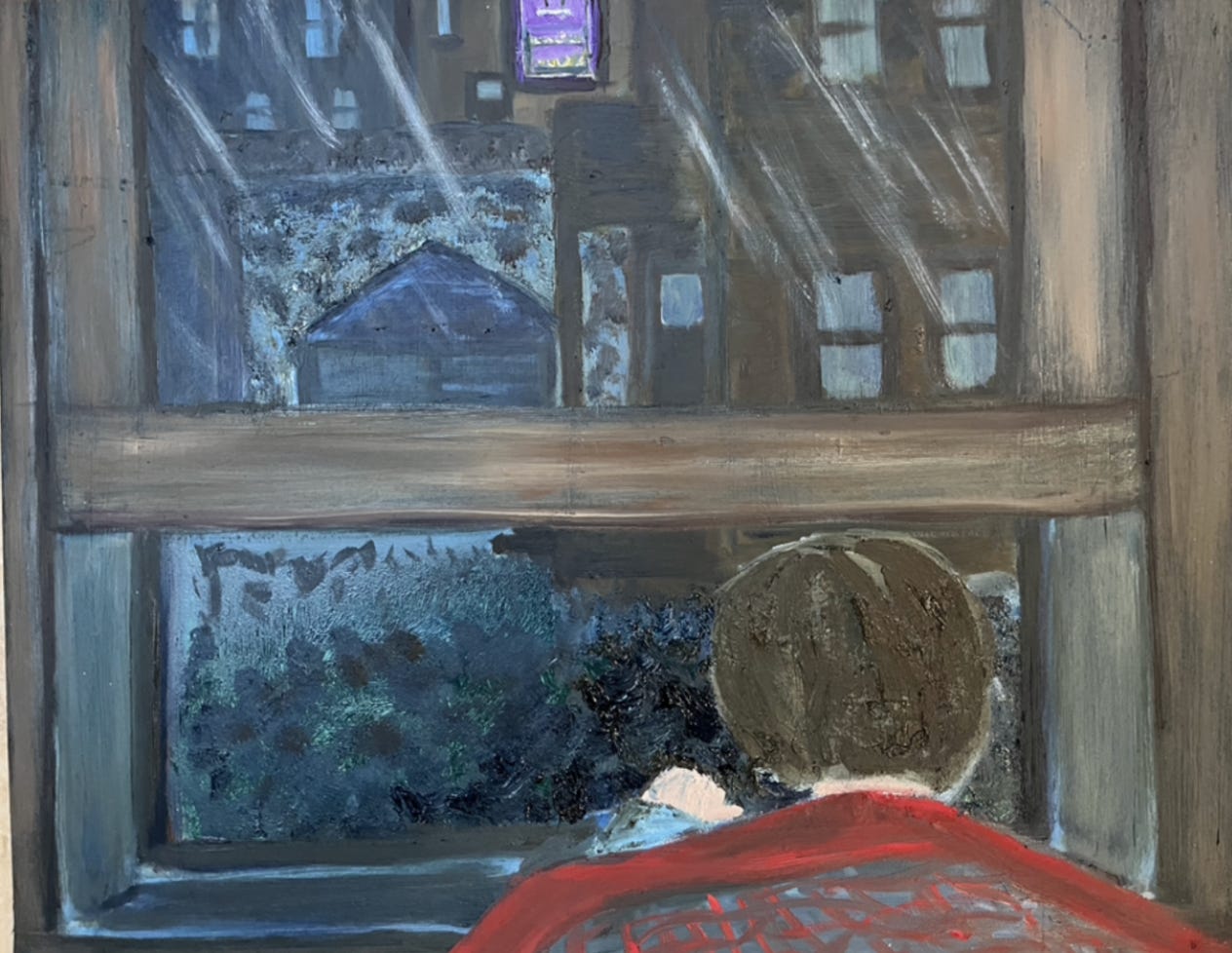
So many nights, especially in the summer, if it was Dad’s week to work 2nd shift, I loved to stare out of my bedroom window. I knew Mom was asleep on the couch as she watched TV.
So, I would crawl out of bed, shut the door, and just curl up against my open bedroom window. Even on the hot days, there was usually a cool breeze at night. And often the smell of fresh-cut grass would waft inside.
The shaded living room windows of the house next door glowed a dim yellow. And through the darkness, I could see the various houses that backed up to our yard. A few windows here and there were lit up behind their curtains. But there was one house in particular I always looked for.
It was at the far end of our neighbor’s yard, sitting atop a retaining wall. The house faced the next street over, but I could see its back windows, and in particular, one small window on the second floor. It was probably a kitchen or pantry window, given its size. But the special thing about it was that it was always bathed in a soft purple light. I loved that window and would stare deeply into the peacefulness of that glow.
I think it was a plant light, as I could make out some racks and what looked like trays of plants in the window. It would make sense, then, that the light might glow at the same time every night for them. Whatever it was, I didn’t care. I only know that I would stare into that purple light for a long time, and just get lost in it.
I LOVED its tranquility. Soaking up its calming effect, I wondered who lived there and what they were like. I wondered about the world on the other side of that purple light, and dreamt up all kinds of ideas for what it would be like to live in that house.
On those nights, it was my respite. My moment of peace and escape to another world, far, far from my chaos. Even now, whenever I see one of those purple lights somewhere at night, it stops me in my tracks and floods me with a sense of calm, peace, and serenity.
And then, there were the second-shift nights. Dad’s work schedule was such that one week he worked the day shift and the next week he’d work the second shift. Frankly, I loved those weeks.
If it were summer, we just had to deal with Dad being around until 1:30. That’s when he left for work, and we wouldn’t see him until the next morning.
If it were the school year, he would be asleep when we left for school. We’d say a quick good-bye, and that would be it until the next morning. Basically, during those weeks, we really didn’t see much of him until the weekend because of our school schedule.
And I made sure that unless I was dying, I didn’t stay home sick on the weeks he was on second shift. I only made that mistake once. He would be grumpy as usual when he got up, and then would start asking why you stayed home, and what you were doing to get better. After all, this was the person who, after I’d just finished throwing up, would tell me to go eat so I could get better quicker.
What were some of the nice things about second-shift weeks?
I’m going to take a moment here to catch my breath. The last few entries have been intense. So it’s time for a Moment of Respite. Just as I would seek out back then.
One of my favorite discoveries was in our bathroom at night. During the day, the bathroom could be moments of fear with Dad and Mom’s fights. But at night, when everyone else was asleep, I would find peace in my own world.
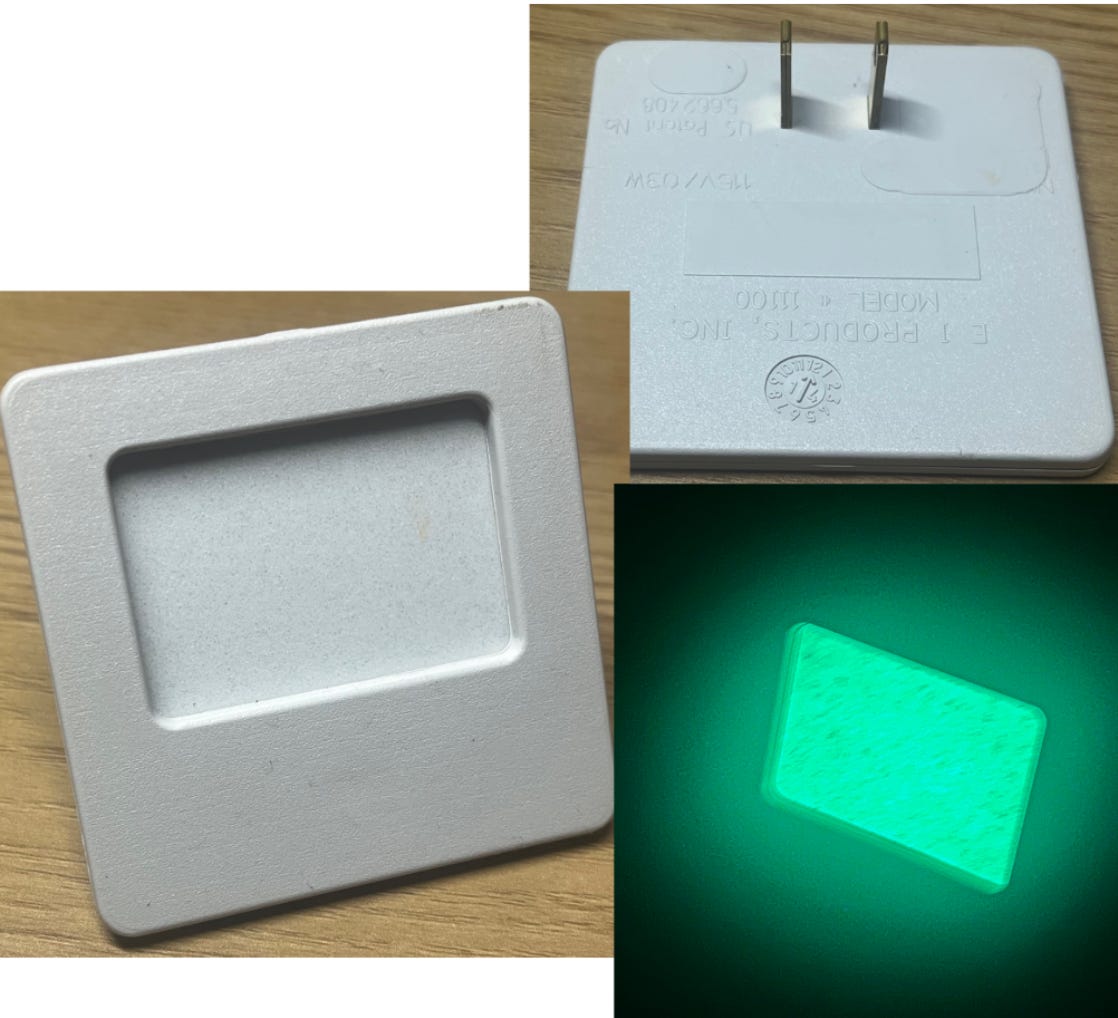
Have you ever had one of those simple green night-lights? They’re nothing special and very inexpensive. You just plug them in and forget them. When the room is dark, they’ll emit a subtle, green glow, just enough to keep you from walking into a wall or stubbing your toe on a door. And I find myself deeply at peace in its presence.
Photo by author
So many times when I was young, especially after those rough days, I would lie awake, unable to sleep. Sometimes I would duck under my blankets with a flashlight to read. Other times, I would conjure up imaginary adventures, dreaming I was off in some faraway land on a heroic journey.
But eventually, when the house grew silent and I knew everyone was asleep, I would pad into the bathroom. Without a sound, I’d shut the door so no one would bother me.
TRIGGER ALERT – Please be aware that this post discusses violent outbursts.
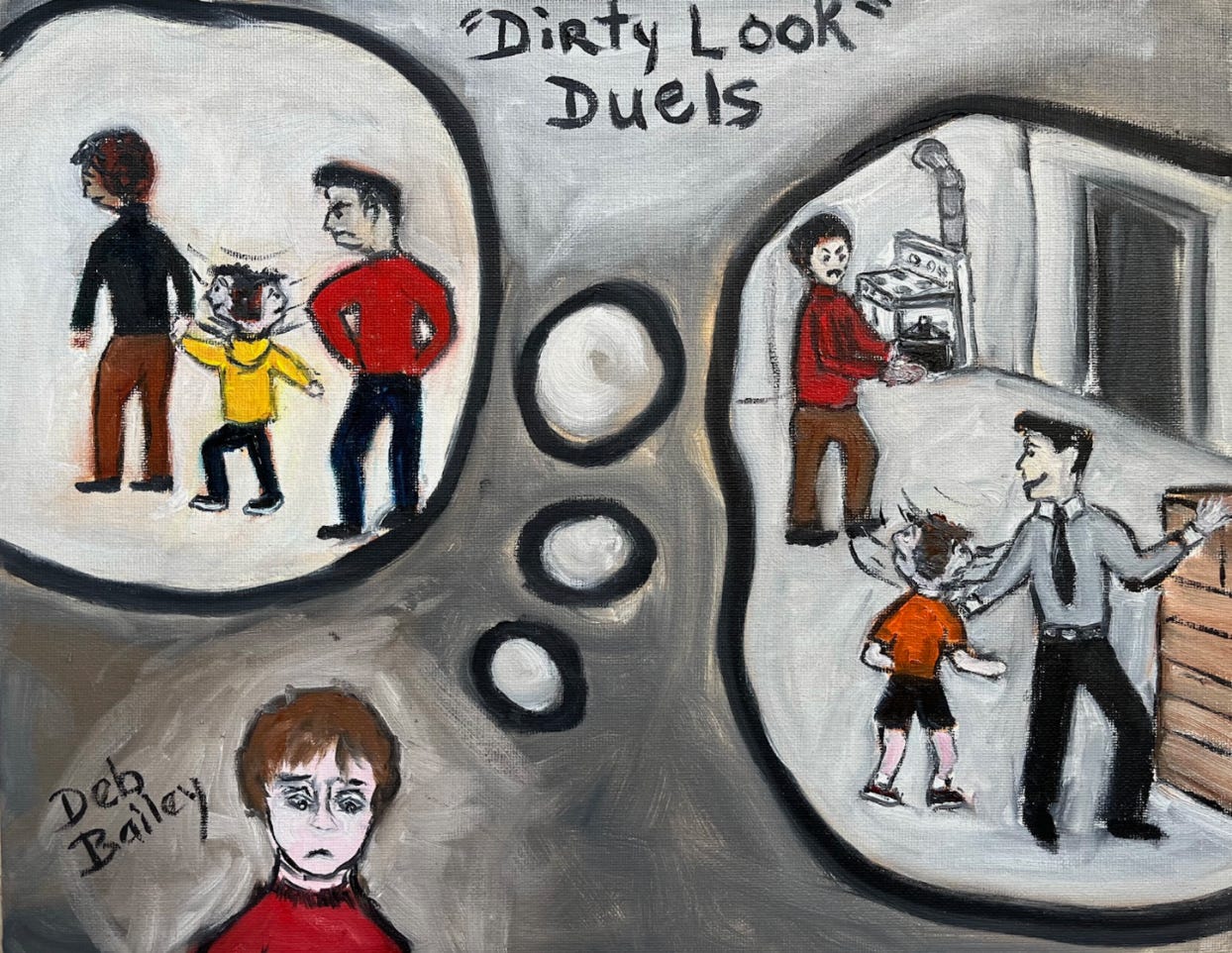
Dirty-look duels
Supper could go in two directions, and neither was in my favor.
Thanks for reading Deb’s Soul Mosaic Abuse-Memoir Substack! Subscribe for free to receive new posts and support my work.
When Dad came in the house, it was expected that we would be there ready to greet him. Lined up by the door, we were his adoring family, welcoming him back from the day’s battles, I guess. It was a small price to pay, though, if it meant a peaceful evening. But it wasn’t over yet.
While he went to change from his office clothes, my mother would be finishing up at the stove, and the rest of us were supposed to be setting the food on the table. If he was in a bad mood, this was especially critical so as to keep things from deteriorating. So for sure, it was all hands on deck, and I stayed in the kitchen. Too many nights, I’d be in the line of fire soon enough. No point in risking it any sooner than necessary.
If he was in a good mood, I still wasn’t off the hook, though. He would start chatting and expect me to accompany him to his bedroom while he changed. I was torn. Of course, I was supposed to help Mom, and I knew it…and wanted to. But I also knew that if he expected me to be with him, I had better follow, at least for a few minutes. If I didn’t, he would take offense, get angry, and then the night would still go badly. So, forced to choose between what Mom wanted and what Dad wanted, even as I wanted to choose Mom, it had to be Dad. The repercussions of choosing her over him were too dire.
But that didn’t mean I went unscathed. For the days I followed him and fulfilled what he expected, I faced her wrath when I returned to the kitchen. As soon as I walked in, her eyes shot laser beams at me across the room. I hated it. I felt like such garbage. But it was survival to me.
She never said a word to him, like telling him I should be helping her. And she never said a word out loud to me either. I don’t think she dared. But she made her fury clear to me — her look said it all.
So supper was almost always the duel of the dirty looks — my family’s name for angry glances. I was going to get them from one parent or the other, and it just came down to which one did I risk on any given day.
Painting by author
Did you practice your accordion today?
On the days he was in a bad mood, I had to be prepared for his questions fired at me like bullets.
“Did you polish my shoes like I asked you to?”
“Did you do the report I told you to?”
“Did you ….” and at this point, insert any number of things. He always seemed to have a perfect sense for the very thing I hadn’t accomplished. It didn’t matter if I did all the other chores. He didn’t ask about those. He’d always zero in on the one thing I hadn’t done yet, and then hell would start.
And the worst of those questions was: “Did you practice your accordion today?”
Up the street from us was a small music shop. So many times walking by it, I would stop and peek through the window at whoever was having their lesson. That accordion — odd and unwieldy — fascinated me. I just wanted to be able to fly my fingers across the panel of buttons on one side as my other hand picked at the keyboard. Never mind that I was barely big enough to hold the thing. But still, it became an obsession…and my doom.
For one, while music, songs, and lyrics speak to my soul to this day, I am NOT a musician. Appreciating music, feeling my soul respond to its call, is a very different thing from “delivering it” on an instrument. So, being a typical kid, I avoided practicing. And it didn’t help that the music teacher spent my entire lesson running his real estate business on the phone. He didn’t care that I didn’t practice. And I was relieved to be off the hook. Until supper-time.
I don’t blame my father for being frustrated with me and my lack of progress. But the usual parent approach would have been to just issue the ultimatum: “If you aren’t practicing, then we’re going to stop the lessons.” That would have made the most sense.
And that would eventually happen once a new teacher took over for my lessons and realized how far behind I was. At that point, my father, rightly so, stopped wasting his hard-earned money and put an end to them. I was grateful. While I loved the art lessons he sent us to and I would have done that every day if I could, music was just a setup for trauma for both of us.
Anyway, on the bad-mood nights, we would sit at the table, say our blessing, and then begin eating in silence. I used to sit right next to him at the table, but I learned quickly it was safer to sit at the other end, with my mother between us…which, in so many ways, was the nature of how the three of us would relate all our lives.
A few minutes into the meal, with only the sounds of chewing and forks hitting plates, the questions would start. It was like an interrogation. I prayed for something I could say yes to, or something I had succeeded in that day at school.
But on his worst nights, that was never the case. And I think my father always picked the accordion question because that was an almost always guaranteed “no,” and one he could use to start a fight.
“Why didn’t you practice?”
“I…just didn’t have time.”
“You NEVER have time!”
“I know. I’m sorry. I..”
“Why didn’t you have time?”
“I…I don’t know…I uh…my homework…”
“WHAT DO YOU MEAN YOU DON’T KNOW?!
The questions came fast. His voice got louder. And each word was delivered like a punch.
“What the hell’s the matter with you! IF YOU AREN’T GOING TO PRACTICE…”
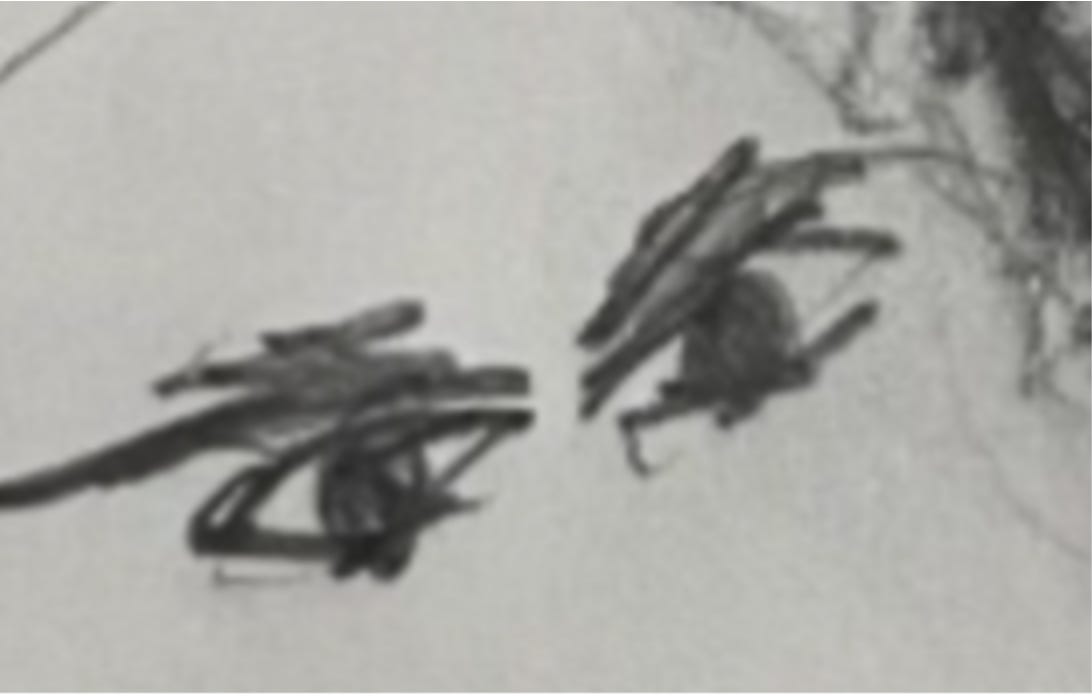
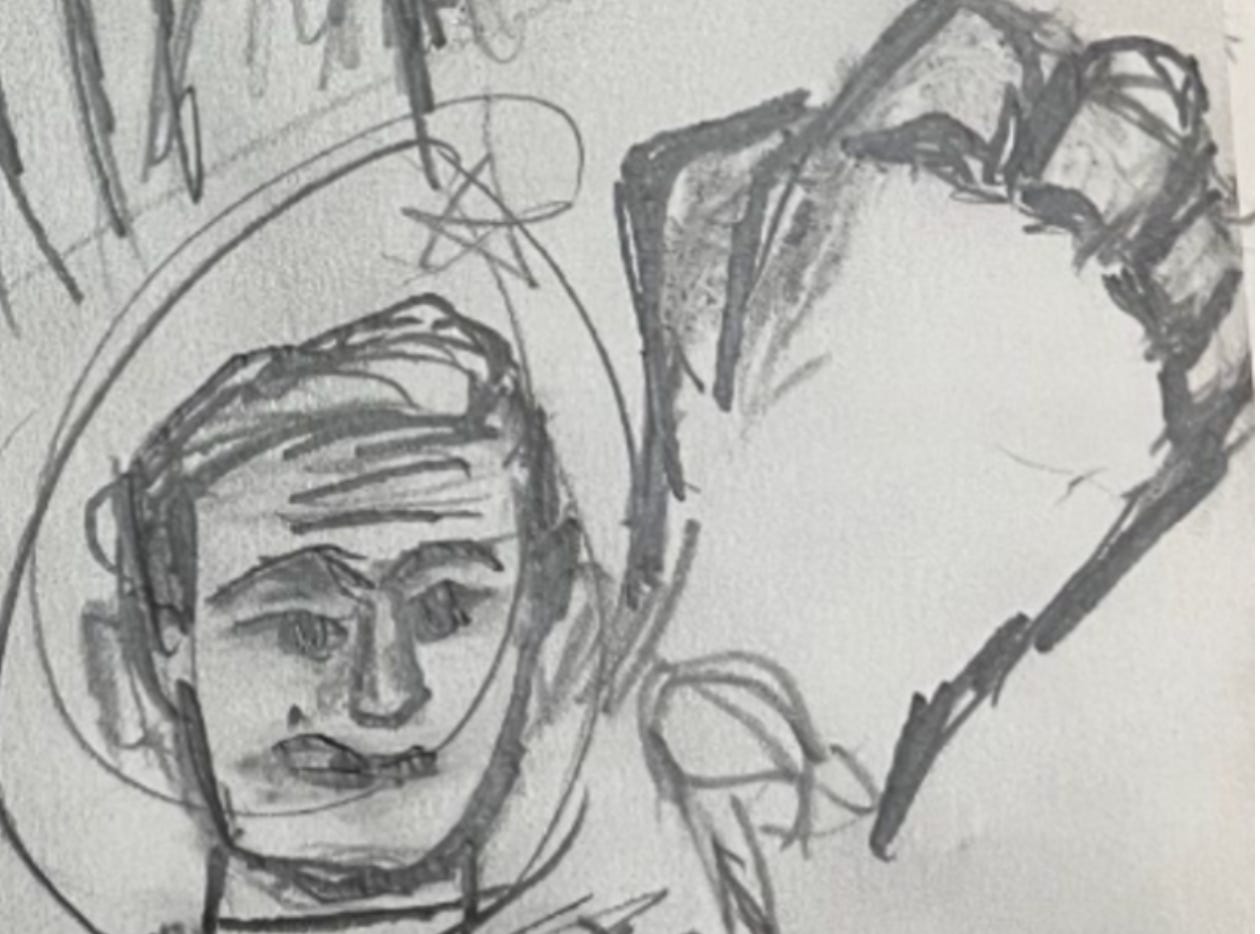
At this point, his eyes burned into me like lasers.
Drawing by author
My supper stuck in my throat. I felt like vomiting.
He continued to yell.
My hands gripped the edge of the table while my eyes never left his face. It was critical that I be ready to move if this got any worse.
Then, it came. He stopped eating, and almost in slow motion, the rage response began.
He’d tilt his head to the side and lower it, like a bull ready to charge. His mouth twisted into that thin line pulled to the side, and his jaw jutted out as he gritted his teeth.
Drawing by author
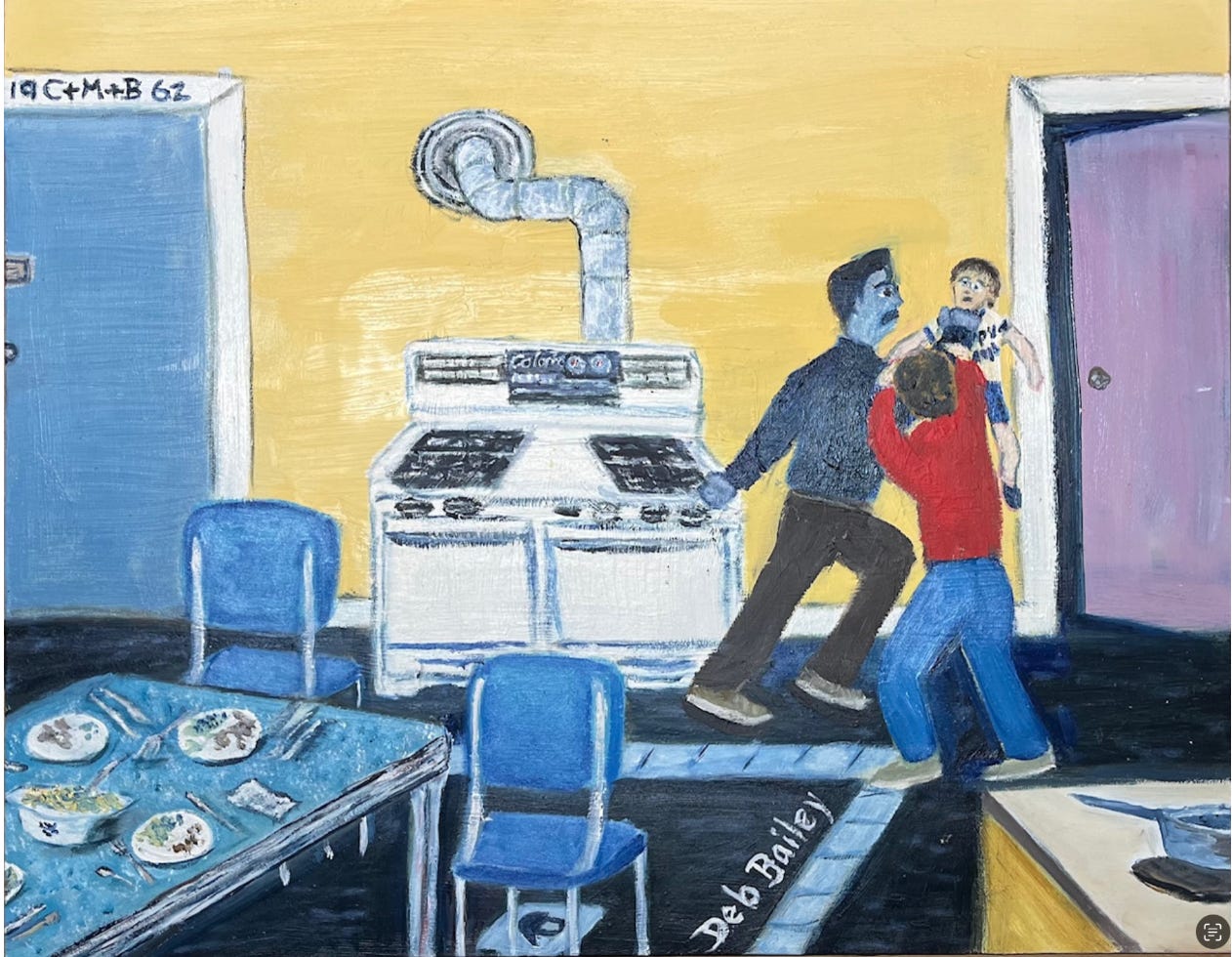
Suddenly, he’d stand upright, kick his chair backwards, and start toward me.
I didn’t wait another second. I bolted for my usual escape route to my bedroom right next to the stove. It was always a race to see if I could get to it before he could round the table and push past Mom.
She would try to block him.
Sometimes I would make it. But not always. Sometimes he got to me before I could get away.
Painting by author
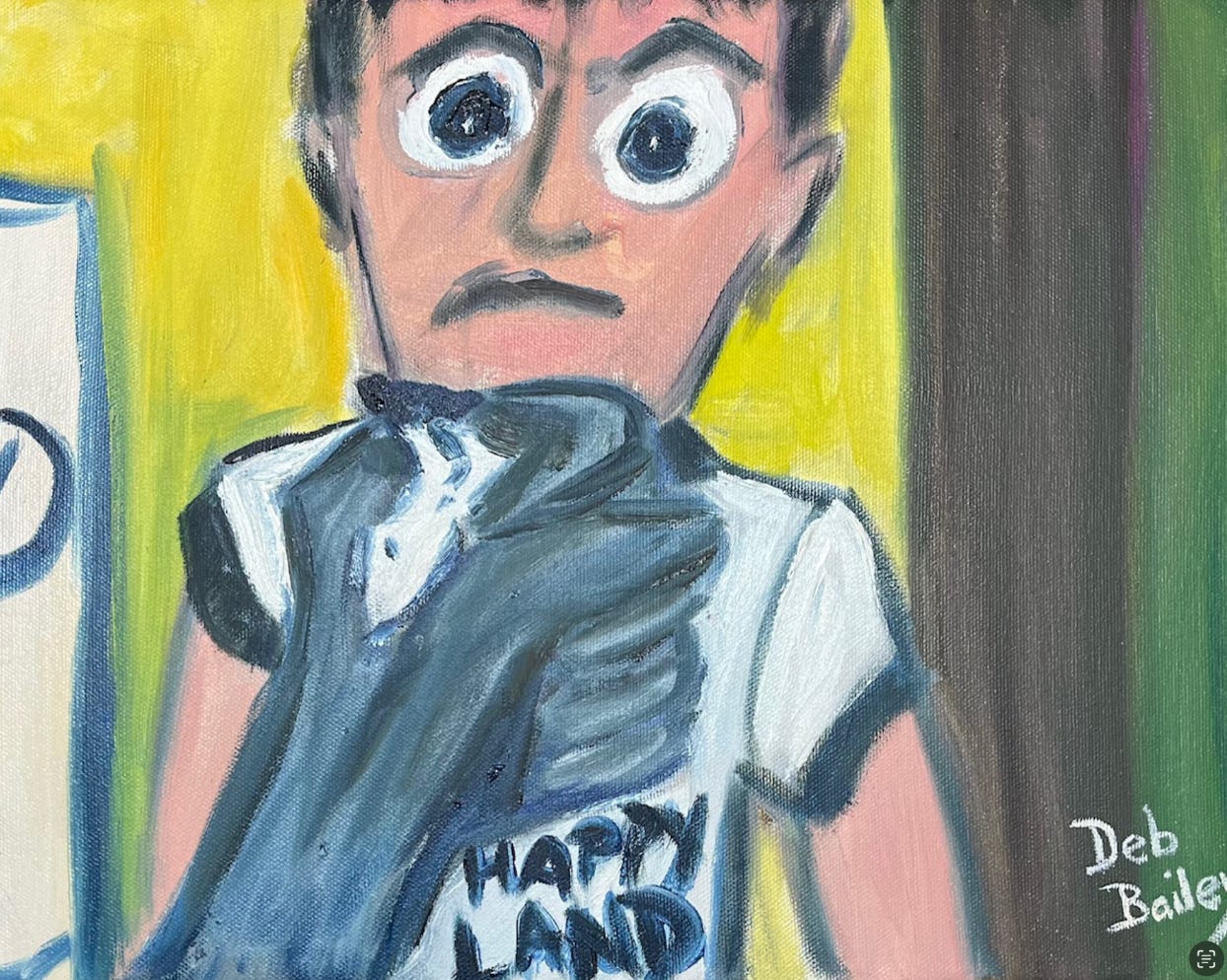
In that moment, he’d grab me by the shirt with his balled fist shoved up into my throat and push me up against the wall.
My head would snap back and hit the wall as his fist hit my jaw. Grabbing my shirt, he tightened his grip until I started to choke. Sometimes my feet weren’t even on the floor. I just hung there, his hand gripping my throat.
Mom would be yelling, “Hon, stop! Hon, stop it! STOP IT, HON!!!’
Back then, I never noticed the irony of her calling him “Hon,” – short for “Honey” – as he was beating her child. I never noticed much of anything except maybe someone running out of the room, and my mother trying to pull him off of me.
“What’s the matter with you??!” she’d yell at him.
Sometimes she had to push him back several times because he kept coming at me. I could always tell how angry he was by how many times he tried to get at me.
To avoid his fist and try to breathe, I remember flattening myself against the wall. I was never sure he would stop choking me in time.
Painting by author
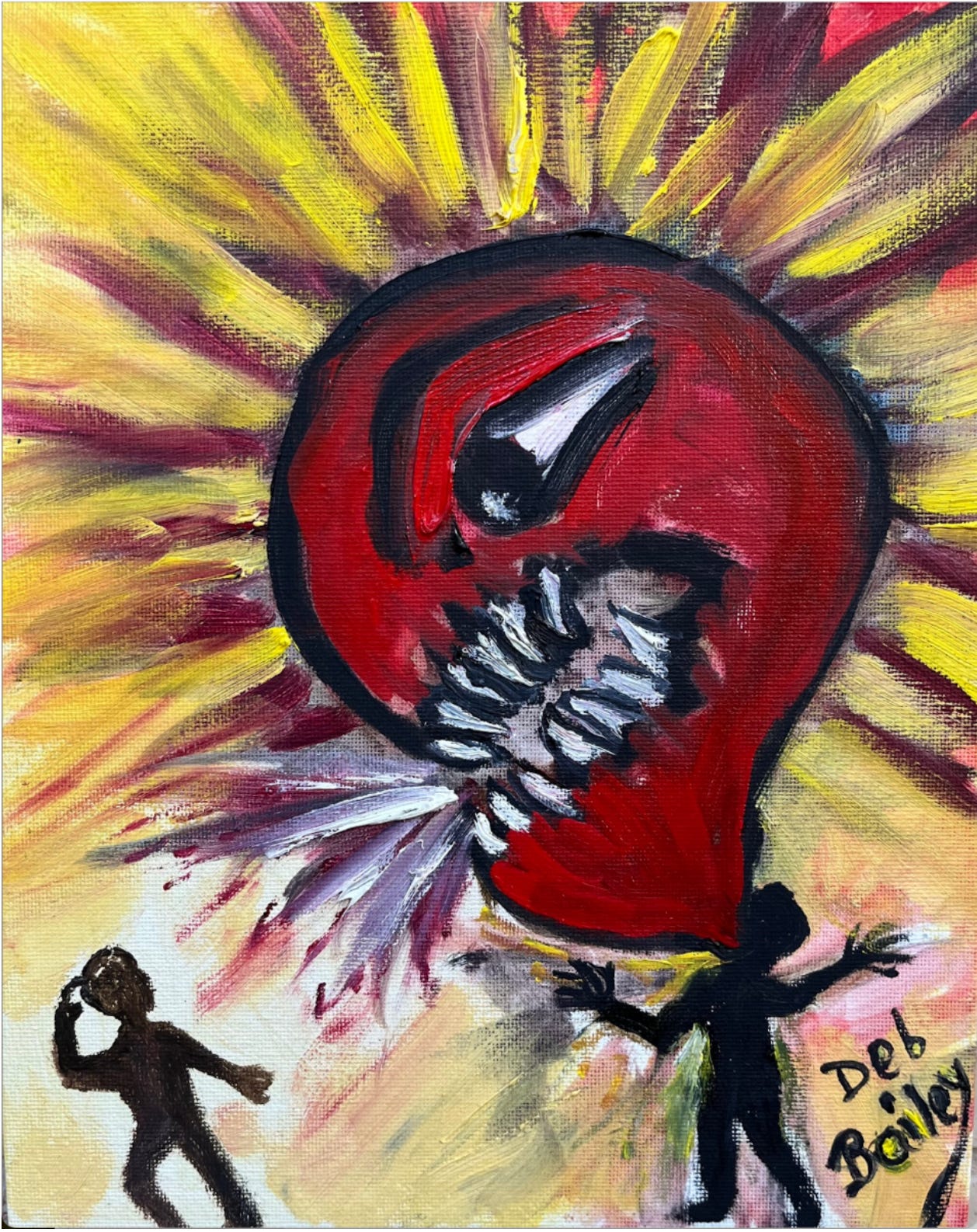
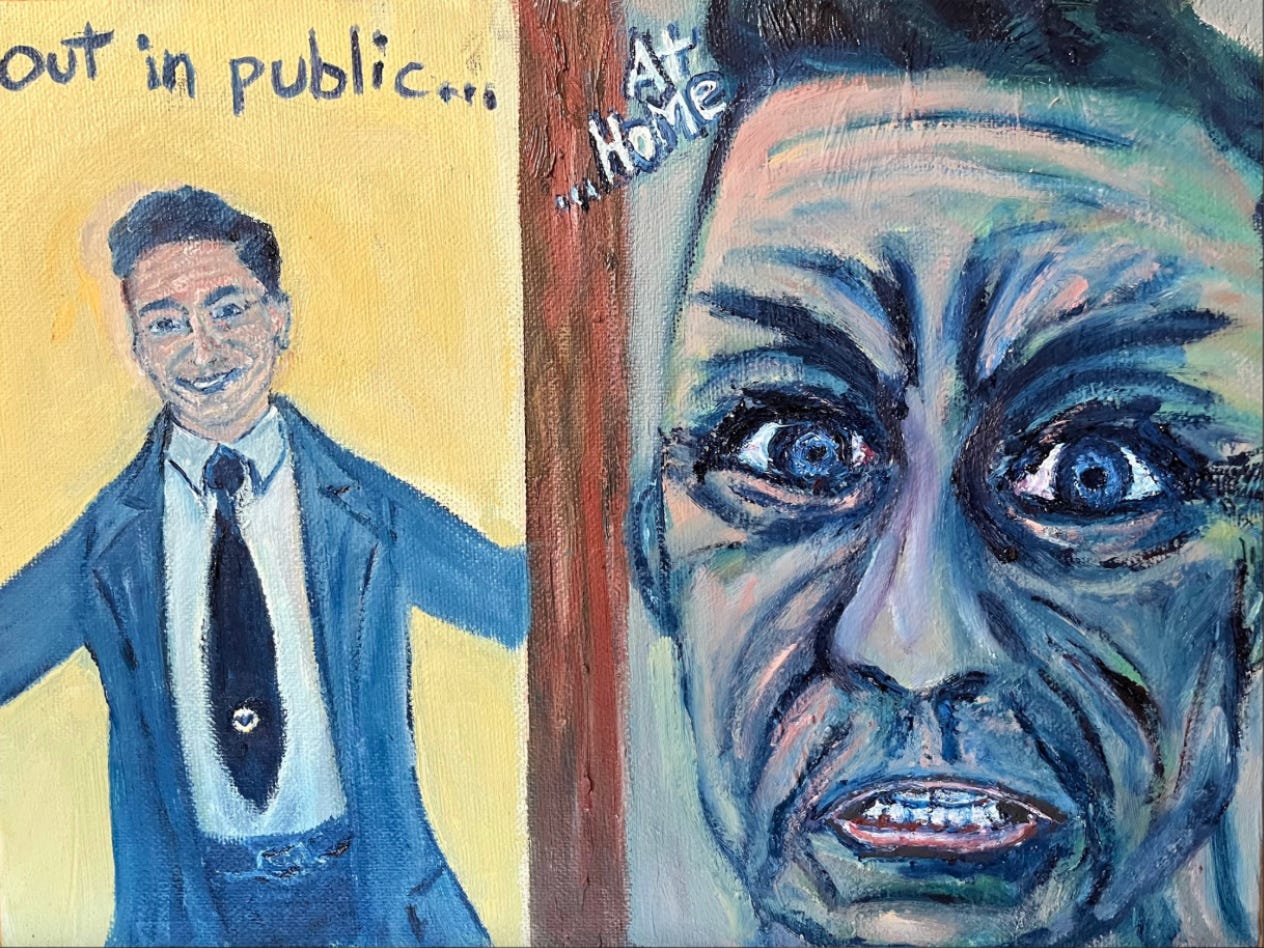
If I could capture what he was to me in that moment, it was a “rage monster.” One minute, he was Dad, the next, he was this out-of-control twisted face vomiting rage at me like a monster.
Painting by author
Finally, Mom would succeed in pulling him away. Panting like that charging bull, he would finally just yell, “GET THE HELL OUT OF MY SIGHT,” and I did.
These moments were more frequent than I’d like to think. From a young age through adulthood. And he didn’t just focus on me — Mom sure got her fair share in that bathroom…and she didn’t have anyone there to pull him off of her.
But I was his frequent target since I was the oldest. There was something about his associating us both being eldest children, with that inner fury he pummeled me with. In those moments, in those eyes, he was someone else.
I’ve often wondered if anyone else in the house — like my Grandparents upstairs — heard these fights. Given the yelling and noise, they had to. The walls in that house weren’t very thick.
During one fight, Dad lost it and tore the shirt and left marks. We were supposed to be going upstairs after dinner to visit as my uncle, Mom’s brother who was a missionary priest in Puerto Rico, who had just come home for his summer vacation. He would stay with my grandparents when he was home.
My mother made sure to powder the marks to hide them, handed over a new shirt to put on, and told us not to say anything about this when we went upstairs.
And somehow, he always managed to switch back from the rage monster, to the charmer, while I just swallowed my terror and slapped a smile on my face.
Trigger alert – The descriptions here may upset some readers. Please proceed gently.
Who WAS Dick Phillip?
When Robert Louis Stevenson wrote his novella, *The Strange Case of Dr Jekyll and Mr Hyde*, he had no idea that 45 years later, his character would enter reality as my father.
Dick Phillip. Richard Phillip. Richard M. Phillip, Richard Marshall Phillip…Richie.
Who WAS Dick Phillip…and as an aside, as a kid…and an adult, I always wondered why he preferred “Dick” for a nickname. Except that in his case, it seemed to fit in more ways than one.
To me, who he was varied with his mood and his needs. Sometimes he was so warm and fun, and other times it was like I didn’t exist, or worse. Intermittent reinforcement. Alternate love with rage, with love, with cold isolation, and back to love again. Mix it up until I was so confused and convinced that somehow it was my fault, and if only I could figure out the right things to do, then it would be okay.
As for how he treated others, it just depended on what you were to him, where you stood in relation to what he wanted and needed, and who had the upper hand in the power dynamic between you.
When I started high school and was worried about succeeding in a public school after years with the nuns, his advice was:
“If you want people to like you, find out what they need or want, and give it to them. Then they’ll like you and you’ll look good.”
Even then, I thought that seemed like a cold way to treat people, and being a young teen, I ignored him. But it was his modus operandi in life because he wasn’t looking for friends. He was always about getting something out of an interaction.
If you were outside of the family and had nothing he needed, you were off his radar…except to make sure you weren’t a threat. If you were a family member, at the very least, he would put on enough charm to keep the peace and preserve any future usefulness you might have to him. If you had something he wanted or you could advance his goals, now you had his attention.
Just like our summer days had their routine when Dad wasn’t around, school days did as well. I’ll talk more about school shortly. But for now, suffice it to say that while the days of the school year had a strict regimen, there was a brief respite period between the end of the school day and when Dad would get home.
The 2:30 bell would ring, and two by two we would exit school in an orderly manner. Then, once clear of the nun’s “jurisdiction,” we’d burst down the street, greedily sucking in the fresh air, literally and figuratively.
It was often the same group of us walking down the hill. My siblings and I, some of our friends from the neighborhood, and usually the two brothers who lived down by the corner of our road.
We were always careful to watch over the younger one. He had Cystic Fibrosis and was fragile, whereas his older brother had a robust loudness that couldn’t be easily contained. But still, he, too, had a gentle soul and worried about his brother.
On one walk home, the younger boy just passed out cold. I still remember the thud of his head against the ground, like a melon against asphalt. While we gathered around him, his brother ran full-speed down to his house, yelling for his Mom. I was grateful for his ability to scream on that day, because she came running up toward us before he’d even gotten all the way home. Fortunately, in spite of the fall, he was okay.
The thing about memories during traumatic moments, very early childhood, or both, is that they are not preserved like a movie. There is no “narrative flow” or complete replay of an event from beginning to end. There are, at best, “flashes” — moments in time, stray images. They may be fully detailed and vivid, including the emotions of the moment. But they are brief. More of a photograph of a second in time, versus a home video of the whole afternoon.
I have a series of these flashes that individually are just that — “photos of a moment in time.” But they are all, with one exception, from around the same time period when I was young. Whether they are related or have any cause-and-effect connection, I have no idea. I can only say that I remember these “flashes in time,” that they are odd, and that they haunt me to this day.
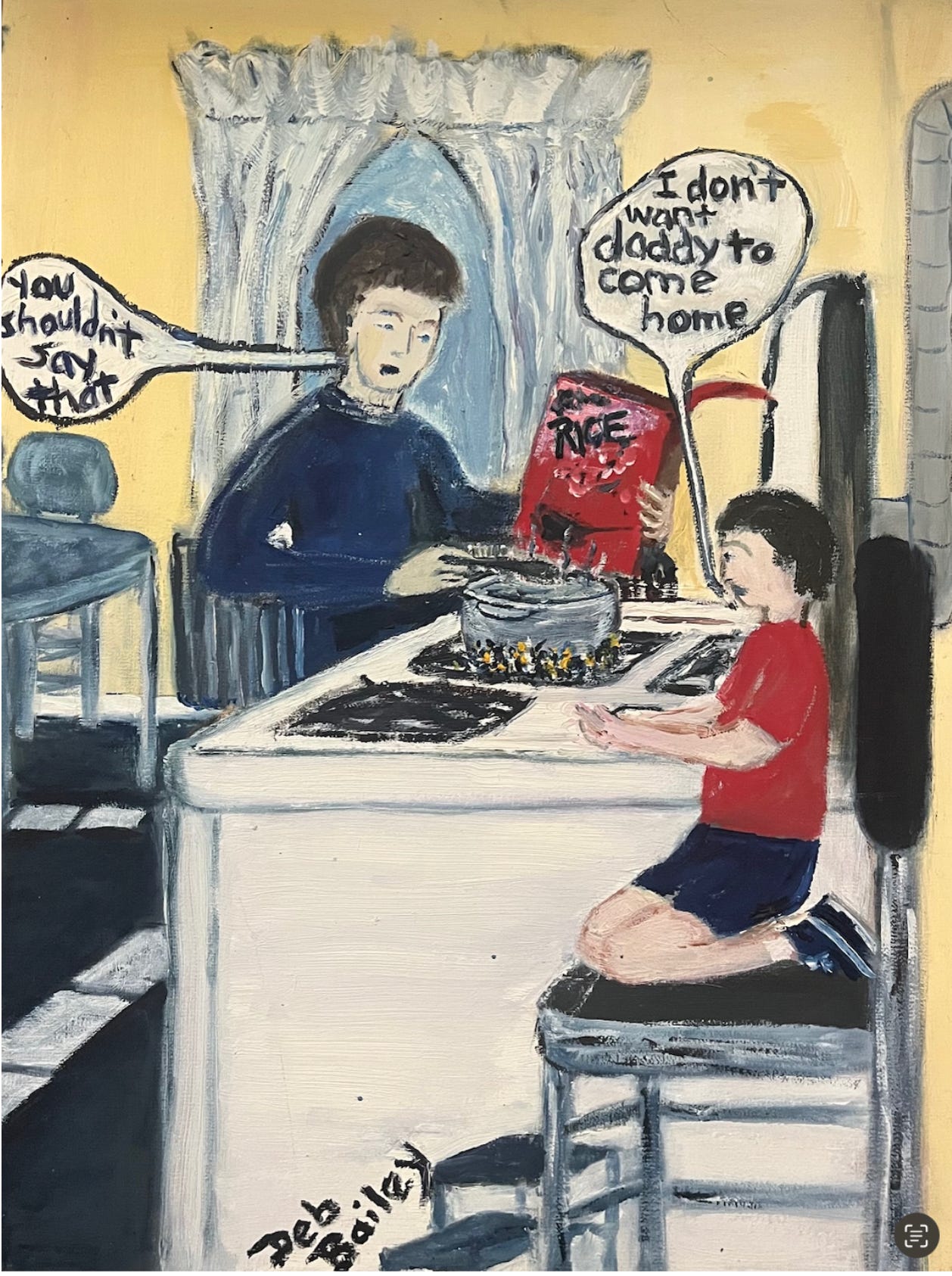
Painting by author
Memory #1 – I don’t want Daddy to come home
I have no memory of anything before or after this moment. But this spot in time, I still recall with total clarity. I had climbed up on the high chair that we kept near the stove. Mom was stirring a pot. I was filled with dread. Supper meant Daddy would be home soon. It was often not fun with him around, not like the daytime home with Mom. I wished it could just stay that way.
I shifted in the chair. Should I tell her what I felt? My stomach tightened. The words were clamped in my mouth behind tightly gritted teeth. I looked at her. Then decided to risk it.
“I don’t want Daddy to come home.”
Mom kept stirring the pot. She didn’t look at me. Was I in trouble?
One of the first things I understood about life on his schedule was to know and follow “his rules.” No debating them. Also, his “view” on things was the right view.
Indoctrination by confusion
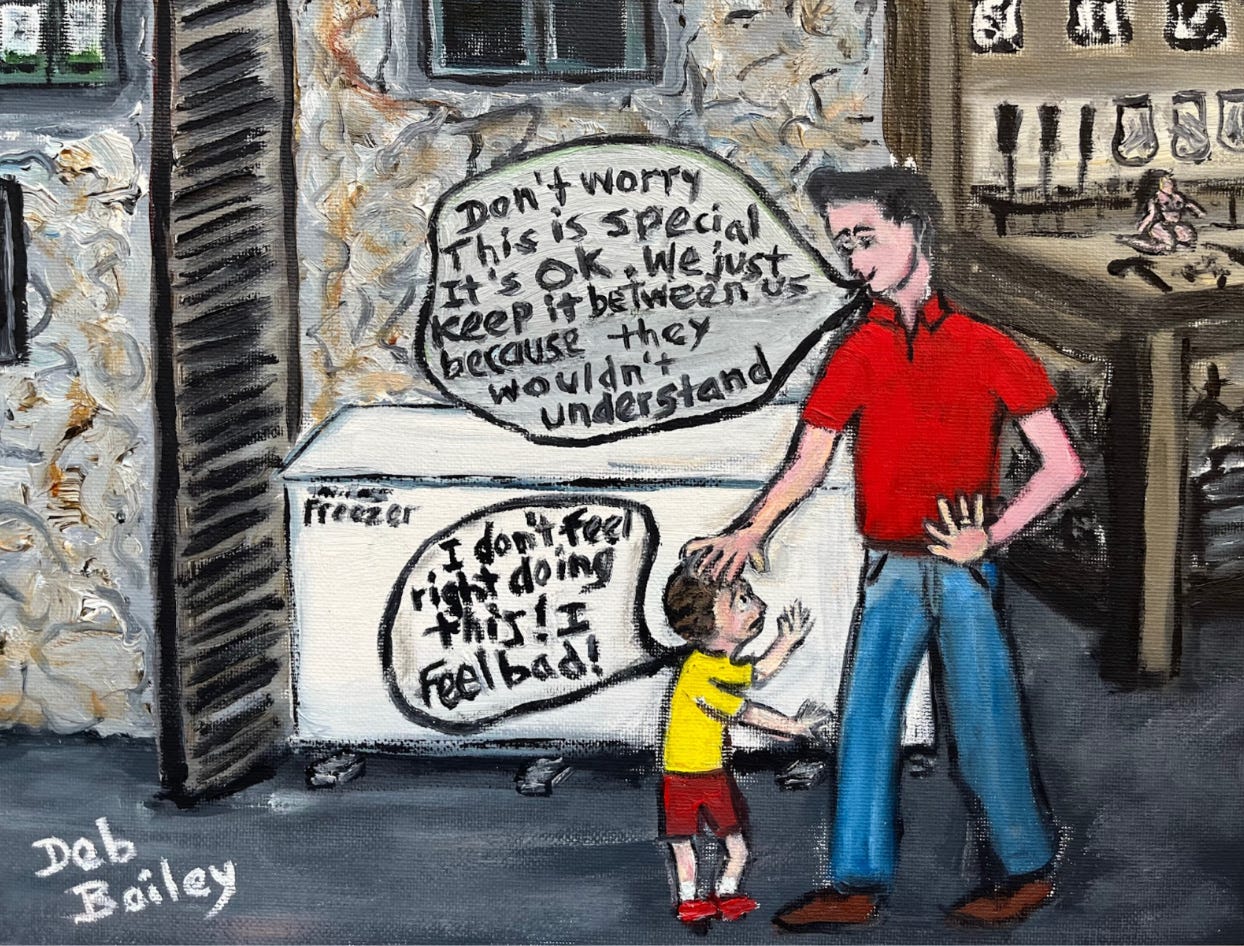
It was very clear, right from the beginning — my life was meant to be hidden. And that indoctrination started at a very early age.
I remember this particular time in that scary cellar. I was very young, but still, I felt so guilty…and bad about what Dad was doing with me. And I was so torn up inside about what it would do to my mother if she found out.
But the worst part was that I was caught between them. I did NOT want to hurt MOMMY. But I didn’t want to hurt him, and was afraid he would be upset. So even though I was nervous, and I hated the cellar, I went down there to talk to him.
Using all my brainpower, I worked to find the right words THIS time that would finally make him understand.
“I don’t want to do this anymore.” I expected anger.
Since my bedroom was right off the kitchen, I got to listen to the recitation of the daily “morning litanies” between my parents.
“Do you have your badge?”
“Yes.”
“Do you have your keys?”
“Yes.”
“Wallet?”
“Yes.”
“Handkerchief?”
“Yes.”
All that was missing from their conversation to make it like the church litanies were a few Amens or Ora pro nobises.
It was the same mind-numbing set of questions every morning, done just before he walked out the door. And woe to her if he got to work and was missing one of these things because she didn’t ask.
On more than one occasion, apparently, he had forgotten his badge. This meant that he had to stand at the guard gate at Pratt & Whitney’s entrance until someone, most likely his hard-assed boss, came and verified he belonged there. Since they did government and military research at the plant in those days, security was not taken lightly. I expect he probably got chewed out, or at least mocked, for forgetting his badge. And since I think it happened a few times, it was probably becoming an actual problem, not just an embarrassment. So somehow, it became my mother’s job every single morning to run down the list before he left the house.
But even before this “festive routine” took place, there was the “battle of the breakfast” litany.
“What would you like for breakfast?”
“I don’t know!”
“Would you like eggs?”
“NO! Yes!”
“How do you want them?”
“I don’t know!”
“I can scramble them. Would you like that?”
“I don’t know! NO!”
“Over easy?” Boiled?”
“Just scramble them!”
“Do you want toast?”
“NO, I don’t want any toast.”
Each of his answers was delivered with an increasing level of anger and meanness. You’d think she was asking if he wanted a pile of dung on his plate.
Why she got up to make him breakfast is beyond me. Years later, I told him one day that I never would have bothered because, based on how he treated her, he didn’t deserve it. But I could say that years later because I was in my 20s, and it was one of those rare days he was in a good mood, pretending to be easy-going.
So he would laugh and agree and shake his head at the idea he could have been so miserable. And he knew he’d been miserable, because one morning he finally just told her not to get up to make him breakfast anymore, because it was better not to be around him in the morning. So even he knew he was out of line.
However, there was one that morning where the “leaving for work litany” actually ended on a protective note, and THAT caught my attention. Especially the reason, which scared me to death.
There were two distinct time periods at home. Times without Dad, when I could be “that kid,” and just revel in my activities. And then…there were the “Dad times.”
His work shifts alternated every week. One week, he was on the day shift, which meant mornings and afternoons were calm, but later afternoons and nights could be calm to violent, depending on his mood. The next week, he worked the evening shift, which meant mornings were dicey but afternoons and evenings were placid. And the weekend times were everything and anything.
And when he was around, I was on high alert. Whoever I was when he wasn’t around, that went into hiding. It was replaced by quiet, tense, scanning, always, for signs of trouble.
Was he in a good mood or a bad one?
Had I tried one too many times to “avoid him” and hurt his feelings?
Was I going to get hit…or more to the point…when?
When he was happy and fun, it was great. In fact, his bad moods seemed like such a distant memory that it seemed impossible that he could go back to that. At those good moments, the bad times seemed like they would never return.
But then it didn’t take much to have hope. Any sign of a positive, a day with a better mood, and you grasped at those moments like a drowning person to a life raft, convinced that, “THIS time it will be different.” The mental reality, at least for me, was, “How could he be this good, fun, seemingly kind and generous, then go back to that? No…that part’s over”…until it wasn’t.
 Soul Mosaic