I just wanted to take a moment, before continuing the story, to share the Introduction for the book, something to set the stage for how my own unique, “ancient-history” story can still be a universal way to view a life and search for answers…
Introduction
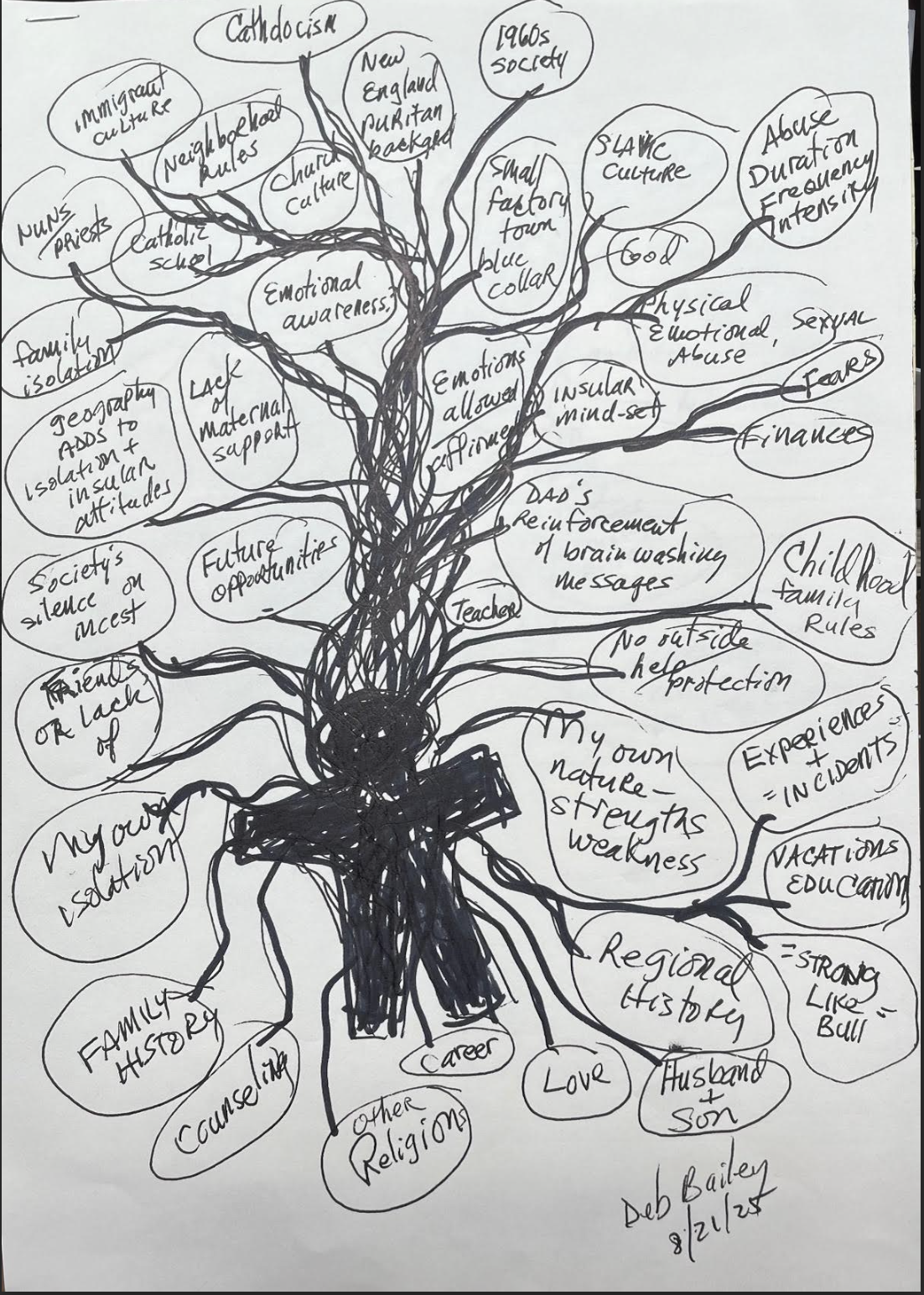
Sketch and photo by author
So, as will become obvious in this book, I am a “split-personality” writer — always torn between my science brain and my “dreamer-artistic” side. I am also an aging Baby Boomer, with my childhood being circa the 1950s-1970s — ancient history to most people now.
The world I grew up in — a small New England immigrant factory town that was heavily ethnic and Catholic— is long gone. The stories I tell out of that culture will be very foreign to anyone reading this book now in the 21st century. As I was told by an editor one time, if I write a novel now and set it in the years of my childhood, it’s considered “historical” fiction. So in that sense, my personal origin story in this memoir is partly “historical” memoir.
But it is also universal, because all of our origin stories are “historical” and unique. The reason to share them is that those stories are the clues to who we were…and became…and why. Those cultures and details are what we are made of and what we had to work with.
So many people have asked me, “Why did you stay so long being abused in that house?” “How did you get out?” “How could that have happened?” — and other similar questions.
For that matter, I have asked myself those same questions…and other, more self-hating ones.
The easy answer is to just say…”It’s complicated.”
But that gives nothing to the reader, and it leaves me with only questions and no answers.
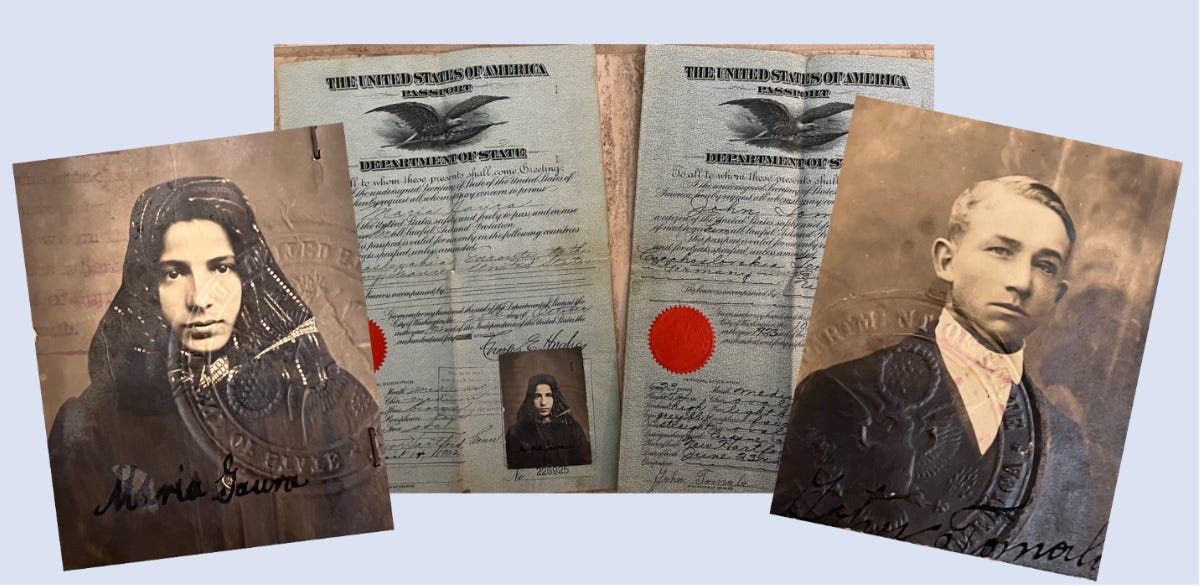
Author’s photo of her grandparents and their passport papers
The Old Country
While my Grandmother was born here in the US in 1902, she spent most of her childhood and early adulthood in a small farming village in “the Old Country,” — or “Old Countr-r-r-y” as she called it because she rolled her Rs strongly — which was eastern Slovakia. And she still spoke mostly Slovak with my mother, which we kids only understood a bit of. When she talked with us, she always apologized for her poor grammar and explained that she spoke “Broken English.” We grew up assuming this was a special form of English. It was a smattering of English and Slovak words delivered in her Eastern European accent with her rolled Rs. To this day, I so miss her and her way of talking. It warmed my heart.
One particular afternoon, I had gone to visit her in her convalescent home and shared that I was taking a vacation trip to Germany. My Grandmother went quiet, then looked at me with an expression of total confusion and surprise. Shaking her head, she said to me in her broken-English style: “For what you go Old Countr-r-ry? There’s nothing there!”
I was kind of surprised at her reaction because I was young and just excited at the idea of going to Europe. It was my chance to travel somewhere new and have an adventure. I couldn’t understand why anyone would question the idea of such a trip. So I brushed off her comment with the arrogance only a “know-it-all” 20-something can have.
The missed story
I so wish, now, that I had asked her more about what she meant. I assumed it was her typical reference to what she and many other immigrants back then would say, that her life here was so much better than what she left behind. But it could have been something else.
Maybe all her family had been wiped out in World War II. Who had been there? What happened to them? Maybe there was nothing there anymore because it had all been destroyed. Whatever it was, I realize now that I had lost a precious opportunity to learn what she could have taught me. Instead of slowing down, looking deeper, and asking her, I rushed to judgment and missed her truth.
Wrong conclusions
All my life, I have always viewed my life in one way. I was abused. I stayed too long. I was ashamed of that stupid younger part of me who “should have” known better, and I spent the rest of my life making sure I never ended up like that again. I could excuse the young child part of me, and knew most people would view her sympathetically. But that older teen and young adult? I despised those parts of me and decided they weren’t worth talking about…they didn’t “deserve” recognition for their “failures. I was deeply ashamed of those parts and figured if anyone else ever knew, they would feel the same way, too. So for decades, except to a therapist, I never spoke of those years and never told anyone just how long I had been stuck in that house. Instead, I just moved on, pretended my past was fine, and privately fought to get back as much of my life going forward as I could.
In case anyone reads that description and picks up on what seems like heavy doses of self-hate and self-judgment, along with an appalling lack of compassion or self-love…you wouldn’t be wrong. I always saw my value as moving forward, being “strong,” and never being “weak or stupid” again.
The new lab experiment: Back to the Old Country
Finally, I came to understand that to move beyond that self-fate, I had to go back to my Old Country — my life — because there was most definitely something back there. Maybe there were answers to questions…or even more questions with no answers, but whatever was back there, I wanted…and needed…to see it. If I ever hoped to unravel that Gordian knot inside me and heal, I couldn’t do it by hating parts of me. So I had to go back there.
What did all of these rounds of work leave me with? A hole. Certainly, I had my center, my adult core, still intact. I was still standing.
But that pit that had been filled with everything I sealed off all my life — when all that pus was emptied out, it left a gaping, aching abscess. It would need to be scraped out, tended to, explored to make sure all the poison was gone, and coated with healing ointment. Essentially…I would have a lot of work to do.
The only words – questions
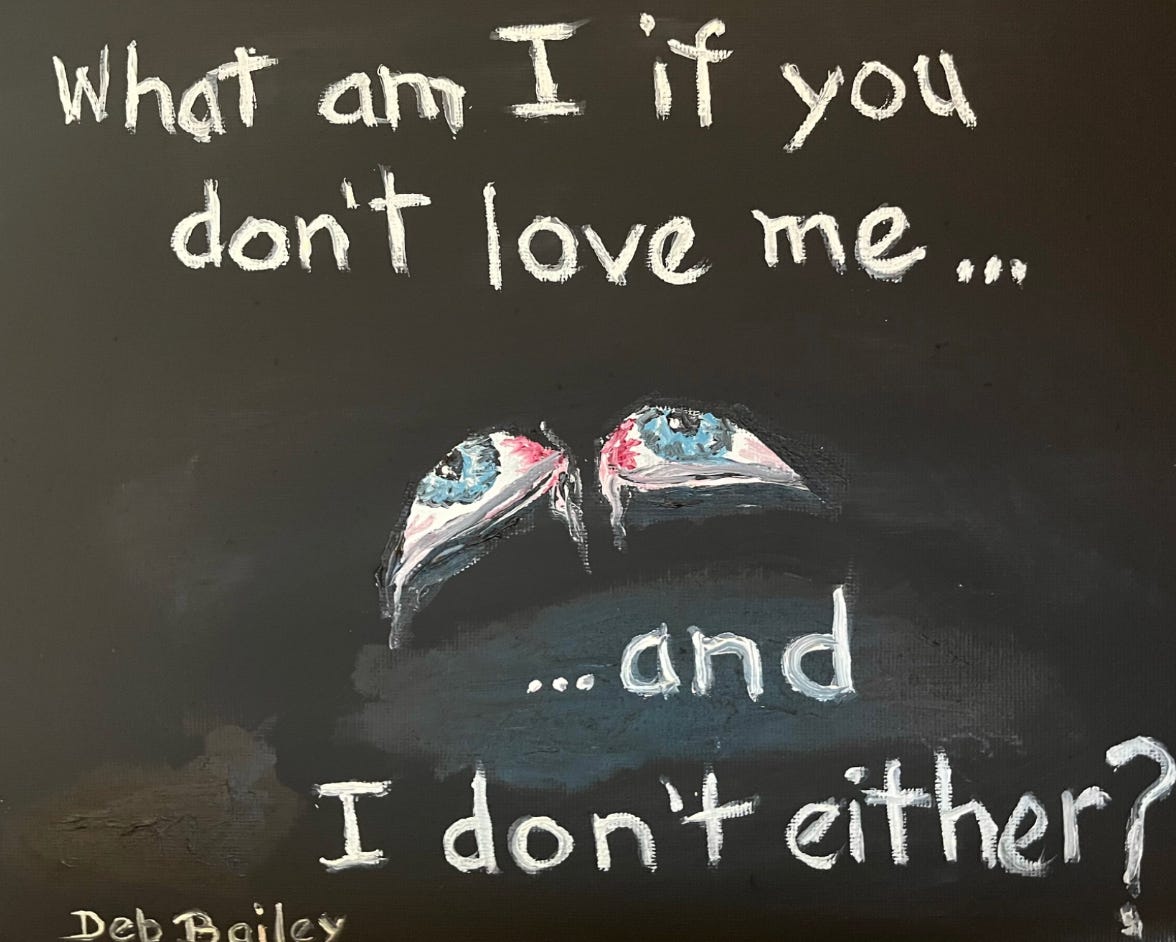
Up until now, there had been few words to express what I was feeling. And even now, they only came slowly…in the language of questions. MANY questions.
Along with all the released pain, the ache in my heart, the emptied out mess of my life before me, there was also an ironic twist in facing this work.
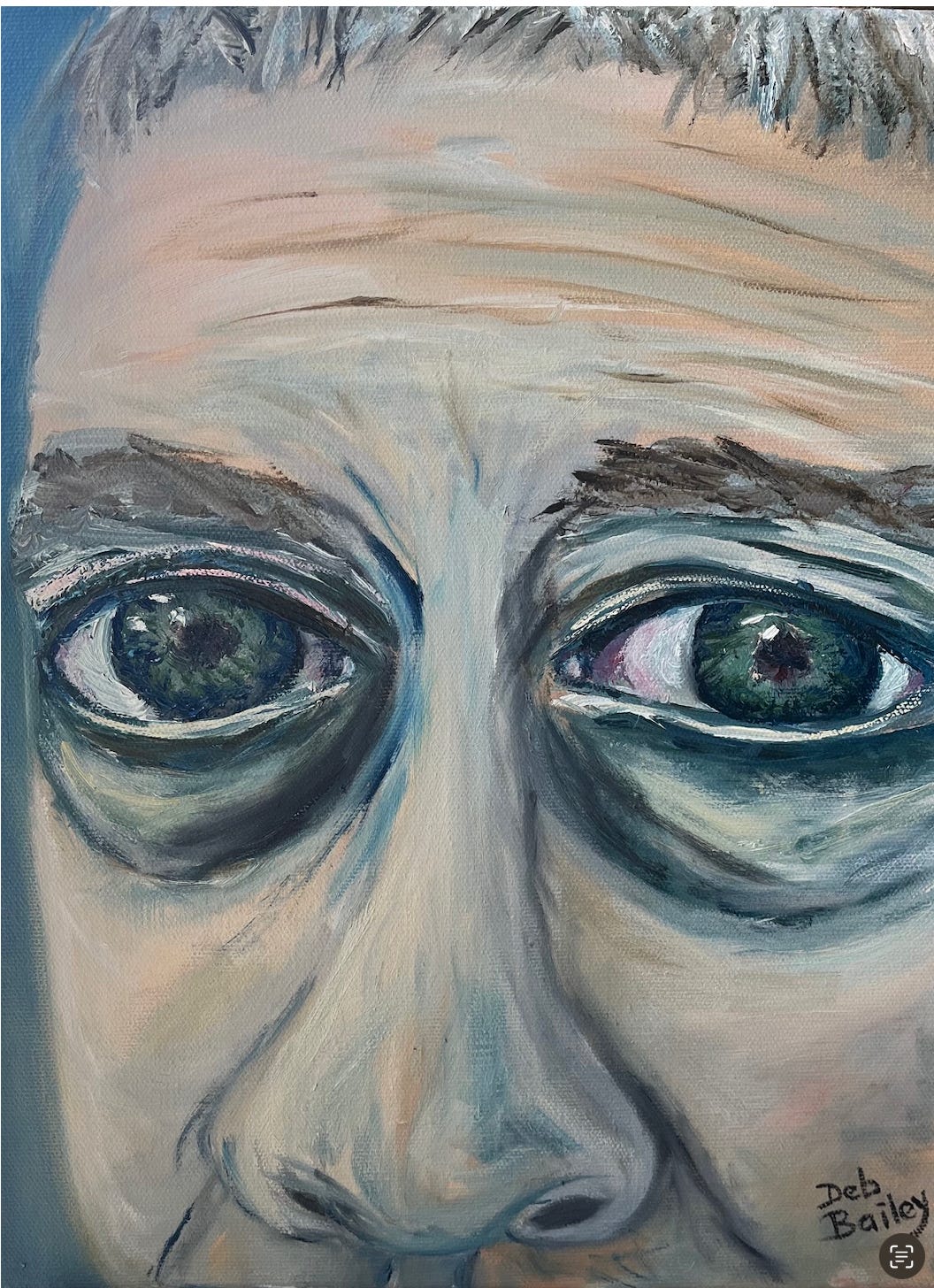
When I painted this particular self-portrait, it was after a hard session of EMDR work. I was looking for a way to capture how much fear, sorrow, pain, and despair I was experiencing at that moment.
On a whim, I took a selfie and realized all of the emotions were right there in my eyes. So, I decided to paint that picture. In fact, all of those feelings were so strong and so near the surface that I did the painting in about an hour.
Unbeknownst to me, Ed, who was exercising in the living room, kept looking over, as he described it, “watching the image emerge.” As the eyes formed and came into focus, he felt horror. Later, he acknowledged I had nailed “that look,” but he also hesitated before saying the rest.
He didn’t have to. I finished the sentence for him.
In stories of adventure and quests, the hero battles mightily and, with any luck, returns with the gift of the effort — some kind of prize. Emotional quests are no different — they give the prize of insight and wisdom, and the desire to know more, so you can keep healing.
At the end of this battering, I wasn’t whole or healing…yet. But I was given a glimpse of a sacred insight…what had been hiding within me all my life. I saw my heart…my tender, bloodied, aching, abandoned heart…fully…for the first time. It was broken, yes. And life’s events had shredded it. But it was still there, beating.
Now, it was up to me to decide what to do with that heart….
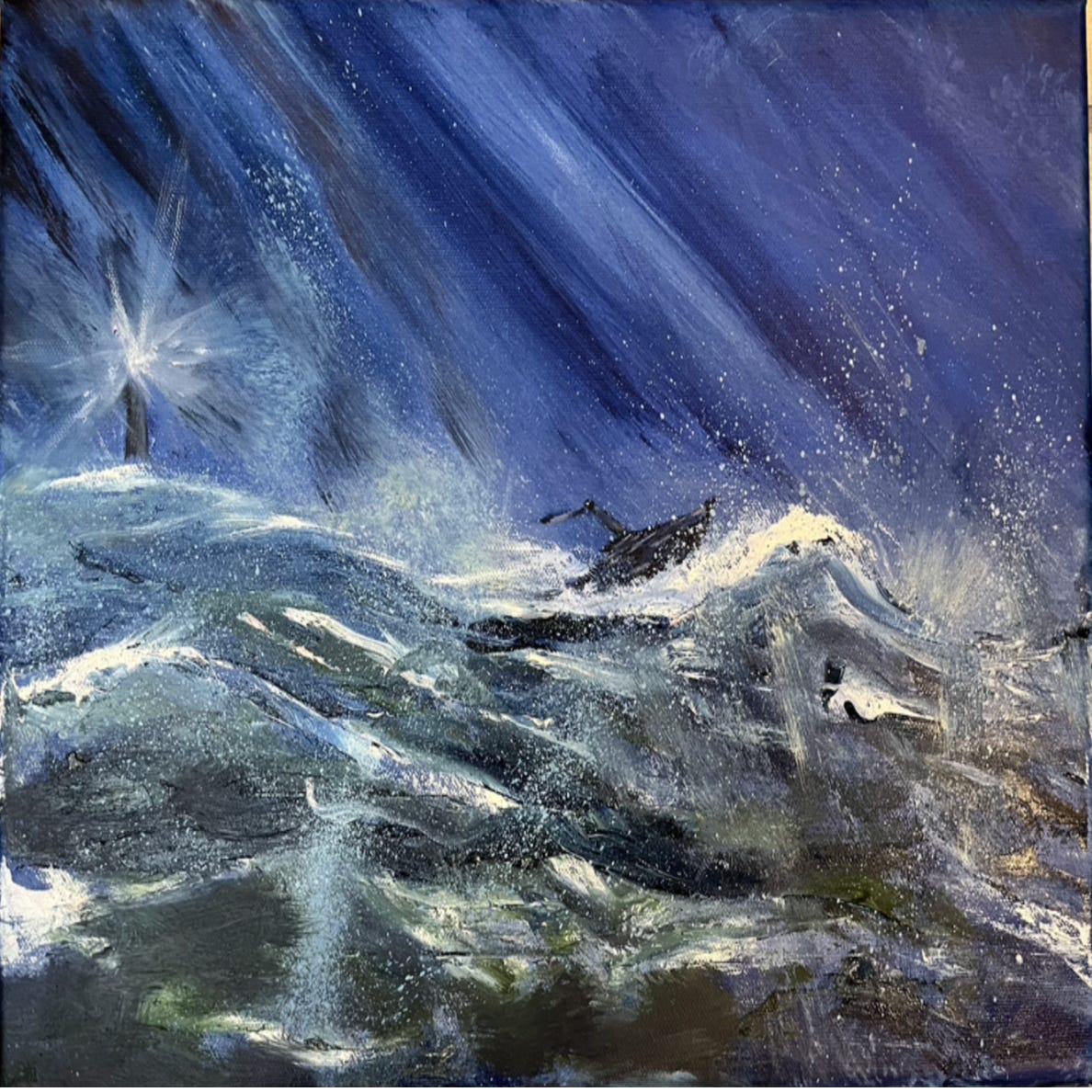
As I dug into this with my therapist, I was doing some of the hardest, deepest work in my life, then going home to try and capture what came up. I would paint as fast as I could, barely able to spread the pigment on the canvas quickly enough. After opening Pandora’s box, the waves of things I’d never felt before just kept coming. Again and again they’d swell, crest, crash over me, and then swell up again. I just held on. I had wanted to confront it all, my free choice, which was a gift in its own way — self-agency. So there was no turning back now.
There are times of relative ease in my work with my therapist. Almost placid. Moments of rest and regrouping. The months after Mom’s death were not this. And I will simply say that I am grateful for the support of my husband and son, friends, and the wisdom of my therapist. This is not a journey to undertake alone.
The sessions were frequent and intense, with Yoga breathing, cognitive behavioral therapy, and EMDR, a process I’ll talk more about later. Suffice it to say, it is a method to help release and finish processing trauma that was put away raw, alive, and unhealed. An understatement.
And there was painting. Lots of painting. The only journaling I could do was to jot down the things we covered in the sessions, any insights from them, and all the questions that needed answers. Essentially, that unsealed pit of long-hidden emotions was in the driver’s seat, revealing to us what the next work was.
And on this day, the mental wrestling of “Should I? Shouldn’t I?” came to a stop. We dove in, and it unloaded….
We all have a shadow side…a place of dark rage, born out of the pain of abandonment that wails the cry: “What about me?”
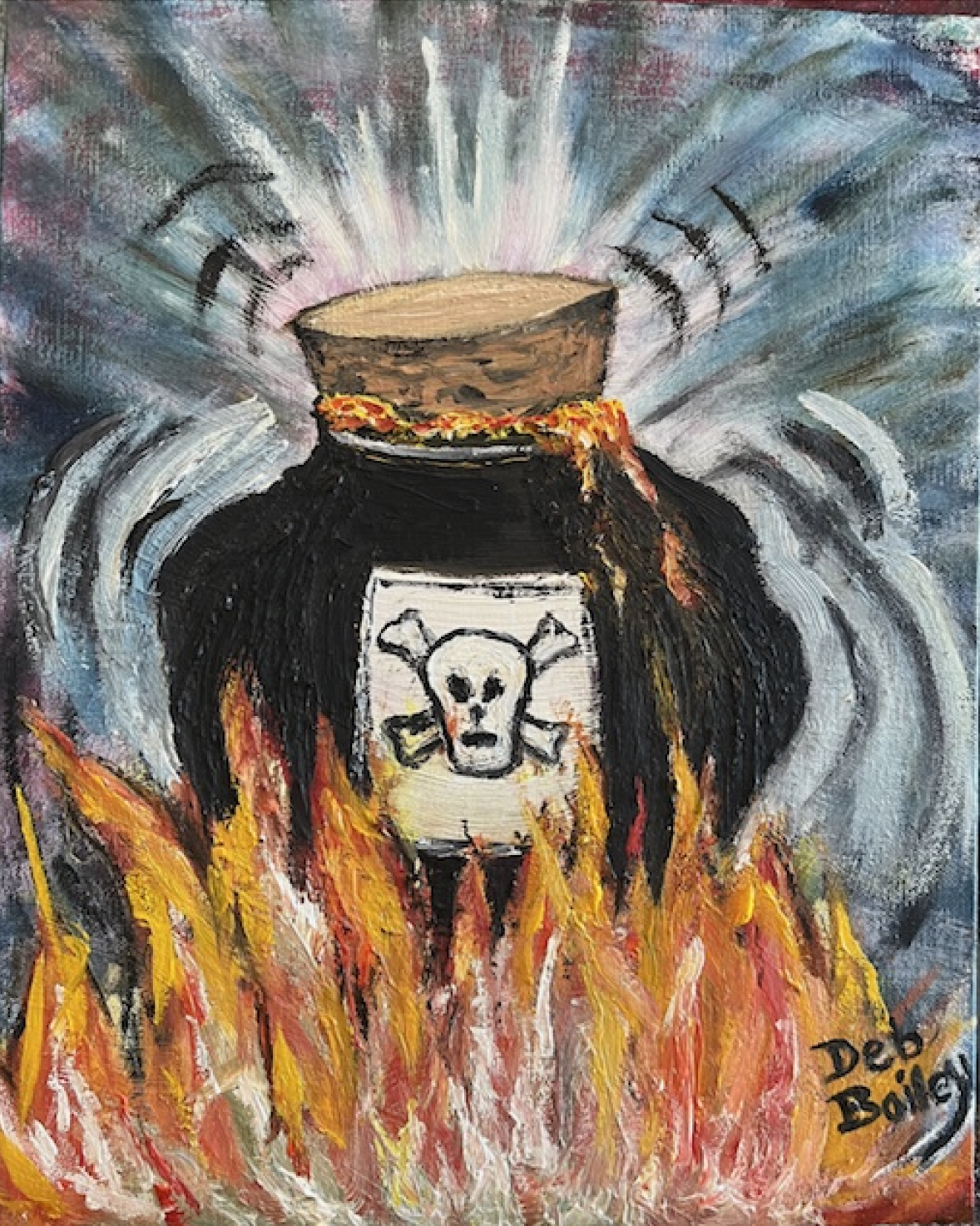
It is a place of our ghosts, filled with toxic poisons, bubbling, oozing, and swelling in a stoppered bottle. As the fires of life’s pain intensify, the heat and pressure build. The boiling liquid rises, forcing itself hard against the stopper until, finally, the block gives way.
If we’re lucky, it will just push the stopper up enough to leak out and ease the pressure. Or, if we can bring attention and wisdom to the process in time, we might be able to toggle the stopper slowly and safely release what’s under it. But if we ignore it, it builds, explodes, splatters, and destroys.
Transformative wrath
I love mythology and stories about old wise women and crones…especially since I am one now, at least, old. So, this excerpt by Jean Shinoda Bolen, MD, in her book, Goddesses in Older Women, says it eloquently:
You can run, but someday you will have to slow down. And what if what chases you doesn’t?
I was never one to run away from a fight. Once I got out of that house, I never backed down or yielded to a challenge. They were “gauntlets thrown down,” and it was my ethic to always pick up the gauntlet and fight back. At least with concrete things like confronting my father. Protecting my son. Learning the “next thing” I needed to, so I could live a healthy, useful life.
At that point, it was the right thing to operate from a place of “keep going and tough it out, because others need you.” It was the truth. You don’t stop to examine “within” when you are fighting external battles.
And society encourages that too, with its spoken or unspoken, but expected rule: Move on. Get over it. Leave it behind. It’s better now, so why dwell on the past? Sometimes society can be downright cruel and tell you that to revisit the past wounds is just indulgence or navel-gazing. But regardless, for those times, I did what I needed to when it mattered. And I am satisfied with that.
But after Mom died, and the emotional roller-coaster that followed, I realized there finally comes a day when there are no more “priorities” in line ahead of you, and life is asking, “Are you ready to face yourself?”
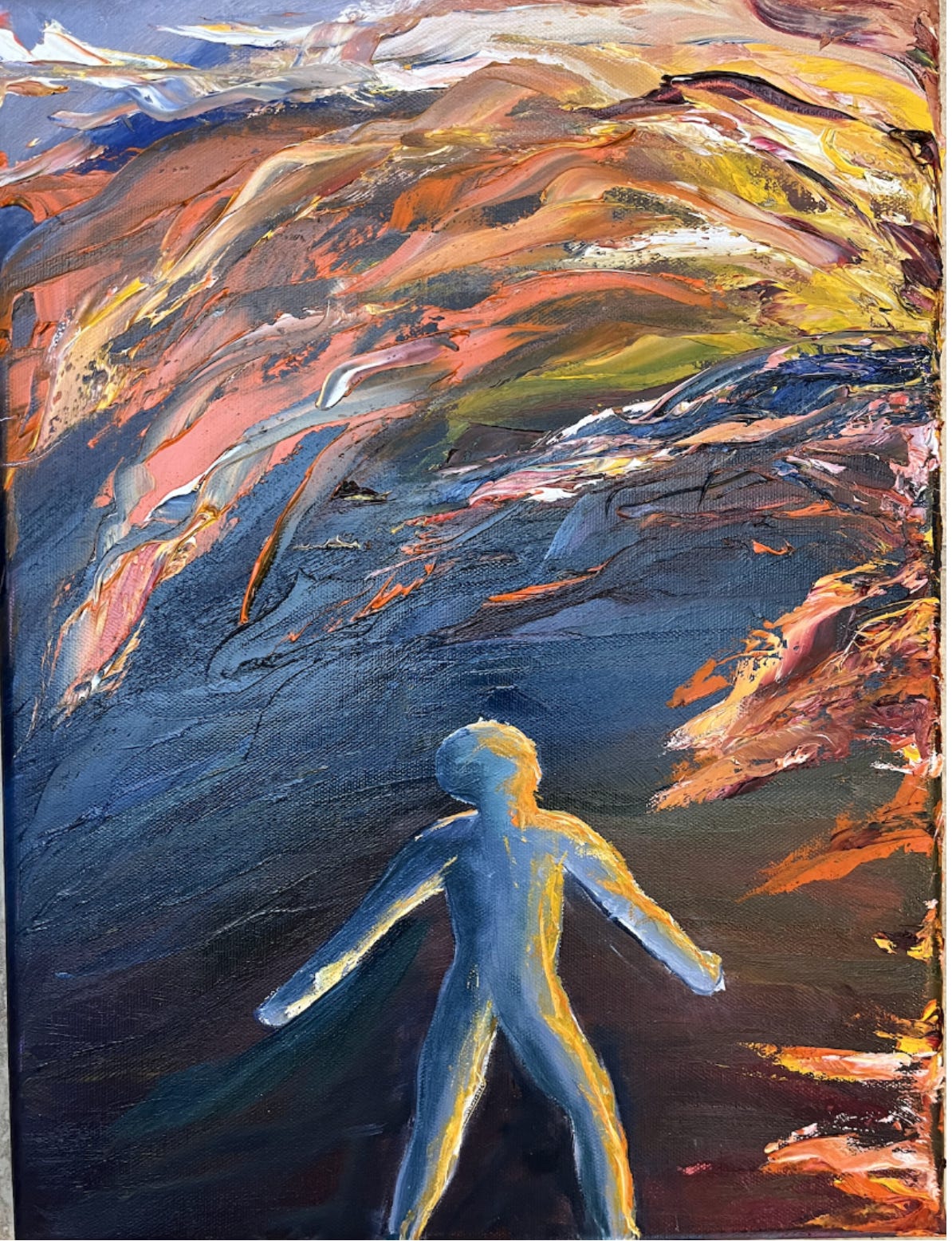
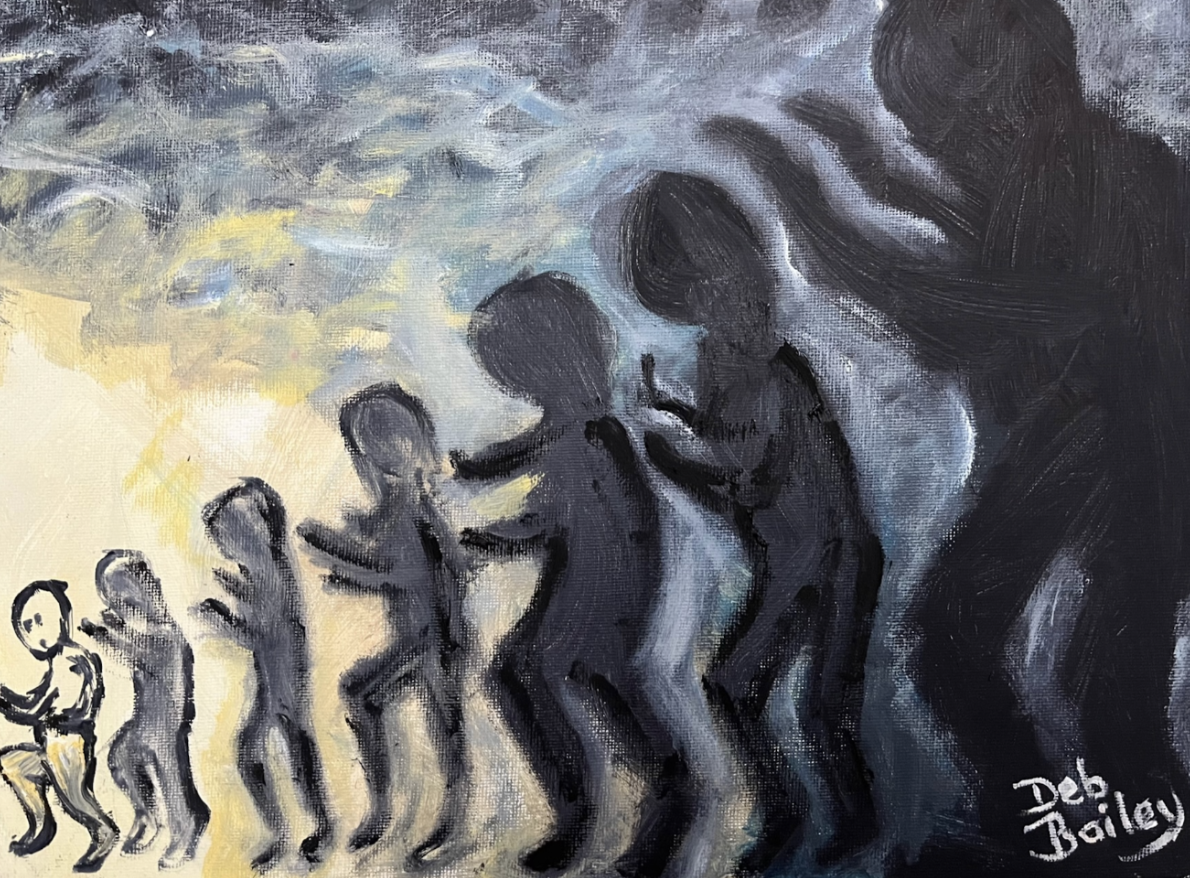
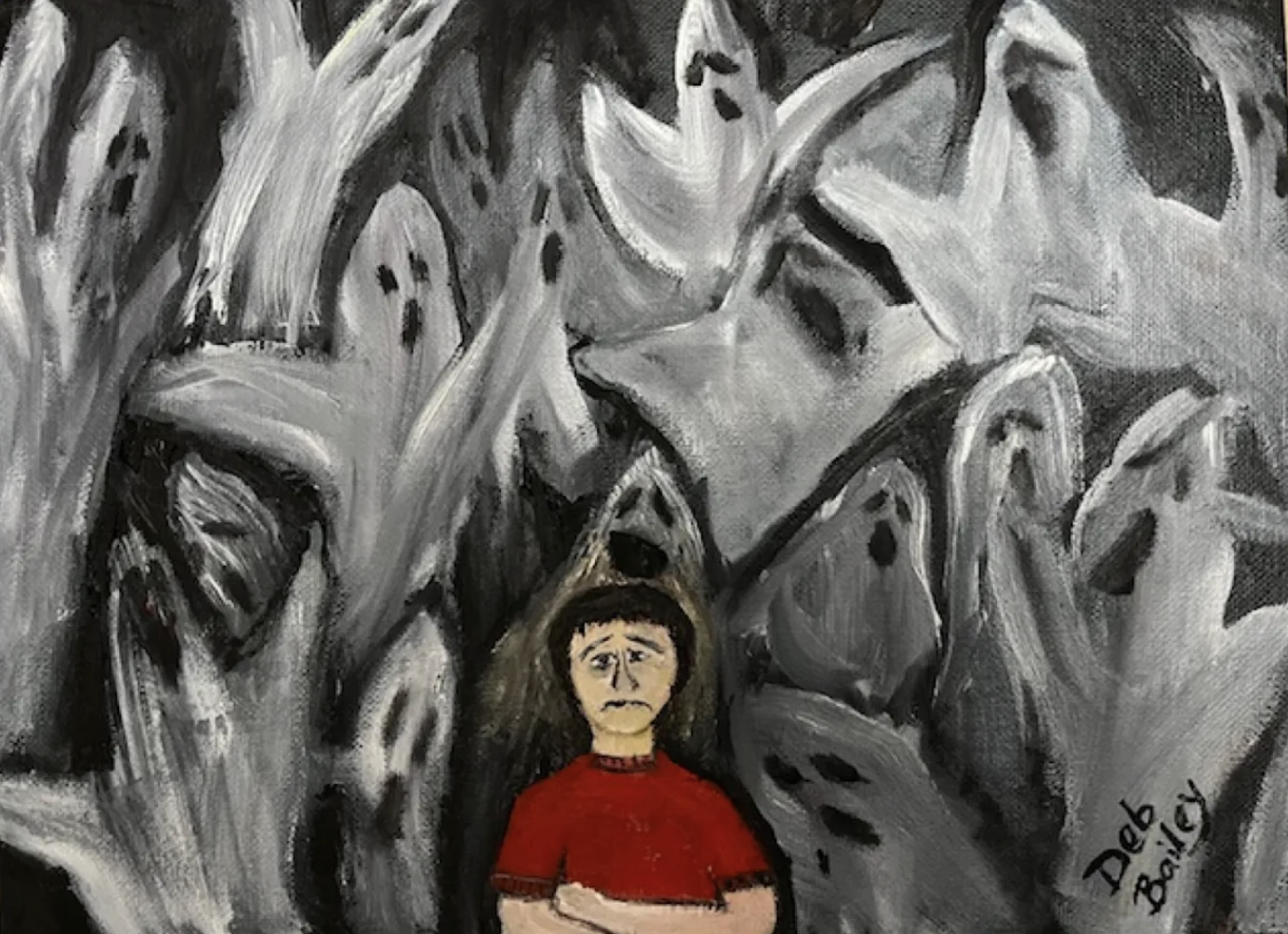
While I couldn’t articulate the issues yet or name all the ghosts, I could feel them. They surrounded me, pressed up against me, shoved me down from above, and choked in my throat. They seemed to take up all the oxygen and all the space, until I finally felt like I couldn’t move.
If I tried to pull away or in, they just took up more space, leaving little for me. Who were the ghosts? Who was I anymore?
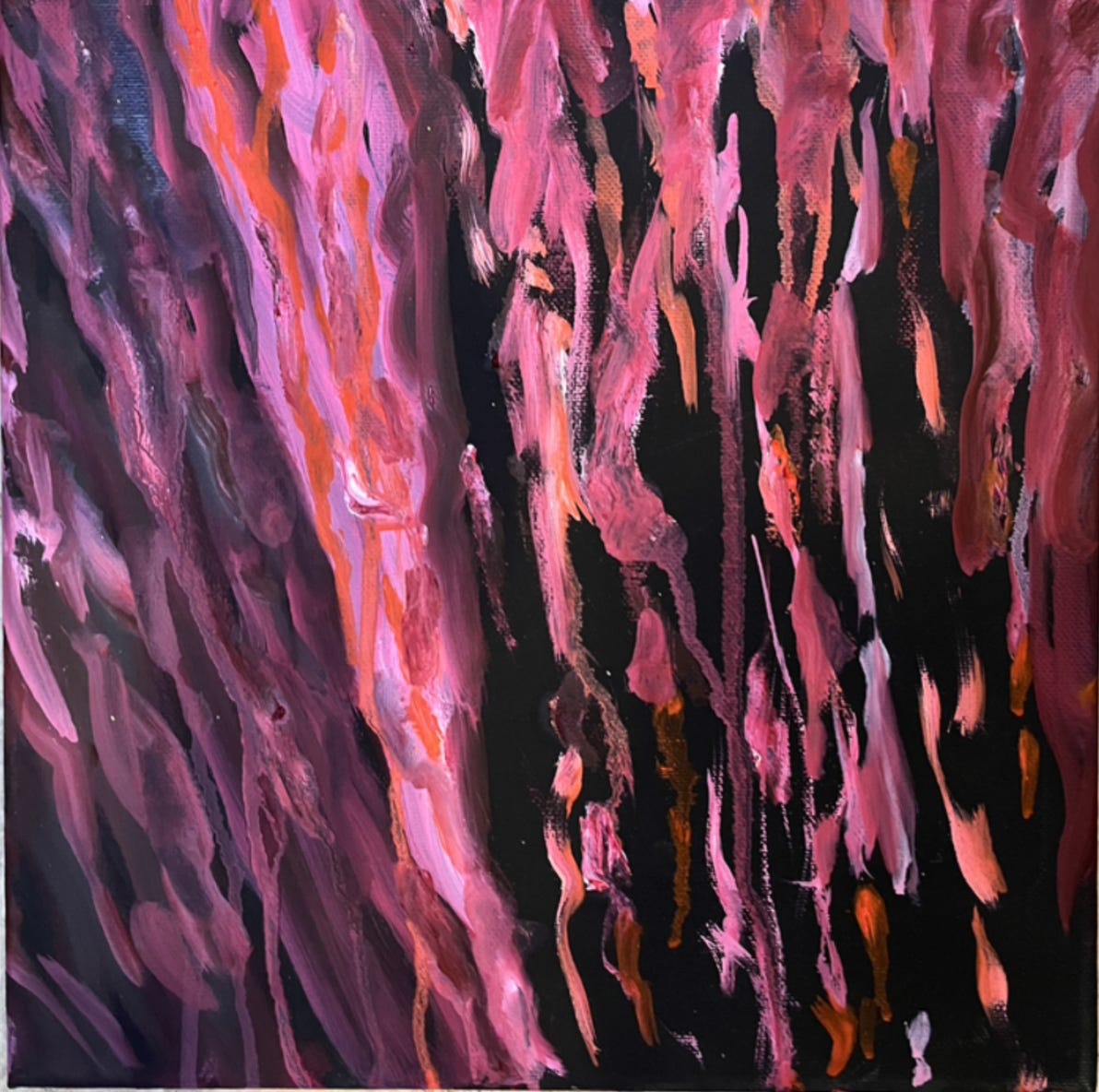
So I painted what they felt like. At least I could “see” how bad I felt. Their presence was like an emotional version of that stomach bug.
 Soul Mosaic