Posts Tagged ‘fiddler crab’
March 29, 2008
I was amazed to see babies born before Monday. Monday was 2 weeks to the best of my knowledge. So she delivered a couple of days earlier than I expected.
Anyway, yesterday started with me doing a 30% water change as nitrite levels in the tank since Scarlett has been in there, have been hovering between 0.5 – 1.0 ppm. I kept the water filter running to give the water the best chance of staying nitrite free and letting the nitrogen cycle mature.
This evening though, I noticed that Scarlett was very agitated. She kept running back and forth in the tank, climbing up onto the air bubbler and waving her claws in front of her as if trying to spread something in the water. There did not appear to be anything in front of her though. I noticed that the center of the egg mass seemed to be swelling. Given that, I went ahead and shut off the water filter.
For the next hour or two, Scarlett O’Hara kept moving around, seeming very uncomfortable. Around 8:30 p.m. I looked over at the tank and noticed she was sitting quietly in the front of the tank eating. She seemed “slimmer.” Looking closer, I realized, she no longer had the egg mass. So I missed the delivery again. However, a quick look around the tank and I could seen thousands of tiny little dots swimming around.
I fed them a small amount of Small Fry and ZooPlex. I wondered if this will go okay since I couldn’t get the nitrites to zero before they were born.
This morning I got up and looked at the tank. It was a white cloud. I thought, “Oh God, the water quality got worse with all the babies in there and the nitrites are probably through the roof.” I looked at the ammonia monitor and it is in the safe zone. I shined a light into the white murk and could see thousands of babies swimming around. So they’re still alive and ?healthy.
Wondering why the tank is so cloudy, I decided to recheck water parameters:
pH 8.0 – good; alkalinity 300, hardness >300, chlorine 0 – all great results, AND the REAL KICKER OF ALL: NITRITES AND NITRATES ZERO!!!! Puzzled, I repeated the nitrites test using a tube test instead of the dipstick. Again – nitrites are ZERO!!
So water quality is actually BETTER??? I looked in the tank and saw all the babies flitting around and MANY on the calcium sand at the bottom. That’s when the light bulb went off in my head. The water cloudiness is “white” like the bottom sand….could it be cloudy because thousands of little tiny guys are bouncing around against the sand at the bottom, eating whatever’s in it (since it’s ground up from live coral…possibly some microscopic food bits there?), and eating it for calcium for their molting?
If they were out in the ocean they’d have “bottom stuff” to dig around in so maybe this is a good thing? Though it certainly makes it harder to see them. For whatever reason, baby fiddlers seem to like to “head for the bottom” – at least some of them. That happened last time with many burrowing into the gravel and dying. So I will see how this calcium sand thing goes. I am PLEASED though that the water quality is so good.
For today – I need to go feed them again and I will need to start raising the salinity to ocean level. If that IS what should happen, they should survive. If not, well, we’ll find out. One step at a time.
Tags:alkalinity, aquarium, calcium, chlorine, fiddler babies, fiddler crab, Kent Marine ZooPlex, nitrates, nitrite, nitrogen cycle, pH, Scarlett O'Hara, Small Fry, tank, water filter, water hardness, water parameters, white sand
Posted in Broken Bits | Leave a Comment »
March 22, 2008
Well the fiddler crab, Scarlett O’Hara’s pregnancy progresses well. I am through “labor and delivery” with Under the Pier’s second draft, and we had an RIP moment for my laser printer, which died trying to print the last two chapters of that draft.
Now, to expand on each just a bit:
Scarlett O’Hara is busy eating or just sitting behind the air filter, in the main fiddler crab tank. Her pregnancy progresses with no odd happenings. Her “nursery” tank is doing well – water parameters are fine and salinity was down to 1.012 when I diluted the water, earlier in the week. I will recheck water parameters and salinity tomorrow in the nursery tank. If they are fine, I will most likely move Scarlett over to that tank Monday or Tuesday. We first noticed her carrying eggs on Monday the 17th. On Sunday the 16th, we saw no evidence of eggs, but that’s when she was spending days living on top of the water filter, sitting in the water currents. So best guess here, is that Monday will be one week. The last time she delivered her babies, it was just about two weeks. So I will move her to the nursery early this coming week. Also, I will shut down the water filter again and just leave the air bubbler running.
I picked up eggs and supplies to hatch brine shrimp and will talk more about that tomorrow. I also picked up a liquid food geared toward larval invertebrates, that is a good brine shrimp substitute. NO MORE LIVE PHYTOPLANKTON. I’m hoping that sticking to the zooplankton food approach will work better and not end up with high nitrites that kill off the babies. So more on this tomorrow and this week.
I spent most of the day on Good Friday, polishing the last chapter of Under the Pier’s second draft. It is finished. Of course it needs more work, but at least now it is a real book. There are no giant piles of fix-it cards or empty places in the chapters where I still had to figure out something or add in a description. Next up in the project:
1) Continue on with the posts about writing Under the Pier – I left off on location as character and Part II of that coming up this week will be more info about specific locations in the story — which though fiction, are amalgamations of real places, as well as how I researched them.
2) I will be putting together the submission package for a couple of editors from last year’s Carolinas – SCBWI conference. These packages include three sample chapters, chapter summaries, and any other info I want to include. At least according to one editor. I have a “map of my story’s town,” a schematic of the diner and the diner area, a smaller map of the area around Max’s house, a schematic of Max’s house, a glossary, probably a bibliography of some of the sources including research papers and the researchers I talked to….and of course, this blog’s address. 🙂
3) Start draft three. This time, I can now read through “completed” chapters, and listen out loud to their rhythm, see where they bog down, see where they need more “sensory details” and also go through the large “revision” charts I made up to see if I’ve covered everything. A later post will cover what I compiled for those revision charts.
Re the demise of my laser printer – FRUSTRATING!!!! I was halfway through printing the last two chapters when it seized up and died. Now I can’t really complain. I’ve had that printer almost 7 years and have printed thousands of pages. I got my money’s worth out of it. I was just hoping not to have to a) deal with buying a new printer just to finish printing my book and b) spend the money now. But…. c’est la vie. We now have a new HP Laserjet P3005dn. I need to make it my friend. 🙂
Anyway, that’s the state of affairs here. Oh, and also, given the impending draft three of the book, I need to get going on “Creature Features” So stay tuned!
Tags:air bubbler, air filter, aquarium, bibliography, blog address, bog down, brine shrimp, c'est la vie, chapter summaries, chapters, crab, creature features, diner, editors, eggs, fiction, fiddler crab, fiddler crab tank, fix-it cards, glossary, Good Friday, HP Laserjet P3005dn, invertebrates, labor and delivery, larvae, larval invertebrates, laser printer, liquid food, listen out loud, live phytoplankton, map, nursery tank, phytoplankton, pregnancy, research papers, researcher, revision chart, RIP, salinity, sample chapters, Scarlett O'Hara, SCBWI, SCBWI conference, SCBWI-Carolinas, schematic, second draft, sensory detail, sources, tank, under the pier, water current, water filter, water parameters, zooplankton
Posted in Broken Bits | Leave a Comment »
March 18, 2008
One of our readers sent in some information the other day about her attempts to raise fiddler crab larvae. That comment was in response to my blog post entitled:
The Fiddler Babies are Dead But We’ll Start Over and Prove HorseyhannahWrong.
Yesterday Laurie has this update that she posted on one of my other blog posts: “Extra! News on Preparing the Fiddler Crab Nursery.”
She has such good info, and generously wants to share it with all, so I include it here for all to see.
I especially loved what she said toward the end of her comment, that maybe if all of us who have knowledge on the subject of fiddler crabs pool our info, we can prove that you CAN too raise fiddler babies without the hundreds and thousands of dollars of equipment that Horseyhannah (on the Animal Planet forum) says you need.
So here is Laurie’s information, her gift to all fiddler enthusiasts out there, updating us on her progress and also listing the many things she’s done to make this work. Thank’s Laurie! And to anyone else who might have more info for myself or Laurie, please do send your comments. They are welcome!
Fiddler crab lovers of the world, unite!!! 🙂
Comment:
Laurie’s Fiddler Crab fry–March 17th, 2008, Day 7 and still going…
Just an update. They were released on March 10th and true to the (artist!?) breeder of the mangrove crabs www.aquahoito.info/sesarma/index.html on March 15th, day 5, I had a little more than half die off. In the last 2 days no more have died, tho.
Today I was able to get supplies for them, including a salinity meter ($7.00) and some test strips for nitrate/nitrite etc. and Kent’s PhytoPlex (not live) for more food. As I didn’t have proper food for them I did the newborn fish fry trick of feeding them hard boiled egg yolk. About 1/2 a matchstick head’s worth smashed fine in some water and dispersed with the fry, twice a day. That was too much, no doubt, but I’m new at crabs and they did ok…
I tested my water (2 gallon hex w/no filtration, slight bubbling from airstone) and nitrates were 0, nitrites were alright-“caution” .5 ppm, salt is .015ppm, hardness 300 (ideal). I’m finding it’s cheaper to do water changes in a small fry tank than buy a whole salt water filtration system. 2 tbsp Ocean Reef salt/quart, 1 qt every couple days. The little squirts only have to get to 2 or 3 months old before they’re little crabs, by the looks of Mr. Mangrove Crab’s work, so that’s not much salt used over time versus the complexities of a nitrogen cycle filtration system. Now that I have test strips I’ll know how often that should be.
Again, shutting off the bubbler, wiping the bottom to free the slime that’s growing there (I don’t think I’m getting it all, so if it’s food it’s still present somewhat), then fluffing it to one side and siphoning it up w/airline tubing seems to clean the nitrite creating stuff pretty well. Shining a light in one corner for them to aggregate near keeps most of them out of the way, and I shine it again in the gunk glass I siphoned into to get the ones I accidently sucked up back into the tank.
One interesting note is that after the “D-Day” day 5 die off the herd that is left swims less and congregates on the bottom on the side facing the window. Their movement is now more like a thousand little frogs hopping around in the herd at the bottom of the tank. Some still swim, but majority is doing the new movement. I can see a bit of their tail now, but no major growth change.
Possible theories: 1.) they molted on day 5 and many didn’t make it through. 2.)Nitrites killed them at this stage and they haven’t molted yet. 3.) Maybe everyone’s dies at day 5 because they have 5 days of food stored in them or because when they molt the new contact with water conditions isn’t right for them…
Interesting to note that my water isn’t the right ppm for salt, but half have survived… I thought I saw somewhere it should be ocean water (1.020-1.024, and somewhere else 1.010. hmm. Wish I had more tanks to test all 3 salinities.
My hope is that with more postings from folks that are having success we can all help each other out to solve this mystery and not make silly statements like it taking hundreds of thousands of dollars to get the right water conditions for this. heh heh that one still makes me chuckle. I bet it’s possible.
Folks could try their filtration systems in their nursery tanks with a big ball of fiber-fill around the intake (intake on LOW!) with super fine cloth over that. That makes the drag into the intake almost nothing. You’ll see if the babies are being pulled onto it, it’s too strong still… but I still am having great water results with one gallon of water in a two gallon tank.
Best… Laurie
Tags:air tubing, airstone, Animal Planet forum, aquarium, bubbler, crab, crab fry, fiber fill, fiddler babies, fiddler crab, fiddlers, filtration, filtration system, frog movement, hard boiled egg, hardness, Horseyhannah, intake, Kent's PhytoPlex, larvae, mangrove crab, molt, molted, nitrate, nitrite, nitrogen cycle, nursery, salinity, salinity meter, salt, slime, tail, tank, test strip, yolk
Posted in Broken Bits | 1 Comment »
March 16, 2008
When I first I walked by the fiddler tank yesterday morning, I was sleepy and oblivious. Then I did a double-take. Sitting at the front of the tank was the discarded molted shell of somebody. On closer examination, and with my husband’s consultation too, we both agreed it was Melanie Hamilton’s discard. That means she is at the moment most likely to get pregnant if Admiral Byrd invites her in.
At the same time we noticed that Scarlett O’Hara was sitting on top of the water filter….again. The last time she did that, we noticed shortly afterward that she was pregnant.
Admiral Byrd of course, was marching up and down the tank, claw arm held high, and waving.
To continue – Scarlett O’Hara spent the entire day and evening yesterday, on top of the water filter. She is still there this morning. She has never done that before or since, except when she was pregnant. I know she is still alive because she is “blowing bubbles.” Crabs foam sometimes when they’re out of water, to moisten their gills.
Even when I freaked out Admiral Byrd yesterday, and scared Melanie Hamilton out of her live rock because I was cleaning the tank and accidentally bumped the live rock, Scarlett O’Hara didn’t leave the filter perch. She just moved down into the filter for a bit, then climbed back up. Admiral Byrd meanwhile kept trying to climb the heater power cord up to the top of the filter to be near her, but he couldn’t quite do it with that large claw.
Yesterday afternoon we noticed that Melanie Hamilton remained outside the live rock, sitting there on the gravel serenely watching Admiral Byrd flex his claw. Then she spent the rest of the afternoon and evening in his cave lair. This morning she was resting just outside his lair, picking algae off the rock. He was napping inside.
With any luck, we can try the larvae thing again somtime soon?
I am in the middle of re-establishing the nursery tank. I had emptied everything from the original set-up, cleaned out the tank, put down the one inch or so of the calcium-releasing sand, and added the water. Now I did forget to rinse the sand out, so the tank water was cloudy at first, but it has settle out by now. I’m not sure how one effectively rinses sand out anyway without half of it going down the drain. I will say the white sand really makes the inside of the tank bright when the light is on. If we get babies again, it should be much easier to see them in such a bright tank.
I couldn’t decide whether to make the 3 gallons of water I added marine or brackish. I guess I should start brackish because first we’ll have to move the mom, whichever one of them it is, from their tank, which is brackish into this one. I wouldn’t want to shock them. Right now the tank is on the “marine side” of brackish. I’ll adjust the salinity with a bit more water shortly.
The live rock is back in the tank hopefully doing its thing to establish the nitrogen cycle. Both the air filter AND the bubbler are running and so hopefullly the tank environment will establish itself as quickly as possible. Rather than replace the old water filter cartridge and lose whatever nitrogen-fixing bacteria that had started to thrive in it, I left everything in place and returned it to the tank.
An interesting about the old water in that tank. I tested it before I emptied it out just to see if the nitrite levels ever came down. They read zero, and the nitrates were in the “okay” zone. I guess once I stopped using the live phytoplankton and let the water filter run for a few days, that was what it needed. So the phytoplankton was most likely the culprit in the high nitrites. In any event, I dumped the old water and just started with fresh sea/brackish water all over again.
One thing – that Reef Calcium product that I’d hoped would raise the alkalinity but not raise the pH, when added to half strength Instant Ocean… maybe it didn’t raise the pH but it didn’t solve the problem of the pH being too high from the Instant Ocean even when I used that at half strength. So I still had to use a pH lowering solution and this morning it is about 8.0 vs 8.4 that it was yesterday. So that’s perfect . At least though, the Reef Calcium did raise the alkalinity.
I will keep you all posted on any news from the adult tank. Keeping good thoughts for a new crop of larvae babies. Stay tuned.
Tags:Admiral Byrd, air bubbler, air filter, algae, aquarium, blowing bubbles, brackish, bubbler, calcium-releasing sand, claw, crab, crab foaming, fiddler crab, fiddlers, foaming, fresh water, gills, Instant Ocean, larvae, live phytoplankton, live rock, marine, Melanie Hamilton, molt, nitrite, nitrogen cycle, nitrogen-fixing bacteria, nursery, nursery tank, pH, pH lowering solution, phytoplankton, pregnant, Reef Calcium, salinity, Scarlett O'Hara, sea water, shell, tank, water filter
Posted in Broken Bits | Leave a Comment »
March 12, 2008
Some Fiddler Updates – New Product Technical Details and Romance
1) Preparations, Take 2, for the Fiddler Crab Nursery Tank:
I came home from PetsMart yesterday armed with calcium sand to replace the gravel in the nursery aquarium. That project will commence later today. The sand is actually something called Seachem Meridian Tidal Marine Substrate. It’s basically calcium carbonate precipitated from ocean waters by coral. It will stabilize the calcium and alkalinity levels in the water, and keep the pH from getting too low. Its porous structure and size supposedly are good for the growth of denitrifying bacteria. We shall see.
At the very least, it’s a dual purpose as I can also use this sand for the bottom of the land hermit crab cage I just bought. The land hermit crab project will be ramping up soon.
I also picked up some liquid food that should work fine for the larvae. I’d mentioned a product called JBL Nobilfluid that a gentleman from Finland used to raise his crab larvae. However the Nobilfluid is made in Germany and appears to be available in Finland, Germany, England, Italy and the UK, but I couldn’t tell if it was available here in the US. I could get it from a UK website but between the exchange rate and the shipping, I expect the cost is prohibitive. A JBL representative answered my email yesterday and said their product is not available in the US yet.
I found this new product at PetsMart called Kent Marine ZooPlex. The problem I had with the fiddler babies was trying to find liquid plankton to feed them. My mistake was getting live liquid phytoplankton, which made the tank toxic and killed them. I realized larval crabs need zooplankton, which is animal plankton = roughly translated: MEAT. Phytoplankton, being plant based, is the wrong plankton. Larval crabs are carnivores, not vegetarians. Anyway, Kent Marine ZooPlex is “concentrated aquacultured Marine Zooplankton” and is geared toward invertebrates including larvae. The bottle notes it can be used as a brine shrimp replacement. So this sounds like it might be just the thing for liquid feeding of newborn larval crabs who are too small to chase live brine shrimp around.
I will still need to get the dried brine shrimp eggs to hatch when I know I have a pregnant female ready to shed her eggs. The brine shrimp hatchery project will come a bit later.
2) How to raise the alkalinity of the water for the brackish tank without raising the pH?
The dilemma I have when using Instant Ocean to make up the brackish tank water for the adult crabs, is that I have to use it at about half strength. That way I get a salinity of about 1.010 instead of 1.020-1.024. The trouble is, that makes the alkalinity way too low meaning there’s not enough calcium in the water for the crabs when they molt.
I’ve tried adding Seachem’s Marine Buffer, to raise the alkalinity and it’s very successful, but it also raises the pH way up to 8.3. That’s fine for a marine tank, but for the brackish tank, the fiddler crabs seem to like the pH closer to 7.8-8.0 I have a constant battle trying to get the salinity low enough, the alkalinity high enough and the pH “just right” somewhere between a freshwater tank and a marine tank. When I use the Marine Buffer I have to then add something to lower to pH.
I was hoping to find something that would raise the alkalinity, but not the pH when I use Instant Ocean to make up the brackish water. Yesterday I came across Seachem’s Reef Calcium. The website description reads:
“Reef Calcium™ is a concentrated (50,000 mg/L) bioavailable polygluconate complexed calcium intended to maintain calcium in the reef aquarium without altering pH.”
I am going to try the Reef Calcium product and see if that solves the problem. I will let you know.
3) Romance: a humorous update for a Wednesday:
Ever since his success with Scarlett O’Hara, Admiral Byrd has been out there claw-waving up a storm. Melanie Hamilton spends just about all her time inside the live rock. Yesterday afternoon is the first time I’ve seen her out of it in weeks. I think she took to hiding out in the rock when Scarlett O’Hara was living in the nursery tank. With Scarlett temporarily gone, Melanie was the total focus for Admiral Byrd. I don’t think she liked that.
Anyway, after giving birth, Scarlett O’Hara has been eating almost non-stop. I think she finally slowed up a bit yesterday, but she’s still pretty ravenous. In fact yesterday, I dropped a shrimp pellet in the tank and Scarlett scrambled up and caught the thing in mid-drop. It never even touched down on the gravel. And she’s pretty good. No fumbling and bobbling the shrimp pellet. She spotted it, she jumped, clutched it to her chest and landed on her feet, eating the pellet before she landed. She could probably earn a spot as an outfielder for the Red Sox.
Unlike Melanie Hamilton, Scarlett hasn’t been too concerned one way or another with Admiral Byrd’s where-abouts. She doesn’t run from him, or toward him. She just eats. Still, I don’t think she’s averse to his presence as she’s spent a fair bit of time in his lair, the fake rock cave, while he walks around waving his claw. I have to wonder if he realizes she’s sitting in his house?
Last night I turned off the tank lights, shut off all the house lights and went upstairs to bed. A little later I had to come downstairs for something and walked by the tank. Even in the dark, I could see Admiral Byrd standing there on his gravel hill, waving his claw. Total darkness, but the crab is still out there trying to get the attention of the ladies of the tank. What dedication.
He is also very funny in his pursuit of Scarlett O’Hara. He climbs to the top of the live rock, to wave his claw of course. Yesterday while claw-waving, he caught sight of Scarlett down on the gravel next to the live rock. He stopped waving, tip-toed to the edge of the rock, peeked over the edge at her to see which way she was going, then, like a teenage boy in love, scrambled down the rock and followed her around all the while waving his claw.
So watch out Scarlett, Admiral Byrd is peeking.
Tags:Admiral Byrd, alkalinity, aquacultured, aquarium, brackish, brine shrimp, calcium, calcium carbonate, carbonate, carnivore, carnivorous, claw, claw waving, coral, crab, denitrifying bacteria, eggs, fiddler, fiddler crab, Finland, gravel, hatchery, hermit crab, Instant Ocean, JBL, JBL Nobilfluid, Kent Marine, Kent Marine ZooPlex, larvae, larval, larval crabs, live rock, marine, marine buffer, Melanie Hamilton, Meridian, molt, nursery tank, ocean water, PetsMart, pH, precipitate, Red Sox, Reef Calcium, romance, salinity, Scarlett O'Hara, Seachem, Seachem Marine Buffer, Seachem Meridian Tidal Marine Substrate, Seachem Reef Calcium, shrimp pellet, tank, Tidal Marine Substrate, zooplankton, ZooPlex
Posted in Broken Bits | Leave a Comment »
February 23, 2008
I spotted this question on a Google search and decided to follow up on it. It has been the question in our house – Scarlett O’Hara seems to get bigger every day with the larval crabs she’s carrying. How long will she carry them? What will she do with them? I’ve learned that female fiddler crabs usually like to hang on to the babies until the right set of tides and conditions so that their babies will be carried out to the open ocean. Apparently they do this because the larval crabs stand a better chance of finding food, and of not becoming someone else’s food, out in the open ocean. That gives them the best chances for reaching adulthood.
The question in our minds here is: we have no outgoing ocean tides in the “aquarium estuary” so when will she release them?
We’ve noticed she keeps hanging out on top of the water filter. In fact yesterday she was deep down INSIDE the water filter. She’s also been ripping the filter backing apart and eating whatever she’s pulling off the fibers. Since fiddler crabs like to eat a lot of microscopic algae, I assume that’s what she’s found. I keep wondering though, is she going to release her babies in the “currents of the water filter?” If so, I wonder how she will decide which currents are “outgoing tide” to that imaginary open ocean we don’t have. 🙂
Anyway, two good articles I came across in my search:
1) When ‘in a pinch’ won’t do: Ultra-picky female fiddler crab cited in UCSD (Univ of California at San Diego) study.
Apparently the female California fiddler crabs are VERY picky about their mates and have REALLY high standards for what kind of “house” the male is offering them. On average the female passes up 23 offers before finally selecting a male. In one case a female passed up 106 offers before choosing her mate. Now…I don’t know who to be more impressed with – the female fiddler crab who passed on 106 males before choosing one? Or the human researcher who followed this female fiddler crab around and kept track of how many males she turned down before choosing? In any event, an interesting article on the life cycle habits of the California fiddler crab.
2) The SC and C FAQ Database: it has a large number of questions and answers about crabs, shrimp, and crayfish. Question # 16 is about 3 pregnant female fiddler crabs and how long their gestation period lasts. Apparently in an aquarium, the female will release the eggs in about a week. We shall see. …Also it has information on what to feed the newly released babies, which might actually let them survive in an aquarium and grow to adults. Hmmmm 100,000 grandchildren. Needless to say my husband is thrilled with the news we might actually be able to help the babies survive in a tank! 🙂 Now all I need to do is find micro-plankton, like Infusoria, to feed to them…..
Tags:algae, answer, aquarium, babies, California, crab, crayfish, currents, estuary, fibers, fiddler crab, gestation, house, Infusoria, larval, male, mates, micro-plankton, microscopic, ocean, offer, question, released, SC and C FAQ Database, Scarlett O'Hara, shrimp, study, tank, tides, UCSD, University of California San Diego, water filter
Posted in Broken Bits | 2 Comments »
February 17, 2008
After intense things, while it’s important to reflect and absorb the full depth and impact of the event, it is also good to return to humor. My husband found this web site with cute animal pictures and funny quotations. Though it’s not a fiddler crab, I give you “I Has a Stik.”
Tags:animal, depth, event, fiddler crab, humor, husband, impact, intense, pictures, quotation, stik, web site
Posted in Broken Bits | Leave a Comment »
February 6, 2008
As I mentioned earlier, photographing fiddler crabs helped me to “be one with them.” Armed with the heart of a crab, maybe I can get that across in the book.
In a broader sense, there are some similarities between the arts of photography and writing:
1) Narrow the topic:
The viewfinder of a camera sets the limits on how much you can fit in the picture. A photo is a one-moment slice of an event. You can’t show everything, so you have to choose. What will you focus on?
Good writing, especially essays and short pieces, needs limits too. Start with too broad a topic and the piece runs too long, lacks focus and depth, and leaves the reader wondering it’s about. You can’t say everything, so you have to choose what you will say. Choose a specific slant and give the reader depth for that one topic.
2) Composition – Create the Scene:
Part of the art in a good photograph is its composition. What did you include and why? How did you choose to portray it? What angle was it shot from? Lighting? Shadows? Contrast?
In a good story, “show don’t tell” is done with scenes. You’re the director. How will you set it up? Who will be in it and who will be left out? Why? What will they say and do? What are they holding? Wearing? Where are they? Is it frigid or tropical? Are they scared or serene?
3) Detail is the life of the creation:
The camera’s eye doesn’t miss much and often sees more details than the photographer did when taking the shot. The details that show up in the picture bring it alive, especially in things like still life and macro photography. The details ARE the photo.
In writing, specifics are the spice that creates the picture. Something doesn’t smell good, it has a licorice herbal aroma that wafts through the sunlit cottage and makes you salivate with anticipation. Something doesn’t feel rough and hurt you, it has a gritty surface that grinds against the tender flesh of your palm until it strips the skin raw and bloody. Specifics create the image.
4) Deliver the vision:
You can see the image you want in your mind’s eye, but if you can’t work the camera, all you’ll get is a dark blur. Master the technology.
The most amazing story may run through your mind. Yet if what appears on paper lacks organization, moves too slowly, leaves out needed plot points, has poor sentence structure, bloated dialogue, or no sensory details, no one will get it. Master your craft.
5) Know what you want to say:
A photograph may be wordless, but it will still speak to the viewer if the photographer knows what he’s looking for.
In writing, you may have a 500-page novel but you still need to be able to sum it up in a line or two. If you can’t do that, you don’t know what your story is about.
In the future, 10 or so things an oil painting taught me about the writing process. Stay tuned.
Tags:angle, anticipation, aroma, art, book, camera, choose, composition, contrast, cottage, crab, craft, create, creation, depth, detail, dialogue, director, fiddler crab, focus, gritty, herbal, image, licorice, lighting, limits, macro photography, narrow, organization, photo, photographing, photography, picture, piece, plot, plot point, reader, scene, scenes, sense, sensory, sentence structure, shadow, shot, show don't tell, similarities, slant, specifics, spice, still life, story, technology, topic, viewfinder, vision, writing
Posted in Broken Bits | 3 Comments »
February 2, 2008
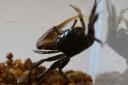
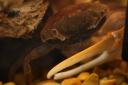
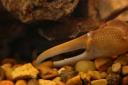
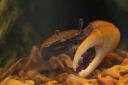
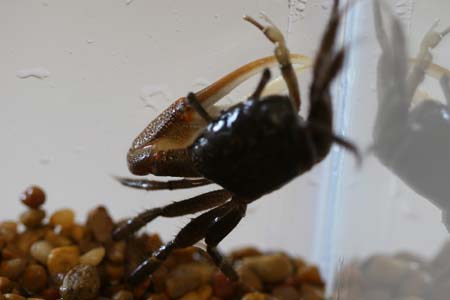
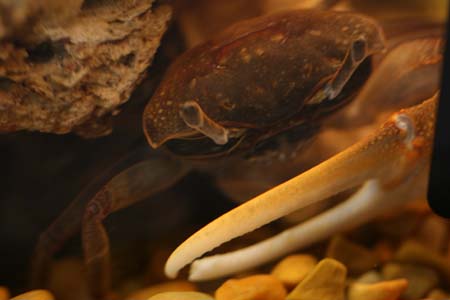
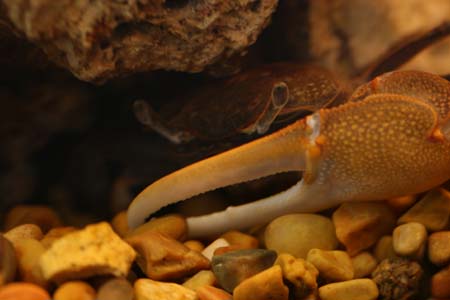
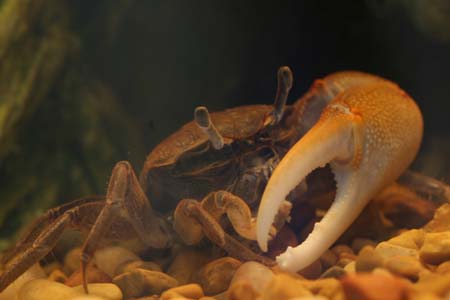
To round out the fiddler crab trio in our household, I give you the sole male in the tank, Admiral Byrd. He is fearless, commands the tank, explored every inch of it the moment he first entered the tank, and so he deserved a name fitting for a courageous explorer.
The first picture shows Admiral Byrd under less than optimal circumstances. In one of the first blogs about the crabs I mentioned the problem of getting the salinity level right in the water. Being brackish water crabs, they like lower salinity. Not knowing this, I had made the water the same as regular sea water. That drove Admiral Byrd literally out of the water, up the gravel hill, and as seen here, climbing the walls of the tank to get out. I quickly diluted the water, thus calming him down and convincing him to stay.
The second picture seems to sum up Admiral Byrd’s standard pose: “Stand back! I have a claw and I’m not afraid to use it!”
The third picture shows Admiral Byrd trying to get closer to the ladies by nestling in against the live rock while they were sleeping inside. (He was too big to fit inside). I guess he figured if he slept outside their front door, they’d have to run into him sooner or later. Admiral Byrd may be brave, but he is not too smart. The ladies just exited the live rock by the side entrance.
The last shows dinnertime. Admiral Byrd is chewing on a shrimp pellet clasped in his smaller front claw.
That’s the crew.
In another post, I will talk about a couple of ways this photo project helps my writing.
Tags:Admiral Byrd, blog, brackish, claw, crabs, explorer, fiddler crab, photo, picture, salinity, sea water, shrimp, tank, water
Posted in Broken Bits | Leave a Comment »
January 30, 2008
Probably the most interesting thing in the fiddler crab experiment is my family’s reaction to them. My son came home from college at Christmas and initially looked at me like I was crazy because I talked so much about the crabs. In fact, my independent college student complained I was paying more attention to the fiddler crabs. He kept laughing at me as I talked to the crustaceans in that high-pitched mommy voice previously reserved for my toddler son and pet poodles. My husband just kept teasing me about the total amount we were up to on fiddler crab expenditures.
Within of day of being home, my son started watching them, and within a few days he was keeping track of who was doing what and telling me to check on Melanie Hamilton or Rhett Butler. In fact, I think he was the one who first noticed that Rhett Butler was dead.
My husband was the one who spotted Scarlett O’Hara molting and eagerly called me over to see her when I came in from grocery shopping. Last night, he came in from work and before he even said hello to me he stopped, peered in the tank and said with great concern, “There’s something wrong with Admiral Byrd! I think he’s dead!” As it turned out (after I poked Admiral Byrd with my latest acquisition, a 25 cc plastic pipette and bulb from Science Safari that I use to siphon out excess food), I think Admiral Byrd was just sleeping – they kind of hang there, their claws floating above their heads, and don’t react to much. But my husband walked away and said very seriously, “I think you’d better keep an eye on him.”
What I realized is that caring, like a cold, is an occupational hazard of sharing space. When you share space, even with a creature who has a brain the size of a pinpoint, it starts to get personal. When it’s personal, you start to care, even when you didn’t mean to.
I think the same thing happens with people. So often you hear people say, “I don’t like this group or that.” Then they meet someone from that group and find out they really are okay . . . maybe even . . . nice. It’s hard to share space – sit across the table from someone, hear their humanness, see it in their eyes – and not care. That’s the real risk factor I suspect . . . contact . . . sharing space. The minute you share the space, you start to see the real person. Once that happens, it’s personal. And once it’s personal, you’re done for because caring is catchy.
Tags:Admiral Byrd, aquarium, brain, bulb, caring, catchy, Christmas, claws, college, crabs, creature, crustaceans, expenditures, experiment, family, fiddler crab, hazard, humanness, husband, Melanie Hamilton, occupational, personal, pinpoint, pipette, plastic, Rhett Butler, risk factor, Scarlett O'Hara, Science Safari, siphon, son, space, student, toddler
Posted in Memoir - sexual abuse trauma recovery | Leave a Comment »
 Soul Mosaic