A need for clarity
Before I go on with my story, I need to clarify something.
As I write, I usually speak of my “family,” either in terms of my husband, son, and myself, or my family of origin – my household growing up. And I try to be mindful to be clear who I mean in each specific instance.
But I will also sometimes mention the “family system,” and it occurs to me I never explained what I mean by that. So, before I continue the story, a clarification is in order.
My own impressions
First, I am not a psychologist or mental health professional, so I can only speak from things I have learned in therapy, read in the research, and then applied to my own situation.
For example, as part of the PAIRS therapy classes that Ed and I took to save our marriage, we had to create family charts that went back 2-3 generations and that identified successes, addictions, abusers, marital difficulties, and such. It was an exercise to see, at a glance, the patterns and behaviors that seemed to operate, both in an immediate nuclear family and across generations. By observing such patterns, it helped us understand issues that came from both of our family histories that were possibly affecting our marriage.
For our work in this, the “family system” included the following:
- Not just the father, mother, or specific child, but all in a household, and sometimes extended family members
- The rules, behaviors, and culture of the whole family, again, not just the immediate family, but also intergenerationally
- Does the system allow each member to become their own person, or are the members forced to serve the needs of others, enmeshed in others, and unable to make a healthy separation?
- The rules, behaviors, and culture of the “surrounding ethnic, religious, civic, and cultural” communities that the family lived in and was affected by
- It is a living “emotional” system, like a biological system, that requires “homeostasis” – that is, everything has to balance out. If one part of a system is extremely out-of-balance, the rest of the system has to compensate or over-extend in order to keep the whole in balance. In the case of abusive households, abusive persons create a large imbalance that favors themselves. This means that the rest of the family members in that system have to work overtime or be pulled way out of balance in order to compensate for the abuser. All of that adversely affects the health of the other members in the abuser’s family.
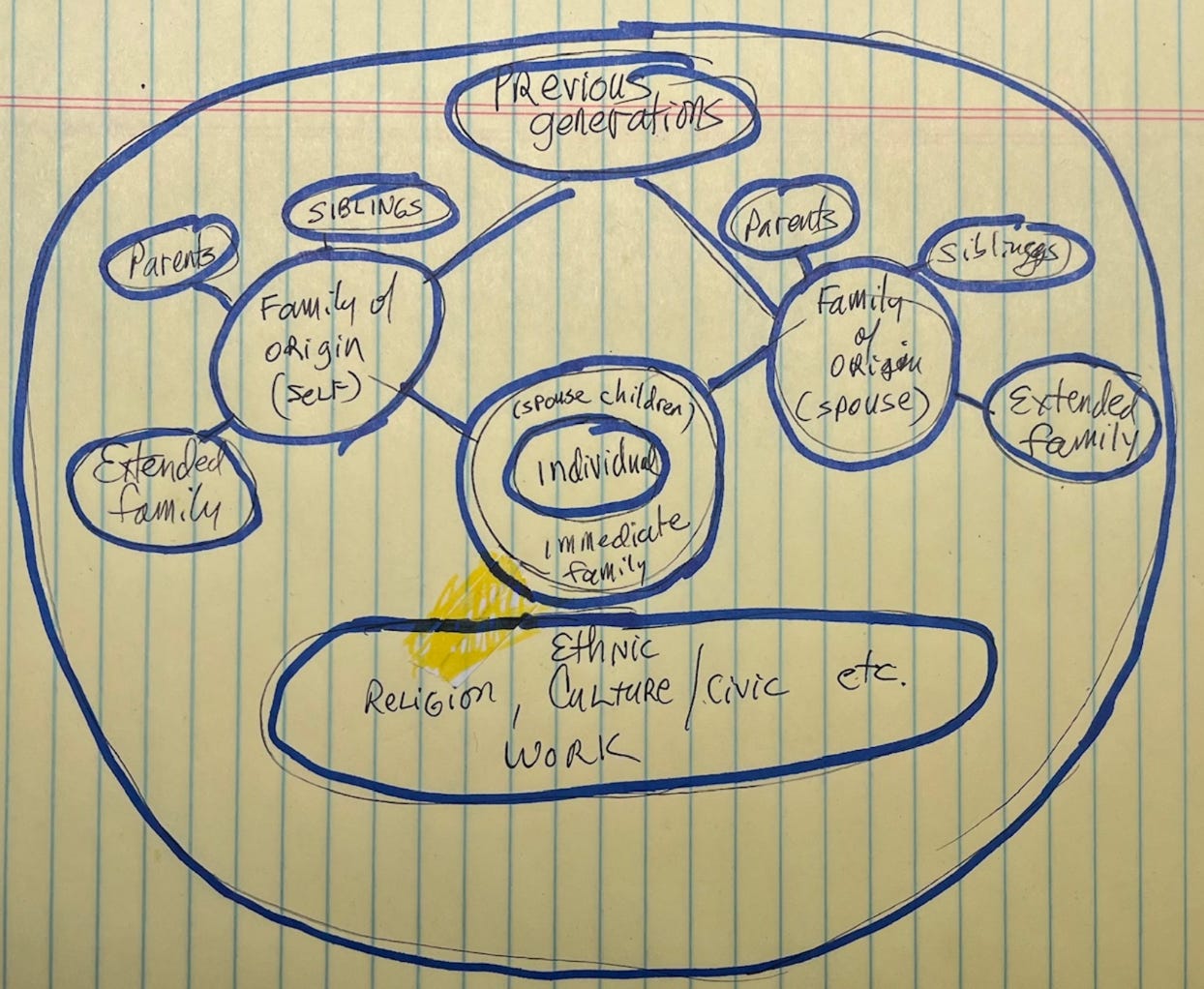
So the things I have defined are my own interpretation, for my own use, and might differ from the formal academic and psychological theories, which I give a bit of info on next.
Google AI’s thoughts
If of interest, I did a search on this topic, and got this information from the Google AI:
“A family system is a therapeutic and sociological framework viewing a family as an interconnected, interdependent emotional unit, rather than just a group of individuals. Behavior, actions, and emotions of one member affect the entire group. Key concepts include, but are not limited to, boundaries, roles, and maintaining homeostasis (equilibrium) within the family.
Key aspects of the family system include:
- Interconnectedness: Family members are deeply connected, with one member’s actions triggering responses from others.
- Emotional Unit: Families often operate under the same “emotional skin,” where stress in one person affects the whole unit.*
- Patterns & Roles:
- Behaviors are often repeated through generations (generational patterns) or assigned (e.g., caretaker, troublemaker).
- Structure: This includes nuclear, extended, or blended families living together or operating as a unit.”
Formal Family Systems Theory research information
Lastly, for anyone wanting to dig deeper into the theory of family systems, I would suggest seeking out a psychology professional. Also, here are some links for background information. Family systems theory was developed by Dr. Murray Bowen, and it focuses on the way relationships affect the well-being and mental health of the individuals in the system.
https://www.theraplatform.com/blog/677/family-systems-theory)
https://www.thebowencenter.org/
https://pubmed.ncbi.nlm.nih.gov/34823190/
https://www.thefsi.com.au/what-is-bowen-theory/
Now, back to the story.
 Soul Mosaic