Each of us has been sent here with unique talents. Somewhere, there is someone needing us to use them. What if we never do?
Keep going . . . you are needed
Each of us has been sent here with unique talents. Somewhere, there is someone needing us to use them. What if we never do?
Keep going . . . you are needed
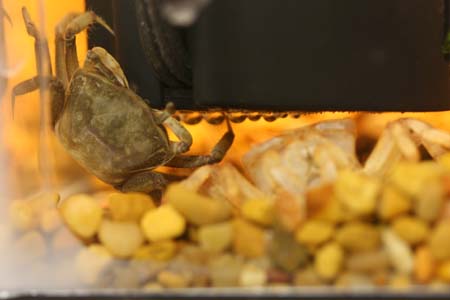
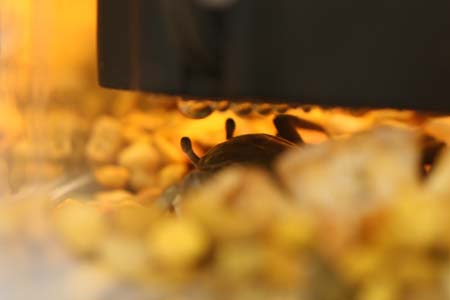
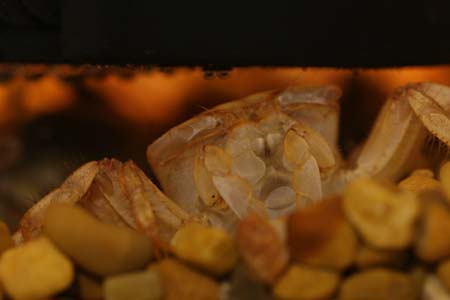
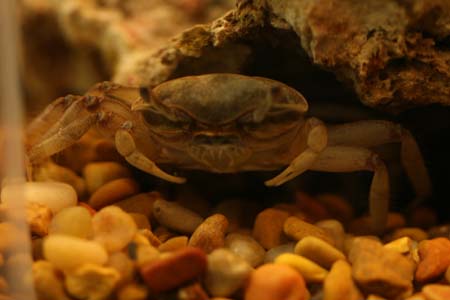
Well, I’ve been promising pictures of the fiddler family members so let’s start with Scarlett O’Hara and her recent molt.
The first picture shows her just after she molted, climbing down the side of the water filter. I love how they can have their eyestalks going in two directions as they move about. If you look closely, the right eyestalk is vertical, while the left one is scanning in a horizontal direction. Off to the right in the picture, her whitish “ghost” sits, discarded. With the water currents waving the legs and claws back and forth, the discarded shell looked eerily alive.
The second one shows her nestled safely under the water filter and behind her old self (fuzzy part in front), where she rested for some time. It is not unusual for newly molted crabs to hide. Their new shells are soft at this point and they feel vulnerable. So they hide to give themselves protection as their new shell hardens.
The third picture though a bit dark, gives you a close-up view of the ghost version. You can see the empty leg, claw and eyestalk casings. I will add that the “ghost of Scarlett O’Hara” no longer exists. Admiral Byrd ate it. Perhaps he is getting ready to molt. Crabs often eat discarded shells to reclaim the calcium the shells contain.
Last picture shows Scarlett O’Hara when she finally emerged from under the water filter. Still a bit tentative, she sought shelter under an overhang on the Live Rock.
These were all from Saturday, the 26th. Today she was back to her old self, running around the tank and eating. Maybe I can get a lighter picture of her now that she’s out and about. I need to work on “lighting” issues for these, but still, not bad considering no flash and long exposure times.
Soon to come, Admiral Byrd and Melanie Hamilton!!!
“You should never have expectations for other people. Just be kind to them.”
Pema Chodron, from her book, Start Where You Are: A Guide to Compassionate Living.
Probably the most interesting thing in the fiddler crab experiment is my family’s reaction to them. My son came home from college at Christmas and initially looked at me like I was crazy because I talked so much about the crabs. In fact, my independent college student complained I was paying more attention to the fiddler crabs. He kept laughing at me as I talked to the crustaceans in that high-pitched mommy voice previously reserved for my toddler son and pet poodles. My husband just kept teasing me about the total amount we were up to on fiddler crab expenditures.
Within of day of being home, my son started watching them, and within a few days he was keeping track of who was doing what and telling me to check on Melanie Hamilton or Rhett Butler. In fact, I think he was the one who first noticed that Rhett Butler was dead.
My husband was the one who spotted Scarlett O’Hara molting and eagerly called me over to see her when I came in from grocery shopping. Last night, he came in from work and before he even said hello to me he stopped, peered in the tank and said with great concern, “There’s something wrong with Admiral Byrd! I think he’s dead!” As it turned out (after I poked Admiral Byrd with my latest acquisition, a 25 cc plastic pipette and bulb from Science Safari that I use to siphon out excess food), I think Admiral Byrd was just sleeping – they kind of hang there, their claws floating above their heads, and don’t react to much. But my husband walked away and said very seriously, “I think you’d better keep an eye on him.”
What I realized is that caring, like a cold, is an occupational hazard of sharing space. When you share space, even with a creature who has a brain the size of a pinpoint, it starts to get personal. When it’s personal, you start to care, even when you didn’t mean to.
I think the same thing happens with people. So often you hear people say, “I don’t like this group or that.” Then they meet someone from that group and find out they really are okay . . . maybe even . . . nice. It’s hard to share space – sit across the table from someone, hear their humanness, see it in their eyes – and not care. That’s the real risk factor I suspect . . . contact . . . sharing space. The minute you share the space, you start to see the real person. Once that happens, it’s personal. And once it’s personal, you’re done for because caring is catchy.
Some lighter fare on tap in the next few days…photos of Admiral Byrd waving his claw, Scarlett O’Hara and her molted ghost self, and . . . even the ever reclusive Melanie Hamilton! Finally caught her sitting on her “front porch” – ie the open hole in the Live Rock – at 6:30 this morning. Stay tuned.
For today: So does staring into a tank of fiddler crabs, never mind shooting photographs of them at 6:30 in the morning, REALLY have anything to do with writing?
The answer? It all depends. You mean you wanted a definite answer? Here’s a clue – Mindfulness and heart. Still confused?
Simply said, it’s what you bring to the situation. You can sit there and stare at them and your mind could be on the bills, what you’re going to buy at the grocery store, what you could be doing instead of sitting in front of a tank of crabs. You could sit there and nod, “Yup, they’re crabs. Eyestalks. Sideways walk. They all look alike. So what?”
Or you can sit there and notice that Melanie Hamilton has much tinier front claws than Scarlett O’Hara. That she is timid and almost never comes out of her crevice in the live rock…except early in the morning when the sunlight streams into the kitchen and hits that side of the tank. She loves to sit in the sunlight on her front porch. Or that Scarlett O’Hara, who normally never stops eating and never hides out, suddenly after molting has stopped eating and has refused to move from under the water filter. Or that Admiral Byrd, normally fearless, crawled into his tunnel cave after discovering Peter Lorre’s lifeless body and started twitching and wouldn’t eat.
The difference is how you watch. Are you fully present? And did you bring your heart? The heart makes all the difference.
I am taking an online spirituality course with some friends, studying the writings of Thich Nhat Hanh (pronouced Tick Naught Han). He is an 80-year-old Vietnamese monk who endured the horrors of the Vietnam War, came to America to try and stop it, and was deemed a threat by both the Communist and non-Communist regimes in Vietnam. While searching for peace, he found himself everybody’s enemy. He was nominated for the Nobel Peace Prize by Dr. Martin Luther King, Jr. for his efforts to stop the war, and in his later years one of his many healing works has been to heal the souls of former American servicemen haunted by that war. Having lost close personal friends to that war, he has every reason to hate Americans. Instead he’s spent half his life healing people around the world, including Americans.
He tells a story in one of his books about a young man who wanted to learn to draw lotus flowers. So he went to a master to apprentice with him. The master took him to the lotus pond and left him sitting there for 10 days. Can you imagine in today’s busy world, signing up for lessons to learn something quickly, only to be left sitting at a pond for 10 days?
The real essence was what the young man did with that time. He could have gotten impatient (something I know a lot about), and grumbled, sighed, walked away, went shopping, took a nap, try to do something USEFUL with that time instead of just sitting there. Instead for the whole time, he watched the flowers bloom when the sun was high. He watched them close into buds at night. He watched one flower wilt and drop its petals into the water, then studied the stalk, the stamen and the rest of the flower.
On the 11th day the master returned and brought him a brush to paint with. Although his picture showed his naivete of technique, a childish style, the lotus he painted was beautiful. Deep beauty shone from the painting. He had become the lotus and as such, even with poor technique, he could paint something that moved another’s heart.
Mindfulness and heart. He paid attention to the lotus. He worked from his heart. Writing, really good writing that moves people’s souls, comes from the heart, not the brain. You can write a technically beautiful book but without heart it’s a sterile desert emotionally.
I started out watching fiddler crabs not sure what to expect. I certainly didn’t expect them to have personalities and subtle differences in appearance and actions. And I most certainly didn’t expect to feel such upset as I watched Peter Lorre tumble off his rock, dead.
With any luck, at least a little part of me has become the crab. With just a little more luck, maybe that crab heart will come through in my book. I’d trade a whole bunch of technical expertise for just a handful of heart.
By the way, if of interest to read a good summary of Thich Nhat Hanh’s life, check out this link at Parallax Press.
For any writers who want to play, I learned of this new virtual writing site. The author describes it this way:
“Flip through the Flash Fictions, read the papers scattered on my
desktop, play vocabulary solitaire and fill someone’s rice bowl at the
same time, add your comments about a 21st century spell on our
adolescents, and look for the squirrels that hide random things in the
walls.”
http://rhombusroom.net
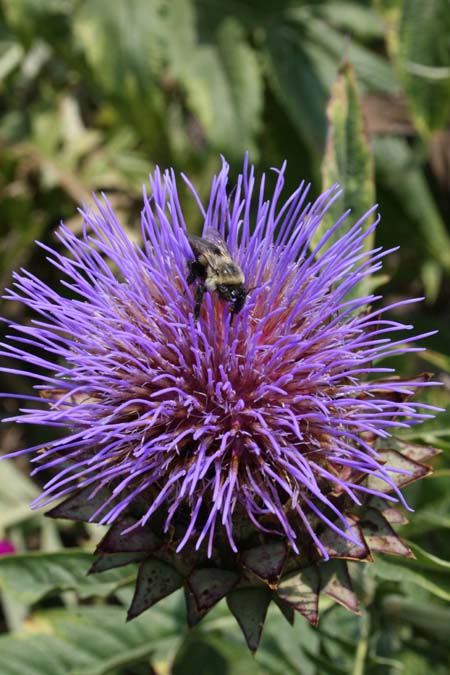
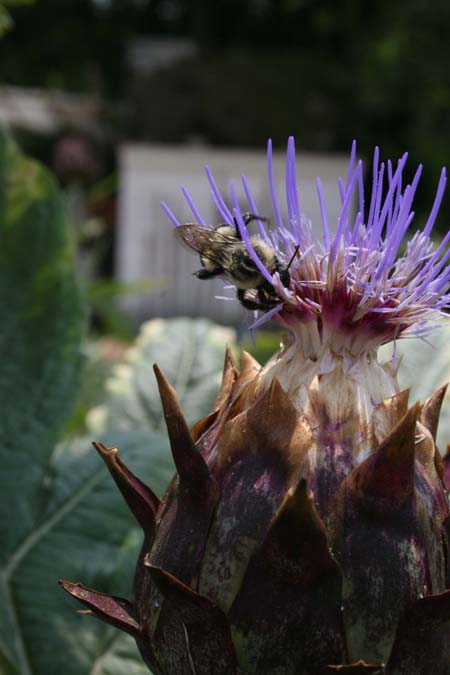
Can you tell I hate the cold of January? A reminder of summer – a “resident” hard at work on the thistles at Colonial Williamsburg in Virginia, a place I’ve loved since I was 10.
“The real voyage of discovery consists not in seeking new landscapes, but in having new eyes.”
Marcel Proust
It’s natural to struggle with that sense of we don’t measure up, especially when we compare ourselves to another. We’re always checking ourselves for how do we look or think or succeed, compared to someone else. Are we as smart? Or pretty? Are we as good a parent? And of course there are the times someone else is trying to make us feel inferior with all their bragging and strutting. Adults can usually regain perspective with lines like, “it’s what’s inside that counts” or “we’re all equal” or that line from the Desiderata: “If you compare yourself with others, you may become vain and bitter; For always there will be greater and lesser persons than yourself.” These did little though, to comfort a six-year-old boy many years ago. Such lofty abtracts just don’t mean much to the six-year-old brain. They require something plainer, more direct, tangible, not to mention shorter. So I share with you the 8-word bit of wisdom we taught to our son, that in a funny way even works to comfort adults. When feeling like you don’t measure up, or someone is trying to make you feel that way, just remember: “We all taste the same to the worms.” At least for six-year-olds, it did the trick.
 Soul Mosaic