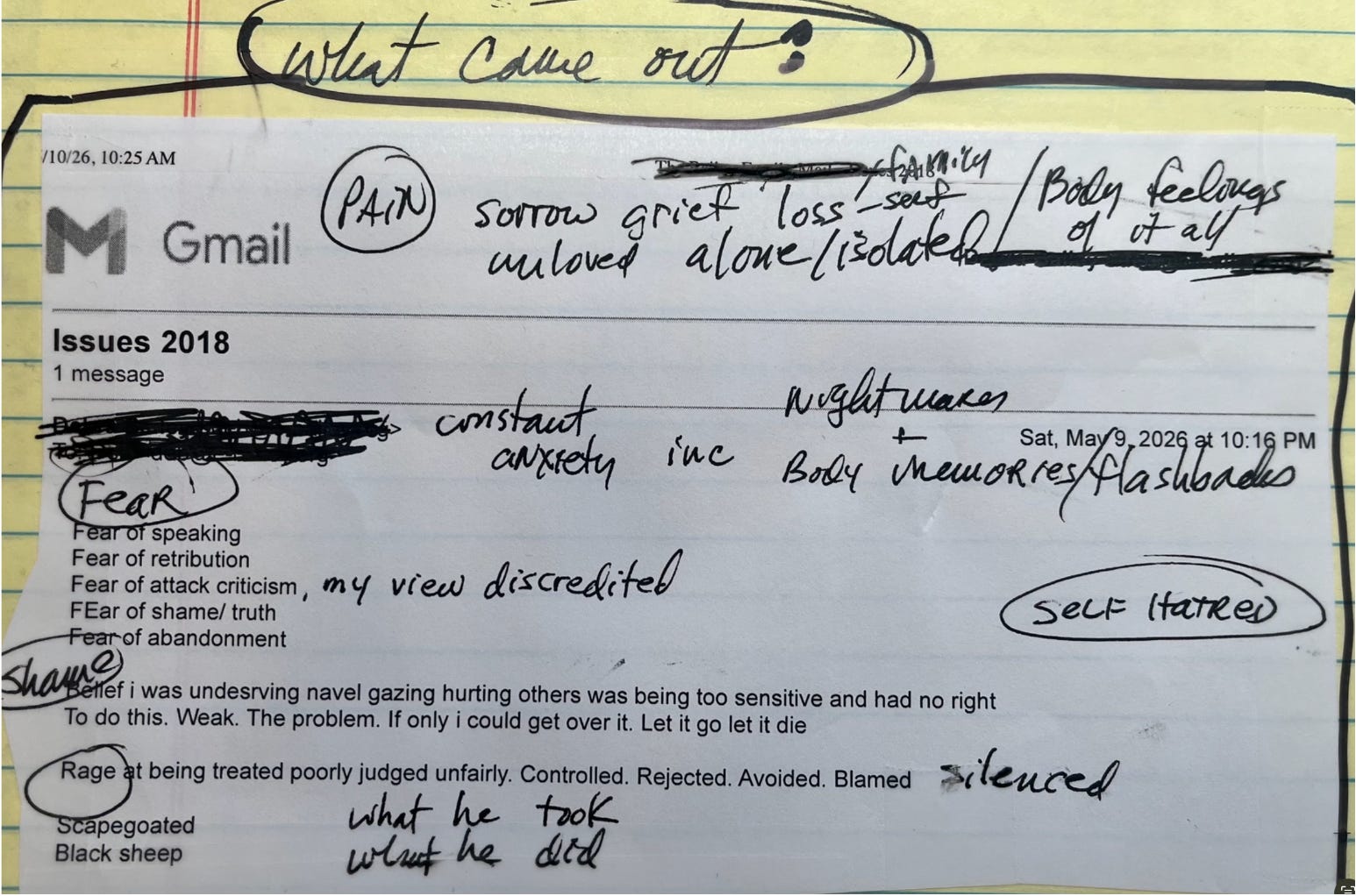
In looking back at my 2018 notes, whatever the specific items I listed in that email, I realized they boiled down to these core items:
Fears (many)
Shame
Anxiety
Rage
Pain
Self-hatred
The usual culprits, at least for me.
Photo by author
As to fear, it was interesting to see how many different things I was afraid of. And I can’t say that any one of them was bigger than another. They were all about equal in size…huge.
For example, at that point in time, even as I started to consider writing this book, I was ADAMANT that it would be under a pen name. I was absolutely TERRIFIED that any family members or people who knew me would see my name on the book. And I fully expected I would be attacked for speaking out loud. For that matter, I may yet be. But I feel differently about it now.
But at that point, I was even terrified of using a pen name. I still hated my younger self, was drowning in shame over many things in my life, and I still believed that telling my story would cause others pain, that I didn’t deserve to pursue this “navel-gazing,” and I would, rightly so, be attacked, then abandoned.
So it was no small thing that I even considered writing this. I will discuss efforts surrounding the issues of “why write, how, and how to manage courage and fear” in a few upcoming posts.
Reassuring my inner person
I find it helpful, especially when all my fears and emotions feel like they are ganging up on me, to get it out onto paper. Like an exorcism. That way I don’t have to carry them in my head, which both releases the pain of them and reassures me.
On that latter one – reassurance – I feel like as long as I have a list on paper, I know those things won’t be forgotten. For that hurting inner person at my core, it is calming. Soothing. She feels like this time she won’t be forgotten, stuffed down, or….locked behind that door again like in the past.
Sharpening the focus
It also helps me to formulate a coherent plan. I can’t just splatter rage all over the therapist’s office…well, I can, and there is a time for that, but in terms of us making a clear plan for the upcoming EMDR, that wouldn’t do.
“You know, I believe we have two lives. The one we learn with, and the one we live with after that.” From the movie, The Natural
If ever a statement gave me hope that I COULD learn, catch up to others, and end up with a good life, it was this one. It was only a fleeting moment. After all, it was 1984, that most horrible year after I got out of my parents’ house, and I plunged into a pit of suicidal despair. But still, that one sentence gave me pause. And sometimes a pause makes all the difference in whether you stay or go….
I would also add this newer quote:
“With the clarity you have now, it is easy to look back and think: ‘I should have known better.’ But you couldn’t have. Because you only know now what time has taught you, and back then, you were only doing the best you could with what you knew.” @SimonAlexanderO / tinybuddha.com
I’ve been told by more than one therapist that what I considered my past “failures” were simply me doing the best I could in the moment, to blindly learn all that I’d been prevented from learning by my father’s abuse. Each emphasized again and again, that I really had been doing the best I could at any moment.
It’s taken until now to really believe that. Oh, that I had believed this, years ago…. But I do now, and I am hopeful.
For ten years, I studied Buddhism. It helped me release some of my fears. My anger at God. It gave me a new way to look at what happened to me. How to understand and embrace pain in life. And it gave me a path toward healing and opening my heart.
That path was called the “Eightfold Path” in reference to the eight steps one could take to learn, grow, and heal. When I wrote the title above, I immediately flashed back to that Buddhist training and realized that more than a couple of those steps applied here.
Not a bitch session
The journey through this part of my writing is a journey into the unknown. It winds through darkness and descent, into that “soul’s underworld” spoken of in mythology and religion — the journey for understanding, meaning, transformation, and rebirth. In a bit, I’ll write more about that “Descent to the Underworld,” and what my journey there taught me. But first, I’ll revisit those Buddhist tools.
I call this piece “Right Mind” because it’s essential that I approach this whole phase of the book in the right way if I want to find peace. This part is not a bitch session or a blind casting of rage and blame. For sure, I won’t let anyone off the hook, and that includes myself. But there is just raging, and then there is a balanced review of what life has been and what it can teach.
In the previous post, I described my process to use “order” in this last section of the book to reach all the meaning and insights.
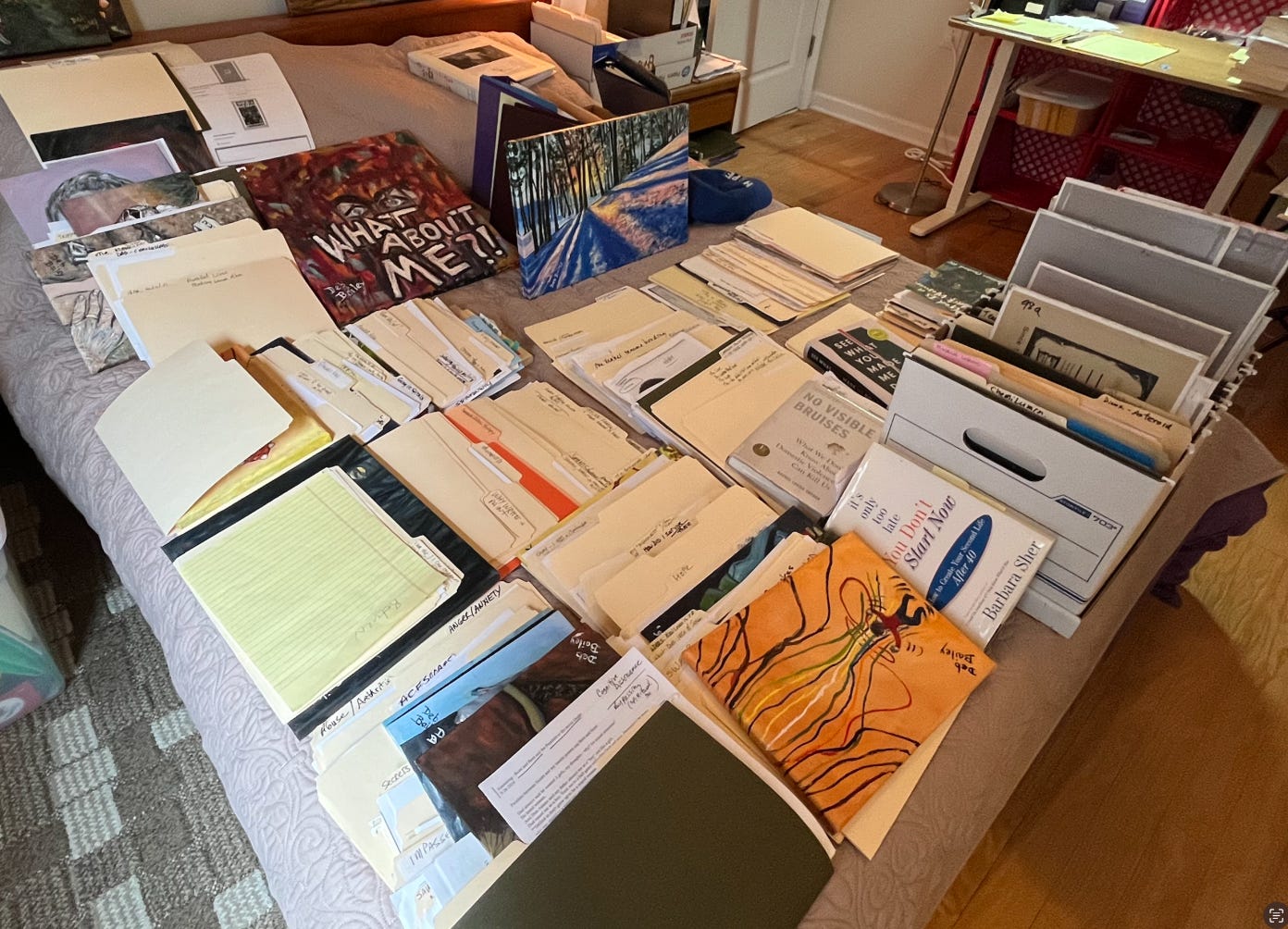
I showed this image of a bed covered with folders and notes, which I described as “all my clues” to who I am, at heart, and who I am becoming. That bed, with all those items, is my “power base” for healing.
Photo by author
But it was my husband who REALLY nailed a symbolism that I totally missed.
These current entries are taking more time and thought to write. There were so many things going on simultaneously during those years, complicated and all knotted together. In order to share something meaningful and coherent, I have needed to reflect deeply and not rush the process.
In the last two pieces I wrote, I spoke of my husband and me managing many priorities, and just finishing the marriage-skills classes, as well as my finally ending a friendship that was not working.
To continue with the story thread, I will begin with the onion that is “therapy.”
“Why write…now?” Three simple words, but a vital question that demands an answer to the motive for my change of heart.
Dr. Edith Eva Eger, in her 2017 book, The Choice, about her experiences both as a Holocaust survivor and a psychotherapist, talks about the question, “Why now?” Whenever she was confronted with a new patient, her approach was always the same–questions. I loved her description:
“Why now?…This was my secret weapon. The question I always ask my patients on a first visit. I need to know why they are motivated to change. Why today, of all days…Why is today different from yesterday, or last week, or last year? Why is today different from tomorrow?”
So it’s a fair question.
But before I can even answer why I would write now, I need to answer the question that came before it: “Why write?”
So let’s get something straight right now – because I am a direct person, all my friends know that, and I prefer to be clear. This is not a book about a person’s journey from harm to forgiveness. If you are looking for a tome on the blessings of forgiving your abuser or how to achieve it, I recommend you look elsewhere.
My journey is about healing…restoring my soul from a lifetime of trauma and pain that was inflicted on me, and that I have carried way too long. And just to be clear, to me, forgiveness and healing are not the same things. They may both come about, or not, but they are not the same thing, and for me, both are not required. So first and foremost, I write to heal.
If I am to be totally honest, I don’t give a shit about forgiveness anymore…about whether it comes or not. In fact, the next person who tells me that I must forgive because it is the only way to happiness, or repeats that all-too-often quoted trope, that withholding forgiveness is like drinking poison and expecting the other person to die, I will tell you to just keep on walking. Unless I am in a bad mood, in which case I may say it slightly differently.
“The point in a conversation that is an impasse – both love each other very much. Both want desperately to make each other happy. One doesn’t want to hurt the other with his opinion but feels compelled to say it. The other wants desperately to agree, to be able to agree so all can be happy again, but can’t.
Both search to say something that would make it better…want to find those magic words. And “I love you,” may be true, but isn’t enough – it doesn’t dispel the present problem. The love is there, but so is the problem – each looks to the other to back down – to say the one thing they long to hear just to make the problem go away – but can’t, and each knows the other can’t but just hoped they would…and at this point no one knows what to say – all you can do is just walk away – confused – emotionally drained – completely mystified as to a solution.”
The missing link
How do you go from being a submissive, beaten-down child in an abusive family system to a healthy adult who stands up for herself? When does that miraculously happen? It’s not like you leave that house, flip a switch, and suddenly you’re an independent, healthy, assertive human being. In there somewhere is a missing link in the maturation process — years of trial-and-error efforts to heal and learn how to become that adult.
Painting by author – Author as an infant on hood of her father’s car
Driven to paint
Before I share below a sampling of the visual elements I am using in my book, I thought I would share the “WHY” I not only used them, but HAD to use them.
Rebuilding my life
The book incorporates the story not only of the abuse I endured, but also of my journey from my parents’ house—the depression and despair—to my rebuilding, and my creating of a meaningful life.
Even after the initial crises of my escape and recovery with the help of good therapists and friends, I would return for rounds of therapy off and on throughout adulthood. Given all of the life lessons I had missed out on during my early phases of life, I looked at it as “preventive maintenance.” Why “wing something” when I wasn’t sure how to handle it and risk messing it up, then have to fix it? Better to learn as I went along.
The traumas of life
This approach worked well, and I thought I had finally put the past to rest…until midlife. Menopause hit. My husband almost died. The dog did die. My son left for college. All at once. But even worse, those new traumas blasted open a well of trapped emotions I never realized were even there. Like opening Pandora’s box, it unleashed a flood of unresolved depression, anxiety, flashbacks, nightmares…severe PTSD. At the time, I had no idea what was going on. Desperate and having major anxiety, I began working with a skilled trauma specialist who was and remains a godsend in my life.
This was fortunate because, in addition to everything that I was dealing with, I also began navigating the last chapters of my parents’ lives and their deaths. It was then that I realized just how much work I still had to do.
The past comes calling to claim its due
Those first decades of adulthood had been about building a life. Now, it was about returning to the past to address the well of unfinished business and unresolved pain that had come forward to claim its due. It had patiently waited a lifetime…my son came first all those years. But now, it was time for me…and that long-suffering child.
However, I had no tools to reach the pain, to know how much was there, or to express it. I only knew its presence through the agony of body memories and nightmares. That was when I made the discovery that art heals.
As promised, here is the second half of my rules for this memoir. These will be right at the front of the book so the reader is also clear about what I have in mind.
Caveats, cautions, and purpose
Before departing on this journey, here are 7 key points: