“You know, I believe we have two lives. The one we learn with, and the one we live with after that.”
From the movie, The Natural
If ever a statement gave me hope that I COULD learn, catch up to others, and end up with a good life, it was this one. It was only a fleeting moment. After all, it was 1984, that most horrible year after I got out of my parents’ house, and I plunged into a pit of suicidal despair. But still, that one sentence gave me pause. And sometimes a pause makes all the difference in whether you stay or go….
I would also add this newer quote:
“With the clarity you have now, it is easy to look back and think: ‘I should have known better.’ But you couldn’t have. Because you only know now what time has taught you, and back then, you were only doing the best you could with what you knew.”
@SimonAlexanderO / tinybuddha.com
I’ve been told by more than one therapist that what I considered my past “failures” were simply me doing the best I could in the moment, to blindly learn all that I’d been prevented from learning by my father’s abuse. Each emphasized again and again, that I really had been doing the best I could at any moment.
It’s taken until now to really believe that. Oh, that I had believed this, years ago…. But I do now, and I am hopeful.
What IS alchemy and why do I bother with it?
I keep mentioning the word alchemy. It’s an image that resonates so deeply within me.
In its historic sense, it was used in the medieval world to describe the efforts of chemists then to create pure gold out of base metals like lead. At its most core sense, alchemy is about a process to purify and transform. Back then it was lead to gold. In nature, it is the magical process within a cocoon. And in our lives, it is a structure that supports a journey to healing.
I am a person who needs some kind of structure, symbols, metaphors, to guide a process especially when it feels overwhelming and scary. My healing journey, especially the last few years, has been intense, raw, and unrelenting. To not lose hope, and to not lose my way, I needed some kind of “format” that put up the “container with boundaries” for my work.
So I will come back to “alchemy” and how I have looked at this work, below.
First, a bit of nature’s “alchemy.”
Colors and cocoons
The question in the last post was what happens inside that cocoon that allows a caterpillar to “transform” into a beautiful butterfly. It’s often been said that the caterpillar dissolves into total goo, then rebuilds itself. The reality is somewhere in between.
While most of the caterpillar does indeed break down into that goo, there are a few special exceptions. It keeps its tracheal tubes, so it can still breathe. Its gut remains but does shrink and becomes more convoluted, probably because the butterfly will not need to eat as much as the caterpillar did.
And while much of its nervous system dissolves, there are parts that remain. They rewire into the adult nervous system, and even retain some memories of what the caterpillar learned. I don’t know how they know this, but many sources report it.
The parts though, that I find most amazing are specific items called “Imaginal Discs.” These disc-shaped structures were always present in the caterpillar, just dormant. They remained there, blobs of tissues, attached in specific locations until the time was right.
During the transformation process in the cocoon, they do not break down. Instead, they undergo rapid development into the organs and structures the adult butterfly will need: eyes, antennae, wings, legs, and so on. And as this “transformation” nears completion, the cocoon becomes transparent and dry, so the butterfly can break it open and crawl free.
The bottom line of this whole cocoon stage is one goal: the radical transformation into an adult that is much different than the caterpillar.
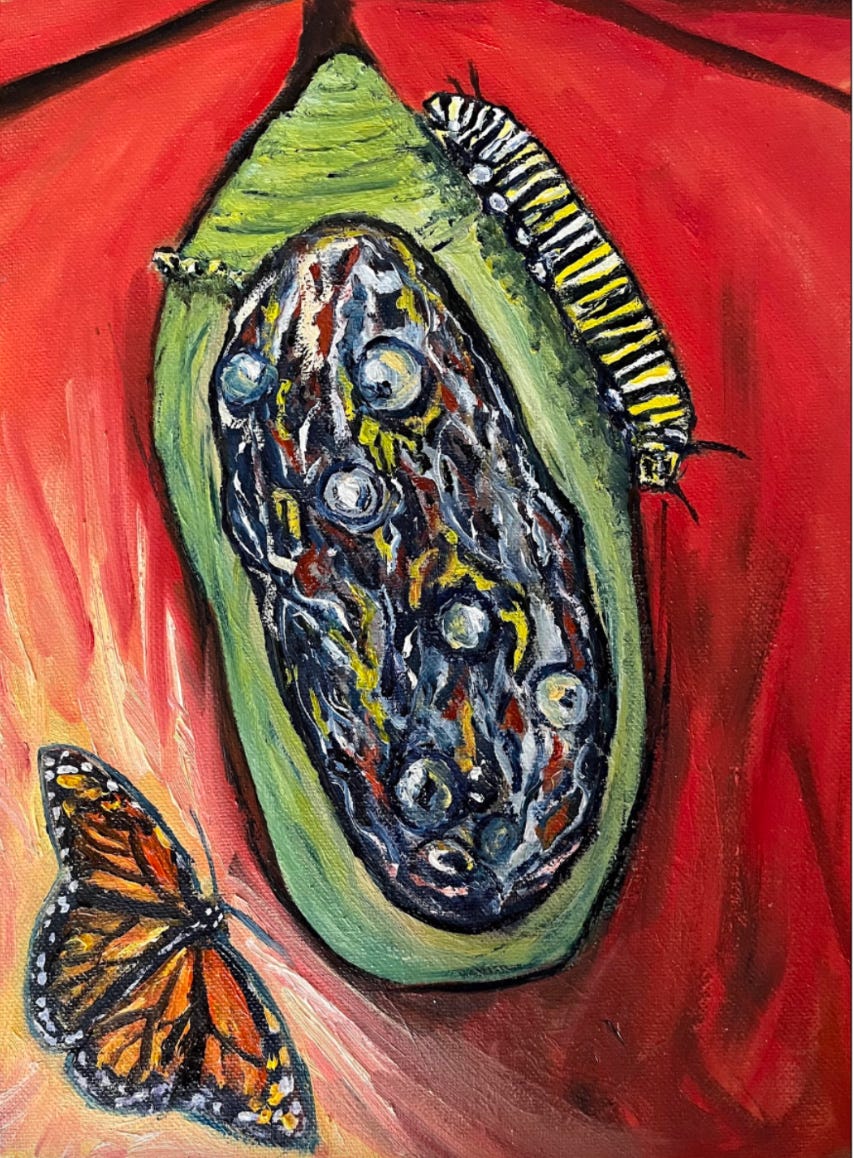
To me, trauma healing seems to be the same. The goal is to purify and transform our souls and psyches. As we face our wounds and dig deep, a lot may dissolve. But I think we all have our own Imaginal Discs that remain, waiting for the right time. And then, those core pieces within us undergo a change to become who we truly are, and give us what we need to live a full, changed life.
Is it worth it?
So many times during my life and my therapy, particularly at some very low points, I have asked the question: Is any of this worth it? Am I worth it?
Of course, I can look back now and know that those questions came out of tremendous fatigue, fear, and despair. But I would be a liar if I didn’t admit that I really struggled with my worth in those moments. I felt so inept and broken, and especially felt guilty about the amount of money and time my healing needed.
For anyone reading this, that question is something only each of us can decide. I can only say I am grateful I kept going…that I had the chance to find good therapists, and most especially that I have such a supportive husband. None of these were a given in life. So I did not take them for granted. And I take special care not to squander the opportunities I have had, but, instead, to share any help and support my story can give to others.
As to my answer for “Is it worth it?”
“Something very beautiful happens to people when their world has fallen apart: a humility, a nobility, a higher intelligence emerges at just the point when our knees hit the floor.”
Marianne Williamson
Strangely, it was those moments when my knees hit the floor, that I felt a “prodding” from beyond me to keep going. So I did, “hoping” that there would be light at the end of the tunnel.
Like that caterpillar that was turned to goo, those so difficult times were my “goo.” But also like the caterpillar, I was able to crawl out. I can look back and see that “transformation and growth” came, and continues. But I could only see that later on. For sure, in the moment, I had to just HOPE it would get better.
A disclaimer
Before I go on, I want to be very clear about the things I am going to share. These posts are written only from my experiences. I am not a psychologist, psychiatrist, doctor, or any type of mental health practitioner. I am simply a human being who spent a lifetime hurting, struggling, and fumbling for answers, doing my best to grow and heal. Aside from my own peace, I wanted my marriage to be solid, and to the best of my ability, I wanted my son to grow up free of the emotional trauma I inherited. So the methods and reactions I write about are strictly the things that worked for me.
There are as many methods and techniques as there are therapists. I had to face and answer questions like:
- Is this what I want, and if so, am I committed to the work?
- What help is possible for me in my own situation?
- Do I like and trust my therapist or counselor?
- Are they the right person for me, and do they have the skills?
As an aside, on rare occasions, there was a therapist who did not work out. That happens. The chemistry and trust have to be there. If it’s not, it’s best to find someone else. I’ve lost enough of life’s precious time due to my father’s abuse of me. I don’t want to waste any more time in a situation that doesn’t feel compatible. If it’s not working, I thank them but move on.
But as far as what I will write here, the bottom line I am trying to convey is that these are my life experiences, what worked for me. My path through darkness that brought me much healing. These posts are NOT medical advice or declarations that what I did is the only or the best way to do this work. Just one way. Any person working on their own journey needs to find their own answers. And in that, I wish them all the best.
Now, back to my own path to healing.
A GPS? Or a Road Map?
Throughout my life, since that early map-making kit when I was a kid. I have related to the work best through maps and charts. An article I read recently described the difference between a GPS system and a road map.
A GPS is great, especially when you need efficiency, speed, and no drama. It tells you where to go. You don’t have to plan or choose, just follow its instructions, and it will get you wherever, quickly.
Road maps are not so simple. They can be complex and take time to work with. And they can bring on the drama. But…they bring riches in other ways.
They show you what the journey COULD be. They provide an opportunity to have an EXPERIENCE, not just a commute.
For one, they give you CONTEXT because they show everything about the area of travel — geography, types of roads, all the different places along the way that you could visit. They reveal ALL THE POSSIBILITIES AND CHOICES available to you. So you get to see the BIG picture, not just the next turn coming up.
Second, they give you CONTROL. What do YOU want? Do you want a fast trip with no stops? Or would you like a slow, scenic, reflective drive? Want to learn the local history? Or do you need the flexibility to change your whole trip on a moment’s notice if your first plan just feels wrong? For all of these, pick the road map.
Two lives
At this point in life, my approach to therapy has been the road map one. Earlier, it was often the GPS method – I needed quick instructions for how to navigate an immediate problem or lack of experience.
But at this stage of my life, I want to transform. I want to reclaim my soul and discover truths and insights I didn’t know were there. If this is “the life I am learning with,” I’ll risk the drama and experience all the lessons I need. Maybe then, I’ll find myself living my way into that “second life” the movie talked about.
How to recover
Judith Herman, in her book Trauma and Recovery, noted that to do this work, three things need to happen:
- First, a person needs to be safe
- Then, they can “remember, tell, and mourn”
- Finally, purified and transformed, they can reconnect to Life
I spent most of my adult life getting to safety and constantly reinforcing it as I dealt with my parents. It was only after both of them were gone, that I was free to remember, tell, and mourn.
Which brings me back to that metaphor of the alchemist….
The Mad Scientist and the Artist
I spoke briefly in the last post about how those medieval chemists described their work using Latin terms for specific colors:
Nigredo – Black
Albedo – White
Citrinitas – Yellow
Rubedo – Red
Given my artistic painter side, of course, this color idea connected with me. I can FEEL the energy of color. And then, of course, having been that 10-year-old with a chemistry set and later an adult working in labs, I totally loved the image of being that mad scientist in some castle basement’s lab, making potions to transform lead into gold.
The colors were a great metaphor for what those alchemists saw as the stages to making that gold. For example, the nigredo process was all about taking that base metal and burning off many impurities until it was charred black. They saw this stage as being like Fall, a stage of death and decay, where the “old form” was totally dissolved.
The albedo or white stage represented that higher-intensity, white-hot fire needed to really purify the metal the rest of the way. It involved washing away the charred remains of the nigredo step. Its season was the stillness of winter, as things moved toward more clarity, light, and purity.
Citrinitas’ yellow represented “Spring” and the dawning of the sun. It was the stage when the transformation to gold was almost complete. And rubedo would be the completion of perfection, like the “harvest of Summer” — the achievement of pure gold.
While alchemists never succeeded, the symbolism of these stages found a new home in psychology and the steps toward transforming a person from victim to survivor. At least that’s how Carl Jung saw it.
Jung’s ideas
Carl Jung (1875–1961) was a Swiss psychiatrist and psychoanalyst who founded analytical psychology. A pioneer in exploring the unconscious mind, he developed key concepts like archetypes, the collective unconscious, and introversion/extroversion. Originally a follower of Freud, he broke away to focus on the psyche’s spiritual and symbolic dimensions.
Google AI
Through his work with patients, Jung came to view the journey of therapy as one of transforming one’s psyche from darkness and chaos to wholeness by bringing together the opposites battling within us. It was all about reaching spiritual and psychological wholeness.
While some disagree with Jung’s thoughts, overall, I really liked the images. They helped me see what my own journey could be like. Their step-by-step progression reminded me of the steps to remodeling a house. First you rip everything apart, then you start working your way to making it new and pretty.
In working with his patients, Jung realized that they had certain roles at different stages of healing. He defined the roles as:
- Shadow – This was the dark side of a person, with all their anxieties, fears, flaws, and repressed memories and issues. This would be the Nigredo stage.
- Anima/Animus – Here, the “opposites” within us, such as a woman’s masculine side or a man’s feminine side, needed to be united as one within each person, in a balanced way. The stages of Albedo and Citrinitas fit this step of realizing, and learning.
- True Self – Finally, the person is transformed into an individual who has united all their fragmented and unknown parts. They have moved into the light of consciousness and understanding.
Then he adjusted those colored stages of purication and transformation to fit the psychological progress to recovery:
- Nigredo – He saw this as the breakdown and dissolving of that Shadow self. It was a time for painful confrontation with one’s own inner darkness. Old structures of the ego were broken down as one faced their abyss and examined everything that came up. It was a period of confusion, chaos, and despair. And it was the risky part because some might get stuck instead of moving to the next stage. The risk was to lose their way, and lose themselves. He saw that the choice of this stage was: TO CHOOSE TO ENTER THE DARKNESS.
- Albedo – Here, the process was continued purification, distillation, and clarification of the individual’s previously unknown issues. It was the recognition of the opposite sides as well as starting to shine light on the specific issues that needed help. This was the stage where a person started to develop a more conscious self-image, and the choice of this stage was: TO CHOOSE TO HEAL.
- Citrinitas – Now, rebirth and renewal could begin. The emergence of consciousness and wisdom brought a number of profound insights, and the ego started to find its place in its larger self. The choice of this stage was: TO CHOOSE WISDOM.
- Rubedo – Last was the final integration of the person, the completion of purification and transformation. Here a person’s opposites within were united, and they became balanced, secure, resilient, and competent. The last choice here was: TO CHOOSE TO LIVE AS GOLD.
For that caterpillar to butterfly transformation, it was probably just a two-step method: the Nigredo, when the caterpillar dissolved, and then the other three steps combined in one as the butterfly formed.
Humans, being more complicated, Jung saw us needing all four steps. But he did simplify them to just these words:
- CONFESSION: Acknowledge one’s limits, weaknesses, and suppressed emotions (Nigredo)
- ELUCIDATION – As the unconscious material reveals itself, the person starts to notice and and see the light of clarity. (Albedo)
- EDUCATION – Here the insights gained are reassembled within the person who looks for ways to act on them. (Citrinitas)
- TRANSFORMATION – The place of unity and wholeness of the self (Rubedo)
MY alchemy color palette
Learning about all of this actually excited me in a way. It was that whole “give-me-a-road-map-to-the-experience” part. It helped me “relax” into the intensity of the work I faced. No question it was going to be messy. But I felt like with a plan, these stages made it “safer.”
And even if things might feel out of control, still, I had retained the control to CHOOSE this for myself.
So I made my own list of the stages, both for moving through these deeper therapy sessions, AND for eventually writing and sharing this work:
Nigredo: I needed to let my guard down and face the fears, anxieties, and memories. I needed to feel the guilt, anger, shame, despair, and stay with them not run. This was the stage when I started painting in earnest because I had such intense emotions coming up that I just couldn’t speak or write yet.
Albedo: This was the stage where I started to see some “light.” Issues that plagued me, costs in my life, misunderstandings I’d carried, all of these and more started to come into focus so I could see what I needed to work on.
Citrinitas: Here is where I dug deeper into research, learned more about others’ abuse, about how abusers operated and kept their victims controlled. By learning more, I started to understand the true reality of what happened, started to shed some of my guilt and pain, and began to find some answers.
Rubedo: I am not totally here yet, nor will I ever be. But there are places that are better. I have more understanding of what happened and what I feel about it. That understanding helps me to feel more whole. I am able to claim more of my own power, and able to feel more self-love and less self-loathing. For the first time in my life, I feel less like a pile of broken parts and more like a work of art coming together.
And with each transformation I achieve in this, ultimately, I feel “cleansed” and gain purpose and meaning for it all — something I’ve sought my whole life.
Some tips about the healing journey’s mess
Now as nice and neat as all these descriptions are, it is also true that plans are just starting points and once you begin the work, the plan goes out the window. Sort of. At least the plan provides the “container” for the process, giving a bit of safety and a set of boundaries to stay within. After that, you work with what comes up and let it lead you.
But I have learned a few things as I go through these steps:
First, just like road maps are good because they give alternate routes and you aren’t stuck with just one way to go somewhere, the same thing applies here. Things can get chaotic. The process does get messy, just like that house remodeling. The good thing is that you can “change the route.” If one way is too much, you can “take an exit” to a slower road. There is no one right way.
Another thing: That “red intense heat of Summer” will circle back to the death of Fall. The cycle starts again…and again. An American Buddhist nun, Pema Chodron, in her book When Things Fall Apart: Heart Advice for Difficult Times, explained it so well:
_“Things falling apart is a kind of testing and also a kind of healing. We think that the point is to pass the test or overcome the problem, but the truth is that things don’t really get solved. They come together, and they fall apart. Then they come together again and fall apart again. It’s just like that. The healing comes from letting there be room for all of this to happen: room for grief, for relief, for misery, for joy…
“…nothing ever goes away until it has taught us what we need to know…nothing ever really attacks us except our own confusion. Perhaps there is no solid obstacle except our own need to protect ourselves from being touched. Maybe the only enemy is that we don’t like the way reality is now and therefore wish it would go away fast. But what we find as practitioners is that nothing ever goes away until it has taught us what we need to know. If we run a hundred miles an hour to the other end of the continent in order to get away from the obstacle, we find the very same problem waiting for us when we arrive. It just keeps returning with new names, forms, manifestations until we learn whatever it has to teach us about where we are separating ourselves from reality, how we are pulling back instead of opening up, closing down instead of allowing ourselves to experience fully whatever we encounter, without hesitating or retreating into ourselves.”
For myself, as I will share in upcoming posts, there are issues that I just seem to constantly revisit. But, each time, I learn something new.
Third: The steps don’t go in neat order, one after the other. Again, cyclical. And they bounce around. I might have moved into white or yellow with some things, only to have something trigger me and bounce me back to that earlier mourning black stage. Then jump ahead back to yellow. The work brings you where you need to be, to learn.
Fourth: Things often don’t come one at a time. Especially early on, we may get hit with multiple things at once. A good therapist is a treasure because he or she can help a person to manage the chaos and decide priorities. They provide structure and support as you decide how to shuffle things around in your work.
And last: The biggest thing is self-compassion. Rest. Go gently, and take in the support of a therapist, friends, and loved ones.
On with the alchemy
Now, I’ll move on to sharing experiences and what I have been learning. The first part of my journey was that Nigredo – the travels through my own “Underworld,” or what the Catholic mystic, St. John of the Cross, called it: “The Dark Night of the Soul.”
The other stages will follow as I write.
Now, time to enter the darkness…
Tags: healing, life, love, mental-health, writing


Leave a Reply