“Writers are very private people who run around naked in public.”
Katherine Paterson, author of the Newbury Medal Award book, Bridge to Terabithia
“Writers are very private people who run around naked in public.”
Katherine Paterson, author of the Newbury Medal Award book, Bridge to Terabithia
I know I am lucky because I have a chance at a dream. I have the rare chance to write my books, my blog, do what I’ve dreamed of. There are moments though, where I’ve considered that a curse, not luck, and I suspect there are at least a few writers who share that. It’s scary.
It’s like the time my husband and I moved from CT where we were born and raised, to North Carolina, where we’ve lived now for 18 years. We’d decided we needed a different environment. Ours was killing us – between climate, work problems, cost of living, we needed a change. We checked out this “North Carolina place” and after some initial uncertainty, decided, “yes, that’s where we want to be.” It took us about a year before my husband found a job that was right. The offer even included relocation costs, something not as likely today. It was exactly what we’d dreamed of. But when the person in North Carolina called and said, “We want you for the position. If you want the job, it’s yours,” we froze.
In that moment, all the eagerness to get the job, make the move, obtain relief from the circumstances draining us and our marriage, evaporated. In that moment terror flooded both of us. The moment of truth – if you want it, it’s yours. Now came the real questions – DO we want it? CAN we do it? We thought we could, but up until that moment it was a dream, not reality. Could we really leave all we knew behind? Go to a place we’d spent one weekend in? It was the equivalent of choosing to jump off a cliff. We knew there would be no turning back if we did. Financially, it was stay or go. No changing your mind once you chose.
My husband and I looked at each other. The question hung in the air. “Well?” We recovered after a few moments, gritted our teeth and said, “It’s not getting any better here. I guess . . . we jump.” With that, we invested our whole souls to make that choice a success.
My writing dream has that same feel. Each day I watch others go off to jobs that maybe they love or hate, jobs they choose or need, and I sit here, with the opportunity to create my dream. All it takes is for me to say “yes” . . . and just do it. I feel the weight of the responsibility, and the wall of fear comes up.
Katherine Paterson spoke a bit about the fear: “With each new book we must dare failure, or worse: mediocrity.” There are the questions: What if I try for that dream and find out that what I wanted all my life, I can’t do? What if I fail? What if I try and nothing happens, or I try, and it’s downright terrible? And if it is, it will be a very open, very public failure. As Paterson also said, “Writers are very private people who run around naked in public.” No hiding the results once you put it out there.
All the years I worked at other jobs to pay the bills, take care of my son, whatever, and didn’t have the chance to try for the dream, it was easier in two ways. First, love or hate the job, I came home with a steady paycheck. No matter what, the mortgage got paid, groceries came home, the car was repaired. I had worth and value because I provided security. It came in a paycheck. Not only was my home life secure but my identity got validated as well. The paycheck gave that, too. If I wasn’t who I said I was, would they really pay me? Second, the weight of having to answer that offer from life – it’s yours if you want it – was lifted from my shoulders. Because it wasn’t an option, I didn’t have to answer. Because I didn’t have to answer, I didn’t have to find out whether I could do it or not and risk humiliation, even if that humiliation was only in my own mind. So I had financial security, value, identity, and I could escape the question I felt God was waiting for me to face.
There’s that truth that a dream is always perfect. The moment you try to pin it down in the real world, it never, ever measures up. I read an interview someone did with Billy Joel one time. He spoke of the songs he heard in his dreams, wondrous bits of heaven. Perfection. Then he woke up and tried to capture them. Now I consider him a tremendous singer and songwriter and a hell of a success, given the body of work he’s created. Yet he said that nothing he’s ever created measured up to what he heard in his dreams.
So if someone considered a success by the world, feels he’s failed, where does that leave me? His work got the financial security. He had a job title and identity validated by his paychecks. God asked him the question, “Will you create?” and Billy Joel did it. Yet he feels it didn’t measure up to his dream. What do I do? Why? And how?
I don’t know how anyone else would answer those questions. For myself, I’ve gotten some glimpses at my mortality. I only know I can’t meet God and say, “Well, I meant to, but . . .” I could get away with that answer before. I can’t now. I also couldn’t look my husband in the eye, the man whose hard work is giving me this chance, and say that. Or my son, or my friends. However, I think the absolute worst would be having to look me in the eye and say that. I think God, my husband and son, my friends, would forgive me, accept me, and who knows, God might even give me another life to try again. But would I forgive myself? Maybe that is what hell is. So why would I do it? Because I would never forgive me if I didn’t.
The question hangs before me: the job is yours if you want it. Deep in my heart, win, lose, fail, or as Katherine Paterson put it, be mediocre, I know what my answer is.
The remaining question is – How? I could say that if I’m terrible, at least I know I tried. But then maybe that’s not quite the right attitude, either. In the movie, The Empire Strikes Back, Luke tells Yoda he’ll try to lift his spaceship with his powers. Yoda immediately jumps down his throat. “NO! Do, or do not. There is no try!” Maybe the answer is that it’s how you show up to do the work that makes all the difference. It certainly made the difference in our move to North Carolina knowing there would be no option to turn back.
There’s a scene from the movie “Hunt for Red October,” that illustrates it. The captain, played by Sean Connery (who looks better and better as he gets older), is leading a select group of officers on a mission to defect and deliver a new, deadly silent Russian attack sub to the Americans. It is treason. If discovered, they’re dead and they all know it. Their consciences drive them to do this so that such destructive power cannot be used by their superiors, yet at one point their resolve fails and they want to quit. At that moment the captain tells them there is no going back. Moscow knows what they are doing because he sent a letter to their superiors stating their intentions. His men freak. In their eyes, he’s signed their death warrants for sure. They know that every ship in the Russian Navy will be out there to hunt them down and kill them. They demand to know why he did that.
His answer: “When he reached the new world, Cortez burned his ships. As a result, his men were well motivated.”
When there is no going back, you have only yourself to work with. It is “Do, or do not. There is no try.” You have only your motivations and faith, or the lack of them, to fall back on. What do you believe? When Luke could not raise his spaceship, Yoda did it for him. When Luke said he couldn’t believe it, Yoda’s answer was simple: “That, is why you fail.”
So my answer to how you do it is: Burn the ships. There is no turning back. Do or do not, there is no try. And believe. Because if you don’t, that is why you fail. I cannot control the outcome of the effort – whether my writings will be read, published, make a dime, validate me and give me value- but I can control how I do the work. And I only know that if I don’t do it, none of those things will matter.
Given it’s Monday, you expect to see someone sitting at their desk with a coffee cup sipping tentatively before plunging into whatever awaits. So it’s not a surprise that I have this Styrofoam cup on my desk. The odd thing is it sits next to my regular ceramic mug, which is what’s actually holding my caffeinated drink of choice – tea. So why the Styrofoam cup?
Ah, a throw-back to yesterday’s post – start this one with a question, right? Well, questions are the order of the day, and that’s exactly the point with this Styrofoam cup. It doesn’t contain caffeine. It’s loaded with . . . questions. No it’s not some mystical beverage, or some liquid whose swirls you gaze into or whose curls of steam you study for the secret of life. It’s a game. And to a writer, it’s like a playground.
Questions are the staple of a writer’s life. It doesn’t matter if it’s nonfiction, essays, or fiction, you write to answer questions. Whether it’s what killed the dinosaurs, why we should care, or a story about bringing them back to life in a doomed amusement park, all three start from a question. No questions, nothing to contemplate, and hence nothing to write.
A question here: In an era of You Tube, My Space, video games and Instant Messaging, how do you cultivate a love for, and the ability to confront questions? No this isn’t another essay bemoaning all of this technology in our kids’ lives. Technology is here to stay and frankly, a lot of it is great. Just see the effect on homebound elderly who’ve embraced email and the web and thus feel connected not isolated. And let’s be honest, even adults are glued to all of the above, not just teens. It’s simply a realization that unless the power goes out, everyone is plugged into something electronic (like this blog?) and when is there time to sit across the table from someone, ask a question, and ponder an answer?
One family confronted this on a vacation trip. They realized each was plugged into their own electronic device, and hence, their own world. Fine up to a point. But there was no conversation. No connection. Now I’m not dissing this completely because hours of several people jammed together in a closet on wheels can get old. Each having their own space for a little while can be a relief. However, I did grow up in an era of “See how many different states’ license plates you could find” or “look for whatever object came up next on a list” as you traveled down the highway. Like it or not, you interacted. So I can understand this family’s concern.
They came up with a simple yet elegant solution. They came up with a list of questions, things like: “What is something about you that would surprise most people?” “What word do you really dislike?” “What is the biggest risk you’ve ever taken?” Simple questions. Yet even one person’s answer could lead to not only an extended conversation, but a newfound appreciation for people you reside with and ordinarily take for granted. We often find talking to “new people” exhilarating because it’s something new and different. Yet how many new and different things are within the very people sitting next to us that we may have grown bored with?
The family went ahead and created a product – a bunch of question cards in a Styrofoam coffee cup – and have recently started to market it. It’s called “Gab to Go.” It started locally and is beginning to spread as people realize what a gift asking a question can be.
For myself, I could probably take each question and write at least one post on it, maybe more, depending on how I slanted it. The possibilities, if not infinite, are pretty extensive. In fact, I may use a question/essay approach on a regular basis in future entries. For now, I revel in the new worlds and travels never imagined, with people very close to me, all because somebody thought to ask a question.
If you’re interested in learning more about the how and why behind this couple’s game, and news articles on their idea, check out “Gab to Go.”
Mondays can be hard days. You pull yourself back into the week, sometimes energized, sometimes entering the day in stealth mode, tip-toeing down the hall, looking over your shoulder to see if you’re about to be ambushed. Cheery slogans feel like fingernails on the blackboard. My thought – just lay the cards on the table and say what you’re facing out loud, then get on with it. Thomas Merton puts it right out there, a kind of “your mission if you choose to accept it is:”
“If a writer is so cautious that he never writes anything than cannot be criticized, he will never be able to write anything that can be read. If you want to help other people, you have got to make up your mind to write things that some men will condemn.”
Thomas Merton, from Echoing Silence
Now that the challenge has been stated, you know what you have to do….
“Judge a man by his questions rather than by his answers.”
Voltaire
“A long habit of not thinking a thing wrong, gives it a superficial appearance of being right.”
Thomas Paine, Common Sense
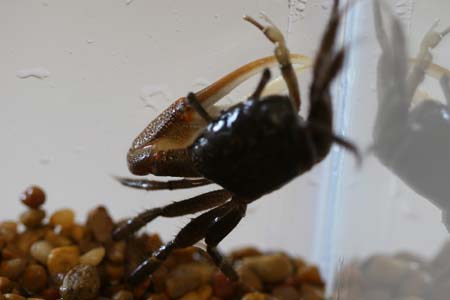
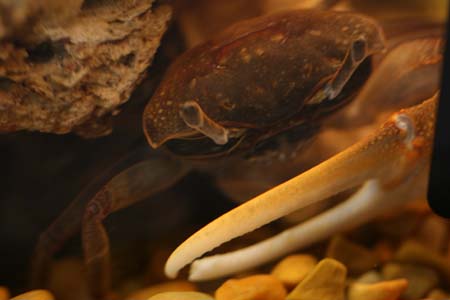
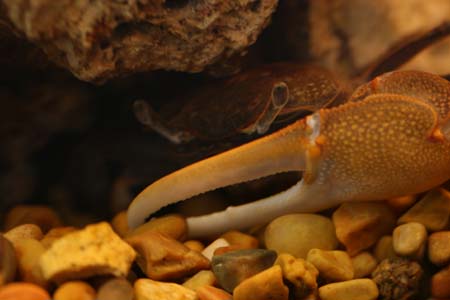
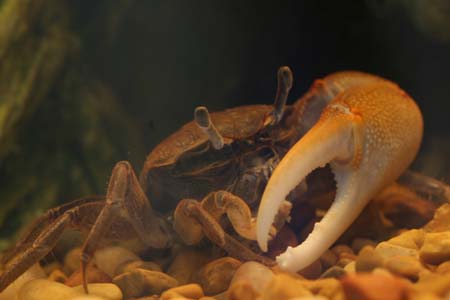
To round out the fiddler crab trio in our household, I give you the sole male in the tank, Admiral Byrd. He is fearless, commands the tank, explored every inch of it the moment he first entered the tank, and so he deserved a name fitting for a courageous explorer.
The first picture shows Admiral Byrd under less than optimal circumstances. In one of the first blogs about the crabs I mentioned the problem of getting the salinity level right in the water. Being brackish water crabs, they like lower salinity. Not knowing this, I had made the water the same as regular sea water. That drove Admiral Byrd literally out of the water, up the gravel hill, and as seen here, climbing the walls of the tank to get out. I quickly diluted the water, thus calming him down and convincing him to stay.
The second picture seems to sum up Admiral Byrd’s standard pose: “Stand back! I have a claw and I’m not afraid to use it!”
The third picture shows Admiral Byrd trying to get closer to the ladies by nestling in against the live rock while they were sleeping inside. (He was too big to fit inside). I guess he figured if he slept outside their front door, they’d have to run into him sooner or later. Admiral Byrd may be brave, but he is not too smart. The ladies just exited the live rock by the side entrance.
The last shows dinnertime. Admiral Byrd is chewing on a shrimp pellet clasped in his smaller front claw.
That’s the crew.
In another post, I will talk about a couple of ways this photo project helps my writing.
“It is possible that God is the way Annie Payne used to lean her old head against my shoulder, trusting me as I held her on the bedpan; . . . It is possible that God is my neighbor with her pan of brownies standing on my doorstep. It is entirely possible, that is, that the God I serve and worship with all my body, all my mind, all my soul, and all my spirit is love (1 John 4:8). It’s enough. It’s all the God I need.”
Kate Braestrup’s reflections on God in her book, Here If You Need Me. After losing her Maine State Trooper husband in a car accident, she went on to become a chaplain for search-and-rescue missions in the Maine woods. She is one of the first chaplains ever appointed to the Maine Warden Service.
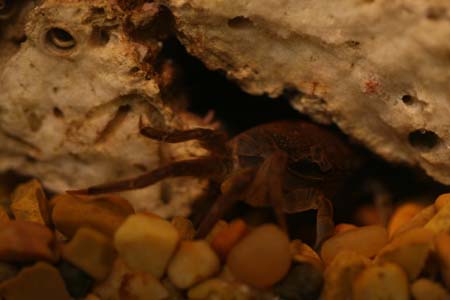
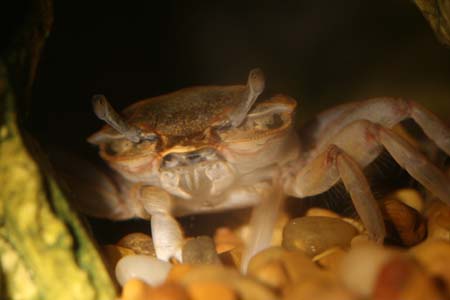
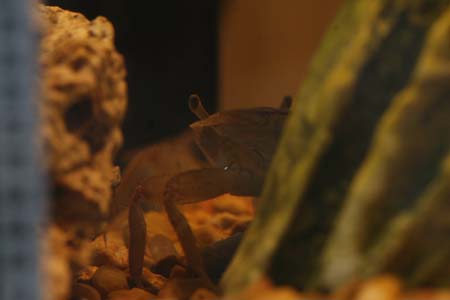
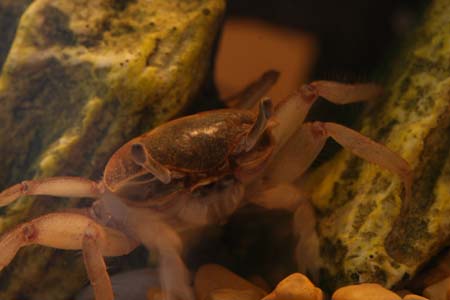
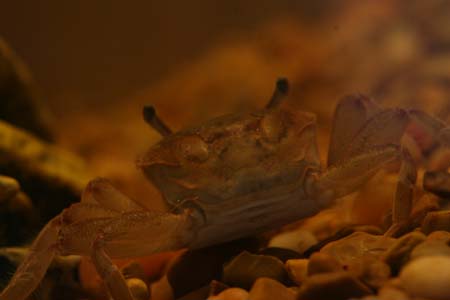
After several attempts over many days, I can at least prove there IS a Melanie Hamilton. Again the shots are a little dark. Flash won’t work due to the glass sides of the tank, so that leaves long exposure times to get enough light. The only problem with the latter is that unlike fashion models who will hold a pose so their best side shows, crabs won’t hold still. Make the exposure time too long and all you get is a blur. I have a lot of those. So I had to sacrifice some light for clarity.
The first picture shows just how much like Howard Hughes Melanie Hamilton can be. Most of the time she barely peeks out of her live rock crevice. Here all that shows are a couple of legs.
The second shot no doubt annoyed her. With the aid of a long exposure time on the camera and an Ever-Ready 5-volt flashlight shining in her face, we finally get a glimpse of Melanie Hamilton hiding in the ornamental cave in the tank. She looks grumpy.
After escaping the flashlight, Melanie now peeks out from behind the cave, probably to see if the coast is clear.
The last two pictures show her in a rare foray outside of the live rock. She seems to like the ornamental cave, and spends part of her time eating microscopic algae off its sides. They do that with fluid movements of their two front claws, delicately picking off invisible algae with the pincers on the claws.
Soon, the dashing and cute Admiral Byrd.
 Soul Mosaic