Archive for March, 2008

The Post – The Fiddler Babies are Dead, But We’ll Start Over And Prove Horseyhannah Wrong!!

March 10, 2008

The fiddler babies are dead.

I am sad, because I really did like the fiddler babies. I looked around on the web last night for clues to their demise and that’s when I got ticked.

The Discovery Channel’s Animal Planet Online Forum had a discussion of how to raise fiddler crab larvae. “Horseyhannah,” a senior member on the forum basically told a member who asked how to raise fiddler larvae that it’s so hard and requires hundreds of thousands of dollars of equipment to simulate ocean environments, waves, tides, etc. so it’s really not possible. Horseyhannah told the person to just enjoy the adult fiddler crabs and don’t bother to raise the babies. Needless to say, the person asking the question was polite, said thank you, agreed it will probably be hard, but would still like to know horseyhannah’s info source…just in case she decided to raise them anyway. My answer to that person is: GO FOR IT!!!! PROVE HORSEYHANNAH WRONG!!!!!

In fact, I am determined to do just that. In my book, Horseyhannah has thrown down the gauntlet and I am determined to prove her wrong.

I will concede failure on this first attempt. I am sad as I was so looking forward to having some fiddler grandchildren survive. I was frustrated and disappointed because contrary to the advice above, I think it was not only possible, but it was happening. Because I lost them so quickly, that tells me something overwhelming happened in the tank to kill them all off at once.

To review, by Friday afternoon, there were no babies moving around. It was a rapid decline, and up until that point, we still had quite a large number alive. I have to conclude it was a water quality issue and I think the biggest culprit was the live phytoplankton. But to go through this methodically, let me look at several things. If it were salinity, ie they didn’t like the marine environment I don’t think they would have lived that long in it to start with. I suspect the following things were problems:

1) I used gravel and we did lose MANY babies because they burrowed into the gravel crevices and died there.

2) The nitrite levels in the water spiked suddenly and got very toxic. Thoughts on this point:

a) I didn’t get the tank set up early enough to have a mature and well-functioning nitrogen cycle.

b) I either fed them the wrong food, or too much, or both. The wrong food or too much food meant it didn’t get eaten, sat in the tank and rotted. OR it created a huge algae bloom that raised nitrite levels beyond a tolerable level.

c) I didn’t change the water fast enough once I realized the nitrites were a problem, though given the phytoplankton issue, I was probablly fighting a losing battle from the beginning.

d) I no doubt lost babies doing the water changes because my only option was to bail water out of the tank and pour it down the drain

So boys and girls, what have I learned from this first attempt that can be done better next time?

1) I will use calcium sand not gravel. Aside from the fact that the babies won’t get trapped in the substrate material, the calcium sand will provide enough calcium for the babies to stay healthy during many molts.

2) Figure out the right food and amount. The gentleman from Finland whose article I quoted a few days back (he raised the Red Clayed Mangrove crabs) fed his larval crab Artemia…brine shrimp. He had a hatchery right in the tank to have a fresh supply. He also used something called JBL Nobilfluid for when the larvae were too small for the brine shrimp. This product is probably similar to the Small Fry liquid food I was using. It it made by a company in Germany and I’m trying to find out if it is marketed here. It has 50 different vitamins and minerals as well as brine shrimp and is geared for newly hatched aquatic animals too small to tackle live brine shrimp yet.

3) DON’T USE LIVE PHYTOPLANKTON this time. In spite of an almost 50% water change, I could not get the nitrite levels down. In fact, they kept rising. Now I am finding information that phytoplankton excrete nitrites. The better the phytoplankton did, the higher the nitrites. And with each feeding I basically inoculated the tank with more. I created my very own algae bloom which released such high nitrite levels, the babies were doomed.

Frankly, the tank seemed to be doing okay until I started using the phytoplankton. I would feed the liquid Small Fry food and while the tank would be cloudy initially, it cleared quickly, telling me the babies ate the food. At that point, in spite of it being a new tank with an unestablished nitrogen cycle, the nitrite levels stayed pretty low. However, once I started using the phytoplankton, the tank got cloudy quickly, the nitrite levels spiked, the water had a greenish tint, and the larval crabs numbers dropped dramatically. So, NO phytoplankton.

4) For water changes, instead of bailing water out, I will use the water bubbler as my “filter” to keep the babies in the tank, and let gravity siphon water out of the tube. I have the bubbler’s pump set up beneath the tank and have a regulator valve in the line to keep water from back-flowing from the air bubbler, into the pump. If I remove the valve and let the tube sit in a bucket, it will slowly siphon off water through the bubbler. This should let me slowly get water out for changes, without bailing larval crabs out of the tank and sending them down my kitchen drain.

So. I will start over. Admiral Byrd is doing his part, trying to get Scarlett O’Hara to notice him. Scarlett O’Hara has been eating and hanging around Admiral Byrd’s cave den. I figure it’s only a matter of time before Scarlett has eggs again. Therefore, tomorrow, I will take down the nursery tank, clean it out, get some calcium sand, and get that tank up and running again with the live rock in it, and get that nitrogen cycle stable.

We are going to try this again! My husband and I would love some fiddler grandchildren, 🙂 and even he said that we must prove Horseyhannah wrong!!! Stay tuned.

The Gift

March 9, 2008

“Our personal attempts to live humanely in this world are never wasted.”

Pema Chodron, from her book, The Places That Scare You: A Guide to Fearlessness in Difficult Times.

The Post – A Followup to Lee Woodruff and Caring for Our Injured Soldiers

March 9, 2008

A REVISION NOTE: THE URL FOR THE WASHINGTON POST ARTICLE BELOW IN INCORRECT. CLICK HERE FOR THE CORRECT LINK FOUND IN MY MARCH 25 08 POST.

I received a comment on March 7th’s post about Lee Woodruff and her Book, In An Instant. Usually I respond directly on the comment for that post, but decided to respond with a post of it’s own. I do not have personal experience with this group and cannot vouch for them. If of interest, here is the information. There is a Washington Post article that is included in the comment that may be of interest.

First, the comment:

Richard Anderson | richard@wellspouse.org | wellspouse.org |

I have read Lee and Bob Woodruff’s book, In an Instant, and it rings true. The Woodruffs were actually very lucky, thanks to top-quality medical care, and possibly divine intervention as well! It is very much to their credit that they have now started their Family Fund for Iraq war veterans and others with TBI.

As President of the Well Spouse Association (http://wellspouse.org, 1-800-838-0879), a non-profit, 501(c)(3) grassroots organization offering peer support to husbands, wives or partners of people with chronic illness and/or disability, I should know.

About 10% of our members are caregivers to spouses or partners with TBI. In this and other chronic illness situations, it can be a life sentence. They need support to help them feel they are not alone in their caregiver journey. Lee Woodruff made that clear in her book in speaking out about her own experience.

Thank you for a perceptive post. For another perceptive look at the life of a spousal caregiver, read the Washington Post Magazine story, The Vow, p. W10, March 9, 2008, about a WSA member whose wife has Huntington’s Disease, here:

http://www.washingtonpost.com/wp-dyn/content/article/2008/03/04/AR2008030402498.

Lee Woodruff noted that there are many small groups and large national groups, including some within the military, working to help the families of traumatic brain injury patients. I imagine there are resources out there for other illnesses as well, offering support to family members. To find a support group, or verify that a group is legitimate, asked your physician, VA, hospital social worker, ask at your military base, or veteran’s groups. Usually these places will have further information on a support group or a place you can contact to locate support.

The Gift

March 7, 2008

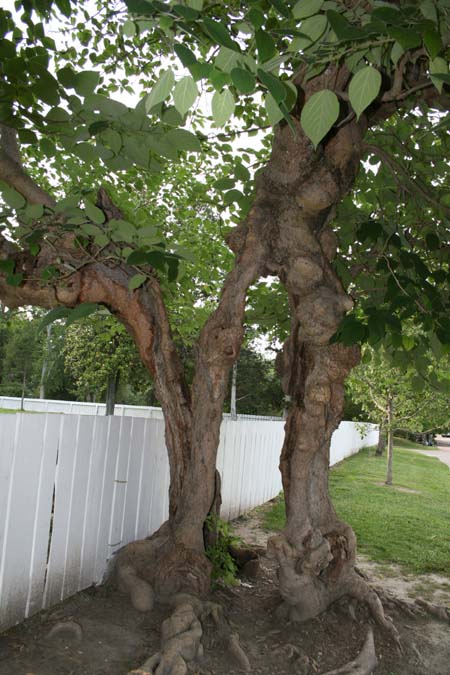
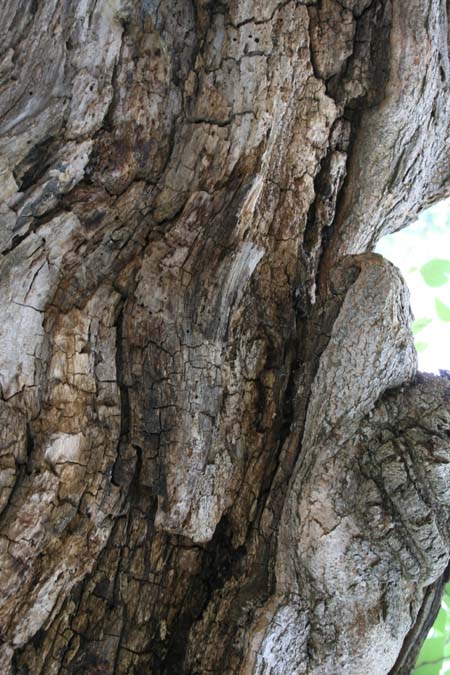
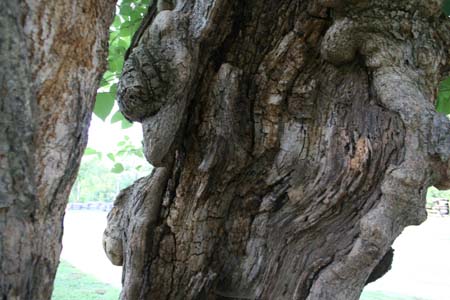
Sometimes when you are feeling very “full of your own power and worth” it helps to be reminded to be humble. If you think you’ve seen it all and know it all, consider the tree below. It might look like the shattered remnants of a tree, not very useful and certainly not pretty for landscaping. But remember that in life, all is not what it seems. Sometimes the most important things come in humble trappings.

The tree below is from Colonial Williamsburg. It is well over 250 years old. It witnessed the beginning of our country’s struggle to be free and shaded British and Colonial soldiers alike. It’s leaves blossomed over hostile residents of Williamsburg on their way to besiege the Governor’s Palace when his soldiers stole their gunpowder from the magazine. In fact, it witnessed the dark figures of those same soldiers stealing that powder in the early morning darkness, just hours earlier. This tree watched George Washington, Thomas Jefferson, Peyton Randolph, and Patrick Henry walk by. Actually, “saw them” in the flesh.

So this strange-looking tree – missing most of its insides – is still here with us, nursed along by the Colonial Williamsburg staff. Strange-looking maybe, but it’s life history gives one pause. It has witnessed so much. A reminder that sometimes the overlooked broken silent things in the background just might have amazing stories if only they could talk, and carry a value beyond money.

img_0496resized.jpg

img_0509resized.jpg

img_0505resized.jpg

The Post – Lee Woodruff – In An Instant and Helping Our Injured Soldiers

March 7, 2008

Taking a rest tomorrow, so posting Saturday’s Gift and Post tonight.

Tonight I had the honor of hearing Lee Woodruff speak at Quail Ridge Books in Raleigh, about her book In An Instant. It’s co-written by Lee and her husband Bob Woodruff, the ABC News anchor who sustained a traumatic brain injury from an IED while on assignment in Iraq . It’s the story of their family’s journey through pain to healing and then recovery.

I could say many things about her – she’s a great speaker, frank, honest, down-to-earth, warm. Passionate comes to mind – she speaks so passionately about our servicemen, what they go through and the struggles they have after sustaining such injuries. She very frankly noted that her family was lucky as they had the care of ABC, Disney, and many family and friends to sustain them. Our servicemen do not. She also frankly noted that it is the willingness of those young men and women to step up to the plate and volunteer that makes it possible for the rest of us, her 16-year-old son included, to have a choice as to what we will do with our lives.

She noted that their family has worked to turn the experience into good, lemons into lemonade, including setting up a charitable fund for servicemen with traumatic brain injuries, which I’ll explain in a moment. They have grown as a family. They have tried to help others. When asked though, given all the good that’s come out of what happened to her husband, and all the good things they’ve done and people they’ve helped, did she view what happened to him as a good thing? Her immediate answer was an unequivocal “NO.” She said if she could rewind the clock, she’d wish this never happened. However, it did. She has come to understand that life is suffering and you simply choose whether it can ennoble you or make you bitter. She noted very simply that she did not want to become a bitter old woman.

She has tremendous compassion for others and said she imagined everyone sitting there has experienced some kind of life-altering event. She feels for all. Often times people come up to her and say “this happened to me, but it wasn’t anything like what you went through.” She immediately put a halt to that thought. Her feeling is that life hands everyone suffering and pain is pain.

She spoke strongly about the struggles of our servicemen and their families when there is a traumatic brain injury. Too often these families are struggling and forgotten. She and Bob make it a point to visit VA hospitals when they travel. It is obvious this is a driving passion for both of them. She feels they were given a chance to have good care so now it’s their turn to bring attention to the servicemen. She shared a quote:

“The willingness with which our young people are likely to serve in any war, no matter how justified, shall be directly proportional as to how they perceive the Veterans of earlier wars were treated and appreciated by their country.”

That came from George Washington. She felt we are not doing enough for our injured veterans now.

In gratitude for their good fortunes they’ve started the Bob Woodruff Family Fund to assist service members injured while serving in the United States Armed Forces. Special emphasis is for traumatic brain injury victims. They work to raise public awareness of the problem, excellence in research, prevention, diagnosis, treatment. support and resources for the injured as they try to reintegrate to daily life. They work with individuals and small organizations to do everything from provide money for cab fares to wives of injured servicemen going to and from hospitals, to funds for bills, treament and rehabilitation for a blinded veteran who lost his pension and whose wife had to quit work to nurse him back to health. The stories were too numerous.

Her deep commitment to these men and women showed in her words, her face, her eyes. It is said eyes are the windows to the soul. That is the truth. Her eyes showed her soul. It is a soul of love.

If anyone wants more information on how to donate to the fund and help our servicemen who have given so much, the website is:

www.BobWoodruffFamilyFund.org

And she noted they have only one paid employee – the wife of a Marine who is on his 3rd tour of duty in Iraq, and she works out of her bedroom so they don’t have to use any money to pay for an office.

The Post – A Fiddler Update – Water Issues and Decreased Numbers

March 7, 2008

I am not sure that things in the nursery tank are going well. A sudden reversal in fortunes over the last day or so. Very decreased numbers of babies. In fact, this morning, it’s hard to tell if there are any left. The water got cloudy, like an algae bloom, and the nitrites spiked high and even a touch of chlorine showed on the dipstick, odd since I use distilled water. So the chlorine is coming from tank conditions, not the water I used. Some thoughts:

I am not sure if the decrease in numbers is:

1) Normal? They cannibalize each other.
2) High nitrites?
3) Touch of chlorine?
4) Wrong food?
5) Too much or not enough food?
6) Salinity? Are the science articles wrong and should I have left it brackish?

Water quality:

It started out that the water would get cloudy for a little while after I put food in the tank. Then it would return to being clear. Now, however, it’s cloudy all the time. I replaced 1 gallon of water last night (still “marine” at 1.019), and I added buffer to raise alkalinity for them to have enough calcium to molt. I also added Prime to get rid of chlorine and decrease nitrites. I succeeded with raising the alkalinity, and eliminating the chlorine. Nitrates are still in the “okay” zone, but nitrites didn’t drop.

This morning the tank is still cloudy. I will recheck parameters in a little while, and probably replace another gallon of water. I hate to do that because if there are babies left, I am most likely pouring some of them down the drain with water I tank from the tank. I do pull the water from the side of the tank where the babies did not hang out much, but still. Nothing to be done there though. a.m.

It occurred to me this morning that maybe the phytoplankton was either a bad idea or I just gave too much. The phytoplankton is alive. I noticed the water I drew off last night had a greenish tint. That means the phytoplankton, which is PLANT plankton, and alive, may be blossoming, in fact, maybe it’s a phytoplankton bloom in the tank. Given it’s not the open ocean, but a closed environment, the bloom, while successful in generating more food for the babies, maybe too much of a good thing in an aquarium. If too much growth, is it raising the nitrites and killing off the babies? I am wondering if I should have left the food at “Small Fry” and maybe the ground up krill and not added the phytoplankton.

I will also put a sample of the water under my “precision” microscope later to see if in fact the water is jammed with plant cells.

I will update on the results of water change, microscope viewing, and repeated parameters later, as well as whether it looks like there’s any babies left.

Live and learn. As my husband says, “Next time”….I think there’s always things we can do better. AND, once this experiment is over, we’re going to leave that spare tank up and running empty so it can settle out with a matured nitrogen cycle. Stay tuned for updates.

The Gift

March 7, 2008

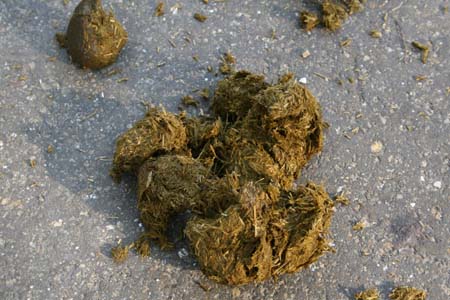
Okay, the gifts have been deep and meaningful all week. Humor is good meditation too. Here is an “excuse” shot – one of those you take just as an excuse to try out your new “macro” camera lens. I am sure everyone is familiar with “road apples.”

They are appropriate I think for a Friday, the end of the work week. For one, people often take off to visit places on the weekend and in that regard, these are special road apples. They come from one of our trips to Colonial Williamsburg in Virginia, left behind by the specially trained horses pulling the handcrafted colonial carriages. So, this should feed that “weekend wish to get away from it all.”

More to the point for a Friday, whether you were an 18th century farmer, or you work in a 21st century office, by the end of the work week, everyone has probably gotten their fair share of this stuff…. 🙂 Happy Friday.

img_0524resized.jpg

The Post – Preview of Coming Attractions

March 6, 2008

Companies have “Product Pipelines.” Teachers have “Lesson plans.” Movies have “Coming Attractions.”

Given that, I thought it was important to take a moment today to let everybody know “what’s coming” in the next few months on Soul Mosaic. The list below is not complete by any means, just some of the highlights farthest along in the planning stages:

Fiddler Crabs:

It remains to be seen whether the babies will make it or not, but I will continue to keep you posted. I see from the blog numbers this is a subject of high interest, so I will keep the updates coming.

As of today, the numbers of babies in the nursery tank has dropped dramatically. I am both sad and relieved. If thousands survived, they might have taken over my entire downstairs. However, I hope some make it. The parameters in the tank are good except for nitrites…the bane of all new tank setups. I am on my way right now to do a water change and see if that helps.

Hermit Crabs:

The next addition to the household in the near future will be 2-3 hermit crabs. I will be chronicling that from the very beginning, including what gear I buy and why, what happens when I “bring the babies home,” and how “life with hermit crabs” goes. Stay tuned for updates on when that will be happening.

Writing Posts:

There will be more posts to come on both My Author Journey, and the journey of Under the Pier as it moves through its process. I am pleased to report I am almost done with the second draft and will be starting both the third draft soon as well as putting together a submission proposal for a couple of editors. I will be sure to document the journey as it progresses. Topics still to come over the next several weeks and months in both of these areas:

1) Essays

From animals to God, geeks to kids, essays are how I speak. So more to come in this department

2) General Writing Journey

– The Writer’s House – That Swarming Bacteria, Proteus mirabilis

– Broken Bits – Encouragement for the Writer’s Soul From Beyond the Grave: A Nobel Laureate “Speaks”

– Writing Sanity: Do Something For Someone
3) More Topics for Under the Pier – Journey of a Novel

– Research Part III: Animal Character R&D

– Research Part IV: Setting as Character

– Three: The Mystical Number for Character Dynamics

– Test, Review, Retest, Analyze, Conclude

– Research Biblio- Diner Books

– Research Biblio – Nature Guides

– Writing the First Draft: If I Find One More Envelope Shred With a Story Note on It I’m Going to Scream!

– The First Draft is Done; What Now?

– So What’s Scribbled On All Those Revision Board Lists?

– What Writings Books Did I Use and Which Ones Did I Find Helpful?

– What Was Writing the Second Draft Like?

– What’s Coming Up for the Third Draft?

COMING SOON!!! A New Blog Category: Creature Features

As part of my preparation for Draft 3 of Under the Pier, I need to refresh my memory on all the critter descriptions. To really have those fish, birds, snails, and crustaceans breathing on the page requires vibrant details. So since I have to do a biology review of sorts, I thought I’d turn it into a creature of the day review for all of us. So – “Creature Features” coming VERY soon. (Appetizer: Did you know that an oyster toadfish can sound like an underwater foghorn?)

Photos and Art:

– New Macro photos coming soon. Since it’s Spring that means I can go back outside and crawl around the pond. Who knows what I’ll catch with my macro lens.

– “Photographic Journey of a Painting” – I will follow the journey of one of my oil paintings from rough sketches to explore composition arrangements, initial layers of paints, through finished product.

– Possibly Pastel: Given that I will be taking a 2 day seminar on Pastels in April, I may start exploring pastel art works and sharing those as well.

The Confusion:

What to do with the years and years worth of animal articles I have collected? – I have a box of news articles from the web collected over MANY years. It’s one of my quirks. I see an article about an animal, a cat who flew cross-country trapped in a plane’s insulation, a zoo animal playing with fabric softener dryer sheets, a 6-legged octopus, and I HAVE to print it out and keep it. My husband finds them for me now and sends them to me. Just like my feeling compelled to keep writing down the words “Mosaic” and “Broken Bits” over and over for the last few years until finally I realized it was my blog’s title and theme, I feel compelled to collect these articles.

The confusion in my mind is: WHAT SHALL I DO WITH THEM? I know I am supposed to do something with them… I FEEL it. But …what?

(Anybody have any flashes of insight????)
…And Last But Not Least: And Then There’s Bear

So, lots to come in the next few months, so stay tuned.

The Gift

March 6, 2008

“The intention to open the heart and mind is what’s essential. If we do good deeds with an attitude of superiority or outrage, we simply add more aggression to the planet. …When we practice generosity we become intimate with our grasping. When we practice the discipline of not causing harm we see our rigidity and self-righteousness. Our practice is to work with guidelines of compassionate conduct with the flexible mind…seeing things without “shoulds” or “should nots.” We aren’t drawing upon a code of conduct and condemning everyone who doesn’t comply. If we draw a line down the center of a room and tell those in it to put themselves in the category of “virtuous” or “nonvirtuous,” are we truly more liberated because we choose “virtuous”? More likely we’re just more arrogant and proud. Bodhisattvas are to be found among thieves and prostitutes and murderers.”

Pema Chodron, from her book: The Places That Scare You: A Guide to Fearlessness in Difficult Times

The Post: Under the Pier – Research Part II: Human Character R&D

March 5, 2008

If you’re writing about Abraham Lincoln, conducting research is pretty straight-forward. If you have a real person, you can find books, movies, articles, people who knew them or experts to interview.

How do you research someone who doesn’t exist? With fiction characters, a lot of times you first decide what your story is about and who needs to be in it, then you start hunting. A lot of the work is really character “construction.” You have to build the characters and give them a life to know what facts you need. Some research might go on as you craft the character, but for me a lot of it came after I had some idea who the people were.

For starters, I had to decide just what kind of characters this story needed – superficial or deep. If this was a plot-driven adventure story, the main change and action would take place outside of the characters. That means the characters, even the main ones, remain the same from beginning to end. So they just need their framework – looks, personality, talents, some backstory. It’s the adventure, the plot action, that changes.

Under the Pier is a character-driven novel. The real energy, drive and purpose of the story take place inside the characters. They will grow or regress, change for the better or worse, due to their personality and circumstances. It’s not about the story actions or problems, but how they REACT to those story problems. So this meant my characters had to have depth, history, psychology, family, emotional wounds, unanswered questions.

Before I could research anything, I had to pin down some concrete things about each character. As much as I hated to have to start picking traits and family backgrounds because to choose things is to exclude others, it’s the only way to have a true-to-life character. Nobody in life can have blonde, red and brown hair (unless they dye it that way), three different colored eyes, be both young and old, and do EVERYTHING you ever dreamed of doing. Neither can your characters. So for both sides of the story, animal and human, I had to create a character, build their life, and then relate their life to others in the story. Robert Frost said “way leads on to way.” In writing, character leads on to character.

For the human side I wanted more than just birth date, physical description, or the meaning of their names – yes, I selected names that matched some aspect of their personality, but I also wanted sections for things like: strengths, weaknesses, goals, fears, driving needs. I took a lot of the information from my extensive journaling and wrote up personality profiles that gave each person a life story – traumas and triumphs, parentage or lack thereof, marital status, family dynamics, issues, problems, glaring flaws.

And by the way, for well-rounded, true-to-life characters, it’s important that the heroes be jerks about some things, and the villains be saints about others. NOBODY in real life is all good or bad. If you do that with your characters what you end up with is a stereotype or a caricature. At the very least, what you end up with is dull and boring. I read somewhere that when police interrogate suspects and witnesses, they expect some discrepancies between the various versions. That’s normal human nature. Everybody sees different things. When the stories match up too perfectly, the officers suspect the story being told isn’t real. The same is true with characterization. For example, General George S. Patton, Jr.’s grandson shared this observation about the man:

“My grandfather once commented that in his view a gentlemen should be able to curse for three minutes, non-stop, without repeating himself.”

At first glance one would never figure a gentleman would use such language, but flesh and blood human beings are full of inconsistencies. So create a character that “overall” is true to his nature, but do sprinkle in some unexpected traits. It makes for more real, interesting characters, and adds to the story action possibilities.

In any event, when writing my characters’ biographies, I started with the simple date of birth and description, then went on from there. For Rosa, the old woman who runs the diner in the human side of the story, the physical description went something like this:

She is relatively thin and wiry, but solid-boned, strong from years of physical work, with short whitish hair that used to be black. She’s about 105 pounds, in good condition overall from walking up and down stairs to her apartment behind the diner. Some arthritis and she is slowing down, but still is healthy and strong enough for being almost 80. She does have high blood pressure and sometimes forgets her meds.

That gave me enough of a picture in my mind – one of those strong old women who worked hard all their life, like many old women I grew up around in my very ethnic hometown. The thing about pinning down part of a person, though, is that it provides the bridge to the next piece of their puzzle. For example, just talking about her life of hard work suggests a need to explore areas like her background, level in society, personality, and attitudes toward life.

The beginnings of personality start to show in the additional information I put down:

She was born on October 29, 1929. If you know any history – this was Black Tuesday – the crash of the stock market and the beginning of The Great Depression. Unless she was born rich and lucky, which she wasn’t, this tells you how her life was going to go. To continue with my description, I decided her parents were immigrants from Italy, arriving just a year before her birth. Her mom died giving birth to her, something not uncommon for the time. Her father wasn’t around much, either looking for work, drunk or simply gone for long periods. She was shifted from family member to family member, often not a happy situation. She had to work from a young age and got out of her aunt’s house as soon as she could. She started working in a place called the Midway Diner, run by this handsome young guy named Frank Santelli, his grandmother, and his maternal uncle, Angelo Campelli. Uncle Angelo started the diner in the late 1890s with a horse-drawn cart and built it up from there. She fell in love with the diner and Frank, almost immediately. She married Frank by 18, revered Frank’s grandmother who took Rosa under her wing, and spent the rest of her life preserving the legacy of that diner, even after Frank’s death. She had 4 children – a daughter who died as an infant, and 3 sons, all still alive.

Okay. Right in this section, by picking the particulars of Rosa’s background, I’ve set up not only the rest of her life, but set up the bridges to the stories of her husband, his grandmother, his uncle, the diner’s history, her children, and raised questions like, why did she revere Frank’s grandmother, where was Frank’s mother and father, and what happened to Rosa’s infant daughter? Just by picking certain details, you create the thread to more questions, more characters, more life situations, conflicts, and relationships. You create….a real person with a real life. MOST importantly I’ve set up the question in the reader’s mind.. Why is all of this important with regards to Rosa’s relationship with Max, the story’s 12-year-old female protagonist? That’s the ultimate thing to remember. Not everything the biography will be part of the story, but if you make it part of the story, it better have a real good reason for being there, ie, how does it relate to the protagonist and the story’s main question?

Now. Research on Rosa. Well for one thing, I looked for anything I could find to “validate” her personality traits so a reader wouldn’t think I was overdoing things. I spotted an article in a Rhode Island newspaper about a woman in her 80s who would go out after snowstorms and not only shovel her driveway and sidewalk but those of her neighbors as well. She shrugged off the effort as “exercise” and viewed it matter-of-factly. She was home, her neighbors had to go to work, so she just took her time and shoveled everybody’s sidewalks. So, Rosa rings true to life. (If you want more of a feel for her, click here for the January 24th, 2008 post where I included a bit from the book describing Rosa)

Other people in the story. I know a bit about diners growing up in New England, and what the people were like who worked in them and ran them. I grew up in an ethnic town full of those early 1900s immigrants from Poland, Italy, Slovakia, Ireland etc. and knew the rules of the culture: hard work, no wimping out, not very much money, family and church were everything. Those people survived the Depression and World War II by helping each other even as they fought with each other and drove each other crazy. They didn’t mince words, but put it right on the table, usually in colorful language. For holes in my knowledge base, I researched books on diners, history, New England, did Google searches, and talked to people.

For example, Rosa’s son Vince, her eldest son, a war hero from Vietnam who is kind of a mystery character with a shrouded past, finally returns home after many years away. He works nights at the diner making doughnuts. I interviewed a number of people who worked in bakeries at night making doughnuts, so I’d get my details right.

For other characters in the book, I did the same thing – wrote the physical characteristics, figured out ages, started linking them to other characters in the book, and creating a “web” of relationships and lives. The more you added to the people and the web, the more possibilities for story action and conflict.

For example, the human protagonist, Max, lives with her grandmother, who also works at the diner. Max’s grandmother is dating Vince. For a number of reasons this both disgusts and scares Max. And Max views Vince’s shrouded past with tremendous fear and suspicion.

Just setting up that scenario, suggests questions like: “Why is Max living with her grandmother? How long has this gone on? What happened to her parents? What IS the deal with Vince’s shrouded past? Why does Max fear him and fear his dating her grandmother?

Then throw in a quirk. Here is Vince, a mysterious character Max fears, and a still strong and burly man. I gave him a small poodle as a pet. Not exactly what you would expect is it? And then there’s that pendant he has around his neck that he never takes off. Just what happened all those years he was away?

If I ran into problems or a block, I “talked to the characters.” You interview them, start a conversation, ask them a question about school, politics, the person they hate the most and why, anything. But having a conversation with a character is like talking to someone at work. The more they talk, the more you learn who they are. Most writing blocks come from either not knowing who your characters are and hence how they would react, or not knowing where the story is going. So…interview and journal, then go back to writing the biography.

The minute you put down one trait on a character then add a second, you set up a chain reaction that leads to more questions, decisions, more characters, more background, more dark secrets in closets, whatever. By the time I was through, I had two binders of character biographies. Some of the characters are background ones. For example, Rosa runs a ladies’ poker game in the corner booth of her diner – her booth – every Friday night. ALL the area ladies who run businesses along Main Street play, and even Sister Rita Luke from Our Lady of the Seas up the street shows up to win money for her outreach programs. Father Steve is the “chaplain” As one of the old ladies in the group puts it: “First we pray, then we play.” So I needed some cursory description of who the ladies were and what stores they ran.

Once you’ve got the real people, the research part is easy. For medical problems I did Google searches, hunted through medical textbooks, talked to an ER physician, and even pulled details from the book, The Perfect Storm. For a legal issue involving Max, I talked to a lawyer. For emotional problems, again, there was Google, psychology books, and a psychologist. I researched Catholic history, and ethnic superstitions, both very big themes in that culture. I researched the fishing industry and what kinds of research post-doctoral students were doing in Rhode Island for either universities, the military or the environment. And yes, I got books on the meanings of names, so I could accurately name my characters, not just pick something out of a hat. In the course of the research, I looked for interesting tidbits or colorful facts that I could incorporate to give my characters the “authority” of that life.

Finally, I looked for things to use as character tags. Character tags allow us to quickly identify the character, tell us something about their deeper personality, and raise more questions for the reader to answer. Vince walks a poodle and wears a mysterious pendant. Rosa has her certain superstitions, Max walks around in the middle of the summer wearing a paint-stained oversized flannel shirt. Almost immediately, we associate certain things with certain people, then begin our quest to find out “why?”

Up Next: Under the Pier: Research – Animal Character R&D