What lives in the heart of another, what REALLY goes on behind closed doors, and who do you believe?
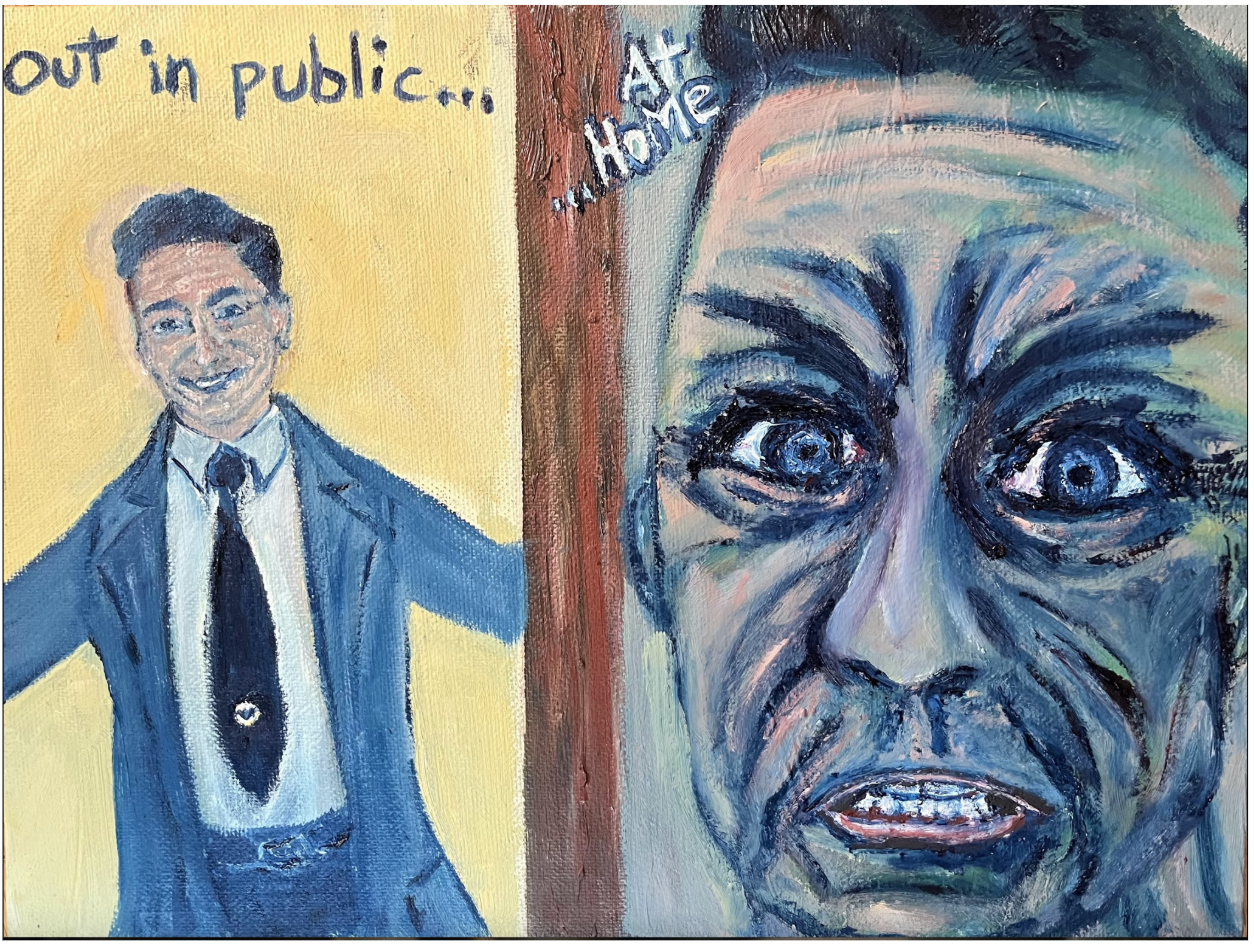
Before I get started, let me first say this piece is not about the average failings we all have where we wish we had done better. We all have dark places in our hearts that we try to overcome with our better sides. And most of the time we actually do. There is not a one of us out there that is perfect. But there are those who carry much darker sides, inflicting harm on others without caring and often taking pride in their ability to fool others.
Why can’t people just leave it alone?
Domestic abuse, child abuse, incest….these are messy topics, uncomfortable topics, topics many would rather avoid than deal with. For many people it comes down to, “he said, she said,” and how do you prove it? And if you know the person accused personally or through their fame, who do you believe? Do you even want to believe it might be true? Why can’t it just be simple and why do people have to bring this stuff up?
The Steven Tyler picture
Case in point. Sitting on my bookshelf across from me as I write this, I have a picture of Steven Tyler. It was a gift from his charity, Janie’s Fund–something I donate to. It’s a very good charity, one he founded to help abused and neglected girls find healing. So far it all sounds like a noble thing. Yet, it is a picture I have deeply mixed feelings over.
What is the truth???
When you hear that someone is accused of assault, rape, or molestation, the question immediately becomes – is it true? That is quickly followed by: What is the evidence? How do you prove it? And if the person is powerful and/or famous, it’s even harder because then it is confounded by power and money, whether on the side of the accused or accuser. Who is telling the truth? Are there other things operating here? Is the victim coming forward because they were traumatized? Did they delay speaking because they feared the person’s power or that no one would believe them? Or is the allegation fabricated or the story “altered” because the person is famous, wealthy, and an easy target?
About the victim
For the victim, they are frequently viewed with suspicion vs support. First, they are bringing up uncomfortable situations that are not easily resolved. So this means it will require deep investigation and thought with possibly no clear answer. For another, they are making us face the possibility that our heroes may not be “heroic”…or even decent human beings. And we may not want to confront that.
So we look at the victim for answers. If they have no outer wounds to prove something happened, we may question if they are telling the truth. And the long-term scars they may carry are not visible. People might question their motives. And many, whether they want to admit it or not, might be angry with the victim for inflicting an uncomfortable situation on everyone else. Why can’t it just be like it was the moment before they opened their mouths and changed everything? And even if it’s true, why couldn’t they just leave it alone, get over it, or move on? It’s a no-win situation.
And then there is the accused
For the accused, if they are innocent how do they prove it? Will their lives be destroyed just by being accused? Even if they clear their name, will it be too late? Is it even possible to clear one’s reputation of the stench of being unfairly accused?
And what if they are indeed guilty? What might they be willing to do…to the victim, their friends, themselves, to evade responsibility and twist the truth? And how would we know for sure? Sociopaths are experts at taking accusations of misconduct and creating plausible explanations, simple explanations, explanations we want to believe because it would end our discomfort.
Brock Allen Turner, Al Franken, Brett Kavanaugh
Brock Allen Turner, Al Franken, Brett Kavanaugh. You read the stories and the question is — who do you believe? What are the motivations and intentions behind the actions of accusers and accused? Because it comes down to one person’s word vs another’s.
In some cases, there is no question. Turner, the Stanford student who raped a young woman behind a dumpster, was caught by witnesses. It was not her word against his. And yet this case still caused outrage because despite the evidence and the crime, the perpetrator got off with a light sentence. His crime will be forgotten, and he’ll go on to have a productive life, maybe even climb into bastions of power, yet the girl will carry that harm for life. But that is another topic for another post.
In the case of Al Franken, he resigned immediately based on the accusations, which may be true and he didn’t fully deny. But later he and other senators, including women, think it may have been too hasty. He was accused but never had the benefit of due process that examined both sides, something highlighted in this BBC article:
https://www.bbc.com/news/world-us-canada-49074194
And more than a small amount of controversy surrounds the investigation…or lack of…into the allegations against Brett Kavanaugh. I won’t go into my own feelings on that one. Again, a whole separate topic you could write a book on. Suffice it to say I do not believe he deserves to be on our Supreme Court when witnesses that might have had other testimony were not fully investigated.
Steven Tyler and teen girls in the ’70s
Coming back to Steven Tyler, he was accused of assaults against teen girls in the 1970s, including one case where he convinced a minor’s parents to let him be the guardian, and the story gets worse from there. In one of those cases, the lawsuit against him was dismissed but still, it leaves doubts as to his innocence. If someone is truly innocent, would they be satisfied to have a lawsuit dismissed on a legal technicality?
Rehab and Janie’s Got a Gun
In the 1980s he went through rehab and encountered someone whose pain over being sexually abused so apparently impacted him that it prompted him to write the song “Janie’s Got a Gun.” The piece is about a young girl being molested by her father and her using that gun on him. To say I “like” the song is not quite correct. But do I “relate” to that song? Oh, hell yes. It taps a deep visceral rage in me at being abused by my father. I “understand” that girl in that song.
Janie’s Fund and Youth Villages
Anyway, later he started the charity Janie’s Fund, in partnership with the organization Youth Villages….something I donate to. It is a good charity. I learned about it because of his fame. But I also researched Youth Villages and really liked what I saw. They not only provide family counseling and help, but most dear to my heart – programs for young adults who age out of foster care and are then just “dropped into the world” with no safety-net, help, or future. They help those kids get established in an apartment, find work, go to school for careers…I like what they do. So through his efforts to create this fund and partner with a very good organization, he is helping many.
What is enough? What is in the heart?
But…is it enough? Does it make up for any harm he did earlier? What is in his heart in doing this? Is it truly about being changed after his rehab? Or is it PR, damage control, or self-absolution? I don’t know. And I probably will never know. I only know I like the charity, I will continue to support it, and I will remain uncomfortable about the truth in Steven Tyler’s heart.
That picture on my bookshelf
So why do I keep that picture on my shelf? Because it encapsulates in one picture, what I’ve had to deal with my whole life. My father abused me–physically, sexually, emotionally and mentally, for almost 3 decades. He started when I was small. He brainwashed me, took a lot, damaged me heavily, and I’ve spent a lifetime recovering. If I stay silent, I harm myself. I have to live in a closet, wear a facade and pretend my life is, and was one thing, when it was totally another.
Cognitive dissonance – What do I do with this?!
But if I speak my truth and embrace who I really am, if I say what I lived through and what I deal with now, I risk being the pariah. Whether they believe me or not, each person has to face the question: “What do I do with this?” and make their own choice for a course of action. I have complicated their lives and most people just want things simple.
Cognitive dissonance is a powerful force. When you are confronted with the fact that someone you respected or who was good to you did horrible things, your brain struggles to reconcile what to do with two very different truths.
The shapeshifter
For example, the people he worked with, the people in our church, his buddy who served as an usher with him, or in his social circles, such as those at the Elks — they all knew him as a happy, affable guy, a good and devoted family man. But he was really a chameleon…a shapeshifter.
Their heads would have spun if they could have seen how quickly that smiling face shifted to an expression of fierce rage in micro-seconds as soon the door to our house closed. To be sure, that was an experience reserved for moments with no outside witnesses. They might have never believed he beat his wife regularly in the bathroom while I listened at the wall wondering if this was the time he would kill her. Or that he hit me regularly too if Mom couldn’t block him in time.
The scary Bilbo Baggins face
The best example I can give for how quickly his temperament changed would have been from Peter Jackson’s Fellowship of the Ring movie. There was a touching scene between Bilbo Baggins and Frodo where they were joyously reunited. And all was well until Bilbo saw the ring of power dangling around Frodo’s neck. In a split-second, his soft loving expression transformed into that of a deranged demon. Bilbo finally managed to recover and I give him credit because he at least realized his failings where the power of that ring was concerned. It was a sobering reminder of the evil that can be triggered in each of us in the right circumstances.
That movie scene – the immediate switch from loving to evil to loving – was my father. Except he only went back to loving when he got what he wanted. And there was never the admission that he had needs that drove him to do unconscionable things to me, his young daughter.
For me, I spent my life always scanning that face for the moment the demon expression might start to appear. Never certain when, or if, he was going to explode, I was constantly on guard so I could do whatever I needed to avoid that rage. And I was the recipient of that rage–that “look”–many times because I tried so hard to get him to stop abusing me.
The Living Breathing Reminder
Now if I speak these truths, certainly some will staunchly support me and care. Others will be uncomfortable and distance themselves. They may have liked my father or thought highly of him and I just ruined lifelong memories and illusions. It’s a sad fact but the abused often pays more of a price in speaking out than the abuser does.
Some may say perhaps things in our house weren’t that bad and surely there are people suffering worse things in the life, as if it’s some contest and I have to meet a benchmark of horror before they acknowledge this never should have happened. Others yet will point out the good things he did and suggest that he changed–as if that negates the irreparable harm he did. It’s like saying about a rapist, “Well yeah he was a rapist but he was good to his grandmother.” One does not wash the other.
And finally, there may be some who won’t believe it or won’t care. They’ll want to keep their illusions about him and just want me to be quiet, let it go, and get over it. To them I am the living breathing reminder of what they don’t want to deal with or remember.
The bottom line is this. There is no whitewashing what he did. One time or 4000 times, he harmed me, a child, and forever changed my life’s trajectory. HE chose that, not me. But I will be viewed by some as the source of discomfort and I will be accused of not being willling to move on. What they don’t understand is that by speaking out, by processing and sharing, I AM moving on, healing, growing, and possibly even helping others. Silence and secrets destroy a person.
The unanswered questions
The questions I wrestle with now are the ones I will never have an answer to. He abused me. I am never unclear about that, especially after thousands of assaults over 27 years. But it’s about what was the truth of him. And “what do I do with my feelings about him?”
Did he have any good in him? Does it even matter? It doesn’t change the evil he did and the responsibility he never took for the permanent harm he caused me.
Yet I have read that even the most vile people have something in them that is good. So in making sense of my life in that house, the question of, “Was he a heartless monster or was there anything of redeeming value in him,” gnaws at me. At the bottom of it all is that question of “forgiveness–do I forgive him?”–which I will write about in another post.
So many people say “well you must forgive, even if it’s just for yourself.” I don’t agree. Or they will point out that he was probably abused too, which he was. But I have my own feelings on that point as well, and that will be another post. So part of my journey in writing to heal is to examine many aspects of this story before making my own decisions on things.
How to get people to like you
Another unanswerable question is “When he did anything nice, what were his motives?”
On the one hand, he could be fun and helpful, and act in very loving ways when he wanted to, which was the mind-f-ck because you would doubt your own memory of his abuse. In those moments you’d question if he was really that bad, or did you cause it by not being attentive or alert enough. And given I was desperate to avoid his wrath and to soak up any positive love and attention, I gladly shrugged off everything, just to have peace and quiet and his good mood.
But…were the good things that he seemed to do for us or others done because he had some shred of goodness in him? Or were they really just carefully calculated acts done to maintain a facade, get what he wanted, and fool everyone else? Buy allies? Many times I saw him assess what he might get out of a situation if he helped another. Transactional, was his modus operandi. I think back to his advice to me one time in my early teens about how to get people to like you:
“Find out what people need or want and give it to them and they will like you.”
Did he stand for…anything?
On his deathbed, he said he always wanted to stand for something. I wanted to ask him when he planned to start. From my perspective, he never did stand for anything except to make sure Richard Phillip got whatever he wanted or needed from you, and if he did, then he would like you.
So as for the truth of him, I will never have my solid proof. Maybe he didn’t even know. It is something that remains an open wound that I work to heal and one of the many reasons for writing my memoir. By looking back with the eyes of an adult vs the eyes of a harmed child, I might be able to make my own sense of it all and release my pain.
The picture, and the unanswered questions
As for the Steven Tyler picture, for now at least, it remains as the reminder of unanswered questions I am trying to deal with. I reserve judgment on its future presence in my house.
Back to “reasons to write a memoir”
Now, on to the piece about all the reasons why it is a good idea to write a memoir.
Tags: abuse, abuse victim, abuser, Al Franken, assault, BBC, Bilbo Baggins, black and white vs gray, Brett Kavanaugh, Brock Allen Turner, calculated acts, chameleon, cognitive dissonance, domestic abuse, domestic-violence, Fellowship of the Ring, get people to like you, goodness, incest, intention, Janie's Fund, Janie's Got a Gun, living breathing reminder, manipulatino, manipulation, memoir, mental-health, rehab, sexual abuse, shapeshifter, Steven Tyler, The Elks club, trauma, truth, unanswered questions, uncomfortable truths, Youth Villages
 Soul Mosaic
Leave a comment