In many stories, the place and the time period are considered characters in their own right. Certainly, I would agree given the unique flavor of where I grew up, and when.
Torrington, Connecticut:
Nestled in the valley between the foothills of a section of the Appalachian Mountains known as the Berkshire Hills, Torrington is built around the Naugatuck River, which flows south through that valley, right through the center of town. When the town was originally founded, it was located on the hillsides east and west of the river valley, where the climate was healthier and less swampy and mosquito-infested in the summer.
A lot of the surrounding county area was, and remains, rural, with dairy farms, state forests, and nature trails. It is hilly countryside, and as such, the geography itself gives a sense of “constriction” between those hills, and isolation from nearby areas because of them. There are a lot of hardwood forests, including things like oak and sugar maples, and in spite of steel-gray cold skies in November, Fall, with its amazing color display, is my favorite time of year there.
The town and surrounding areas are steeped in history. Whether it is of ancient Mohawk tribes living in longhouses, or the story of Connecticut as the Charter Oak State, the state is living history.
The latter story is based on the fact that the state was given a royal charter in 1662, allowing for self-governance. During the Revolution, the charter was hidden in an oak tree to prevent it from being confiscated by the British.
Many locations around Torrington and throughout the state have markers noting various sites of importance from the 1700s and during the Revolution. The culture of the area was heavily influenced by the strict ethics of the Puritans, who had moved there from England to have religious freedom. And throughout the area, there is still a strong sense of individual ruggedness. That ruggedness is further fostered by the climate, which can suffer extremely cold winters with blizzards, and summers and falls with hurricanes, tornadoes, and Nor’easters.
Torrington was and is a small former factory town in that Northwest corner of Connecticut. It was an industrial powerhouse in the 19th and part of the 20th century, providing employment, a decent standard of living, and a strong economic base for the towns there. Industry included things like brass production, arms manufacturing, skilled tool and die companies, and small factories providing parts for the automotive and aerospace industries. Most of those places shut down and moved south during the 1960s-1980s, and later those things moved overseas. So the employment and economy of the area have taken a hit. But during my childhood, especially with the ’60s space race, things related to aircraft and aerospace industries were still thriving.
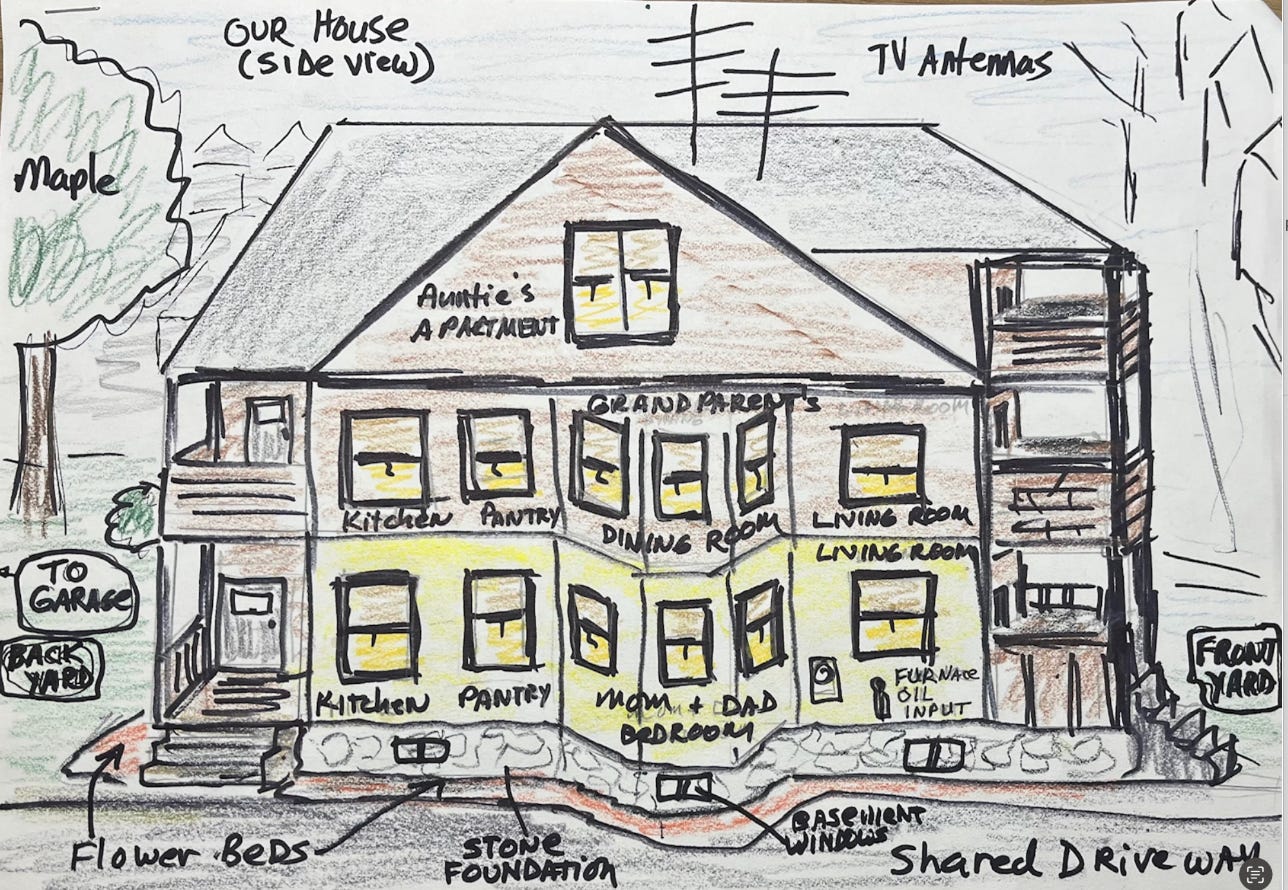
Most people during the early and middle of the 20th century lived in the main town because they worked in the local factories. This allowed them to walk to work, shops, churches, and doctors. My grandparents did not have a car, nor did most of the older Slovaks. In fact, our house was just down the street from the church and school we attended, so easily within walking distance.
The homes in town, including the one we lived in, were multi-family 2- and 3-story homes, in keeping with the blue-collar, industrial flavor of the area. There were some single-family homes scattered around in town, but more of those were on the outskirts, in more residential or agricultural areas.
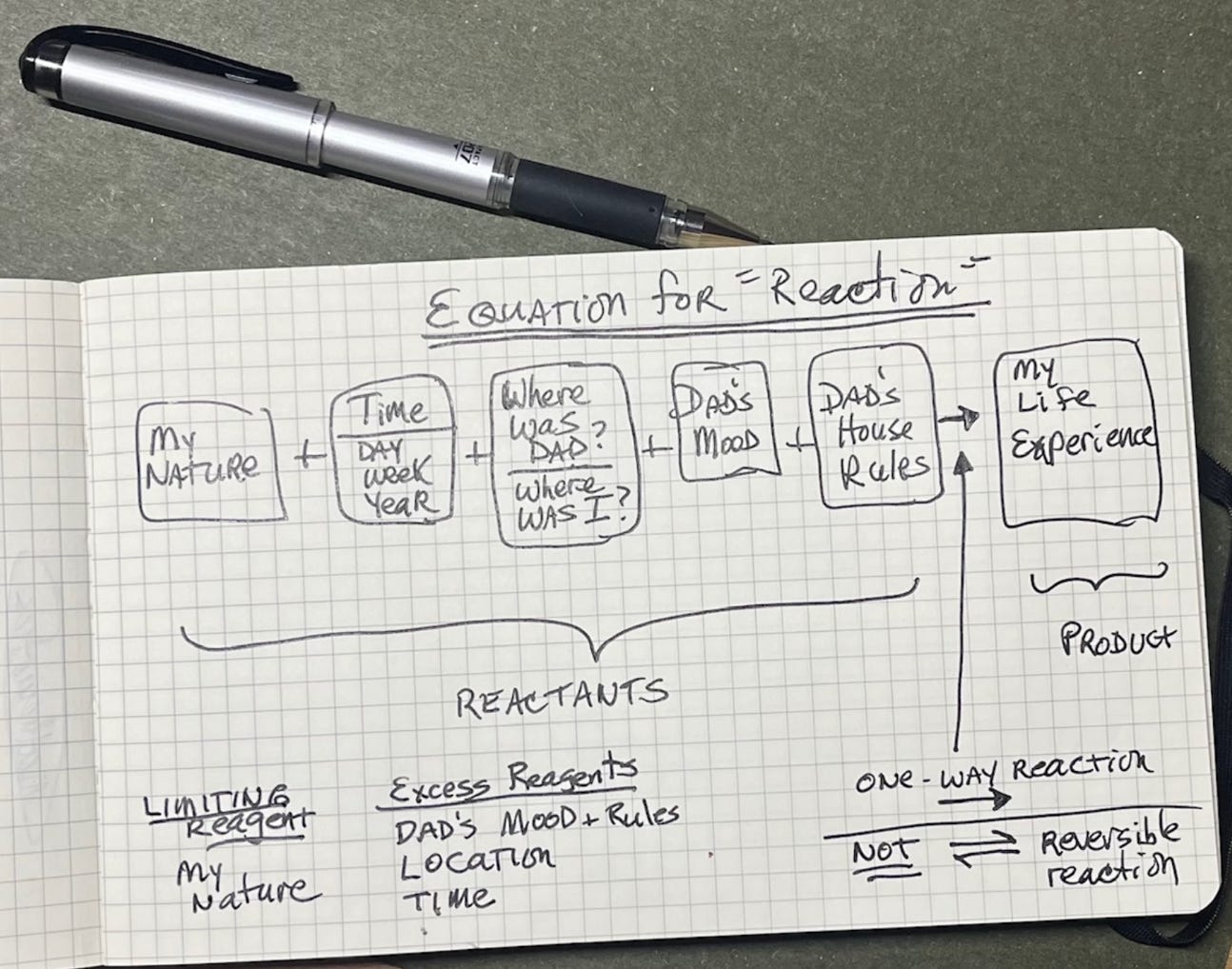
As a scientist, one of the best ways to capture what happens in a reaction, especially a chemical one, is to set up a formula. On one side of the equation are all the reactants, the items that are mixed together for the reaction to take place, and on the other side is the final product or outcome.
I wasn’t aware of what was happening to me all those years, because when I was living in the “water” of that house, I just considered it the norm and never questioned anything. But now, when I look back, I can see the patterns. If I want to visualize life in that house, I could use the following formula:
My nature + Time (Day/Wk/Yr) + Where Dad Was vs Where I Was + His Mood + His House Rules = My Experience
More generally, the ingredients were people, time, place, and rules. But no matter how you look at it, the equation was heavily weighted toward the power of his ingredients: Time, Where He Was, His Mood, and His House Rules.
Another thing about chemical reactions is that some ingredients have more power over the others, especially if they are present in overwhelming amounts, versus the others. In reactions, the reagent with the least amount present is called the “limiting reagent.” Once that particular ingredient runs out, the reaction is done.
For example, consider my nature. At any given time, my ability to be calm or in control of what was happening to me, was limited. If he he wasn’t around, most of the time I could be me, indulging in play with friends, books, daydreams, school. I say “most of the time” because there were times even when he was gone, that if he was angry with me, I would be a nervous wreck anticipating what was coming when he returned. But generally, I could use those “in-between” times away from him, to recharge, and live a “normal life.”
But when he was around, I needed to be on guard. I learned early on that everything about my day revolved around him and his mood. The absolute constant was to always be focused on him, assess the state of things, then adjust me to match what was happening. So in thinking about it, this required some amount of psychic energy no matter what.
If he was in a good mood, I still needed to stay on guard because I couldn’t be sure how long it might last or what might trigger a change. But if he was in a bad mood, I was consuming vast amounts of my emotional energy rapidly to “prepare or endure.”
The bottom line is that my emotional energy would run out long before his. So I was the limiting reagent. He could control me and have his way with me, even when I tried to resist, because all he had to do was keep battering me with his reagents — his mood, twisting his house rules, picking fights with me and not leaving me alone. Since he had these infinite amounts, sooner or later, I would run out of fight out of sheer nervousness. I would have to cave because I just couldn’t stand it anymore.
The last thing about chemical reactions is that they are either one-way or reversible. One-way reactions are “all-consuming,” that is, they can only go on until the limiting reagent is used up. Then the reaction stops. And there is no going backwards to restore any of that limiting reagent.
Reversible reactions can flow back and forth, sometimes benefiting one side and other times benefiting the other, depending on conditions. The chemical reaction in our house was one-way and all-consuming. His way, and I was being consumed.
Only now do I realize all of this, and the full extent of what I was up against. Yet, I am still here. I sustained, somehow, even if I am left with permanent scars. How did that happen? And what does that mean for my continued healing?
It’s time to look at not just Mom and Dad, but time, place, house rules, and the one “people” I haven’t said much about yet…that kid…me…that person in those “in-between” times. Just who was that kid, and why did she survive?
So that is next. But to start off, I will start with “place” — my world, the house and immediate area that I lived in. Then I’ll visit that young child and see what she was like, especially when he was not around…those “in-between times” when I could be myself.
As usual on any afternoon, my Mother was preparing a full meal for dinner, including a homemade dessert. Dad expected full dinners, including desserts, with his meal. While store-bought” Oreos were allowed for snacks because Dad liked them and he brought home the paycheck, desserts had to be homemade.
On this particular afternoon, Mom had two cake layers cooling on top of the stove, and they gave off the sweetest vanilla aroma that I couldn’t miss as I ran into the kitchen. I stopped near the stove to examine them because they smelled so good, and that’s when I spotted the problem.
Poor Mom! She always worked so hard to make all her desserts from scratch, usually from recipes out of the red binder — her Betty Crocker cookbook. But today, looking at the cake tops, I felt bad at how they were turning out. That’s when the perfect idea popped into my head for how to help her and fix the problem.
Happily, I set to work with a knife. A few minutes later, I was almost done when Mom came into the room. She stopped dead in her tracks, her eyes wide in horror, and she yelled, “What are you doing?!”
“I’m helping you!”
I pointed to the piles of cake chunks I’d cut off the top of each tier – the uneven bumps that, to my mind, marred the smooth surface.
“The cakes were all bumpy, so I figured I’d cut them off and make it all smooth for you!”
My mother stood there, staring from me to the cakes, then back again, as she struggled to process my logic. For several moments, she said nothing. I wasn’t sure what was wrong. This was not the reaction I expected.
Then, she took in a deep breath then let her shoulders drop as she exhaled slowly, and said quietly, “It’s okay. Go play. I’ll fix this.”
Now, many years later, I realize the artful skill it must have taken her to spread frosting onto those two cake layers whose tops were almost totally crumbs….
**
I love looking at pictures of my Mother from her early years. She was beautiful and had a radiant joy that seemed to burst out from within.
We were on a typical Sunday visit to Bridgeport, Stratford, actually, where Dad’s parents lived. It was always an uncomfortable time. We’d have to be dressed up, which meant not really being able to play or do anything fun, not that there was anything fun to do there anyway. The only saving grace was the TV set because Grandma could get all the New York City TV channels we could not. So we could at least watch old movies and programs like “The Thunderbirds. But there were strict rules in her living room, and God help you if you broke them.
For one, we couldn’t touch the TV. If we wanted to change the channel, we’d have to ask an adult to do it. If you were even in the vicinity of the TV set and she walked in, she would start yelling. The living room itself was equally uncomfortable, with plastic runners across the rug and plastic sheets on the couches so we couldn’t mess anything up. Also, forget about bringing a snack in there or touching the candy in the dish on the end table. And don’t touch any of the hundreds of her knick-knacks scattered around the room. One time, one of us accidentally broke one of her statues, and Dad actually hid it so we wouldn’t get in trouble.
But on that morning, all of that fun would come later. For right now, we were marched outside to say hello to Dad’s grandfather — my Grandmother’s father — who was usually referred to as “Little Grandpa,” because he was shorter than Dad’s father, who was “Big Grandpa.” Little Grandpa was very old at that point, and mostly stayed out on the patio in good weather, or upstairs in his room in bad weather, as he and Big Grandpa did not get along much.
On this particular Spring Sunday morning, he was sitting outside. So, we dutifully went up and said hello and stood there lined up like robots in front of him as Dad talked with him. Little Grandpa didn’t say much that we could understand. He had no teeth, didn’t speak much English, and just kind of sat there nodding his head at us. But there was one thing he would always say, every time we saw him. He would shake his head, point a finger at us, and look at us very seriously, as if he were about to deliver a sage bit of wisdom that would save our lives. He would draw himself up, raise his voice, which was very raspy, and say in a Slavic accent, emphasizing each word slowly:
“You…lucky…you…got…Richie!” Richie was my father’s nickname.
He would then shake his head again, fold his hands, and look down at the ground, I guess satisfied that he had told us this.
I was never sure what to make of it. Did I really trust a toothless old man who spent most of his time drunk? And given Dad’s alternating good and bad moods, I wondered why we were so lucky. But being a kid, I remember thinking, Well, he is an old man, and an adult, so he must know something. He must be right. I also wondered, if we were so lucky to have Dad, how bad were his brothers to live with?
So we just smiled and agreed, “We lucky we got Richie.”
But to this day, I’ll be damned if I know why…or if it was true.
Of my two parents, there is no question that Dad was the interesting one. And I mean that in a kind and grateful way. Whatever else I will say about him in this book, like all human beings, even ones who do horrible things, he also did good things. No one is *just* evil. And maybe it’s because of those things that it was so hard to know what to make of him, or to even know I should stand up to him.
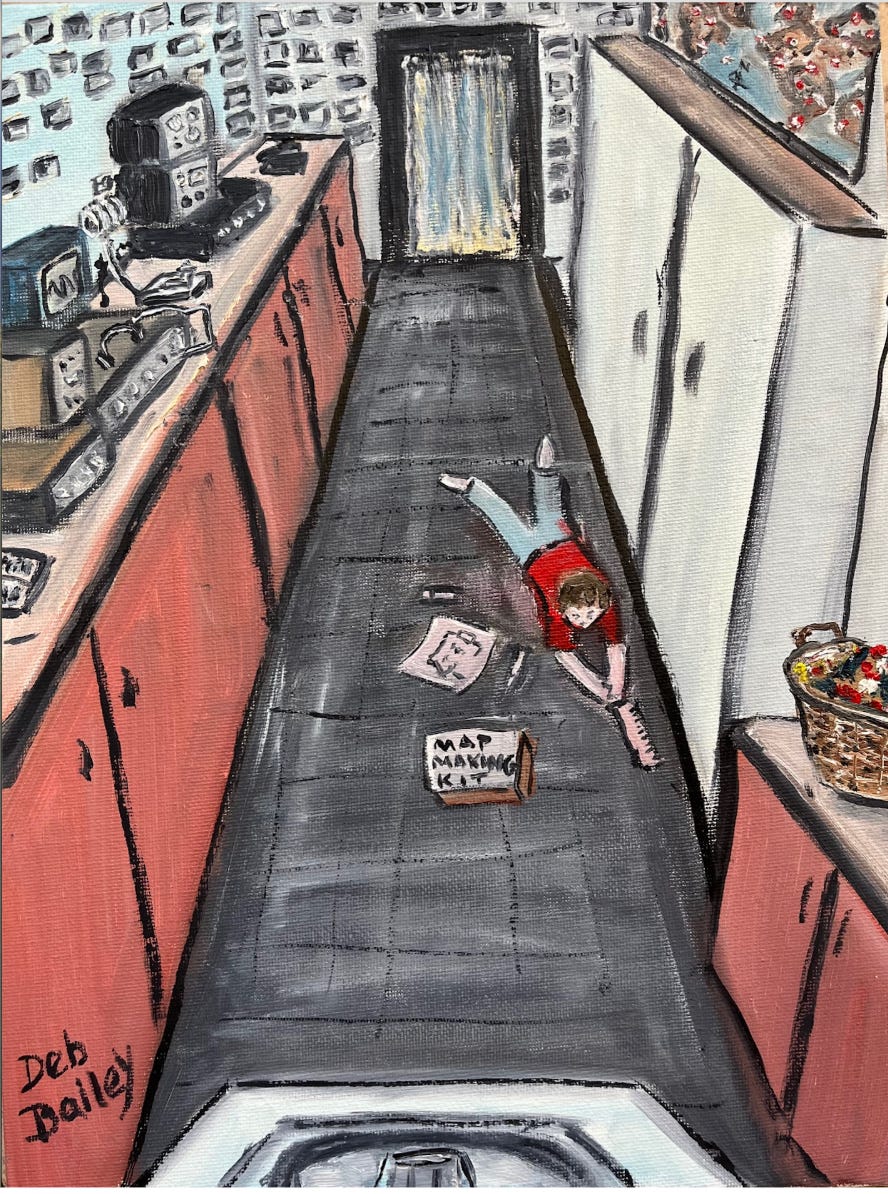
It was no accident or twist of fate that I started mapping our house in the radio room. He called it his radio “shack,” because apparently that’s what all ham radio operators called their “space.” And while the room had many things jammed into it, the REAL draw for me was that counter covered in radio receivers, transmitters, boosters, wires, coils, and that precious Morse code key.
I loved playing with Dad’s ham radios…when he was not home, of course. I would have been in trouble if he’d seen me flipping switches, spinning dials, and changing frequency settings.
One time, I went in there when I was really young, fascinated as always by the wall of black radios. The adventurer in me was overwhelmed with excitement at how these powerful things could bounce invisible radio waves, whatever those were, off the ionosphere, whatever that was, and depending on the frequency and time of day, those radio waves could reach people all over the world. I remembered that something magical changed in the ionosphere at night, so there were people he could talk to then, whom he couldn’t reach during the day.
When he was home using his radio equipment, I would rarely venture in there, though he was usually in a good mood then. I loved listening to the dit-dah-dah-dit sounds of him sending code, and the beeping from the US Bureau of Standards channel when they did their countdown to mark the exact time. But one time, while he was sending a code message on his key, I went in and reached up to touch this round metal coil — an induction coil — that was on the wall, and it burned my hand. Rather than get in trouble, I didn’t say a word, just pulled my hand back, slipped out of the room, and crossed the hall to the bathroom to run my hand under cold water. So, I usually stayed out of there when he was home.
But when he was at work? Oh, that was my time to dream. I would pretend to be flying a spaceship or on an adventure in the jungle, spinning the dials and tapping the code key. It was like a giant toy.
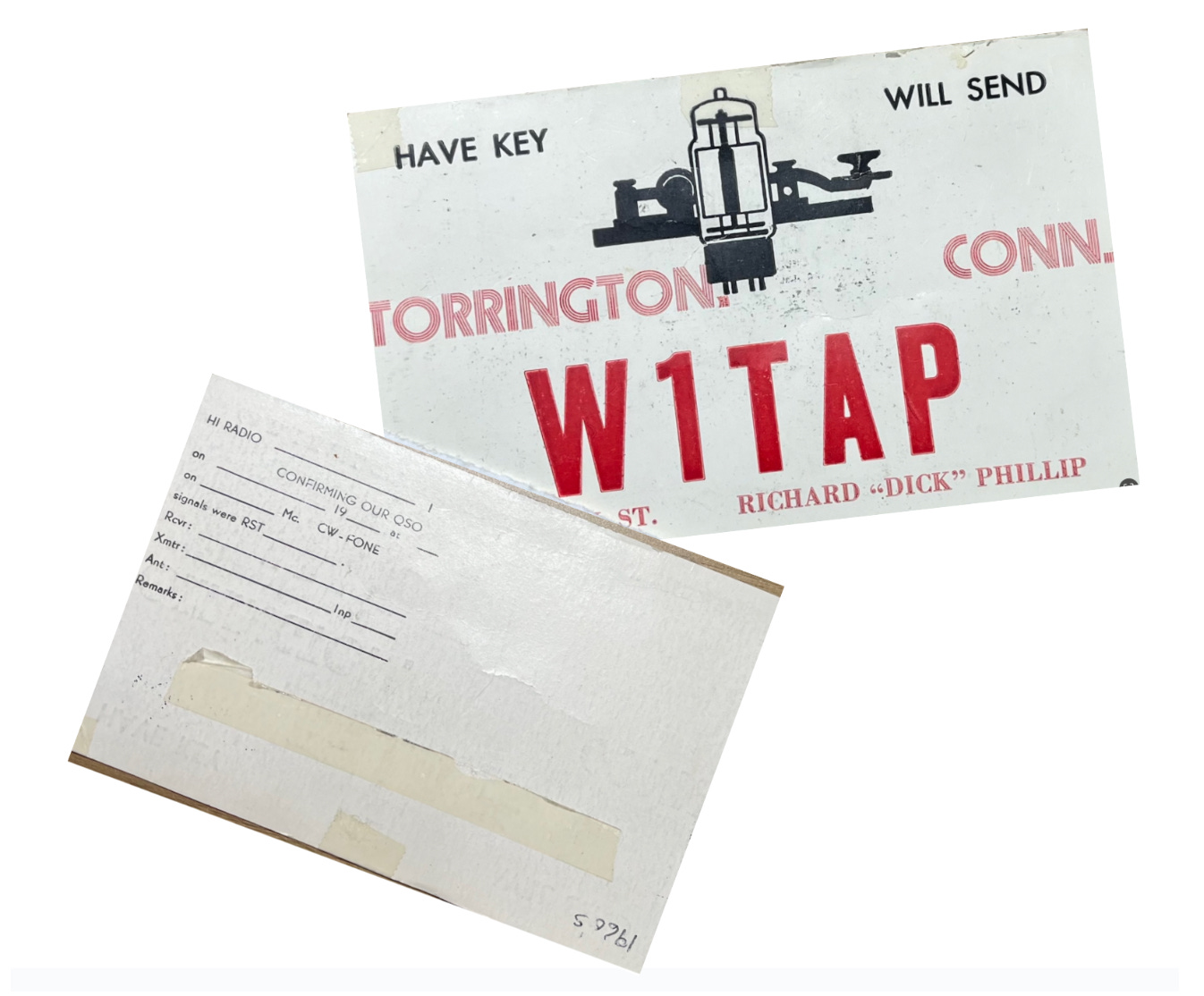
Two of the walls were covered with “QSL cards,” postcards from people he’d “talked to” in Morse code – a Ham radio operator’s way of being penpals with someone. Whenever he connected with another “Ham,” they would each send their postcard to the other to document their transmission. It would have the radio operator’s call sign, name, information, logo, and on the back, the frequency, time, and other notes about their conversation. The term QSL basically meant “I acknowledge receipt.”
Photo by author
The other thing that just fascinated the hell out of me was, of course, a map — the big world map taped up above the linen closet, across of his radios. Red stick pins were scattered all over the earth, each marking the location of someone he’d communicated with. It was a room that represented dreams of faraway worlds, exotic peoples, and adventure, all achieved through the magical, invisible force of radio waves.
The room also apparently spoke to the artist side of me. One particular day when he was at work, I went in there, as usual. Awed by the expanse of black radios, and armed with a white crayon, I was moved to create. For the next several minutes I scribbled all over that vast expanse of black. It was like an empty canvas calling to be filled. When I finished, I stepped back to admire my work and suddenly, that rational side of my brain freaked out. Realizing what would happen if Dad came home and saw white crayon all over his radios, I began to panic and cry.
My Mother walked in, surveyed the situation, and asked me why I had done that. My response was instantaneous and filled with the desperate realization that my survival was in her hands.
“I don’t know how it happened!”
She arched her eyebrows. “You don’t know how it happened?”
“No! But it will never happen again!”
I recall a smile and an acknowledgment of my “promise,” and she sent me off to play in another room. Later that day, the black radios were back to normal. I never did draw on them again, but the radios – they held a power over me that has never been broken.
I remember that Dad wanted us to get our ham licenses. He would teach us Morse code and test us on it over summer vacations. Because I found it so fascinating, I wished I had been able to get my license. But electronics were not my strength. I was about playing with the radios in my dreamer world and making up stories for myself, than of actually getting the license. I was never going to be an engineer. Case in point, years later, on a whim, I bought myself a model train set and promptly wired it wrong so that only half the track worked at a time.
But the radios served their purpose, though. His attitude told us that we could actually do something like this. It was a confusing message in one way. He expected us to be something. He would constantly tell us, “Don’t grow up to be a stupid woman.” While he instilled in us that we could do anything and we should, it was a horrible message. But at the same time, it all had to meet his criteria and rules and control, since he ruled the household and made clear what you could and could not do.
At that age I took it to mean that there were smart women out there– women who did well in school, got good jobs, did things, and then there were the “other women” and they were stupid. So HIS daughters were not to grow up and be that.
I look back and question if that was really about us and for our benefit…or so he could proudly show off his “smart daughters.” I also wondered – what did my Mom feel about that statement? His mantra. After all…she hadn’t gone to school, she didn’t work, she didn’t “do things” that his “smart women did.” Was she a “stupid woman?”
But at that time in my life, aside from his indoctrination, it was that room that fired me with a desire for adventure, a vast curiosity about the world, and a sense of possibility for my future. I didn’t want to be a wife or mother; I wanted to be out there, having adventures.
From a very young age I had spotted that it was the world of men that had all the fun and the power. Women cooked, sewed, and cleaned. Men had “careers.” They were scientists, explorers, makers of action. My father’s stories, and this room, with the QSL cards all over the walls, were proof. Even when I played house with the neighborhood kids, I would be the Dad because I knew men ran the show.
Even at that age, I knew I didn’t want to be the one worrying about whether supper was ready. I wanted to be the one coming home to supper. I wasn’t sure what I would be or how I would get there — all those “in-between” details I had no concept of then — but I would be “something and not stupid”….and the world with all the space flights and TV travel specials, the exotic places out there I was learning about and all the things there were to learn about, I fell in love with that.
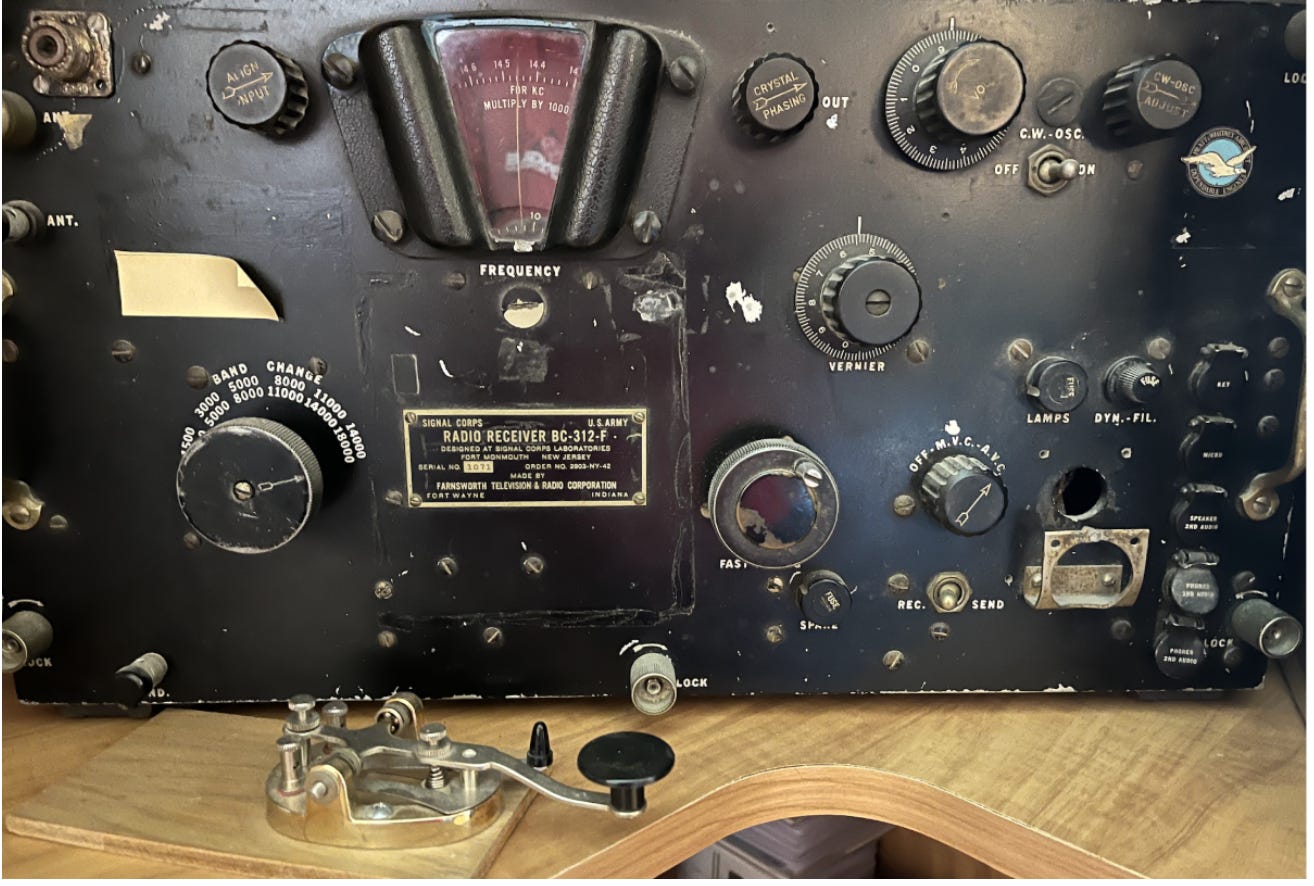
Over the years, Dad would eventually replace the radios with newer transmitters and receivers. But somehow, one of those old black ones — a World War II Army tank radio — survived and made its way into my hands, along with that Morse code key. They have a place of honor now, in my living room.
Photo by author
My husband asked me one time why I kept it, why I kept something of Dad’s, knowing how bad many of the memories were. Without hesitation, I said I didn’t keep it to remember him. I kept it to remember her — that younger version of me.
That old tank radio is a talisman. Magical. Every time I touch one of those dials or press the key, I am directly connected to her — my young inner child playing and dreaming in that radio room — and I can still feel a sense of joy just putting my fingers on those switches. That radio was my talisman filled with hope and power, a portal that could transport me to a better future where I could reach for the magic in the world — whether it was radio waves bouncing off ionospheres or the dreams in my heart that said anything might be possible…someday.
A “talisman” is often defined as a magical object that brings luck or special powers to its owner.
If it is not obvious by now, maps, mind maps, charts are talismans for me. Being a visual person, these tools empower me to bring order to my life. It is how my brain works. Whether it’s a road atlas, a treasure map, or a topographic map, I love them all. Give me a map and I can do anything.
Maps give you knowledge, and thus, power. They show you everything that exists, where it is, how to get there. Maps make the unknown visible, clear, quantifiable, and possible. With a map…a plan, you can get anywhere you want.
So maps would become one of the key tools in my life, both for my journeys and my understanding. When I discovered “mind maps” I became a power user. Just a sheet of paper and some markers let me plan my life, a project, or my writing. And it all started with one Christmas when I was very young.
“David Foster Wallace’s ‘This Is Water’ speech uses the metaphor of fish and water to highlight how the most fundamental aspects of our existence often go unnoticed. In the story, two young fish swim past an older fish who greets them with, ‘Morning, boys. How’s the water?’ After a while, one of the young fish turns to the other and asks, ‘What the heck is water?’ This illustrates how the most pervasive elements of our lives can become so familiar that they become invisible to us.
Many things go into forming a person, especially if the programming starts right from birth. As I tried to find the “entry point” to tell my story, I was overwhelmed by all the things I needed to weave into the narrative.
So, I resorted to what I always do when confronted with too much information: I throw everything I can think of onto a large sheet of paper to see it all at once. That way, I can then notice if there are key pieces that stand out — relationships, patterns, repeating elements.
In my true scientist way, I made a list of all the different influences over my young life:
 Soul Mosaic