Imagine a school that actually had a crest with a motto… in LATIN no less!
Quod Facis Bene Fac…What You Do, Do Well
I noticed that as the first thing when I got the school handbook. And I was in awe. What a message to give….What you do, do well. I fully intended to do just that.
Oh, the possibilities!
AND then there was the fact that there was an actual handbook! Torrington High School had an actual school student HANDBOOK. It spelled out the rules of academic achievement. It listed the MANY teachers, by subject. Their degrees. The universities they attended. I read each one. These were not just “teachers.” They were scholars…accomplished people. The portals to all that wisdom I wanted.
And courses. So MANY courses listed by subject. So many subjects. And MULTIPLE choices for courses in each subject.
Imagine you didn’t just take “English.” It could be College English. And it wasn’t grammar. You studied LITERATURE! Like that book the nun gave me. And you wrote term papers!
You could read about the Greeks. Shakespeare. British and American Literature. Poetry! And in your senior year, you could have electives like Creative Writing. Introduction to Film. Mythology and Bible Studies.
You didn’t just study “History.” You took World Civilization. American History. Political seminars. And it wasn’t just hand-waving for science, but Chemistry, Biology, and Earth Science. And languages – Latin, German, French, Italian, Spanish…. I was beyond excited. I hadn’t even started the school year yet, but I had already mapped out all four of my years to take everything that sounded interesting. And all of it did.
This felt like such a big new world. Like maybe a future was possible yet with this knowledge…and certainly, Dad wouldn’t keep doing “things” to me that much longer. I would grow up, and he would have to stop, right?
The summer before my last year in Catholic elementary school, one of the sisters gave me this book she had used for her graduate college literature course. She was done with it and was cleaning out her desk. Knowing I liked stories, she passed it on to me.
It was magical…like nothing I’d ever seen before. I was in awe. Who knew there were these large, soft-bound books that held entire collections of LITERATURE? Who knew you could have a class in college entirely focused on that? Up until that point, English classes were always about grammar and writing topic paragraphs. And reading was from my books purchased through the book club.
Sure, we’d had “readers” in the younger grades – hard-bound books with stories of kids on adventures throughout history. But this? This was a real, honest-to-goodness, classic LITERATURE collection. I spent the whole summer reading that book.
There were all kinds of authors and stories I’d never heard of, including somebody named John Updike with a story about the A&P, which I mistakenly assumed was about the real grocery store chain. The stories were, in a lot of ways, above my head. But I sensed deeply that these were stories to aspire to. Latch on to. Dissect. There was the mystique of hidden wisdom in them. And even if it took a lifetime, I was going to understand that wisdom!
The story that made a lifetime of impact on me from that book was a story I didn’t really like…didn’t understand…found somewhat upsetting. And yet over my entire life, including now, I cannot let go of that story. I have read every word of it again and again, trying to understand not so much the story, but why I can’t let it go.
It was by Flannery O’Connor, a heavily Catholic, Southern author whose religious beliefs put me off. Yet, her story, “A Good Man is Hard to Find,” sunk its nails into me that summer of my 8th grade year, and has never let go.
It had a character in it named the Misfit, who was a killer, and a family on a summer vacation trip who took a very wrong turn due to the grandmother’s interference. As a character, I would describe her as hypocritical, hollow, self-centered, and willing to manipulate anyone to suit her ends. I didn’t like her, and I couldn’t help but think of my father as I read the story. At the end of the story, the Misfit kills her, even as she seems to have a last-minute epiphany about how she should have lived.
But it was his chilling last line assessment of her that has followed me through my life: “She would of been a good woman,” The Misfit said, “If it had been somebody there to shoot her every minute of her life.”
Before I continue with the rest of the story, I take a moment to note where I’m at in it. The preceding entries showed all the various influences on me from birth. And the rules I lived by that I took as normal life.
At this point, I was 14 years into that abuse. And I had no idea I was only halfway to an escape.
For all intents and purposes, I was controlled and didn’t realize it. I was manipulated and unaware. I was aware of my stress level whenever I crossed Dad. Aware of my relief and gratitude when he was kind and loving. And I was most aware that if he got upset, I blamed me.
I took it all in as any child would, and believed him. Why wouldn’t I? I had no idea that this was wrong. I had no role modeling that this was, in fact, truly aberrant behavior for a family. True, it felt wrong at times, but I assumed that was my mistaken judgment.
Painting by author
The trapped fly
If you’ve ever watched a spider wrapping a fly caught in its web, you might think of the spider as a vicious killer. But the spider isn’t breaking any laws. Nothing is calculated or premeditated. It’s just following the biology of its life cycle. Like all of us, the spider has to eat. And it responds to the thrashing of a fly trapped in its web out of instinct only. At least so far, science research hasn’t shown that the spider is finding pleasure in its actions.
In fact, given the process it uses, a spider could even be considered “humane.” It reacts quickly and efficiently. And with one exception, most spider species administer a venom into the trapped fly that not only immediately paralyzes it, but leaves it unaware of what is being done to it. It will then either digest the fly and eat it right then, or set it aside for a later meal. But the fly is mercifully unaware of anything. It doesn’t experience pain at that point, nor does it feel any apprehension of what might be in store for it.
The spider is just living by its life rules, and so is the fly. And to that end, there is no guile or treachery.
3. operating or proceeding in an inconspicuous or seemingly harmless way but actually with grave effect.
Insidious. Just the sound of the word makes my skin crawl. When I say it and feel the tactile sensations of the syllables as my mouth muscles form them and they roll off my tongue, I feel afraid. Listening to the word as I slowly enunciate each letter, it conjures sensations of evil. And that’s because it is.
It is something deliberate. Calculated. And executed before you even know what is being done to you. It is done so subtly and slowly that by the time you realize it, you’re in too deep. It’s too late. And all you can do is wonder if you were to blame because you didn’t see something coming, and feel stupid.
If ever there was a word that captured how he wove his web of control over me, “insidious” is it. He started on me from infancy. I will talk later about how I know that. But I was groomed, manipulated, and played like a puppet for years using the strings of his power, intermittent reinforcement of love, abuse, and brainwashing.
Like the fly, I was rendered helpless, and it all happened before I even knew what was being done to me. But unlike the fly, which was put out of its misery quickly and whose misery was just part of a natural cycle, I was NOT unaware of the sensations of apprehension, fear, and pain. It was definitely NOT part of a NATURAL cycle. And unlike the spider who was just following the rules of its species in a straightforward way, my father was most definitely choosing to break his in a calculating and stealthy manner. Nature…the spider… is actually merciful. My father was not.
Just a short update today, as I am working on the next posts.
This becomes the turning point for this section, “The Old Country.” It is the halfway mark of 28 years of constant, frequent, intense abuse…though I had no way to know that then.
But the upcoming entries will enter whole new phases of my life – teens, college, young adulthood, and the impending crisis. So, the nature of the posts, pacing, and complexity of the events will change.
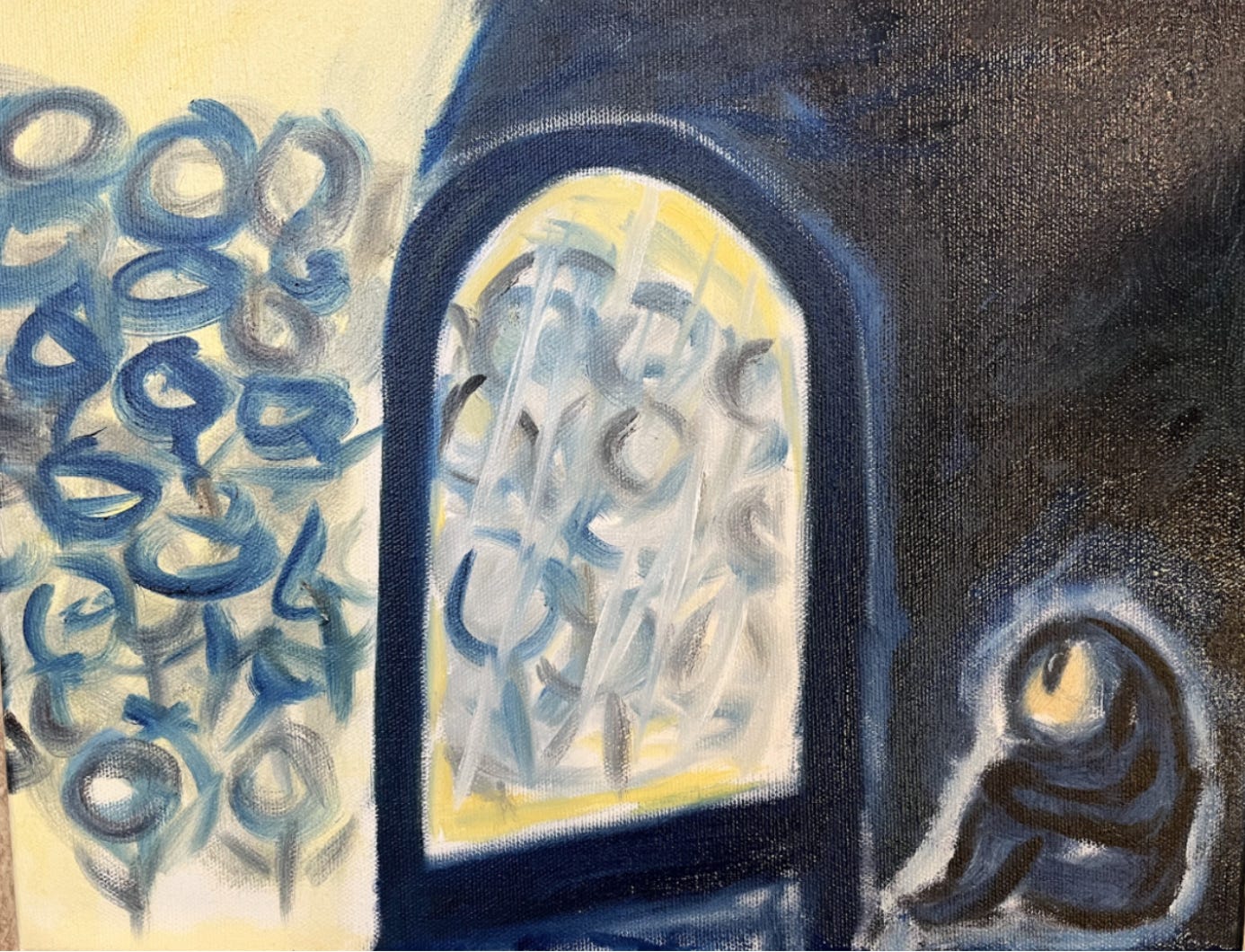
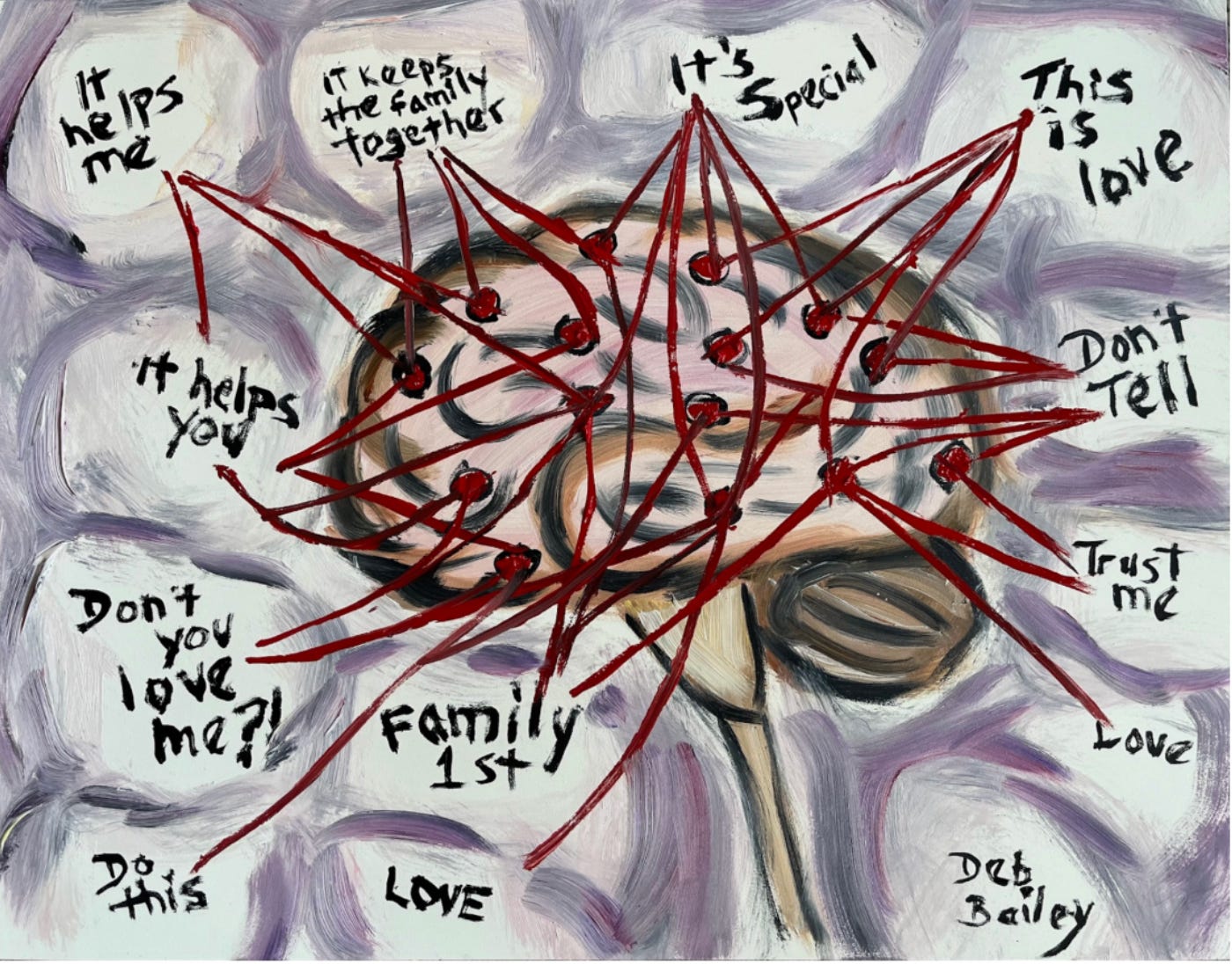
For a preview, here are the paintings for the next two posts. Please stay tuned….
Insidious…..Learned Helplessness and Behavioral Control
Up to this point, I have shared all the various influences that shaped who I was. From my own personality, my town, its culture, my parents, and our apartment, to the wider circle of grandparents, cousins, friends, school, and church, each was a thread of my world. Very soon, many aspects would be gone.
But before I move on to those next phases, I want to touch on one last “wider circle” influence in my life – family friends.
While the inner workings of our household were kept secret, my father did present that affable, easy-going, family man to the world. He was an usher at church and belonged to the Holy Name Society, a men’s group there. And my parents would go out to dinner occasionally, with a few of the couples who went to our church and whose kids were our friends.
In fact, occasionally on a Sunday after church, a group of us might head out for brunch. Sometimes it was to Hartford to the International House of Pancakes. Another time, it was an outing to Waterbury to have lunch at the new McDonald’s restaurant there. We didn’t have one in our town yet.
Expanding the circle
Somewhere during that time period, my parents and one of those couples decided to jointly buy 40 acres of land on a rural hilltop on the west side of Torrington. That was the land we all referred to as “The Lot,” a name even our dog knew and would get excited to hear because she loved to go there.
Putting aside the solitary trips there with my dad when he abused me, the place itself was beautiful woodland. The other couple would build their home there within a couple of years. For my father, it would take seven years before he had enough money to do that. But we would eventually be neighbors there with our houses right next to each other. Even though we were worlds apart
That land deal, though, was one of the better things to happen because it expanded our insular family just a bit. We went to school with, and were friends with their kids, and even our dogs were friends. I loved visiting with their mom and spent more than a few hours talking with her. I will refer to her from here on simply as “my neighbor.”
Cape Cod
About the same time that all of the breakfasts and the property purchase were going on, our family also did something we’d NEVER done before…or would ever again. We went on a weeklong vacation to Cape Cod with my neighbor and her family.
We went to a place called Dennisport, in an area on Cape Cod that faces south onto the Atlantic side of the Cape. Each family rented a house, and their grandmother even joined them. We’d spend time at the beach, time at the cottages playing games, going out for ice cream sodas at A&W Root Beer, and spending hours playing miniature golf. It was such a gift of a trip, not being restricted to just our family unit and subject to the vagaries of Dad’s moods.
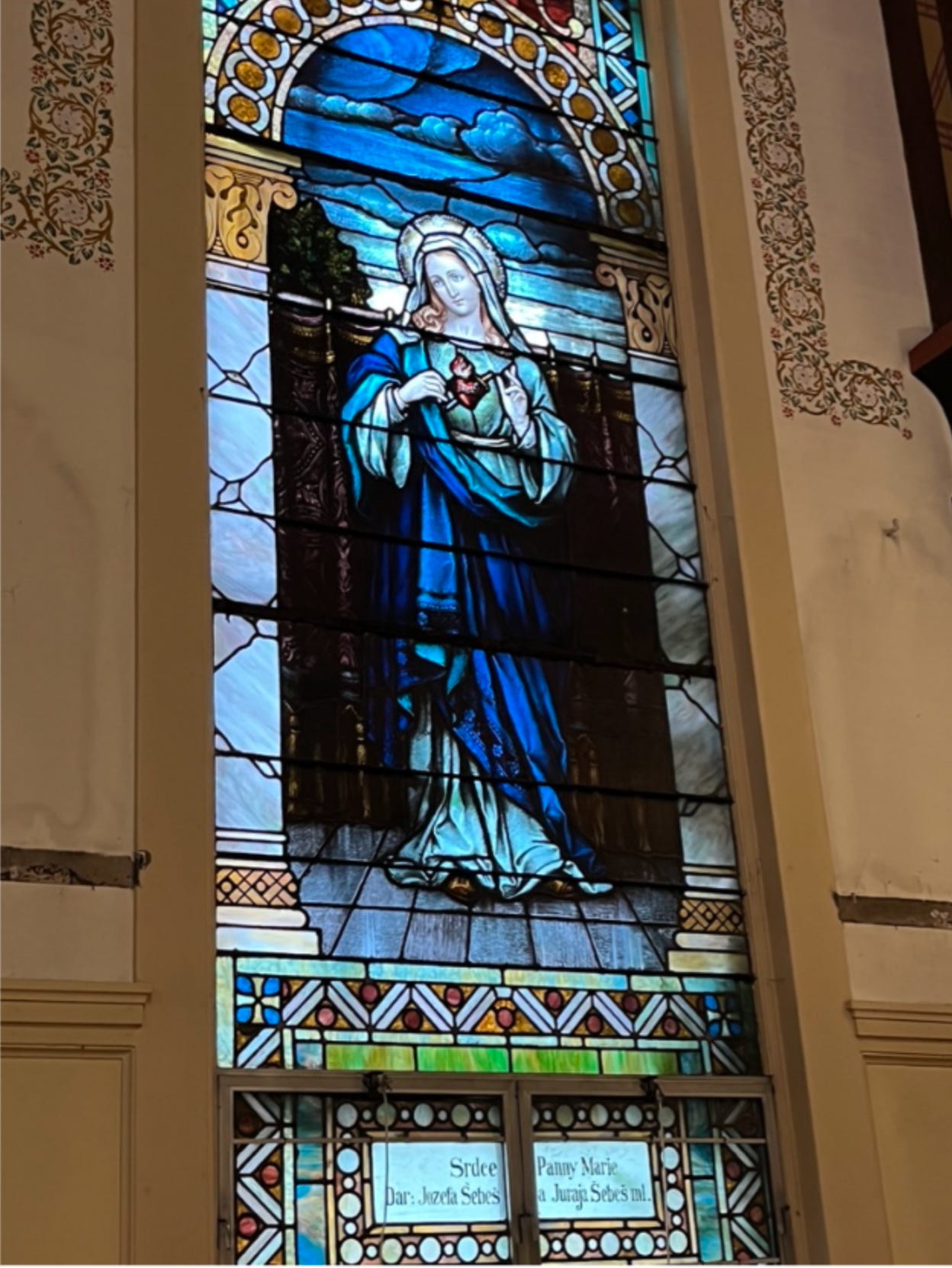
Mary…The Blessed Virgin….The BVM…The Lady in Blue…The Mother of God…The Black Madonna…Compassion Goddess…Great Earth Mother….Tara….Kwan Yin…
Regardless of the name, the embodiment of mothering, compassion, and love in some feminine form has shown up in all cultures and time periods. I will talk more later about my own journey to make my peace with a “spiritual mother” in my life. It was something I rejected for a good part of my adulthood, but I have since welcomed back, this time with a much broader understanding of things.
During my childhood, it was Mary, Mother of God, or the Blessed Virgin Mary. And as much as I loved God and prayed to Him, it was his mother that I really felt close to. He was scary. She was welcoming. Approachable. Kind. And never more so than on those Saturday afternoons after confession….
Photo by author
Once the ordeal of confession was over and I’d said the prayers for my penance, I’d wander around the church. Emotionally spent, but grateful to be in a total state of grace again, I wanted to remain in the peace of that church for as long as possible. I would have stayed there forever if I could have.
The first place I wandered, ALWAYS, was to the front of the church. My two favorite things were there — the votive candles and Mary’s statue. It was my favorite statue of the many in our church. She was tucked off to the right side of the front altar, kind of her own “grotto,” right next to the flickering votive candles.
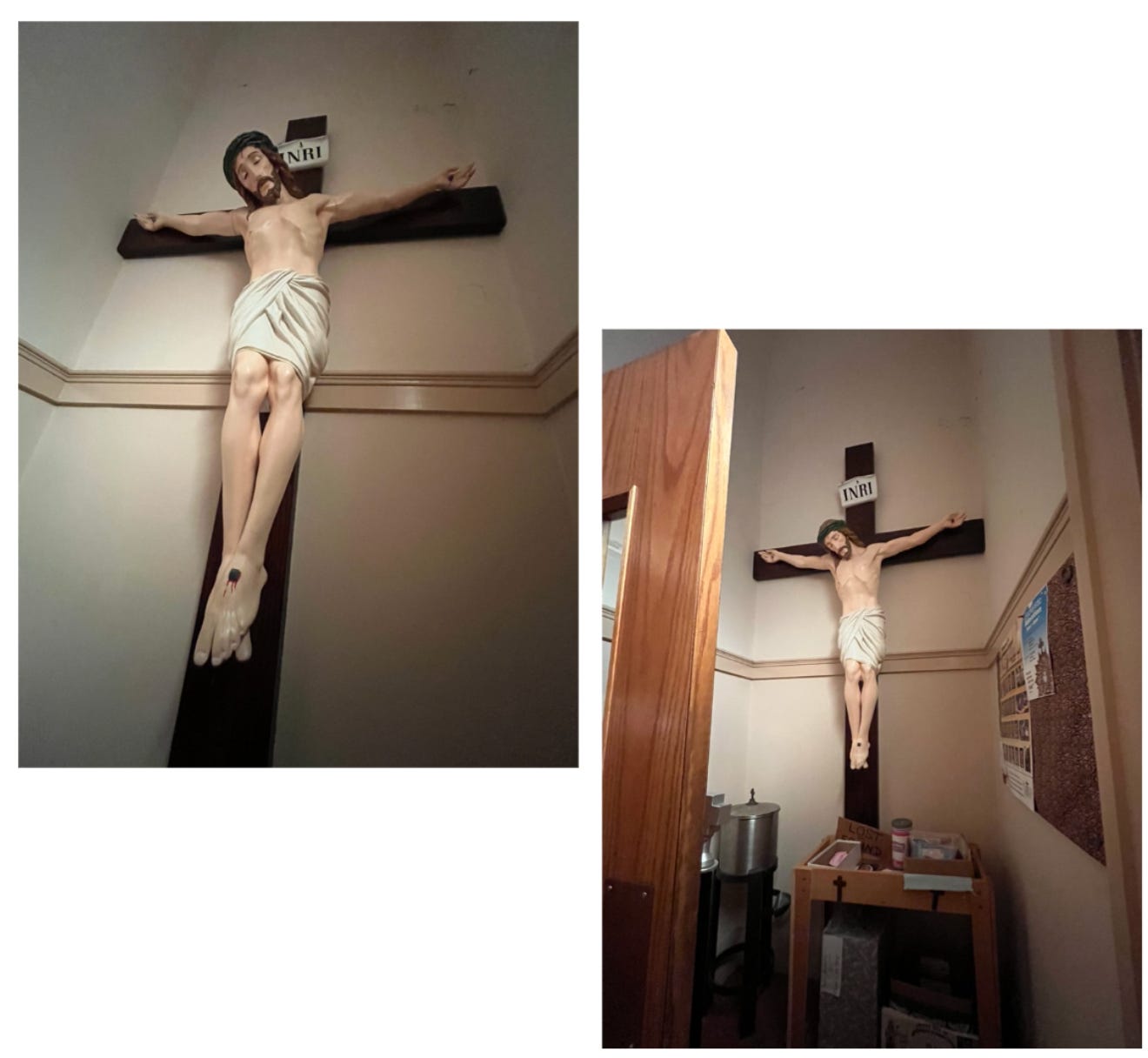
Every Saturday, He was there, waiting for me. The door would close behind me, wrapping me in the silence and darkness. And He would be there, waiting, watching, silent.
Guilty and scared, I would glance up at the life-sized crucifix in the vestibule, then look down. I couldn’t tell if I was being viewed with compassion, like He understood my “predicament,” or disappointment, because yet again, I failed Him.
Why couldn’t I have a dad who didn’t do these things? Why couldn’t I have a body that didn’t even have these kinds of feelings? It could be so easy to go to heaven if you could just focus on other things in life and never on “that.”
I looked over at the bookstand and wanted to see if there was anything new. But right now, I was too upset. After.
Photo by author
The agony of the choice
Before I’d even gotten here, I’d gone through the agony of the first decision: Do I even go to Confession today? And, if so, which church do I go to?”
The first time I walked into a therapist’s office, I was actually shaking. Terrified, consumed with shame, and coming apart at the seams, I could barely speak. In fact, when I told the therapist why I was there, I could only WHISPER the words because I was so afraid. For 28 years, I’d been brainwashed, guilted, and bullied into loyal silence by my father. And I understood that just by walking into that office, I was breaking EVERY ONE of those rules drilled into me for a lifetime. I expected unimaginable horrors to descend on me, though I couldn’t tell you what they would be. I was just convinced that this was going to result in something terrible. AND I would be inflicting hurt on my family, because of my “transgression in speaking.”
But I was hanging on by a thread, and was actually scared about how unglued I felt. I was caught between two “no-win” situations. I was damned and betraying my family if I spoke. And I was going down the tubes if I remained silent. I’d never felt this low or hopeless before. And God was of no use to me anymore.
For all those years, I’d believed in and prayed to God for help. Yet in the end, it seemed that I’d asked but not received. I’d had to get myself out of that house, alone. And that was the story of my life, past, present, and future – I was alone. So it was on me to save myself. God was out of the picture. And if my only choice left was to mentally “jump out of the plane,” so be it. Life would either provide a parachute or it would finish me.
Aside from school and my quiet morning Masses, my religion had other ways that it was a very strong influence over who I was and how I dealt with what was happening. I can’t speak for how things operate in the Catholic Church today. I have long since left. So what I share here about Catholicism is from what I grew up with and how it affected me, personally, for better or worse. Thus, I speak only about my own experiences, and no disrespect to anyone else’s.
What is Normal?
To a child, whatever they are living in is “normal.” A child has no other experience or way to assess that what they are living in is beyond the pale, or “abusive.” They only know what is reflected back at them from those around them.
For me, that was from the rules of my culture, my religion, my household, the ethics and examples of the adults around me….all the things I have been sharing. And that would have been IN ADDITION TO the constant repetition of brainwashing messages I got at home from Dad. So if all of those influences reflect back to me that this is just normal life, that is what I accepted.
The only other reference point a child has is their own sense, intuitively, of what feels right or wrong, good or bad to them. Their own compass that just comes from within. My own nature was gentle, even as it was competitive. I loved deeply. I was loyal and had a strong code of honor. And I was very sensitive to not hurting anyone’s feelings, especially the people close to me.
I also seemed to have an ingrained sense of morality, and an intense awareness of church teachings and of what was sinful…which meant what was hurting God.
So it was a source of conflict to me to hear Dad’s messages that what we were doing was okay, versus feeling in my gut that it wasn’t right. Then add in what I learned in religion class and in church. And to me, it seemed like what we were doing was a sin, and so I must be hurting God. These were no small conflicts for a child to feel, much less resolve. And it would only get worse with time.
What were those church teachings and influences? I split them into two categories, the first of which I’ll talk about in this essay – the stories that taught a way to live. The second, the rules and rituals the Church laid out, I’ll speak of in the next essay.
As strange as it sounds, I LOVED the weekday Masses we had to attend before school. It was just me, and God, and a safe space…
Photo and painting by author
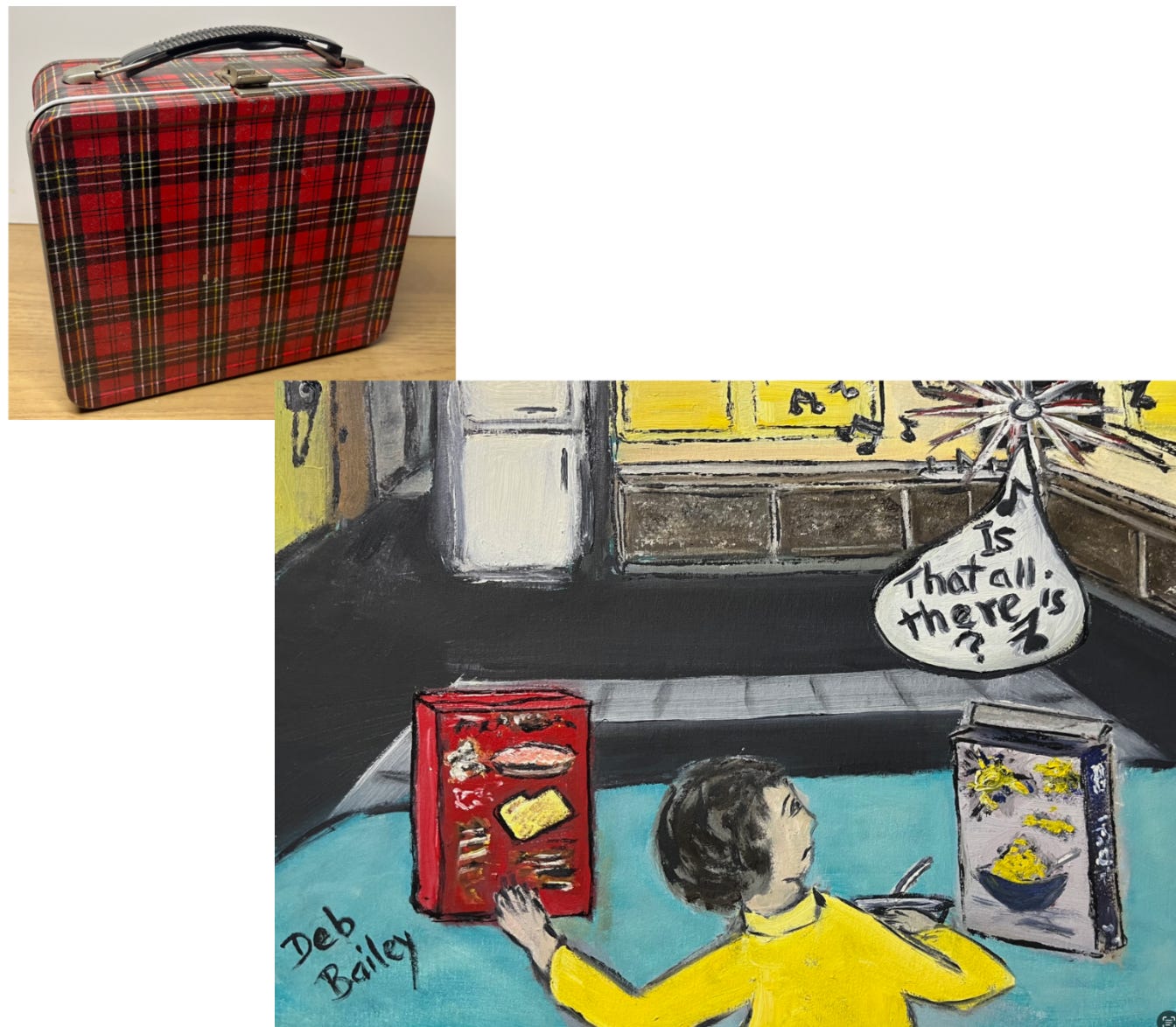
School days started early. When I was first able to receive Communion with Mass at the end of second grade, the rule required that we fast for 3 hours prior to Communion. So I would just dress, grab my red-checkered metal lunch box, and go to church. My mother had packed not just lunch, but some buttered toast with cinnamon and sugar – my favorite. After Mass, the Sisters would give us time to eat breakfast. That rule changed soon after to a 1-hour fast, so I would eat breakfast before leaving in the morning.
Dad would’ve already gone to work, or he would be asleep, so that part of the process was peaceful enough. I’d munch on cereal while the local AM radio station played in the background.
At that time, one of the popular songs was Peggy Lee’s, “Is That All There Is?” I’d listen to her lament over and over, “Is that all there is?” about everything from a circus, to love, to her house burning down. No matter what happened in the song, all she would say was, “Is that all there is?” And then suggest breaking out the booze and keep dancing. I wasn’t sure what the point of the song was or why anyone bothered to write it. Mornings were hard enough without that energy.
Instead, I’d focus on the back of the Ritz cracker box, reading the recipe for “Mock Apple pie” as I ate. Apparently, using their crackers and some spices instead of apples, you could make a pie that tasted like the real thing. While I thought it was neat that you could do that, I wondered why anyone would want to make or eat a fake apple pie. Years later, I learned that during the Depression, apples were expensive and scarce. So this was a way to substitute crackers and still have a dessert. Anyway, done with cereal and Mock Apple pie, and not thinking about if that was all there was, I got dressed and headed to school, and morning Mass.
Photo by author
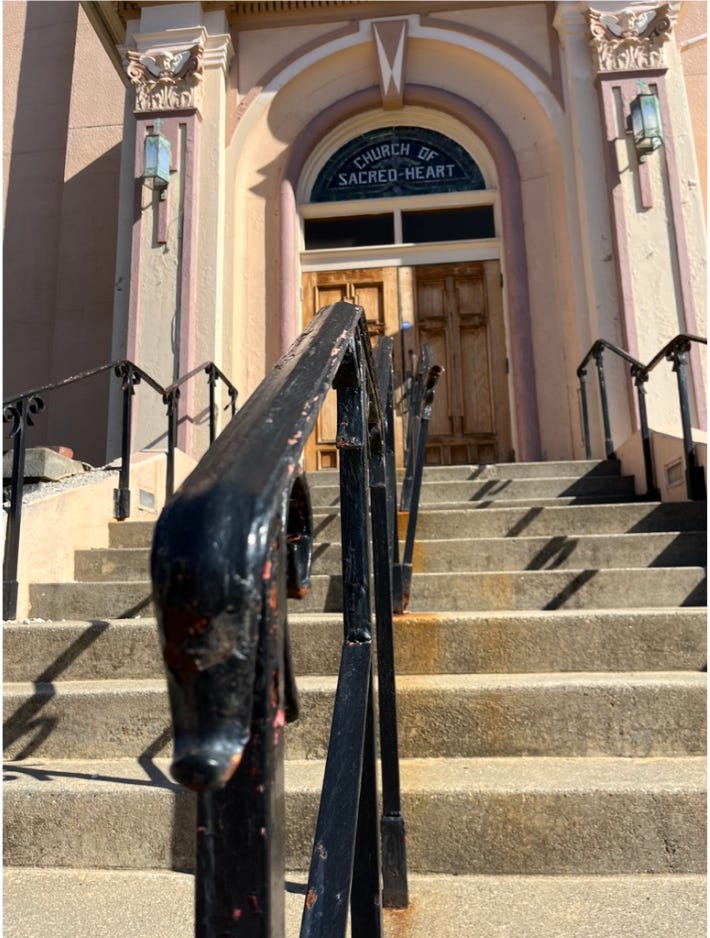
At church, I’d run to the top of the concrete stairs, yank open the heavy wooden door, and slip quietly inside the vestibule area. The moment the door shut, it felt like I’d entered another world — still, dark, and quiet. It seemed like the air itself didn’t move. Sometimes I would stand there for a couple of minutes before entering the church, just to “soak up” the holy feeling. It was so peaceful, and I loved it.

 Soul Mosaic