Painting “me”
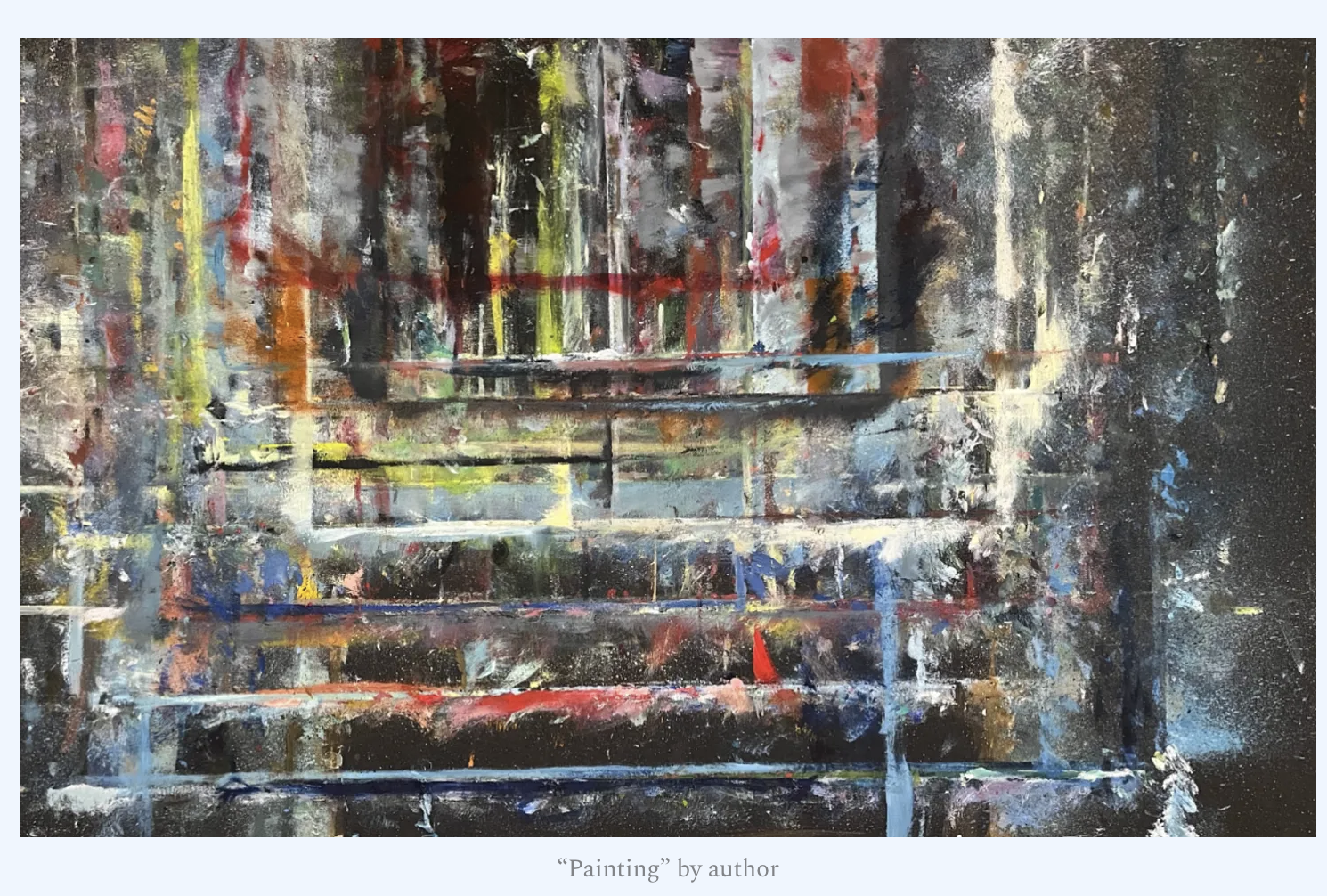
Recently, I pulled this painted-up black piece of cardboard off my easel so I could place a new, clean one there. I use these backboards to catch excess paint when I am painting around the sides and bottom of the canvases. It keeps paint from getting all over the place.
As I pulled the board off the easel, my husband stopped me from throwing it away.
I know he has always honored my painting efforts and loves what I paint. And he says he loves watching me paint because when I am engaged in my art, I am in a totally different place emotionally.
So I appreciated his support of my work. But I had to ask him, “Why do you want this backboard?”
He was quiet for a moment, then said, “Of anything you’ve created, THIS one is most ‘you.’ It bears the paint of every single piece of artwork you’ve done, either for the book or to relax with. And so I want it. I don’t care about any of the other paintings. This one I am going to frame and keep.”
You never know how a piece of “art” will touch the soul of another.
To be the pipe
The same is true of this book. As much as I needed to do it to help me, I felt like this book was also the answer to my lifelong question: “Because of what happened, what do I do with it?” It was about something much bigger than just me.
I want to help others who may be in pain. I view this whole writing effort not only as a healing work for me, but as something the Universe was asking me to do for whoever out there needed it.
I like to think of it as if I am the “water pipe.” People need water to live. Without it, they won’t make it. But how do you get water from a lake to their homes? Pipes. Now, the pipe is important, yes, but only in the sense that the pipe makes it possible for the people to get what they need. If all they have is an empty pipe, that’s useless. Ultimately, it is the water that is key to their survival.
In the same manner, the Universe, God, whatever name you give to that force, has healing energy to give if we want it. But God isn’t here on earth. To send what a person may be asking for, God needs one of us to be willing to be the “pipe” – the conduit to pass on that gift. If we are open to that, the gift can come from beyond us, through us, to whoever needs it. So, I see this work as not just for me, but for anyone who needs it. For anyone it speaks to.
My husband noted that the artist, Bob Ross, may not have been Rembrandt, but because he let his joy and soul come through his work, he touched the hearts of so many others and gave them a gift.
So as I paint and write, I remember that, as well as author Marion Roach Smith’s words: “Memoir is not about you. It’s about something, and you are its illustration.”
Rescued from the desert island
Another thing the painting did was allow me to rescue myself. By putting all the memories down on canvas, recording them to be seen in the light of day by all and not forgotten to obscurity, I finally gave peace to my younger selves.
Those earlier parts of myself felt rejected and abandoned my whole life because I HAD abandoned them. I blocked them out and shut off any connection to their pain. So, by this point, they were convinced no one would ever come back for them.
My inner infant and toddler — those pre-verbal parts of me — had no words to tell what he did to me. They only had sensations trapped in my nervous system — emotions, such as terror, confusion, and abandonment, body sensations, such as vague aches, tension, and anxiety, and…nightmares. I will address nightmares in future posts.
But because those early parts of me had no words or clear memories to share, they could only speak to me using depression, sorrow, and fear. And hopelessness.
“‘Chaos’ is a word that many trauma survivors use to describe their past….The brain, undergoing trauma, struggles to create cohesive narratives….You’re often left with sensory snapshots as sensations, sounds, and images. These reside in your unconscious, connected to very strong emotions but without a clear narrative.”
Susan Madsamen and Ivy Ross, Your Brain on Art: How the Arts Transform Us (69)
For so long, my younger selves held all these emotions and had waited for me to come back for them, to see and hear them, heal them. But, for most of my life, I’d walled them out. Abandoned them.
Self-abandonment creates tremendous pain within. Imagine taking a toddler on a family outing to an amusement park, then leaving them behind, all alone. They would be terrified and inconsolable until their family came back to rescue them. They are too small to understand, and so all they have is terror. Our younger parts are no different. And mine, abandoned in the back alleys of my brain and despairing that I would ever rescue them, could only communicate with hurt, anxiety, and emotional and bodily pain.
But then, I gave them the tool of paint. Finally, they had a vehicle they could use to speak with me. To clearly depict the agony within. That long-buried pain could cry out and shed its hurt. And the full impact of all that abuse could be made visible, not minimized. The trouble with most abuse is that its “bruises and wounds” are often invisible. For sure to others. And sometimes…to ourselves. Painting made those wounds real.
So as I painted, I saw and “heard my younger selves.” And finally, those infant parts could feel cared for, and they could relax.
Even my older selves, who remembered what had been done to me, felt the same relief at my return. For decades, they had been standing guard, waiting for me to return for “all of them.” And constantly calling out with flashbacks and intrusive memories. Until I returned, they would not…could not rest or give me any peace.
So painting heals the wounds of self-abandonment, which is the first step on the journey to reclaiming self-worth.
When you paint what you feel, missed, or denied, and SEE what you lived through, THAT is the moment when self-hate starts to melt into compassion and self-love.
Stop the video loop
Another gift is to free up space in my head and stop the video loop running in my brain. By giving the memories concrete existence on canvas, they are recorded for real, just like photographs. They won’t be forgotten, but they don’t have to be on display 24/7.
It was a relief that I no longer had to remember them or carry them in my head anymore. And make no mistake, they can’t and shouldn’t be forgotten. I needed them to be remembered and honored for what I lived through. They just don’t need to be present in my head, haunting me all the time.
Also, by freeing up that headspace, I could use it for healing work, such as making sense of my life, understanding what it did to me, finding insights, and then cultivating peace and healing.
Slow it down
The act of painting those memories and emotions also allowed other parts of my brain to come online and contribute to the healing. Because I had to take extra time to sketch, paint, let the image dry, and then ponder if it rang true, it slowed the whole process down. Slowing down allowed time for self-reflection. Research. Thinking. Without those, I would have had no gifts of wisdom to learn with. Only images of trauma. Wisdom…takes its time.
Staying alive
And finally, by the act of creating art, we have a chance to stay alive. The New York Times did an article about Brian Stonehouse, a British spy in World War II who was captured and landed in five different concentration camps, the last being Dachau.
When the camp was liberated by American troops, he started sketching the very next day, committing all the horrors he had witnessed onto paper with charcoal. During his imprisonment, he himself had endured months of interrogations, long periods of solitary confinement, and then the death camps. He saw the bodies, the gas chambers, mortuaries, and crematoriums, and secretly sketched them at night.
Tom Edwards, the owner and managing director of the Abbott and Holder gallery, noted, “Drawing was a pretty important part of his whole survival…It was very much a functional thing that helped him stay sane and stay alive.”
Psychiatrist James Gordon, a researcher at the National Institute of Mental Health for years, has worked with many individuals who survived the horrors of earthquakes or wars. Gordon shared that a common misconception about trauma is that it is impossible to recover from. Instead, he noted that “…we can learn from it, heal from it, and move through it.”
To that end, he has found “drawing to be one of the simplest, most reliable ways to access traumatic images and to move through and beyond fear to process what has happened….drawing helps to stimulate the verbal processing regions of the brain, supporting cognitive processing….Drawing activates multiple regions in the brain that force our brain to process information in new ways while inspiring us to imagine and create new images in the brain.”
Susan Magsamen and Ivy Ross, Your Brain on Art: How the Arts Transform Us
Beyond staying alive
If I could only pick one word to describe what comes after just staying alive, it is “transformation.” I will talk about this word in an upcoming post. But for now, I leave it here along with this one last quote about the power of art in our healing:
“The creation of art enacts release and transformation….Art is not about being. It is about becoming.”
Jen Cross, Writing Ourselves Whole
Becoming… that is the story captured in the remainder of this book.
Note:
I am seeking financial support to complete my memoir, work with an editor, and make a visit to my home state for fact-checking. Your help would mean the world to me as I take this step toward healing and giving voice to my journey.
Please like, comment, and share this post to help spread the word. The link for my fundraiser is on GoFundMe. Thank you for your support.
 Soul Mosaic
Leave a comment