“Your body is the place where heaven and earth meet.”
God in Your Body: Kabbalah, Mindfulness and Embodied Spiritual Practice, Jay Michaelson
For most of my life, my body was not a meeting place with the Universe but a despised battleground. I hated it. It had betrayed me by yielding to pleasure when he abused me. Failed me by fearing him and freezing up.
It had been his tool for his own gratification, so I loathed what he craved. And he had drilled into us that taking time for self-care was a waste of time. Whenever I got sick, right after I threw up, he would tell me to eat so I could hurry up and get better. Bottom line – the body was something to suck dry and make demands on, not take care of.
So for years I just worked it to death, gave it no quarter, and took from it. It didn’t deserve any better in my estimation. I refused to exercise or give it proper ease and care. I demanded that it deliver, be strong, and be there whenever I placed a demand on it. And I showed it no compassion or gentleness.
News flash: In case it isn’t obvious, that attitude has not served me well. I don’t recommend it.
Second news flash: True healing is not just emotional work. It’s body healing, too.
Because so much of the trauma is stored in the body tissues and nervous system, somatic, or body healing, is essential. Psychiatrist Dr. Bessel van der Kolk, who wrote the book The Body Keeps the Score, describes trauma and its connection to our bodies:
“Trauma is not what happens to you, but what happens inside you as a result of what happens to you.”
And regarding how to heal from trauma, he added: “The body keeps the score: If the memory of trauma is encoded in our senses, muscle tension, and in anxiety, then the body must also be involved in the healing process….Once you start approaching your body with curiosity rather than with fear, everything shifts.”
Cracking the resistance to self-care
But before I could work on caring for my body, my mind and heart needed to be on board, because they were subverting the efforts. If a person thinks something’s worthless or doesn’t deserve doing, they will find every reason to avoid it. I lived like that for years. It is only in these last few years, after a LOT of therapy, EMDR, and Yoga work, that I finally believed my body both needed to be cared for and DESERVED it.
I was so focused on left-brained, cerebral approaches, which are necessary. And yes, I spoke at the beginning of these “Tools” posts about the need for “attitude” – determination, tenacity, etc. But those things alone still left a large part of the wound untreated. There is an underlying foundation for healing that goes deeper than the brain or personal attitudes.
Even as I read more about how the body stored the pain of my abuse, and even as I cognitively started to accept that truth, some internal part of me resisted loving my body.
To do this, I needed to open my heart to my body and truly care that it was crying out for love. I had to change my “soul.” To go within and confront my inner beliefs. While EMDR was vital in this and I’ll share more about that soon, I still needed “soul work.” To change my inner beliefs, I had to have something nurturing and nourishing to replace the old, harsh ones.
What do I feed my soul?
Spiritual practices and ritual. That is just how I am wired.
This post is a hard one to write because the things I will talk about are very individual and personal ones. What worked for me to crack open that rigid wall of self-hate might totally put off another. I am only going to speak about my approach. Each person has to find their own way to feed their soul and start to value themselves.
I started life as a devoted Catholic child. I loved the stories in the Gospels, loved the statues of Mary with the kind mothering eyes. Loved quiet morning Mass before my Catholic school days. And soaked in the cadences of Latin litanies even though I did not understand them. Those were my times with God, and I felt like God would protect me, help me, save me.
Even though I left Catholicism far behind many lifetimes ago for good reasons, I am a person of ritual and spirit. I needed things that fed hope, healed wounds, and gave me the constant encouragement to keep trying.
And I believed there was a force bigger than me at work in life, and I needed a way to reconnect to it. While I raged at God because I thought God had abandoned me to the abuse, deep down, I still wanted and missed that connection.
I began a quest to find my answers. I studied Taoism and read the Tao Te Ching. Its sparse but deep words gave me much to think about in terms of how to live a life. I read about Hinduism, studied the writings about unconditional love and compassion in the Course in Miracles. The Desert Fathers and other Christian Mystics.
And for ten years I studied Buddhism – in all its various forms – Theravadan, Zen, Mahayana, Tantric, Vajrayana, Tibetan. I meditated and again, tried different forms of that as well.
All of these things helped to some degree. Buddhism, in particular, really helped me understand the nature of life, and that life was suffering. It offered me paths to transform the suffering, hold compassion in my heart, and though it never talked of God, it healed my anger at God.
But even there, I felt an emptiness, especially around the subject of God. I no longer hold the same ideas about God that I did as a child, and I am still evolving in what I believe God is. But I also realized it was time to return to “God as friend and giver of strength,” in some fashion.
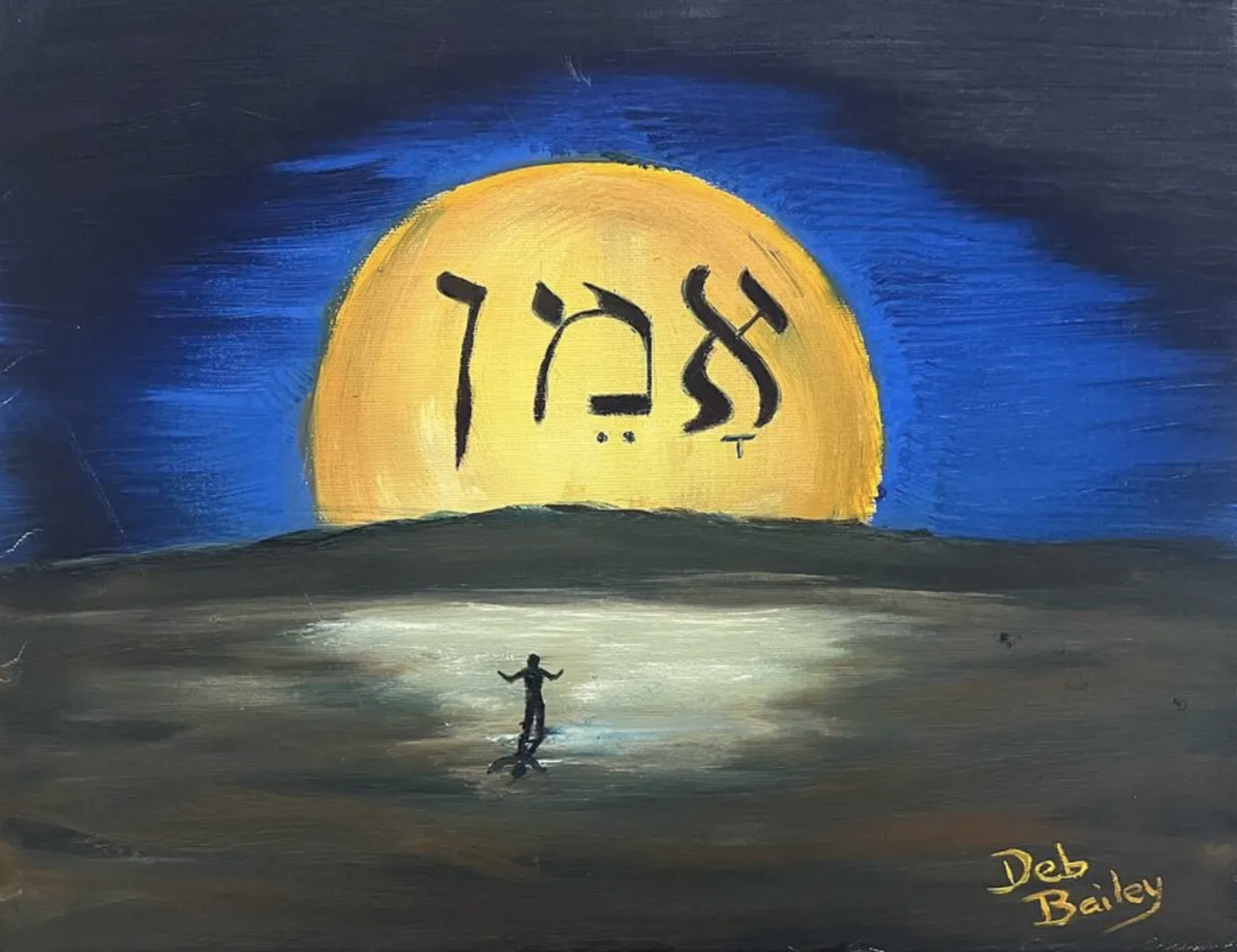
“Amen” painting by author
Which brought me to Judaism, a path I had interacted with several times over my life. And that is where I found my home. What I love is my ability to argue and wrestle with God. I loved the idea that instead of acquiescing to “Thou shalts or Thou shalt nots,” I am encouraged, even expected, to wrestle and argue and think. I am supposed to be an equal participant in what my life’s path is to be. The sect of Judaism I follow is a very liberal one and is more about the spirit of the law rather than the letter of the law. It suits me. I reject anything that is so rigid that one is not allowed to question God.
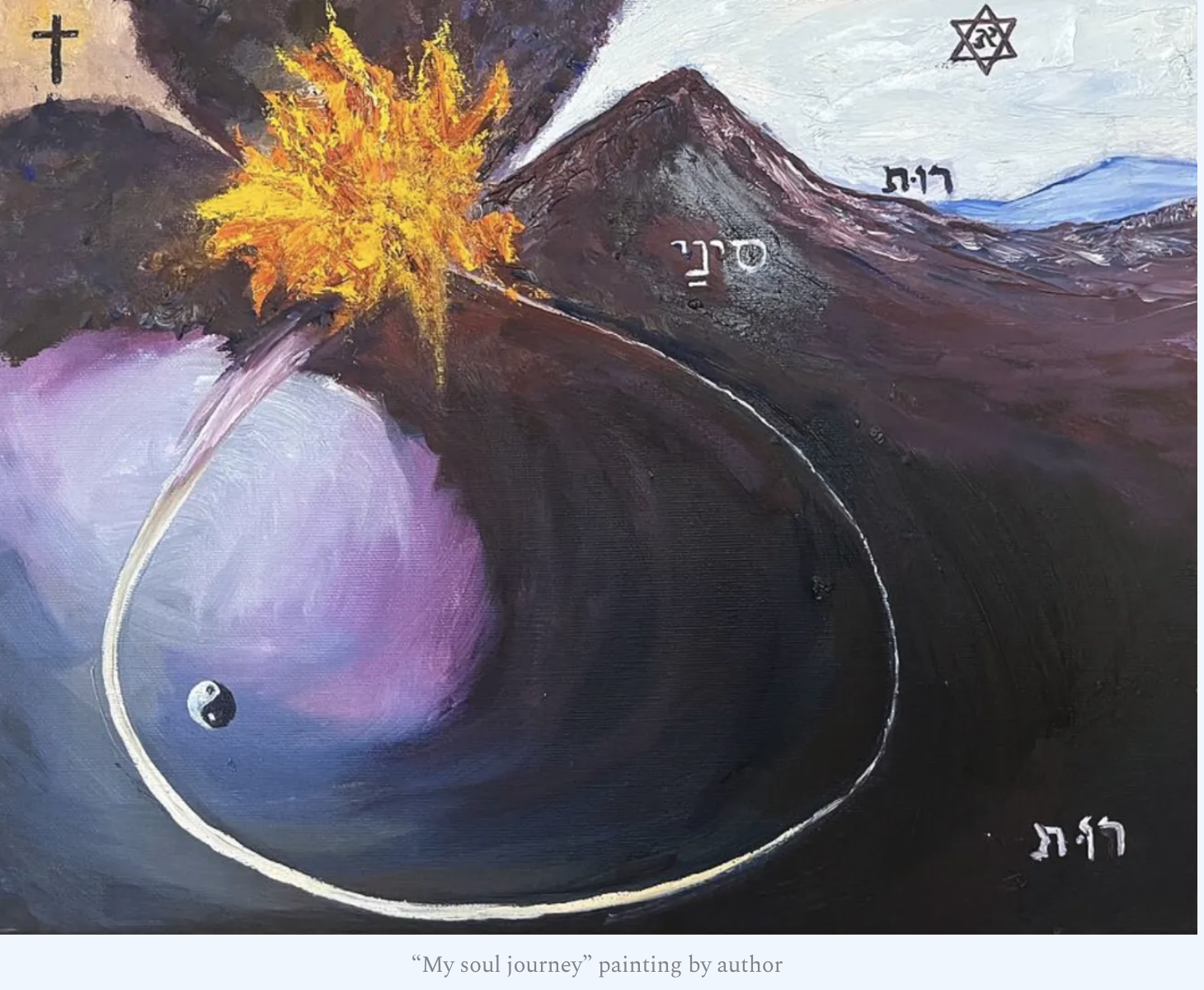
So for me, my “diet of soul food” over life has been very diverse. Some might accuse me of “cafeteria spirituality.” I don’t care. For me, no one path in life is the “ONLY” path. No one dogma has the sole ownership of, or the only teachings on, unconditional love.
The Roman Stoic philosopher Seneca said, “I shall never be ashamed of citing a bad author if the line is good.”
And so in the same manner, I embrace wisdom from many sources. Philosophers, especially the ancient Stoics. Mystics. Native American beliefs. Nature. And even secular sources.
While Judaism is my true home, I seek and embrace wisdom wherever it is presented to me. I believe God not only inspired the stories of Torah, the arguments in Midrash, and the mystical wisdom of Kabbalah, but God also speaks through artists, writers, comic books, movies, and the people around us.
The kinds of messages I keep in my heart and strive for are those present in all the major religions and philosophies. Many of them are no doubt familiar:
- If something is beyond my control, let it go and instead do the things in my power to make a difference
- Don’t make things worse
- Unconditional love is what matters. If there are conditions, it is not love
- Life is suffering, but there are ways to comfort yourself and use wisdom to keep going
- Don’t run from facing your demons, challenges, pain, flaws. Face them. Embrace them. Love them into healing.
- Hard is growth, while easy is about staying the same.
- Be okay with wherever you are in your healing. You are perfect as you are, and can continue to get better.
- Be okay with not being okay. Hold the pain. Breathe, and stay with it in love.
- Accept that many lessons will come back again and again.
- The opposite of patience is aggression.
- I can control how I show love in the world
- I will die. Accept that and make use of time. It is the precious and non-renewable gift.
- Embrace uncertainty
- Greater love hath no man than that he lay down his life for a friend
- Speak to yourself like you would to a person you love
- Don’t do to another what you would not want done to you
- Pay attention
- If you don’t know what to do, or you are in the grips of intense emotions, wait.
- Say thank you
- Everything is grist for the mill. Learn from it all
And regarding that last one, wisdom can be found in the most unexpected places…
Even modern media can have mystical wisdom
There are lines from movies that hit unexpectedly and sear straight into my soul and prompt me to rethink something. A book quotation, a song lyric, ESPECIALLY song lyrics.
There is wisdom even in the power of the melody itself, the rhythm or percussion of the instruments, which have their own effect on your body and mind.
All of our artists – painters, singers, dancers, musicians, writers, etc. – can be modern-day mystics as they so often channel the heart of the Universe in their art.
The bottom line is that wisdom comes from anyone around us. Our job is to be an active participant in life and stay aware, so we are ready for when those messages and moments come up.
There is a book I am reading, God is a Verb: Kabbalah and the Practice of Mystical Judaism, by Rabbi David A. Cooper. I really LOVE the idea of “God” being an active part of speech. That spiritual connection is an ACT, a choice, not something we passively sit through.
One of the ideas in this and similar books is that we are not “children” waiting for an all-powerful heavenly being to fix things for us. We are adults, equal participants in life, collaborators with God, here to receive the Divine requests and messages and then DO something with them in this world.
I love a quote from a Kabbalah text, Pirkei Avot, that sums it up for me:
“It is not your responsibility to finish the work of perfecting the world, but neither are you free to desist from it.”
Pirkei Avot 2:16 (sometimes 2:21)
So no matter where it comes from, I take it in, let it feed my soul, soften it, stretch its boundaries, and then apply it to life. I need all the help I can get, especially in that one place I have resisted SO much, and one that is so necessary for that body healing I mentioned above – movement.
Movement is medicine
Slowly, through my soul work, I accepted that the body as well as the mind needed and deserved to be healed. Yet I still struggled to make myself do the exercises. I had to understand why movement was necessary.
Susan Magsamen and Ivy Ross, in their book Your Brain on Art, quote somatic therapist Resmaa Menakem’s answer to this:
“There are moments that may seem benign…but the body may hold on…trauma is not primarily an emotional response…It is… ‘a spontaneous protective mechanism used by the body to stop or thwart further or future potential damage. Trauma is not a flaw or a weakness. It is a highly effective tool of safety and survival.’ Trauma gets stuck in the body… and it stays stuck until we deal with it.”
Then, in one of my therapy sessions, I did a Yoga exercise with my therapist and found out firsthand just how true this was.
“Bath” time
She had me lie on my back and placed pillows under my head and legs, all to ensure total comfort. I was then to close my eyes and do some deep breathing exercises. This was designed as a relaxation work that could gently release the stress I was holding in my chest and throat.
Instead, I began to experience increasing anxiety, fear, and body tension. I felt afraid. vulnerable, exposed to…danger. I couldn’t stand it. So we called a halt to that particular work.
My therapist then helped me understand what had just happened. This was a body memory, a fear reaction that had been stored in my muscles from something done to me at a very young, pre-verbal age. When I commented that I knew my father had molested me in the car around the age of 3, she quietly said to me, “No. This was a body memory from MUCH younger. Infancy. Something done that you can’t remember because you were too young. But your body remembers it.”
As soon as she said the words, my gut twinged, as if viscerally agreeing with her. I “felt” the truth of her words.
Add to this the fact that my father admitted he liked to give me a bath as an infant because it turned him on, and that other therapists told me that I “had never been safe from him,” I had no reason to doubt my current therapist’s assessment. But even if I had, that intense physical reaction I had to being in that vulnerable position erased any doubts. It was a position I would have been in as an infant, when being bathed, or having my diaper changed. And in this present moment, I hated that position and could not remain in it.
All of this matched how psychiatrist Bessel van der Kolk described trauma: “…trauma is not a cognitive memory of the past, but an active, physical reliving in the present.”
Daria Burke, in her book Of My Own Making, said the same thing regarding her own healing journey from trauma: “The process of healing involves not only the mind’s reconciliation with the past but also the body’s. These memories, locked away in muscle and marrow, held the key to understanding the language of my past, a dialect of emotions that gave voice to the unspeakable.”
So what to do?
In a recent article, “Trauma is Not a Memory: Insights from Dr. Bessel van der Kolk,” author Ronald De Caluwe wrote:
“Because trauma affects the body so fundamentally, Van der Kolk has advocated for body-oriented therapies for decades. Qigong, dance, massage, and theatre—these are not alternative whims, he argues, but direct pathways to help the body rediscover itself as a safe place.”
Rediscover the body as a safe place. THAT was a powerful idea to me. Just as revolutionary as the quote above, that my body was where heaven and earth met. But I no longer question the validity of either statement.
These days, I use a variety of movement regimens as part of my healing process. I won’t go into any of them deeply as the information is available online. But they are growing on me.
And if my brain tries to “resist,” I can “convince” it that it’s worth the effort because they do “double duty.” Not only do these movements help release embodied trauma, but they are simply great exercises that are gentle on older joints. They strengthen my physical balance to avoid falls, and they keep my aging body more flexible and strong! So, I’ll do whatever I have to do to defuse resistance, heal my trauma, and stay healthy into old age.
Here are just a few comments regarding the modalities I use. From the lists below, it is clear the body provides a wide range of “healing movement opportunities.”
The first list includes several things I can do on my own at home anytime. This is particularly good because it reduces any resistance to going somewhere else for a class.
I particularly like Qigong and Tai Chi because they are slow, relaxing, meditative, yet also give me a workout and improve my breathing and balance. While I had tried Tai Chi years ago in a class, it was too fast-paced. But I recently did an online class that was geared to seniors, and the pace was perfect and gave me time to learn the moves.
Walking, meditation, and lifting light weights are also quick and easy, as are tapping/pressure point routines and lymphatic massage. For the “tapping/pressure point” therapy, my therapist sent me a video by Cheri Clampett, who was the certified instructor for this training. The other thing about tapping to relax is that you can also do this anywhere, just by tapping lightly with your fingers on your knees. It can be done very discreetly with no one even aware of it.
While I reacted badly to the Yoga position mentioned above, I HAVE found that if I am at home in my own bedroom with the door closed so I feel “safe,” I can sometimes have success with the parasympathetic nervous system one listed below.
Even our ears can be involved in “movement.” The rhythm of melodies from the instruments, the vibration frequencies, and percussive sound waves all trigger movement. Certainly, it can cause us to dance or sway in time with the music.
But those sound waves trigger movement in a snail-shaped, fluid-filled inner ear chamber called the cochlea. Within the cochlea, tiny hairs pick up the sound waves and react with MOVEMENT. They, in turn, convert the movement into electrical pulses that are transmitted to the brain via the auditory nerve.
The second list includes things that require the help of another person, whether a therapist, physical therapist, instructor, etc. I have found all very helpful, and I especially like deep massages for getting the “tension knots” worked out of my muscles.
The one warning my therapist gave to me regarding group Yoga classes was to be aware that sometimes a particular move might release some trapped trauma that results in crying or emotional upset. Given the depth of my trauma, I only do Yoga with my therapist.
Movements/Somatic Therapy I can do on my own:
- Qigong
- Tai Chi
- Tapping/pressure points
- Lymphatic massage
- Yoga movements and Yoga breathing exercises
- Walking
- Parasympathetic nervous system relaxation- Lie on your back with your feet elevated and resting on a bed or couch, and eyes closed while breathing slowly and deeply
- Meditation
- Gentle weight exercises
- Music, drumming
Movement/Somatic Therapy done with professionals/instructors:
- EMDR – eye movements
- Physical Therapy
- Deep Massage
- Dance/exercise/Yoga classes
The circle of healing
The really interesting thing about this whole process is that it constantly circles back around, feeding itself:
- I started by working on healing my mind and emotions, but ignored the body.
- Then, I used some of my emotional healing to feed my soul so I could heal the body.
- As I heal the body, more emotional issues come up to be healed, so I go back to the mind and soul.
- And then I circle back around to the body again.
- Repeat.
And whether it’s the body, mind, or emotions, it is the same stages:
- Retrospect: I go back in time to examine what happened, and learn.
- Reframe: As I learn, I can reframe what happened, and see it in new ways.
- Redemption: With new attitudes, I take new actions and am changed in the present moment.
- Result: If I change in my present moment…I CHANGE SOMETHING IN MY FUTURE.
- Repeat: I go back, to go forward, to go back, to go forward.
And if I do it right, I’ll do this for the rest of my life, because I want my life to be as rich, full, and healed as I can make it.
Up Next for This Book
There are a few remaining posts about tools, the next one being how I find inspiration and healing through the stories of others.
Then, I will finally address the subject of writing. I put it last because all of the previous tools had to be in place before I could face writing. The topics will include:
- Metaphors, Similes, Symbols
- The Power of a Word
- Courage to Write
- The Nature of “Truth” in Memoir
- Why Write, What to Write, and How
After those, I will return to the “Alchemy” framework for the remainder of this part of the book – The Undiscovered Country. I’ll complete the posts for the Nigredo or Dark Night of the Soul section and then move on to the sections that cover the beginning of insights; deeper understanding and redemption, and finally – where am I today, and what is next.
Note:
I am seeking financial support to complete my memoir, work with an editor, and make a visit to my home state for fact-checking. Your help would mean the world to me as I take this step toward healing and giving voice to my journey.
Please like, comment, and share this post to help spread the word. The link for my fundraiser is on GoFundMe. Thank you for your support.


Leave a Reply